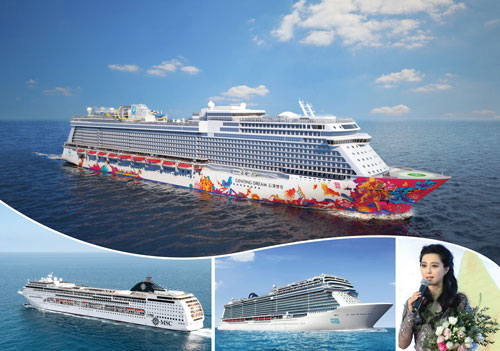
A fleet of new ships built specifically for Chinese cruise passengers is starting to come out of the docks and sail to their new homeports in China and how they are different
MSC LIRICA
Debut: May 2016
“China is a market that many different cruise lines are looking at and investing in. We expect to see continued double-digit growth in the market over the coming years.”
– Achille Staiano, head of commercial services, MSC Cruises
MSC Cruises’ first ship reconfigured for the China market, MSC Lirica, set sail for her maiden voyage on May 1 with predominantly domestic Chinese guests and a cruise itinerary around China, South Korea and Japan.
A majority of the cruises are three to four nights in duration, however longer voyages of up to nine nights will start in January next year.
“For a number of years we have been gathering insights into the Chinese cruise market and working with partners on the ground to fully understand the specific needs of Chinese guests. Using these insights, we have completely overhauled one of our ships, MSC Lirica, to meet the needs of the Chinese home market,” said Achille Staiano, head of commercial services, MSC Cruises.
“Paying particular attention to the differences in cultures and values, we modified a number of aspects of ship life to ensure that every guest receives our best-in-class service and a memorable experience.”
Three examples include:
altering the dining options on board, tailoring them for Chinese tastebuds, including the introduction of a partnership with world-renowned chef Jereme Leung.
“This means that we are able to bring an excellent mix of cuisines to guests, including traditional Asian experiences, as well as a range of refined international dining opportunities,” said Staiano.
introducing its first-ever cruise ambassador scheme on board, where staff have been trained by native service providers in order to pass on specific Chinese service customs.
“We recruited local staff specifically for MSC Lirica,” said Staiano. “Over 80 per cent of staff on board are Mandarin-speaking, offering specific and expert advice to guests in their native language.”
changing the shopping experience onboard, reflecting the popularity of European brands with Chinese guests.
“China is a market which is of great interest to us. We already work with partners that cater to Chinese guests wishing to experience our offerings in the Mediterranean, Europe and the Americas. We are very excited to have launched, in partnership with CAISSA Touristic, our China-dedicated product which made its maiden voyage at the beginning of this month,” said Staiano.
GENTING DREAM
Debut: November 2016
 “The number of Chinese and Asian cruise vacationers has grown substantially over the past few years and these passengers have developed a more sophisticated understanding of cruise products; they are better able to appreciate the value of a luxury brand such as Dream Cruises.”
– Thatcher Brown, president, Dream Cruises
The first ship under Genting Hong Kong’s new cruise brand, Dream Cruises, will set sail on November 13, offering two-, five- and seven-night coastal China and Vietnam cruises from Guangzhou. With a capacity of around 3,400 passengers, the 150,000-ton Genting Dream marks a new chapter in Asian cruising.
Dream Cruises’ president, Thatcher Brown, explained: “Currently, the majority of ships with homeports in China are mainly targeting the mass-market consumers with the occasional seasonal premium ship deployment in this region. With Dream Cruises, we are proud and excited to be the first-ever Asian luxury cruise line that specifically caters to the large and rapidly-growing premium market in China and Asia with a purpose-built new ship, exclusively for this market and that is homeported in Asia.”
When asked why Dream Cruises won’t be on a collision course with sisters Crystal Cruises and Star Cruises, Brown said they were all positioned differently – Crystal for the international luxury market, Dream for the Asian luxury market and Star for the contemporary segment.
“Star Cruises currently services the region with a well-established fleet of contemporary ships and we felt that it was time to create a completely new and distinct brand with a singular vision to cater to the Asian luxury segment to service the burgeoning middle and affluent classes in China and the region,” he said.
Agents can expect Dream to combine the history and expertise of the six-star Crystal and the Asian hospitality of Star, he added. There will also be the right balance between international elements with the product customisation for the China and Asian market.
Highlights of Genting Dream include a VIP-only Dream Mansion with 142 suites and access to a private sundeck with pools, Jacuzzi, a private gym and a private dining room.
The ship also boasts 100 connecting rooms for family and larger group vacations, 35 restaurant and bar concepts, a 610m-wraparound promenade for dramatic seaside dining and lounging, and a plethora of recreational features including six water slides, a rock-climbing wall, mahjong room and mini-golf.
MAJESTIC PRINCESS
Debut: Summer 2017
 “We believe there is a strong demand for a locally-based premium cruise product that is offered by an international cruise line, with experiences custom-designed for travellers from China.”
– Tony Kaufman, executive vice president international operations, Princess Cruises
Princess Cruises’ first ship built and designed specifically for the China market, Majestic Princess, will set sail on her maiden season voyage in summer 2017 from her homeport in Shanghai for year-round cruising to Japan and South Korea.
For China’s international travellers, Princess Cruises would continue to tailor itinerary lengths to their needs, explore new ports and take these travellers on fly-cruise voyages in Alaska, Australia, New Zealand and Europe, said the line’s executive vice president international operations, Tony Kaufman.
When asked how different Majestic Princess would be from other ships, Kaufman said it would have many of the well-received features of her sister ships, Royal Princess and Regal Princess, including a dramatic multistorey atrium serving as the social hub; an over-the-ocean SeaWalk, a top-deck glass-bottomed walkway extending eight metres beyond the edge of the ship; and a special Chef’s Table Lumiere, a private dining experience that surrounds diners in a curtain of light.
However, while it caters to Chinese travellers’ desire for international experiences – flavours from around the world, warm and gracious service, entertainers sourced from Hollywood, etc – there will be “a number of new onboard venues and experiences designed specifically to satisfy what’s important to Chinese travellers, the details of which will be revealed in the coming months”, said Kaufman.
The ship will debut a new livery featuring Princess’ logo that will be rolled out fleet wide.
Befitting her dedication to the Chinese market, the ship will carry a Chinese name on the hull that suggests ‘grand world’ or ‘grand spirit’.
The 143,000-ton vessel has a capacity for 3,560 guests. It reached a construction milestone when it was ‘floated out’ of its building dock at the Fincantieri shipyard in Monfalcone, Italy, and met ocean water for the first time.
As for the competition with sister Costa Cruises, which is also fielding purpose-built ships for China, Kaufman said there was a market for both.
“The products on Costa and Princess are very different. Princess is a premium international brand focused on bringing its experience of providing cruise vacations throughout the world to the Chinese passengers, allowing them to enjoy food, service and entertainment from all over the world and making them feel special. Costa is an Italian brand and brings its authentic Italy at Sea product to its passengers. Chinese travellers are seeking differentiated services and unique experiences,” he explained.
NORWEGIAN JOY
Debut: 2H2017
 “Cruise passengers, whether (they are) from North
America, Europe or Australia, have their own unique preferences. China is no different.”
– David Herrera, president, Norwegian Cruise Line Holdings China
Norwegian Cruise Line (NCL) will debut its China-centric ship, Norwegian Joy, in 2H2017. It will be homeported in Shanghai year-round and, following a short season in Tianjin in August and September, sailings will be predominantly four- and five-night cruises to Japanese and South Korean ports with some three- and six- night cruises as well.
The ship has a capacity of 4,200 passengers and is the second of NCL’s Breakaway Plus class ships.
When asked how it’s custom-designed for Chinese passengers, David Herrera, president, NCL China, gave the following examples: “Chinese guests travel more often in multi-generational family groups than (Americans), therefore we have added new family cabins with multiple sleeping areas and a shared common area so families can travel together while still having some privacy.
“Clearly the dining options and venues have been made with the Chinese passengers in mind as well as the multiple new entertainment shows. Other key differences on Norwegian Joy will include Mandarin-speaking crew in all passenger-facing roles, and signage predominantly in Chinese characters. This ship is being made for our highly valued guests to know we did not simply modify an existing vessel, but designed it especially for the Chinese market. We wanted our first entrant into China to be the ship that Chinese VIPs deserve.”
He added that the line’s goal was to make every ship a little bit better than the previous one.
“In the same way that Norwegian Escape took the best aspects of the Getaway and Breakaway before her and improved the experience for our guests, Norwegian Joy continues this trend,” said Herrera.
The launch of Norwegian Joy is key to NCL’s return to Asia this year after a 13-year hiatus.
“We think that by giving Chinese cruise passengers the ability to experience our premium product from a ship homeported in Shanghai or Tianjin, it will make a repeat customer interested in cruising with NCL again,” said Herrera, adding that NCL has designed programmes specifically for Chinese guests on its ships in Europe, Alaska and Hawaii that include special pricing, language skills and menu options.
“We are excited about both homeport and fly-cruise China business potential,” he said.
COSTA ASIA
Debut: 2019/2020
“The new order will allow us to continue to significantly build the Chinese cruise market, which will become the second largest in the world at the end of the decade.”
– Michael Thamm, CEO, Costa Group
Costa Asia did not reply to TTG Asia’s queries by press time about its vision and strategies for China purpose-built ships, but a press release issued on April 6 announced an order for two new ships specifically-designed for the Chinese market to be built by Italian shipbuilder Fincantieri. Operated by Costa Asia, they represent an investment of more than six billion euros (US$6.8 million).
The ships, each with 135,500 gross tons and carrying 4,200 guests, will be delivered in 2019 and 2020. The order is part of contracts signed by parent Carnival Corporation with Fincantieri to build five new ships by 2020 at the company’s shipyards in Monfalcone and Marghera, both in Italy, providing jobs for many Italians.
Costa Asia ships feature an innovative Italian design in line with its concept of Italy at Sea, offering an authentic Italian and European experience for Chinese guests, with high-quality hospitality, style, cuisine and entertainment.
The Costa Group said it was the first cruise company to enter the Chinese market back in 2006. Four Costa ships are currently deployed in China and Asia year-round: Costa Atlantica, Costa Victoria, Costa Serena and most recently Costa Fortuna.