TTG Asia
Asia/Singapore Monday, 13th April 2026
Page 1879

Strong greenback, local economy spur US travel to Asia

0

us-dollar

SINGAPORE welcomed a record 500,000 US travellers in 2015 and the US market grew three per cent last year, according to the New York office of the Singapore Tourism Board’s (STB) Singapore Exhibition & Convention Bureau (SECB).

Kershing Goh, regional director, Americas, international group, of STB and SECB, said there was a 50-50 split between BTmice and leisure travellers.

Goh attributed the good showing to the strong US dollar and good economic conditions as well as SECB’s efforts in targeting US incentive groups and corporate travellers last year. But she noted that US outbound growth was more strongly driven by leisure traffic.

She said: “Every region in the world, including Asia, is seeing growth. China is a big magnet and US arrivals into Japan grew by double digits.

“The launch of United Airlines’ Boeing 787-9 Dreamliner direct non-stop service between Singapore and San Francisco on June 3, and the additional frequencies by Asian carriers such as EVA Air and All Nippon Airways would continue to open up opportunities to tap the US outbound market.”

“This year, we are ramping up efforts to promote leisure travel as well as business travel from Silicon Valley,” she added.

Kathryn Loh, general manager, destination management, inbound, SingExpress Travel commented that distance is still a major obstacle in cracking the US MICE nut, but observed business travel is increasing.

“United’s direct non-stop flight will help, but direct non-stop flights on Singapore Airlines from the US will be more critical in tapping and growing US meeting and incentive groups,” Loh said.

Aloysius Arlando, CEO, SingEx Holdings, added there has been a rise in US delegates at conventions and exhibitions held at its venue in the last two years, in particular for sectors such as aerospace and aviation, IT and healthcare. He added that the number of US delegates attending MRO (Maintenance, Repair Overhaul) Asia increased between 10 and 12 per cent.

“US business travellers are coming to Singapore to explore establishing an office or R&D base to springboard to other parts of the region,” he said.

Arlando noted that while “larger US SMEs wanting to break into the Asian market will find Singapore a good entry point”, Singapore players must be industry focused to tap the US market.

He elaborated: “Asia is now part of a number of mega MLM (multilevel marketing) events with up to 12,000 participants and for the big achievers, money is no object. Of those numbers, some two to three per cent of attendees are from he US headquarters who also make follow-up business development trips and to seal new business.”

Arlando observed the last “spike” in US BTmice numbers was in 2007/08 before the global financial crisis.

Travelport acquires distributor Galileo Japan

0

gordon-wilson

Gordon Wilson, president and CEO, Travelport

TRAVELPORT has bought over its third-party distributor in the world’s fourth largest economy, Galileo Japan, which previously belonged to a group of airline owners.

The acquisition allows the GDS to establish a consolidated Travelport Japan entity in the country, having operated in the market on a franchise basis for the past 30 years. Travelport will still offer customers a choice of Apollo or Worldspan platforms.

All former Galileo Japan employees, including managing director Yoshinobu Aoyama, will transition to the new Tokyo-headquartered Travelport entity. There will also be two satellite offices, one in Nagoya and another in Osaka.

Commenting on the acquisition, Gordon Wilson, president and CEO, Travelport, said: “The decision to transform from a distribution franchise to a wholly owned operation is commensurate with our goals to further expand our successful business across Asia.

“Japan is a major travel market and owning our operation here, whilst continuing our other successful strategic partnerships in Japan, will enhance our growth prospects in the country.”

Upgraded experience at Singapore Marriott Tang Plaza Hotel club lounge

0

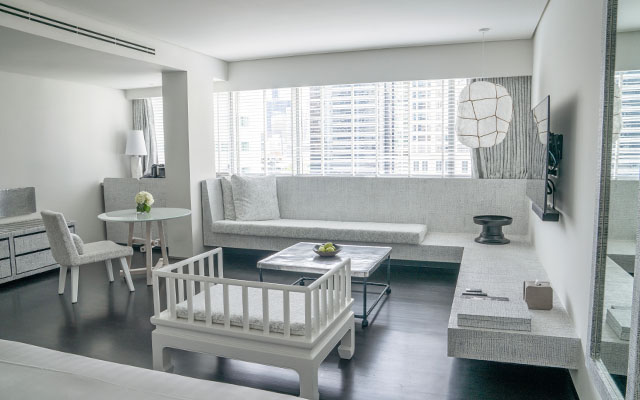
SINGAPORE Marriott Tang Plaza Hotel has completed refurbishments of its Executive Lounge, which now promises the highest levels of comfort, luxury and exclusivity for its guests across a larger space.

The refreshed experience begins at the expanded lift lobby to the Executive Lounge on the 27th floor, which opens up to translucent glass panels that offer a glimpse of the facilities within as well as of Orchard Road.

Inside, modern and elegant furnishings and bold hues of cream, green and brown greet guests. Formerly 197m2, the Executive Lounge today spans across 268m2 to cater to the growing number of well-heeled and business travellers who prefer a premium experience. It can seat more than 90 guests.

Simon Bell, hotel general manager, said: “The Executive Lounge is the ideal choice for travellers who expect more than just the ordinary. With this in mind, our management team had worked closely with Tang Holdings and renowned designer Mark Ormsby Interiors to create a luxurious sanctuary that is functional and comfortable, yet exquisite. We strive to create one of the most brilliant home-away-from-home experiences at the Executive Lounge by offering the ultimate in luxury.”

No meeting limits with Wyndham’s new rewards programme

0

SINCE its launch last October, the new Wyndham Rewards loyalty programme, Go Meet, has seen “very positive” response, and has rewarded meeting professionals with over 40 million points. This translates to more than 2,600 free nights.

Hailing Go Meet as the world’s most generous rewards programme for meeting planners, Gabriella Chiera, Wyndham Hotel Group’s manager of global communications, said: “Go Meet has transformed and simplified the world of hotel loyalty programmes.

“Unlike any other programme, there is no minimum spend requirement and no maximum point cap, which means that there are no limits on earning potential,” she said.

She added that with Go Meet, members can earn one point for every dollar spent on qualifying revenue at all participating hotels. Guests are guaranteed a minimum of 1,000 points with every qualified stay and have the chance to earn major rewards fast, including a flat 15,000-point free night redemption rate.

Wyndham Hotel Group president and CEO Geoff Ballotti said: “Planners told us about the challenges they face, such as minimum spend thresholds, maximum point limits and a lack of value.

“We addressed these pain points head on with Go Meet. Not only are we giving them a simple programme and faster, more meaningful rewards, but with 230 hotels with 10 or more meeting rooms, and 145 hotels with at least 930m2 of function space, we can meet all of their event needs,” he added.

Melbourne dishes out special perks to international incentive groups

0

MELBOURNE Convention Bureau (MCB) has brought back its Melbourne Values You programme, providing a larger variety of special deals from its partners to help incentive travel planners put together a cost-effective and price-competitive event in the city, in comparison to other Australian states and international destinations.

Over 50 MCB partners have embraced the programme, providing over 150 deals across a spectrum of business events products and services. This is an 87 per cent increase in deals offered from the programme’s inception in 2013.

Participating partners include Crown Hotels, Accor Hotels, Hilton, Melbourne Star Observation Wheel, Kentera Events, Chadstone Shopping Centre, Chocoholic Tours, Hidden Secrets Tours, Queen Victoria Market, Epicure – Melbourne Cricket Ground, Etihad Stadium, and St Kilda Venues.

MCB CEO, Karen Bolinger, said in a media release that as Melbourne a complete business events destination has been made more attractive by the Melbourne Values Youprogramme.

“Thanks to the support of our partners through Melbourne Values You we can provide access to a diverse range of offers such as hotel room upgrades, reduced entry into attractions, food and beverage packages and truly VIP experiences, ensuring each event is unique,” said Bolinger.

More information on the the programme and the benefits available to qualified incentive groups can be found on www.melbournecb.com.au.

Langkawi, Kota Kinabalu ride on new air links to secondary Chinese cities to court MICE groups

0

BUSINESS events stakeholders in Langkawi and Kota Kinabalu have stepped up destination promotion efforts in secondary Chinese cities following announcements of new direct flights between Langkawi and Guangzhou and Kota Kinabalu and Wuhan.

Director of Langkawi International Convention Centre (LICC), Ramizan Kaman Shah, told TTGmice e-Weekly that a joint familiarisation trip was organised late last year with Malaysia Convention & Exhibition Bureau to invite media agencies from all over China to Langkawi, ahead of AirAsia’s launch of its direct Langkawi-Guangzhou services on January 24.

Ramizan said: “Langkawi is a new destination for China. Its UNESCO Geopark status, golf courses, good beaches, as well as water and jungle activities make it an ideal destination for meetings and incentives.”

He pointed out that efforts are made to target Chinese MICE buyers from all over China, not just from Guangzhou, “as there are also good linkages from Kuala Lumpur to Langkawi” which enable Chinese MICE travellers to visit the island via Malaysia’s main gateway.

AirAsia’s new daily service between Kota Kinabalu and Wuhan, which commenced on January 22 this year, has also encouraged Sabah Tourism Board and Malaysian Association of Tour & Travel Agents Sabah Chapter to band together on a sales mission to Wuhan in March to engage outbound Chinese agents.

According to Ebony Leong, marketing manager at Sabah Tourism Board, the bureau is ready to provide non-financial support, such as welcome cultural performances, to Chinese meeting and incentive planners.

Currently, Kota Kinabalu receives 61 weekly flights from China and Hong Kong, including new services offered by China Southern Airlines in December 2015 connecting Guangzhou with Kota Kinabalu and Spring Airlines four-weekly services from Shanghai which commenced in October 2015.

Asia perceived to be safer by European travellers

0

kuta-beach

Tourists at Kuta Beach, Bali

A spate of terror incidents in Europe has struck fear into the hearts of Europeans, causing many to hold off travel plans and denting business for some European business events specialists attending IT&CM China.

Lidia Ivanova, manager of Mega Travel based in Bulgaria, told TTG Asia that her business had slipped by at least 60 per cent over the past few months.

She said: “The overall sentiment on travel is very negative. Many clients have decided to stop travelling altogether. There is a lot of fear with regards to taking flights now, made worse by the recent hijacking incident (on Egypt Air).”

Ivanova predicts business to fall farther, saying: “Instead of flying, more clients may start opting for road trips (to destinations) closer to home.”

Although Ivo Van De Velde, travel planner with Advivos Belgium, has not seen weaker demand for incentive travel after the Paris and Brussels attacks, he noted that interest in destinations perceived unsafe has fallen.

He elaborated: “People are not going to Turkey, Morocco and the Middle East as these are perceived to be unsafe at the moment. Meanwhile, demand for destinations perceived to be safe has increased. These are Spain, Portugal, Italy and the UK, as well as Asian destinations, specifically China and those in South-east Asia.”

However, even as these travellers have greater faith in destinations like Thailand, China, Singapore, Hong Kong and Japan, Jean-Paul Bonomi, general manager of incentive agency Squirrelviaggi.net, said these places are “very expensive” and demand will not shift from Europe to Asia especially when corporate event budgets are smaller now because of the European financial crisis.

“The (high) cost of longhaul airfares (to Asia) negates the savings made on (cheaper) ground arrangements,” remarked Ivanova, who agrees that not all cautious European clients will be able to consider safer alternatives in this part of the world.

“That is why I am here (at IT&CM China) to explore new and cheap products in Asia to sell,” she added.

Additional reporting from Paige Lee Pei Qi and S Puvaneswary

Accor combats Airbnb with onefinestay acquisition

0

onefinestay-london

One of onefinestay’s properties in London

ACCORHOTELS has acquired luxury serviced home rental company onefinestay for a sum of 148 million euros (US$168 million), with an added commitment of 64 million euros to help scale the UK-based startup.

The move comes on the back of increased pressures from non-hotel accommodation providers such as Airbnb gaining market share from traditional operators, as well as motivated by Accor’s ambitions to further expand its luxury portfolio.

Started in London in 2010 by Greg Marsh, Demetrios Zoppos, Tim Davey and Evan Frank, onefinestay has 2,600 properties in the cities of London, New York, Paris, Los Angeles and Rome, and will remain an independent business unit led by Marsh.

According to a joint statement by Accor and onefinestay, the company plans to expand to 40 new cities around the world over the next five years, with revenues estimated to grow tenfold.

Sébastien Bazin, chairman and CEO, AccorHotels, said: “onefinestay has successfully captured a sweet spot: a combination of needs that neither traditional hotels nor new actors of the sharing economy can meet.

“With the acquisition of this exceptional brand, unique operating model and outstanding management team, AccorHotels is developing as the worldwide leader of the serviced homes market.”

Asia favoured, perceived safer by European travellers

0

kuta-beach
Tourists at Kuta Beach, Bali

A spate of terror incidents in Europe has struck fear into the hearts of Europeans, causing many to hold off travel plans and denting business for some European business events specialists attending IT&CM China.

Lidia Ivanova, manager of Mega Travel based in Bulgaria, told TTG Asia that her business had slipped by at least 60 per cent over the past few months.

She said: “The overall sentiment on travel is very negative. Many clients have decided to stop travelling altogether. There is a lot of fear with regards to taking flights now, made worse by the recent hijacking incident (on Egypt Air).”

Ivanova predicts business to fall farther, saying: “Instead of flying, more clients may start opting for road trips (to destinations) closer to home.”

Although Ivo Van De Velde, travel planner with Advivos Belgium, has not seen weaker demand for incentive travel after the Paris and Brussels attacks, he noted that interest in destinations perceived unsafe has fallen.

He elaborated: “People are not going to Turkey, Morocco and the Middle East as these are perceived to be unsafe at the moment. Meanwhile, demand for destinations perceived to be safe has increased. These are Spain, Portugal, Italy and the UK, as well as Asian destinations, specifically China and those in South-east Asia.”

However, even as these travellers have greater faith in destinations like Thailand, China, Singapore, Hong Kong and Japan, Jean-Paul Bonomi, general manager of incentive agency Squirrelviaggi.net, said these places are “very expensive” and demand will not shift from Europe to Asia especially when corporate event budgets are smaller now because of the European financial crisis.

“The (high) cost of longhaul airfares (to Asia) negates the savings made on (cheaper) ground arrangements,” remarked Ivanova, who agrees that not all cautious European clients will be able to consider safer alternatives in this part of the world.

“That is why I am here (at IT&CM China) to explore new and cheap products in Asia to sell,” she added.

Additional reporting by Paige Lee Pei Qi and S Puvaneswary.

Not quite business as usual

0

The impacts of a tepid global economy and plunging oil prices are not playing out equally across Asia’s business cities, with some markets seeing a cutback in corporate travel while others are enjoying faster growth momentum. TTG Asia sizes up the situation
apr8_biztravel_main

Jakarta
Policies and domestic demand spur confidence  
By Mimi Hudoyo

Increased government spending and strong domestic travel demand in Jakarta are keeping the Indonesian trade sanguine despite signs of declining hotel revenue in 2015 and a sluggish global economy.

The capital’s hotels, which are “predominantly driven by corporate demand”, saw RevPAR fall last year, according to Matt Gebbie, director, Pacific Asia for Horwath HTL.

“In 2015, economy/midscale hotels in Jakarta suffered the greatest falls in RevPAR of around 10 per cent, followed by upper midscale/upscale, down around five per cent. The upper upscale hotels were able to maintain RevPAR at 2014 levels,” he said.

But the trend could change as the recent boost in Jakarta’s upscale and luxury hotels is expected to exert a downward pressure on the same small high-yielding market, Gebbie opined.

John Flood, president and CEO of Archipelago International, noted: “For our (midscale) hotels we’re seeing an increase (in occupancy) – perhaps due to belt tightening by some companies downgrading from (upscale) to (midscale) to save money.”

Amid the slowing global economy, the oil and gas and related industries are the hardest hit. The automotive industry is also declining, while the construction and pharmaceutical sectors remain strong, observed industry players.

Mixed sentiments are seen for the financial sector though. Said Hellen Xu, COO of Panorama Tours Indonesia: “We see some financial institutions that are growing their presence in Indonesia, while some established firms here are cutting their spending.”

Still, there are compelling reasons to believe that Jakarta’s business travel sector will hold its own, especially as the Indonesian economy is performing better than its regional competitors, Flood posited.

He added: “(Archipelago’s) business in 2015 was down in 1H but picked up in 2H; 1Q2016 is about 30 per cent up from the same period of last year.”

Gebbie said: “The local economy and domestic tourism are what drive Jakarta’s mid to upper-upscale hotels and there are some encouraging signs for the Indonesian economy this year.”

Increased government spending and lower interest rates should drive greater investment and consumption, and the government has been pushing forward with infrastructure projects, he explained.

Furthermore, midscale hotels might benefit from government bookings, since the sector is once again allowed to organise events in hotels with some stipulations.

Singapore
Corporations stretch travel dollars more than ever
By Paige Lee Pei Qi

As financial storm clouds gather on the horizon, companies are likely to tighten their travel policies with a stronger focus on cost control but they will continue to travel, according to TMCs interviewed.

Several key industry sectors for premium travel – notably banking & finance, mining and energy – face challenging conditions that weigh down on their travel demand, noted Greg O’Neil, president of Asia Pacific for BCD Travel.

Due to plunging oil prices, the energy sector has suffered heavier travel cutbacks more than other industries, noted Bertrand Saillet, general manager of FCM South-east Asia.

Alvan Aiau, vice president, global sales & program management, Asia-Pacific at Carlson Wagonlit Travel, commented: “We see many of our customers adapting to the continued challenging economic climate. Although many companies are under pressure to reduce costs, they also understand that travel is necessary to facilitate and grow their business.”

Sharing similar sentiments, Saillet opined: “We do not expect a complete travel freeze, (perhaps) a slight drop in (business) travel this year but it will not be too drastic.”

The demand for business travel remains high though and business travellers in Singapore are very much focused on luxury, according to Saillet, with 52 per cent of flights booked on premium classes and 75 per cent of accommodation booked with international hotels.

“Companies are now looking at value-driven travel solutions to maintain the same travel volume but for less,” he added. “The current economic situation presents a good opportunity for companies to now mandate their travel policies to drive more value and greater savings.”

Saillet elaborated: “Instead of travelling less, companies can travel smarter and better on the same budget. By applying simple rules like advanced booking (at least seven days), allowing more restrictive fares, considering LCC for short trips, a company can generate substantial savings.”

O’Neil also suggested: “(Corporates) have many options including changing booking patterns, restricting who can travel, changing the class of travel or hotel tier.”

apr8_biztravel_alvan

Manila
FDI inflow bodes well for corporate travel demand
By Rosa Ocampo

Greater foreign investment volumes and improving business infrastructure in Manila are contributing to positive sentiment within its business travel sector.

The Philippines is seeing economic growth and foreign investments in major industries and business enterprises related to infrastructure, energy, hospitality, as well as special economic zones.

“There are lots of opportunities for investors. Business process outsourcing and real estate developments are just two of the many industries that are getting a growing number of foreign investments,” said Fe Abling Yu, general manager of Arfel Travel and Tours.

“Several five-star hotels are opening (in Metro Manila). These hotels will not invest in the Philippines had they known that the business landscape was not improving,” she opined.

“This is the best time to invest in businesses in the Philippines and that’s why business travel is booming,” Christine Urbanozo-Ibarreta, director of sales and marketing, Golden Phoenix Hotel Manila, pointed out.

She said the boom in foreign investments include China-based companies pouring their money into the country where there are already a plethora of Filipino-Chinese-owned businesses and industries.

As well, the attractiveness of Manila to foreign investors is becoming more apparent, with a growing number of investors from South Korea, Japan and China setting up offices and headquarters in Manila even though their operations are elsewhere in the Philippines.

The growing wave of businessmen seeking opportunities in the Philippines has helped to buoy occupancy rates at New World Makati Hotel, according to its director of sales and marketing, Jann Delgado.

Corporate meetings and conferences too have been on the rise since last year, she noted.

But business travellers have to contend with pricey room rates and traffic congestion in Metro Manila.

“Hotel rates are still high compared with other Asian countries despite an increasing inventory of hotel keys in the city”, said Abling Yu.

She added that the Metro Manila’s traffic situation is another complaint among time-strapped business travellers.

Kuala Lumpur
Shrinking travel budgets prompt new tactics
By S Puvaneswary

Feeling the effects of the global economic slowdown, particularly in the oil & gas and banking sectors, Malaysia’s industry players are bracing themselves for a tough year ahead.

Corporate Information Travel’s business development manager, Foo Sze Zhaun, projected outbound travel to be flat, adding that longhaul travel demand has dropped as corporate clients opt for regional destinations instead.

Even incentive travel has been affected as fewer people had met their targets in 2015, resulting in a reduction in the number of qualifiers compared with previous years.

On the other hand, business travel to trade fairs and exhibitions in Europe had picked up slightly for the automotive, publishing and industrial machinery sectors, added Foo.

According to Syed Razif Al-Yahya, group managing director of Sutra Group of Companies, the government sector has reduced travel budgets by more than 50 per cent for both overseas and domestic travel.

“The cost cutting measures taken include sending fewer staff on trips and choosing a lower subclass of airline seats,” he explained.
Many corporate clients have dragged payments in the current challenging climate too, he revealed.

Expecting a 40 per cent fall in revenue from corporate and government bookings, Syed Razif plans to grow the leisure market, which currently comprises 10 per cent of the group’s total business.

Hotels too, are rolling out new strategies to cope with the reduced travel budgets among corporate and government sectors.

Following slower forward bookings this year, Eric Tan, general manager of Pullman Kuala Lumpur Bangsar, shared that the hotel is targeting both leisure and business travellers with ongoing tacticals such as including rooms with breakfast inclusions.

And as hotels compete for business amid an uncertain economy, Dorsett Kuala Lumpur has collaborated with Zuger International to equip guestrooms with smartphones that afford guests free 3G connectivity, local calls and SMSes in the hopes of attracting more business and leisure travellers.

Bangkok
Diversified economy a boon
By Michael Mackey

Business travel to Bangkok is proving resilient despite turbulence in the global economy and uncertainties at home, and players are pointing to Thailand’s diversified economy which continues to bring travellers to the Thai capital.

“Business travel for us continues to grow,” commented Leanne Harwood, InterContinental Hotels Group’s (IHG) vice president, operations, South-east Asia and Korea, adding that this market segment was the first to rebound after last year’s bombing in Bangkok.

“What we are seeing is growth across both SME and MICE segments,” she added.

IHG, which has nine properties in the capital with 2,800 rooms, put the business  travel crowd at 20 per cent of its guests, substantially higher than the Bangkok average of 12 per cent.

Unlike most other cities which often see companies with tightened travel budgets switching to lower-category hotels, pointed out Menard, this approach as not been observed in Bangkok as the Thai capital “still offers good value”.

“Corporate (demand) is slightly up about 15 per cent on the first two months,” said Accor’s Ianic Menard, vice president sales, marketing & distribution, who also observed stronger competition among Bangkok’s hotels for corporate travel business.

Alvan Aiau, vice president, global sales & program management, Asia-Pacific, Carlson Wagonlit Travel, believes Bangkok will remain an important business travel destination.

He said: “We expect to continue to see a strong volume of business travel to Bangkok in 2016, and CWT’s 2016 Global Travel Price Outlook forecasts that hotel rates in Thailand will increase 1.6 per cent this year,” he told TTG Asia in written responses.

Helping matters is Thailand’s economic diversity.

Oil and gas sectors have been hit, but manufacturing, consumer goods and banking were described by Accor’s Menard as “fairly stable”, electronics, chemicals and software sectors “okay”, and car manufacturing exceedingly good.

Thailand will turn out some two million vehicles this year.

Sharing similar observations, IHG’s Hardwood said: “We are absolutely seeing growth in the automotive and pharmaceutical sectors.”

apr8_biztravel_leanne

Tokyo
Domestic economy holds the fort
By Julian Ryall

Japan’s business travel trade appears relatively unconcerned about recent uncertainties in the global economy, thanks in large part to the strength of the domestic economy.

Japanese airlines are also reporting good performances in the most recent quarter, thanks to falling aviation fuel prices, making overall travel costs lower.

“We have not seen any impact of the global economic downturn and we are not predicting anything down the line,” said Jian Yang of the Japan Airlines’ public relations office. “Our 3Q results show stable growth and all the data is still on track.

“A big factor is probably the domestic economy doing so well and the fact that there has been no downturn in our business class sales, which suggest that there is not too much concern here,” he said, adding that the abolition of the fuel surcharge is welcomed by business travellers.

Hotel operators also foresee few clouds on the horizon as demand for rooms still remains high in Tokyo for business and leisure markets alike.

Ignatius Cronin, director of international public relations for Tokyo’s Imperial Hotel, has so far seen “no discernible impact”.

“Our occupancy rates are up and we’re not factoring economic problems into our sales activities at all for the foreseeable future,” he said.

For Shinya Kurosawa, head of global business and a member of the board of JTB, the strength of the domestic economy is keeping the business arm of his company buoyant.

“Japanese companies are having a good time at the moment and we’re seeing that reflected in the business they are doing with us,” he told TTG Asia.

However, there has been a slight tapering off of business in economies traditionally closely linked to the economy of China, such as Singapore and Malaysia, Kurosawa said.

Other countries in South-east Asia, such as Vietnam and the Philippines are less exposed to volatility in China and consequently business has remained solid, he said.

Hong Kong
Decline in leisure arrivals prompts business tack
By Prudence Lui

Travel trade players in Hong Kong are training their sights on the business travel segment after feeling the pinch from the decline in leisure travel to the city.

According to Hong Kong Tourism Board’s statistics, business arrivals grew 3.3 per cent to eight million last year with overnight mainland business arrivals rising 11.4 per cent due to a surge in commercial activities between China and Hong Kong.

Following a weak 1Q, BCD Travel managing director, Lily Agonoy, believes that the trend will continue into the next few months.

“2H will be better than 1H. I believe the retail luxury goods sector will be most affected, followed by banking and finance sectors. We will be more aggressive and innovative to win business.”

To make up for the loss of leisure traffic, hotels are competing for the business travel segment.

For instance, Hotel Icon used to see a 70 per cent share of leisure travellers but business travellers now make up over half of hotel guests.

Director of strategy & business development, Sally Osborne, said: “We put a strong focus on this segment over the last six to eight months. In 2016, we’d look at international business and so far, the US and UK markets are strong.”

The hotel has embarked on plans to cater to bleisure travellers, with value-added services like breakfast on the club floor and a “creative conversion space” that allows the travellers on business to work outside the confines of their rooms.

Harbourview Hotel in Wanchai, general manager, Harrison Leung, said: “With a lower travel budget, business travellers tend to cut down their attendance to trade fairs. Indeed, hotel rate in this district was down by 15-20 per cent.

“Five-star properties even lure their business back by offering a lower rate. What we can do is to maintain our volume of business and occupancy by cutting our rate.”

This article was first published in TTG Asia, April 1, 2016 issue, on page 16 To read more, please view our digital edition or click here to subscribe.