TTG Asia
Asia/Singapore Saturday, 25th April 2026
Page 1808

Making rail connections

0

Enhanced rail and road networks connecting to other parts of China have given rise to new tourist circuits around Guilin and raised the appeal of travel in the region

aug-19-chinamain

Riding on the region’s expanded high-speed rail network, the Guilin Tourism Administration is keen to draw repeated and new FIT traffic by combining Guilin with attractions in neighbouring Sanjiang, Danzhou, Longsheng, Longji and Liuzhou.

According to Guilin Tourism Administration, deputy secretary general, Zhao Gui Xing, new road networks such as the Liuzhou-Sanjiang Expressway have also boosted connectivity in the destination.

He said: “Traditionally, it took four to five days to tour around these towns with lots of time spent on the road. (Now), travel convenience has improved with an enhanced two-pronged rail and road system. Hopefully this will draw more tourist traffic from the Pearl River Delta, Hong Kong and Taiwan in the future.”

Since the launch of the inaugural Guiyang-Guangzhou high-speed rail in 2014 to link up China’s mountainous south-west with Guangdong, Guilin’s network has flourished with more new routes to cities such as Guangzhou, Shenzhen, Guiyang, Changsha, Wuhan and Zhuhai.

Sheraton Guilin Hotel’s director of sales & marketing, Portia Zhou, sees the greatest benefits from the Guangzhou-Guilin service, which boasts the highest frequency and shaves travel time on this route from 12 hours to two hours 40 minutes.

Said Zhou: “With the train network and construction of new highways, Guilin tourism and hotel markets have won new opportunities from the neighbouring countryside.

She added: “Longsheng and Sanjiang are now packaged together as new sightseeing points, strengthening Guilin’s appeal for the leisure market. The FIT segment grew 50 per cent from the previous year.”

Sanjiang – a remote town 150km from Guilin – can now look forward to more international visitor traffic with the D2975 (Liuzhou-Sanjiang) train service launched in May 2016. Plying between Sanjiang South Station and Guangzhou South via Guilin, the journey time from Guilin to Sanjiang now takes only 30 minutes, down from the previous three hours 45 minutes.

Commenting on the change, Guangxi Tourism Development Group, vice general manager, Lu Bo, said: “Given the birth of new highways, Sanjiang is now at the crossroads between Hunan, Guizhou, Guiyang and Guilin. Moreover, the town is home to the Dong people, who boasts  the biggest presence among Guangxi’s ethnic minority groups.

“Our company is keen to push a Greater Guilin Tourism Area concept, (integrating) small towns nearby like Sanjiang and Danzhou to create a brand emphasising culture, wellness and ecotourism.”

This explains why the group has actively pumped investment into Sanjiang’s tourism infrastructure, such as revamping the Chenyang Eight Villages (see page 27), constructing a large-scale resort centre at Sanjiang Bay, and upgrading the Sanjiang Bird Nest. The group welcomed its first fam tour from Taiwan in March 2016.

Shangri-La Guilin’s general manager, Leslie Wang, has noted an increase in leisure tourists since the expanded railway network places Guilin at the crossroads on the Guiyang-Guangzhou route.

“Our hotel received better results from the expanded railway network, especially in Hunan. It almost doubled our (guest numbers) from 2014,” he said.

“We observed a growth in Shenzhen, Guangzhou and Dongguan as well. The high-speed railway definitely accelerates Guilin towards the urban economy with this integration.”

This article was first published in TTG Asia, August 5, 2016 issue, on page 24. To read more, please view our digital edition or click here to subscribe.

Accor debuts Novotel in Xi’an, targets small business and event groups

0

Novotel Xian SCPG

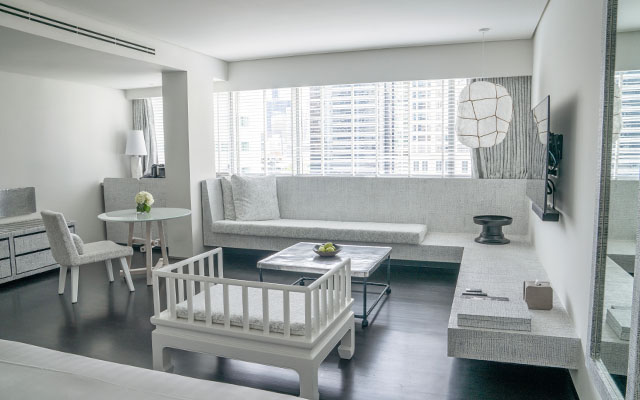
ACCORHOTELS debuted its Novotel brand in Xi’an’s CBD last month with an aim to lure small corporate meetings, incentive groups and product launches.

The 275-room Novotel Xian SCPG Hotel is a 15-minute drive to the China Railway High-speed station and 30 minutes to Xi’an Xianyang International Airport. Function rooms range from 60m2 to 130m2 in size and are able to fit between 50 and 110 pax theatre-style.

According to Accor spokesman Kelly Chen, the hotel has secured pharmaceutical, automobile and cosmetics industry meetings for between 20 to 80 participants since its opening on July 28.

The hotel features a “crab” set-up, ideal for meetings with audiovisual presentations as it allows the speaker to move among the participants and make visual contact with them.

Other facilities include three F&B outlets, a fitness centre and computers with Internet connection.

Novotel Xian SCPG Hotel sits alongside Accor’s four existing properties in the area, namely Sofitel Xian on Remin Square, Grand Mercure Xian Renmin Square, Sofitel Legend Peoples Grand Hotel Xian and Mercure on Remin Square Xian.

Hong Kong exhibition industry rakes in US$6.8 billion in 2014: HKECIA

0

economic-impact-study-shows-hong-kongs-exhibition-industry-worth-billions-to-the-city
Hong Kong

HONG Kong’s exhibition industry contributed HK$52.9 billion (US$6.8 billion) to the economy in 2014, up 29 per cent from 2012, according to a study commissioned by the Hong Kong Exhibition & Convention Industry Association (HKECIA).

The Economic Impact Study, which takes into account direct and indirect expenditure, found that the industry accounted for 2.3 per cent of the city’s total GDP for the calendar year.

It further revealed that the industry provided around 83,500 full-time jobs – a 9.6 per cent increase from 2012 – both within the industry and in supporting sectors including hotel, F&B, retail, stand design and construction, and logistics and freight forwarding.

As well, the industry contributed fiscal benefits (i.e. benefits arising from various government taxes associated with exhibition activities and participants) amounting to HK$2.1 billion.

Stuart Bailey, chairman of HKECIA, said: “The study shows the many ways in which exhibitions fuel Hong Kong’s wider economy – for example by spinning off economic benefits and extensive workforce to supporting industries, and attracting high-spending international business visitors to the city.

“(It also) reveals that overseas exhibition exhibitors and visitors continue to spend more than international overnight tourists,” he added.

According to the report, leisure travellers spend an average of HK$7,960 per visit. This is compared to foreign exhibition visitors who spend on average HK$12,776 per visit and international exhibitors who fork out HK$12,829 on average, a 61 per cent increase from their leisure counterparts.

Given these benefits, he urged: “I hope our policymakers will take the findings of this study into account as they plan for the infrastructure and facilities that Hong Kong needs in the years to come.”

Dedicated unit to manage Kuala Lumpur’s MICE sector gets green light

0

norazayusof
Noraza Yusof, general manager at Kuala Lumpur Tourism Bureau

THE board members of Kuala Lumpur Tourism Bureau have agreed to the formation of a dedicated body to coordinate the promotion, branding and facilitation of events in the capital of Malaysia.

This is being initiated as part of the Kuala Lumpur Tourism Master Plan 2015-2025, which identified the need to develop a Kuala Lumpur-specific business events unit with focused strategies and initiatives.

“There is no clear vision or strategy for the (MICE) sector in Kuala Lumpur. Governance/ organisation of the industry remains at the national level, under the Malaysia Conventions and Exhibitions Bureau (MyCEB), which is not able to focus its efforts on Kuala Lumpur,” stated a Kuala Lumpur Tourism Bureau report.

“Hence the need to develop a Kuala Lumpur-specific MICE unit with its own set of Kuala Lumpur-focused strategies and initiatives,” it further explained.

The new body will also provide event support and facilitation for organisers and help with liaising with Kuala Lumpur City Hall on approvals.

Noraza Yusof, general manager at Kuala Lumpur Tourism Bureau, said the dedicated unit will come under them. It will be made up of a small team who will work in collaboration with Malaysia Conventions and Exhibitions Bureau to strengthen the city’s business events branding and positioning.

Funding for the unit will come from charges that Kuala Lumpur City Hall plans to implement in the near future.

Corporate meetings player seeks DMC partner

0

SHANGHAI-based 1000meetings, a procurement solutions company for high-end corporate meetings, is seeking DMC partners to integrate into the eight-year-old business.

Entrepreneur and former IT consultant in France, Julien Delerue, who is founder and general manager of 1000meetings, developed the proprietary RFP platform costing some RMB2 million (US$300,849) when he founded the company.1000meetings, with a staff of 12 employees, offers procurement solutions for four- and five-star international hotel chains and caters to Fortune 500 companies that organise between 10 and 30 meetings a year in China.

Delerue said: “The budgets of these companies are in the range of RMB250,000 per event for between 50 and 250 attendees. Some times the events are for up to 600 people.”

1000meetings ran the summer edition of its MICE Showcase trade event on June 2, which saw the participation of international hotel brands such as Starwood Hotels & Resorts, Hilton Hotels Worldwide and IHG Greater China, and featured some 30 chain hotels.

At the event, the company introduced its new cloud-based solution to enable organisations to manage their corporate event RFPs and generate measurable savings in a more compliant way. Delerue said the next MICE Showcase in Shanghai will be held on September 22.

On what else 1000meetings is looking at, Delerue commented: “The majority of the staff already focus on sales and only a small percentage look into sourcing. But it It’s always a challenge to find new customers and the next opportunity is to find solutions for small events for about 10 people and budgets of around RMB20,000.”

Ritz-Carlton, Millenia Singapore names new DOSM

0

THE Ritz-Carlton, Millenia Singapore has appointed Stanley Tan as its new director of sales & marketing.

In his new role, Tan will oversee sales, MICE, catering, conference services, public relations and marketing, revenue management and reservations at the hotel.

stanley-tan-director-of-sales-and-marketing

He most recently led the sales and marketing team at Shangri-La Hotel, Tokyo, and was part of the hotel’s opening team in 2008. Prior to that, Tan also took on sales and business development roles at properties like Marriott Associa Hotel and The Peninsula Hong Kong.

Tan also spent the early years of his hospitality career at The Ritz-Carlton, Millenia Singapore where he scaled the ranks from assistant guest relations manager to director of sales in 2002.

Dual roles for Guy Poujoulat in Vietnam

0

GUY Poujoulat has taken on dual positions at AccorHotels, being appointed as the general manager of Grand Mercure Danang as well as the area general manager of Central Vietnam.

As general manager, he will be responsible for all hotel operations, including operational planning, sales and marketing strategy, promotional synergies and day-to-day management of the property.

guy-poujoulat

He has over 30 years of experience in the hospitality industry and was working under the Sofitel brand the past 20 years. Poujoulat was most recently the general manager of Sofitel Plaza Hanoi.

His experiences in Vietnam also span across other roles in properties such as the Sofitel Metropole Legend Hanoi.

Outgoing Mövenpick CEO Pérès to lead Kerzner

0

jean-gabriel-peres
Jean-Gabriel Pérès

KERZNER International Holdings (KIH), developer and operator of ultra-luxury resort brands such as One&Only and Atlantis, has appointed Jean-Gabriel Pérès as its new president and CEO.

Pérès, who is currently CEO of Mövenpick Hotels & Resorts, will be succeeded by hotel veteran Olivier Chavy come September, allowing him to take on his upcoming position.

Pérès is currently supporting Chavy in the transition, stated Mövenpick in a press release last week.

Pérès has overseen the daily operations of Mövenpick for the last 17 years and had been instrumental in driving the global expansion of the company into Europe, Africa, the Middle East and Asia. Prior to joining Mövenpick, he spent 11 years with Le Méridien Hotels & Resorts.

“Jean-Gabriel joins us at a very opportune moment in our journey as we embark on an accelerated growth and expansion plan to take Kerzner to new places around the world, from China to Mexico and beyond,” said KIH chairman Mohammed Al Shaibani, who is also executive director and CEO of Investment Corporation of Dubai.

“Throughout his career, Jean-Gabriel has carved his expertise in building exemplary corporate cultures, achieving customer satisfaction, and driving superior returns for the companies he worked at. I look forward to seeing KIH prosper and grow its global footprint under his stewardship.”

Pérès’ official start date with KIH will be announced in due course by the company.

Touristly to integrate with Tune Group platforms after funding

0

touristly_team_2016The Touristly team

MALAYSIAN travel startup Touristly, first launched in June 2015, will be incorporating its platform with several companies within the Tune Group after securing investment from Kuala Lumpur-based incubator and accelerator Tune Labs.

Platforms such as AirAsia’s Travel 3Sixty, Tune Hotels, Tune Protect and AirAsia BIG will be integrated with Touristly’s activities planning functions, which are focused on Asia-Pacific destinations.

“We are very excited to be part of the Tune Group family as it complements our services for travellers and tourists. After a traveller books their flights and accommodation, the natural next step is to plan the holiday itinerary itself and this is where we come in,” said Aaron Sarma, founder and CEO of Touristly.

“We currently offer 7,000 deals in over 70 destinations and we will be working to grow our base to shadow AirAsia and AirAsia X’s 120 destinations. This will be in favour of completing the travel experience for anyone who flies with the airline.”

Touristly already integrated with AirAsia BIG earlier in March, which allowed users to earn AirAsia BIG Points when they use the travel platform to create and book their holiday itineraries.

“Touristly provides the Tune Group with a neat stepping stone to extend its presence along the travel and hospitality chain,” added Gareth Lim, co-managing partner of Tune Labs.

“AirAsia travellers, BIG Loyalty members, and Tune Hotels guests will now have easy access to a one-stop platform to plan, book, and purchase holiday activities – at a compelling price point consistent with Tune Group’s unique selling point – and share their travel experiences throughout Asia.”

Standards system for SE Asia tourism professionals goes live

0

atprsASEAN delegates marking the launch of ATPRS onstage

STATE NTOs jointly launched the ASEAN Tourism Professional Registration System (ATPRS) at an event held in Jakarta yesterday.

The event is part of a two-day conference held from August 8 to 9 to herald the launch of the platform and for stakeholders of the Mutual Recognition Arrangement on Tourism Professionals (MRA-TP) initiative, which resulted in the ATPRS, to get better acquainted with the programme.

The ATPRS, which is still work in progress, is a web-based platform to facilitate the registration of tourism professionals and industry stakeholders in order to match individuals seeking jobs in travel with potential employers.

South-east Asian states first agreed upon the formation of the ATPRS as part of the MRA-TP, designed to facilitate the free movement and employment of qualified and certified tourism professionals among ASEAN countries.

Indonesia’s minister of tourism Arief Yahya said that while there are greater opportunities ahead for tourism in South-east Asia, “competitiveness and the availability of qualified human resources” is a growing challenge.

He added that the establishment of MRA-TP does not only fulfill the promise of ASEAN leaders to formulate non-restrictive arrangements stipulated within the ASEAN Tourism Agreement signed in 2002, but also supported the enhancement of tourism by improving service standards within the region.

“By implementing the initiative, I would expect that tourism not only bring a more holistic improvement to people’s life in South-east Asia, but also achieve a people-centered, people-oriented ASEAN,” he said.