TTG Asia
Asia/Singapore Tuesday, 13th January 2026
Page 1744

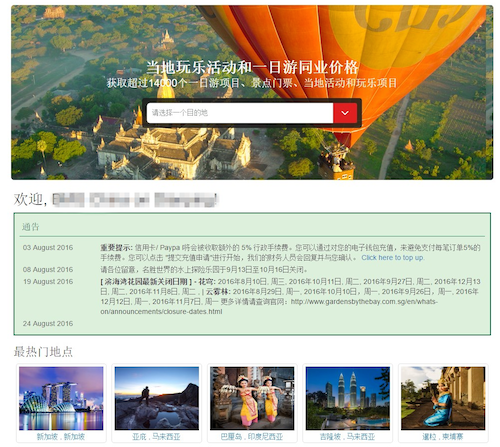
BeMyGuest opens first China office in Hangzhou

0

bemyguest_china_agents_marketplace_homepage

ACTIVITIES, tours and attractions provider BeMyGuest has opened an office in Hangzhou, China as part of expansion plans in the market.

Headed by general manager He Xiaoxing, the new office is set up to provide capacity for increased customer support, engineering and key leadership functions for the Chinese market.

BeMyGuest China will continue focusing on its B2B business in China with its API already integrated with Chinese OTAs such as Ctrip.

Additionally, it is offering Chinese travel agents a wholesale platform, BeMyGuest’s Agents Marketplace, to provide them access to industry rates and products specifically for Chinese travellers.

“BeMyGuest China will allow us to increase our capabilities in key areas that align with our current and future growth plans. This will allow us to expand our core teams to support the growth we are experiencing while giving us dedicated facilities to host partner briefings and attract talent to join the team,” said Clement Wong, CEO of BeMyGuest.

“Under the leadership of Xiaoxing, we are very confident of scaling our Chinese business. Our team is excited about the rapid growth we are experiencing in China and this move represents a commitment to continue to build on the success our team has accomplished in the world’s largest outbound travel market.”

Hertz debuts loyalty programme in four Asian markets

0

hertz-1

HERTZ has launched the Hertz Gold Plus Rewards loyalty programme in China, Singapore, Japan and South Korea, allowing users in those markets to earn and redeem points in participating countries.

Hertz Gold Plus Rewards is free to join and has added membership benefits including fast pick-up and drop-off of their booked car, free additional drivers, members only discounts, access to exclusive promotions and service information.

Members earn one reward point for every US dollar or its equivalent spent on rentals and select optional service charges. Points can then be redeemed for a day, a week or a weekend rental towards a selection of cars.

Participating countries for points redemption include Australia, Belgium, Brazil, Canada, Denmark, Finland, France, Germany, Ireland, Italy, Luxembourg, Netherlands, New Zealand, Norway, Spain, Sweden, the UK and the US.

“It’s fantastic to be able to launch the Gold Plus Rewards programme and to give our dedicated members in China, Japan, Singapore and South Korea access to premium tiers, providing them with even more reasons to rent with Hertz,” said Eoin Macneill, vice president Hertz Asia-Pacific.

To celebrate the launch, Hertz is offering its Gold Plus Rewards members residing in China, Japan, Singapore, South Korea and selected European countries up to 550 bonus points when booking their Hertz rental.

In order to receive the bonus points, members need to book their vehicle by September 30 and complete the rental by December 31.

Online sales overtake agency sales for Best Western

0

best-western-cebu-sand-bar-resortBest Western Cebu Sand Bar Resort

BOOKING revenue arising from online sales channels has overtaken sales derived from traditional travel agents for the first time for Best Western Australasia.

Its head of commercial Steve Richards said 1H2016 booking revenue surged 19 per cent year-on-year with the bulk of sales attributable to internet transactions.

“The balance has finally tipped – the majority of our business is now coming through the online channels,” he said.

Richards expects online sales to increase further when parent company Best Western Hotels & Resorts launches a new global website in early October.

Preferred partnerships with TMCs have also been delivering results for the company on the corporate front. “The Flight Centre preferred partnership has been particularly effective,” he revealed.

He added that the company’s record-breaking free breakfast marketing initiative also contributed to the strong surge in internet bookings.

“It was our most successful ever marketing campaign, delivering more room nights to members than anything we’ve ever done,” said Richards.

Flights, trains cancelled as typhoon batters northeast Japan

0

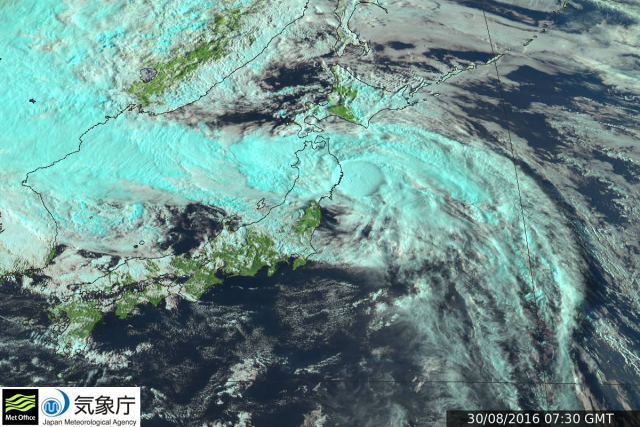
lionrock30aug

A POWERFUL typhoon has battered large parts of northeast Japan, with airlines forced to cancel more than 100 flights and operators of trains and ferries also halting services.

Typhoon Lionrock was so severe that Japanese authorities ordered the evacuation of around 410,000 people in areas deemed to be at risk of storm surges or landslides.

More than 35,000 homes lost power after the storm came ashore on the Pacific coast at around 18.00 on Tuesday evening. The typhoon had winds of up to 162kph and rainfall of 8cm per hour was recorded in some districts. Authorities said one month’s worth of rain has fallen in just two days.

All of northern Japan and Hokkaido have been affected, with flights into Sapporo curtailed and bullet train operations in the region delayed or cancelled.

Travel firms in northern Japan have been affected, although operators said they had escaped largely unscathed.

“We started receiving cancellations on Monday, with 14 people cancelling and an additional 18 cancelling on Tuesday,” said Shuichi Matsuda, president of the Capital Hotel 1000 in Rikuzentakata.

“But the hotel is in operation and the building has sustained no damage. During last year’s typhoon, part of the hill facing the ocean was damaged so we rebuilt that earlier and will stay vigilant to make sure it is not damaged again,” he said.

Aya Yokosawa, an official of Marugoto Rikuzentakata, which promotes tourism and study trips in the town, said the organisation had not received any cancellations, although a group of students visiting from Osaka had been moved to an emergency evacuation centre.

“We have been quite lucky because although it was one of the biggest typhoons we have seen in this region, it did not do much damage,” she said.

The storm has crossed the country and moved out into the Sea of Japan, where it has been downgraded to a low pressure system.

The Nam Hai to become a Four Seasons hotel from December

0

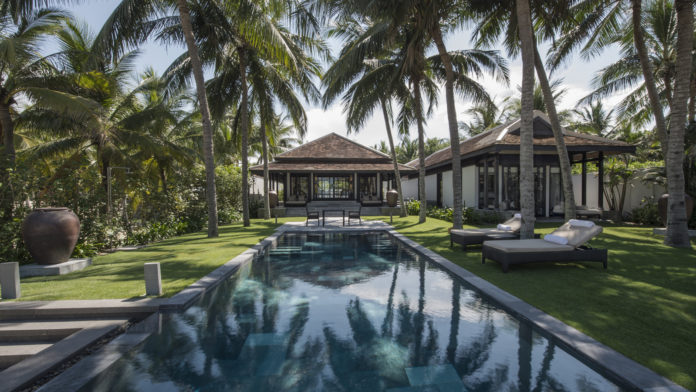
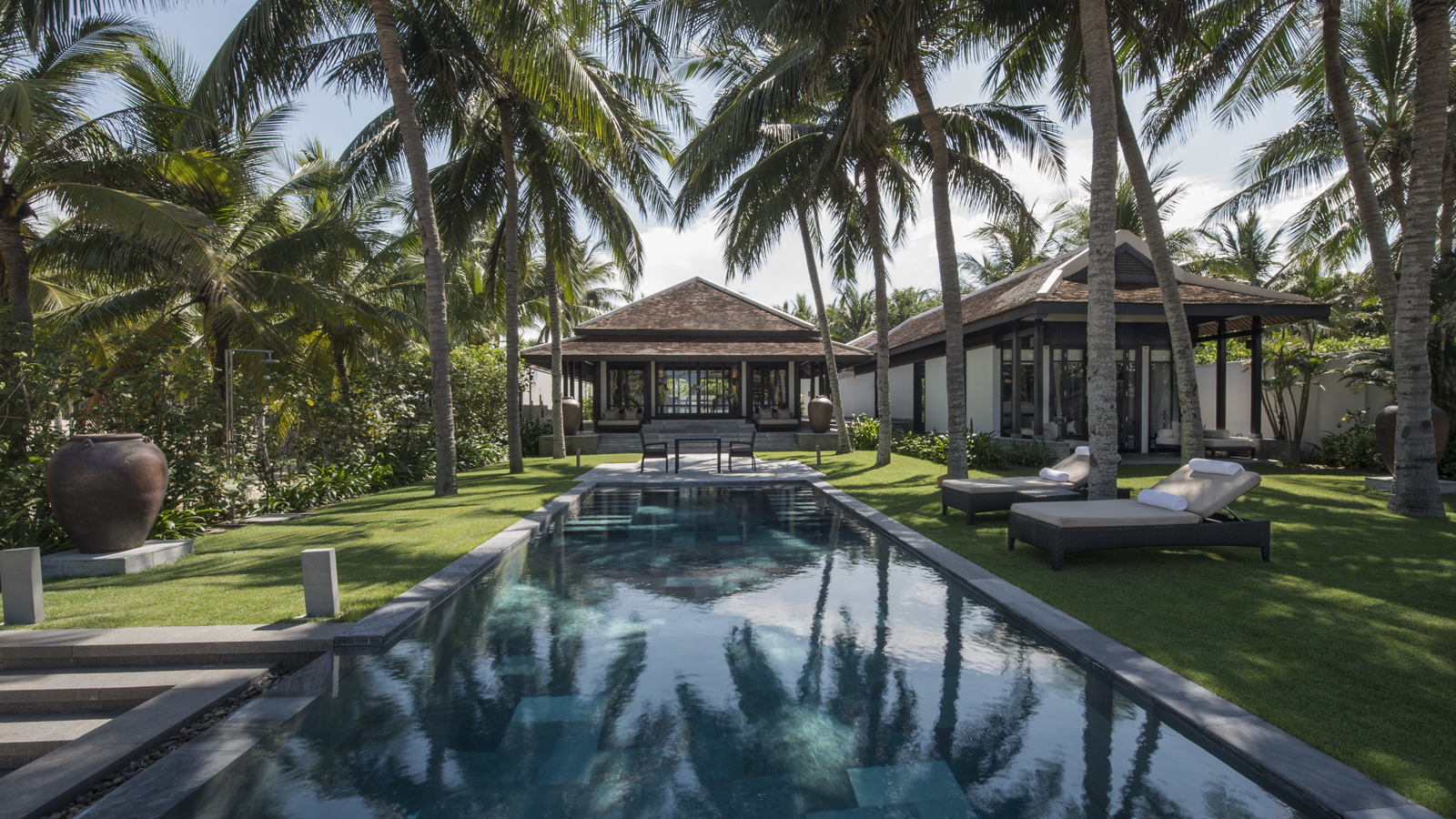
four-seasons-resort-the-nam-hai-hoi-an-vietnamFour Seasons Resort The Nam Hai

SINGAPORE-BASED GHM (General Hotel Management) bows out proudly of The Nam Hai in Hoi An, Vietnam, as the luxury hotel’s new ownership switches to Four Seasons Hotels & Resorts with which it has a long-standing relationship.

The property has been sold to a joint venture comprising Singapore’s Hotel Properties Limited (HPL) and Dubai’s ASB Development. Four Seasons manages other HPL hotels, including two in Bali and one in Singapore, so it comes as no surprise that the US brand was picked for The Nam Hai.

GHM’s president Hans Jenni told TTG Asia e-Daily that the parting was “very amicable”, adding he was proud of the mark the hotel had made.

He said: “We’ve had a highly fulfilling and rewarding association with The Nam Hai, Hoi An these past 10 years and are extremely proud of the legacy and reputation that we have imparted to this phenomenal resort. Since its conception, development and subsequent launch in 2006, GHM had worked tirelessly to manage what is often tagged as the best resort in Vietnam (and possibly in Asia) – a fact which innumerable awards and accolades that this hotel has garnered bear testament to.

“We’re couldn’t be more proud of the team that we have assembled, nurtured and trained all these years and are delighted that the majority of them will stay on even after the transition. While we may no longer be managing The Nam Hai from mid December, the GHM Style to remember legacy will always live on in the property.”

For Four Seasons, the resort marks its first entry into Vietnam, effective December 20.

“Vietnam is an important growth market for Four Seasons and this is a unique opportunity to quickly establish a presence in the country’s top resort destination with partners HPL and ASB, who believe in the culture of Four Seasons and share our vision for success,” said J. Allen Smith, president and CEO of Four Seasons, in a press statement.

Renovations to the resort will add an all-new beach bar, kids club and a variety of water sports to the existing tennis, badminton and basketball courts, and fitness centre. The resort will also offer a world-class spa, featuring eight private pavilions surrounded by the glass-like waters of a lotus pond.

A UK tour operator, David Kevan, director, Chic Locations, said: “I like GHM personally as individuals, but Four Seasons has a much more prominent international presence. I think this could be very good for Vietnam, increasing the range of truly deluxe options within the country. I am sure it will not be long before we see some additional Four Seasons resorts in places like Phu Quoc, Ho Chi Minh City or Hanoi.”

Meanwhile, GHM has its hands full with a pipeline of 11 hotels to open between 2017 and 2020, its joint venture in China to develop Ahn Luh Hotels & Resorts (the first of which has opened in Shanghai) and its latest partnership with van de Bunt Partners to launch a mid-market brand, Tin Hotels, to cater to growing middle-class populations and millennials.

Let’s catch ‘em all in tourism

0

pokemon-go-blog

Unless you live under a rock, it’s almost impossible to miss the hype Pokémon Go has unleashed around the world in the last two months. Based on the 1990s game but levelled up with the latest technology, this augmented reality (AR)  game has taken the world by storm since its release in more than 70 countries.

Thanks to its virality, there are now more people than usual walking around with their eyes locked on their phones, raking up Poké-related complaints of people walking into traffic, reckless driving and even causing stampedes. But the Pokémon Go craze has also spurred novel services such as private car/motorbike services to chauffeur Pokéholics to nab the elusive Snorlax or Dragonite.

Seeing the possibility of attracting existing and new visitors through the game, Singapore Wildlife Reserves promptly hatched Pokémon-related lures and prizes. While some people may visit the wildlife parks just to hunt for the animated characters, the management hopes that in the process of roaming the grounds players get to bond together and, of course, learn and appreciate the majestic real-life beasts standing in front of them.

In Thailand, the enterprising managing director of Phuket Holiday Tour, Yongyuth Chankul, himself a Pokémon Go player, reaped unexpected benefits from launching Pokémon hunting tours. He rolled out promotional material in Thai with the domestic clientele in mind, but several foreign travellers also signed up for the Pokémon tours.

At the end of the experience, these French and German tourists told Yongyuth that they had fun catching the virtual monsters while visiting the major landmarks of Phuket. “Phuket has some unique Pokémon characters different from those back home,” these travellers told Yongyuth.

And herein lies the beauty of Pokémon Go and its relevance to travel: whether you are a proponent or critic of this game, this hit mobile app promotes wanderlust, getting players to move around and explore new places and routes.

While earlier AR devices like Google Glass have faded following a much-lauded debut, will such a fate await Pokémon Go? And how will it compare with virtual reality, which has been adopted by several tourism pioneers in their marketing strategies too? Only time would tell, but this mobile hit has changed societal expectations of how information is presented and assessed, so there is a real chance of it influencing successors in the gaming and non-gaming fields alike.

Meanwhile, for travel industry players who are less enamoured with the game, they can consider branding themselves as no-Go zones, just as how some resorts have positioned themselves as adults-only getaways.

It’s game on for tourism players

0

Agile travel and hospitality players are capitalising on the Pokémon Go craze in their marketing. Have they reaped tangible benefits from the game and will this mobile hit transform future travel?
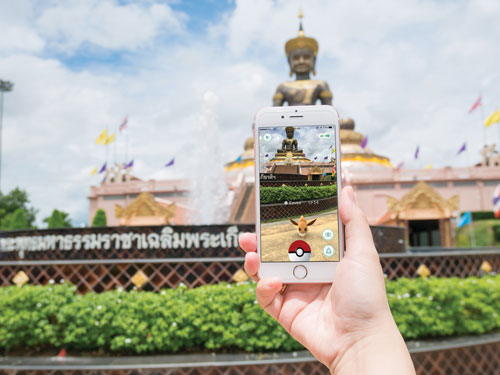
sept-02-pokemongo

The arrival of Pokémon Go has taken the world by storm and since its global release in over 70 countries in the last two months, the augmented reality (AR) game has captured the attention of savvy marketeers and tour operators as it creates a new tourist class and opportunities to sell travel.

A GPS-based exploration game, Pokémon Go mixes AR with real-world locations, allowing players to view and hunt for the brightly coloured creatures through their smartphones, collect bonus items at designated points called Pokéstops and send their Pokémons into battle at gyms (also real locations where players train the characters).

Pokémon Go’s focus on the users physically visiting and interacting with actual places also gels well with travel, as some commentators think the game will encourage players to leave their comfort zone and discover new locales.

Aussie tour operator Gecko Adventures was one of the first to jump onto the craze by launching a 45-day global Pokémon Go tour to Peru, Galapagos Islands, Egypt and South-east Asia, including stops in Cambodia, Vietnam and Thailand.

James Thornton, managing director, Gecko Adventures, said: “All this exploring creates an appetite for adventure and getting behind the scenes of a destination – so a whole new generation has been bitten by the travel bug and wants to get out there and explore the world.”

Since launching the tour at the end of July, the tour company has seen a 10 per cent increase in bookings.

An enterprising Thai tour operator has also created Pokémon hunting tours.

Said Phuket Tour Holiday managing director Yongyuth Chankul, a Pokémon Go player himself: “We already have existing Phuket city tours that cover the island’s landmarks, many of which are also Pokéstops, so I created tours highlighting sites where monsters are in abundance.”

Interestingly, for a tour operator whose main clientele is the domestic sector, the Pokémon tours have helped to nab foreign tourists too. “All my Pokémon tours marketing is done in Thai, so I was pleasantly surprised to receive enquiries and interest from German and French travellers too,” he added.

In the wake of the recent bomb attacks at resort towns, Thailand’s Ministry of Tourism and Sports has indicated interest to work with local telecom provider True Corporation to add Pokéstops and gyms to various tourist destinations in the kingdom to promote tourism.

Other Asian attractions and destinations, too, have been quick to explore the marketing benefits of Pokémon Go, seeding their sites with virtual creatures and “lure modules” as a means to draw potential new customers.

Vivian Lee, executive director of sales and marketing at Ocean Park Hong Kong, said: “We noticed over 50 Pokéstops scattered across the park. We (would) release lure modules at these Pokéstops every Friday in August from 16.00 to 20.00 to provide non-stop luring of Pokémons.”

Resorts World Sentosa (RWS) has similarly unleashed lures at its two popular attractions – S.E.A. Aquarium and Universal Studios Singapore – for visitors to play the game and get admission discounts.

According to a RWS spokesman, these lures had brought “increased visitorship” to both attractions, with players prolonging their stay and patronising the resort’s retail outlets and restaurants.

For Wildlife Reserves Singapore, which manages Singapore Zoo and Night Safari, Pokémon Go presented an opportunity to reach an untapped youth market, chief marketing officer Isabel Cheng shared.

She said: “Of course, real-life animals remain our main draw, but with these initiatives we hope that these youths will come to our parks for Pokémon but stay for the animals.”

While Cheng admitted that it is difficult to assess if the game has succeeded in attracting more footfall to the wildlife parks over the weekend when over 500 lures were released, many visitors were observed to be playing Pokémon Go in between checking out the animals, with a number of them doing that as a family.

By offering a 40 per cent discount off its admission fees for the first 100 visitors sporting the colour of the day – red, blue or yellow – each day, Sunway Lagoon in Selangor hopes to attract more than 100 players a day and some 2,700 additional visitors over the six-week campaign period, informed the park’s director of marketing Michelle Sonia Gregory.

Likewise, hotels have been quick to ride the fad. Hong Kong’s Ovolo Southside has its sights firmly on the millennials when it  rolled out a a six-week luring campaign, charging zones, and a range of themed cocktails, incentives and prizes, all of which are designed to align with the tech-savvy Gen Y users.

“So far, (the Pokémon Go campaign) has provided direct sales to room bookings as well as visits to the hotel’s restaurants. We have also seen a number of new enquiries to the hotel and a strong uptick in search and visitors to our website,” said a hotel spokesperson.

Other hotels like Four Points by Sheraton Puchong in Kuala Lumpur and Kokotel Surawong in Bangkok, given their fortuitous proximity to Pokéstops, are dropping lures and blasting on social media for reasons to visit or book a stay.

However, in Cambodia, the game has been marred by negative publicity after tourists descended on the capital’s S-21 – Tuol Sleng Genocide Museum – where more than 12,000 people were brutally killed during the Khmer Rouge regime. It was host to two Pokémon gyms, four Pokéstops and a series of wild Pokémons.

Museum director, Chhay Visoth, said: “We do not welcome this crazy game because this place is not the place to play a game.” Players were immediately banned from the site.

The game has earned the irk of Malaysia’s Islamic authorities, who declared Pokémon Go a no-go for Muslims in the country, citing concerns of addiction, intrusion into personal privacy and craving for power, among others.

Safety remains a top concern for Patrick Fiat, general manager of Royal Plaza on Scotts, one of the Pokéstops in Singapore’s Orchard area.

“We hope that Poké trainers keep themselves aware of their surroundings and exercise vigilance when playing the game,” he remarked. “We would hate to see any mishap taking place at our Pokéstop.”

Tim Russell, co-founder & chief marketing officer, Representasia, thinks there is “a huge market” for Pokémon Go abstinence too, especially for destinations and attractions frustrated with their unauthorised appearance within the viral game.

“In this case, hotels should advertise themselves as Pokémon-free zones and request that guests refrain from playing in public areas,” he suggested. “Properties can request that their property be removed from the game (as Pokéstops or gyms).”

While it may well be a major passing fad, Pokémon Go’s engagement potential has proven to be immense and it’s likely to spawn more useful apps that allow travellers to explore and interact with the world.

Sentosa Development Corporation’s branding & communications director Tay Cheng Cheng  sums it up: “The popularity of this app comes amid the convergence of technologies with location-based entertainment, and illustrates the direction in which visitor experience is headed.

“This provides valuable learning points to the industry as we look for further ways to innovate and enhance guest experience, and to leverage digital technologies for self-guided learning and discovery,” she said.

Reporting by Xinyi Liang-Pholsena, Paige Lee Pei Qi, Marissa Carruthers, Prudence Lui and S Puvaneswary

This article was first published in TTG Asia September 2016 issue. To read more, please view our digital edition or click here to subscribe.

Dream come true

0

His role is as large as a ship: making Asia’s first luxury cruise line a dream come true. Thatcher Brown, president of Genting Hong Kong’s Dream Cruises, tells Raini Hamdi about it as the first ship, Genting Dream, gets set to sail this November

sept2_thatcher-brown

Is Guangzhou the right place to base the first ship of the first Asian luxury cruise line?
You could argue the same thing if you were launching a ship a long time ago. There’s always a conversation about who’s going to be the first. ‘You’re launching in Fort Lauderdale, that’s crazy!’, etc.

Guangzhou and the Pearl River Delta are extremely well-developed in terms of infrastructure, and the demographics indicate to us there is a lot of interest in cruising. We feel confident that the area is ready for us. Part of that confidence stems from us having the benefit of a pathfinder ship there in the SuperStar Virgo. Southern China is as much a home turf for us as South-east Asia. This is where people recognise us and understand Genting, where our partners have worked with us over the years with Star Cruises.

And if you look at the cruise distribution in China, so much of it has been focused on the east, in Shanghai and Tianjin. I’d say 70 per cent of the homeporting is out of those two cities. So in fact, there is a natural evolution in the market where people are asking, ‘Where do we go next?’.

But the Guangzhou base may cause people to misconstrue Dream Cruises as being China-centric rather than Asian-centric. What is the ideal market mix for the first ship, Genting Dream?
It will vary based on seasonality. Often, the vacation patterns of our source markets don’t overlap.

The perfect mix is having affluent Asian travellers onboard the ship, who want to have a quick two-night getaway or a five-night extended vacation. In summer and peak holiday periods, that mix is going to look 65-75 per cent Chinese and the rest pan-Asian. So part of our offering is to be able to manage that mix carefully.

You aren’t worried it will become mainly Chinese at any one time, that too much of any nationality has its disadvantages?
I don’t have a worry about that. We are targeting affluent Asian travellers who tend to be more sophisticated, more educated, more knowledgeable about standards – I am more sensitive about being successful in catering to their different luxury needs. Some affluent people want to be discreet, others want to be seen. There is always going to be differences in interests as well. Imagine if you are in Latin America and catering to Brazilians and Argentinians; one parties all night, the other likes going to the spa. So how can we cater to the diverse needs of wealthy multi-Asians?

For us to be able to manage that is critically important. So we need to be able to offer different products to manage a different Asian mix. Our Dream Mansion product (a ship-within-a-ship concept with two floors of exclusive suites, villas and private facilities) on Genting Dream, for instance, allows us to cater to different levels of luxury. And as we get more capacity (a second ship, Genting World, will debut in November 2017), we can probably offer different products that have different appeal (to different Asians).

What’s important is, it’s not us who define the brand but the guests, that as the brand builds its personality, the management listens to its target audience, then modifies and organically evolves the brand to suit the needs of the target audience. We have to be adaptable and respond quickly to guests’ needs. If you look at the excess of information today, your brand will be left behind if you are not in a constant dialogue with the guest and respond quickly to trends.

What are the challenges of being the first Asian luxury cruise line?
The challenge of recruitment is one. I see supply coming into the market grabbing for resources and, for us, the software is the most important aspect. We want to be the best in the industry and in order to do that, we have to create a process and a culture that embrace development, recognition, reward, etc. And that takes time.

Another challenge is infrastructure related. Port development needs to catch up with capacity development, although many destinations are investing a lot and accelerating their build-up plans, which is terrific. We encourage that, and we’re happy to work with the destinations to do that.

vftt_quite

Dream Cruises is debuting at at time when there are at least nine new-builds coming into the market.
Yes, a lot of capacity is coming in and another of our challenges is how quickly can we educate consumers – for us in the affluent market – on this wonderful cruise alternative.

So we’ve spoken about the challenges of getting the right people, about port infrastructure development, about the need for us to manage and evolve our brand. One other challenge is how we control our sales distribution, because one of the things I see happening is brands losing control of their identity and integrity through distribution mechanisms like charters, which result in price dumping – and that’s not going to help the market to evolve. Of course getting a charter from a large corporate company to fill a ship is important and we do appreciate large group business, but in general there is this tension between taking the risk and controlling your destiny. We want to keep a healthy, balanced approach.

So we are careful about our partnerships in terms of sales distribution. We want partners who are committed to us for the long term and who respect the price integrity and the positioning of our brand.

What is the difference in price positioning between Dream Cruises and Crystal Cruises which Genting had bought?
I consider Crystal to be uber luxury, a lifestyle brand with international clientele and a higher price point. The revenue model is different – the fare is much higher, the cruise length is longer, the onboard spending is different, there are probably more shore excursion opportunities and pre-/post-cruising is important for these guests.

For us, we’re kind of entering the luxury market from an Asian perspective if you like. The seasonality of the Asian market makes it a rollercoaster in some ways on pricing – there’s a lot of price volatility. So we hope to come into the market, establish ourselves above the contemporary pack and create stability in our pricing.

Which brings me back to your first question on homeporting in Guangzhou. A lot of the capacity you’ve just mentioned are homeporting in Shanghai and Tianjin, whereas we see an opportunity and a pioneering advantage in the Pearl River Delta. We also see a luxury positioning as strategic, because it gives us some key advantages.

How sort of ROI is Genting expecting from this investment and how soon?
Well, going by industry standards, the expected ROI is 10 per cent at least, and within six to eight years. Our goal is to accelerate that for our company.

This article was first published in TTG Asia September 2016 issue. To read more, please view our digital edition or click here to subscribe.

Travel employers offer fresh look at younger generation workers

0

tern-event

WHILE the new generation of workers have routinely come under criticism for being coddled, idealistic and lacking in resolve, travel industry leaders in Asia-Pacific are suggesting a different perspective.

A foremost concern, declining job longevity, they say, may be a result of the dilemma of choice in today’s dynamic labour market rather than the fault of young job seekers themselves.

Louise Daley, executive vice president & CFO, AccorHotels Asia Pacific, who entered the workforce at a time when “there were no jobs and you basically got a job that was offered”, opined that the plethora of choices available to today’s workforce “is not always a good thing”.

“(Back then), working (came with) a certain doggedness of getting things done, solving problems and achieving things. Part of this was born out of having to battle it out to get a job,” she said last Saturday at Tern, a travel industry career event held in Singapore.

While this form of motivation has become less typical today, many in the younger generation can still identify with roughing it out but at the same time aligning it to their self-interests.

Lionel Yeo, manager hotel partnerships, APAC at TripAdvisor, for example, shared his personal mantra of “doing hard things that sound interesting”.

Having ran an e-commerce business selling t-shirts, started a successful blog on personal finance (after experimenting with various topics) and worked for five years at Singapore Airlines in different roles, he stressed that having an innate passion cannot be taken as a given.

For those who do not know their desired career path, “testing different areas” of their interest and strengths is a good way of figuring where they should head towards.

Some of those present at Tern expressed it is not only unpragmatic, but also potentially costly to take a “tunnel vision” approach to careers.

“(For) young professionals, when they have passion, they have only one goal. Young people come in and say, ‘this is where I want to go’, ‘this I where I need to be at in X number of years’. When it doesn’t happen, they’re shattered and lose direction,” opined Bina Tulsidas, area manager partner services at Booking.com.

One piece of advice I give to my team is to have not one but several (goals) and test them out. If it’s not happening now try something different. With career progression it doesn’t have to be vertical. It can be lateral too.”

Concurring that it was “important to not get stuck on choosing”, Daley added that being agile can be valuable at a time like this.

“It is a wonderful thing to chase your passion, but it is also wonderful to bring your passion to the job,” she said.

Still, reminds Loh Lik Peng, founder of the Unlisted Collection, job hopping unnecessarily can be a detriment to job seekers. He said: “Maybe you want advancement and for your skills to be valued, but I want to see three or four years (in the same company) on your CV.”

Zsanett Maizl, team lead recruitment at Booking.com, added: “Changing jobs every year may come across as negative because when we hire, we’re looking for people who would like to stay at the company and who are committed.

“However, you can have your reasons such as relocating. We also try to look beyond the CV and get to know the person.”

Thailand’s oldest travel agency sheds 80 per cent of staff

0

world-travel-service-bus

THAILAND’s oldest travel agency is shedding about 80 per cent of its staff in an overhaul its general manager says is essential for survival.

World Travel Service (WTS) general manager Thongchai Phithakstrakul said the company would have about 100 employees, down from more than 500, when the restructure is complete. Most had already departed and branches have been closed in favour of local representatives.

The 69-year-old travel agency had been under pressure from the digital revolution. “It is very difficult for us to adjust ourselves. And since we have high headcount, we now have to trim them down,” said Thongchai.

The downsizing is the result of both manual jobs that have become obsolete and weaker demand as younger generations move away from using traditional travel agencies.

Thongchai said WTS will continue by relying on corporate clients and a small sales team to respond to online requests, but said the cuts were essential to ensuring the agency had a future.

“We’ll be more flexible and we can survive. I think we have come to the minimum already at 100. So we will survive at this level,” he said.

“We are changing from a conventional agency. Now we have to adapt to the new market, the new generation.”

Thongchai, a 50-year veteran of the company established in 1947, described the challenges as the biggest WTS had faced.

The payouts have also been expensive, with WTS compensating many employees who had worked for the company for decades.

“Most of them worked with the company for more than 20 years, so they got 100 per cent of their last salary multiplied by the years they worked. That’s a lot of money.”