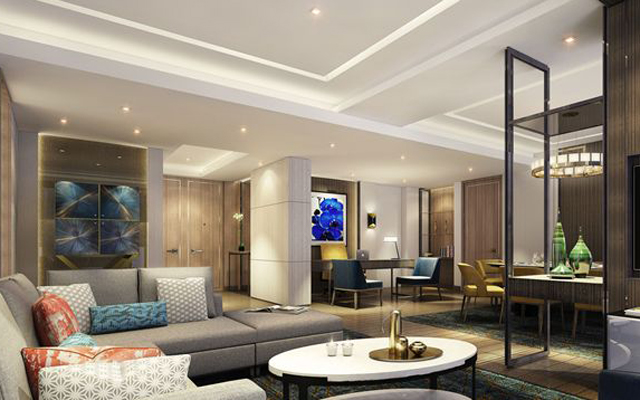
Lead-in package bumps guests up to a Grand Room (pictured)
From now till its launch on January 15, 2018, The Murray, Hong Kong, a Niccolo Hotel, is offering pre-opening deals and Best Available Rate for stays between January 15 and June 30, 2018.
Pre-opening packages start from HK$3,850 (US$493.70) for a N1 Deluxe Room, which includes an upgrade to a N2 Grand Room (50m2), daily breakfast for two, a complimentary “personal bar” and late check out up to 16.00.
Lead-in package bumps guests up to a Grand Room (pictured)
The Explorer Suites (75m2) package is priced at HK$8,630, and includes an upgrade to a Signature Suite (75m2), daily breakfast for two, roundtrip private airport transfers with VIP meet-and-greet services at the airport, complimentary personal bar, HK$1,000 in dining credit to be enjoyed in the hotels’ restaurants and bars (excluding Guo Fu Lou Cantonese Restaurant), and an extended check-out time of up to late check out up to 16.00. This offer applies for a minimum stay of two nights.
All rates are per room per night basis, subject to availability and a 10 per cent service charge.
Centara Hotels & Resorts has appointed Markland Blaiklock to the newly created position of deputy CEO.
Blaiklock will be responsible for steering the continued expansion of Centara, which aims to double both its revenues and number of properties over the next five years.
Blaiklock will also oversee operations, human resources, sales, marketing, business development and legal services.
He returns to Centara in an expanded capacity, having previously served as the company’s COO in 2015. He has held senior executive positions with Le Meridien, Shangri-La, Raffles and Accor hotel groups, in Asia and North America.
Centara has been expanding outside its base in Thailand, where it operates 32 properties. The company has 67 properties open or under development across 13 countries in South-east Asia, the Indian Ocean, China, the Middle East and the Caribbean. The next phase of growth is expected to see Centara become an even more significant regional brand with properties opening in China, Cambodia, Laos, Indonesia, Qatar and the UAE, according to its statement.
Tourist arrivals continue growing, but some origin markets are on the decline
Singapore saw a four per cent year-on-year increase in international visitor arrivals in 1H2017, but declines from markets such as Hong Kong and Thailand, according to the Singapore Tourism Board’s latest performance report.
Over the first two quarters, China (1.55 million), Indonesia (1.47 million), India (660,000), Malaysia (562,000) and Australia (523,000) were the destination’s top five international visitor-generating markets, accounting for 56 per cent of total international visitor arrivals in January to June 2017.
Tourist arrivals continue growing, but some origin markets are shrinking
While India (+15 per cent), China (+ five per cent), and Indonesia (+four per cent) registered the largest absolute growth, Hong Kong (-17 per cent), Thailand (-seven per cent) and Taiwan (-five per cent) posted the largest drops.
The three fastest shrinking markets all ranked in the city’s top 15 source markets. In 11th place is Thailand (262,000), while Hong Kong (222,000) was the 13th top feeder and Taiwan (195,000) 14th.
Arrivals from Japan, Singapore’s seventh top source market, also dipped one per cent to hit 362,000 arrivals.
Notably, the destination saw a 10 per cent increase in tourism receipts to S$12.7 billion (US$9.3 billion). Growths were observed across all major components including shopping (+20 per cent); accommodation (+eight per cent); food & beverage (+three per cent); sightseeing, entertainment & gaming (+two per cent); and other components (+12 per cent).
Meanwhile, gazetted hotel room revenue for January to June 2017 was estimated at S$1.6 billion, a 1.6 per cent decline over the same period last year. But with average occupancy rate up 1.2 percentage points to 85 per cent – offsetting a 1.2 per cent fall in average room rate to S$231 – RevPAR still saw an increase (+0.2 per cent) to S$197.
Dubai-based air services company Dnata has relaunched Yalago as a leisure bedbank.
First launched as a metasearch engine in 2011, the platform makes a return with Dnata recognising its ability to “garner distribution where Dnata doesn’t have businesses operating”, said Sébastien Doussin, managing director of Yalago.
Fernando Morote (left), Yalago’s sales and business development director, and Doussin
Yalago will specialise in leisure travel, and service third party customers with accommodation supply.
“We will be focusing on quality rather than quantity, and one of our commitments is to retain a low hotel to contractor ratio – with our contractors based in-market – in order to continue to manage our contracts and relationships effectively. We have also invested significantly in a health and safety programme, partnering with an independent provider to continuously audit all of our hotel suppliers,” Doussin elaborated.
Dnata said in a statement that the bedbank is “different from the standard start-up”, with a room night production of over seven million a year already coming from Dnata’s in-house brands, giving it “significant volumes to deliver competitive rates and a flexible approach from day one”.
Yalago is well placed in the bedbank space, Dnata further stated, with its leisure focus in line with the tour operation heritage of the various brands that make up the Dnata Travel portfolio, namely Emirates Holidays, Travel 2, Gold Medal, Travel Republic and Travelbag.
Capacity on the carrier's Manila-Istanbul route boosted
Barely three years old and notwithstanding the terrorist attack in Ataturk airport in June 2016, Turkish Airlines’ Manila-Istanbul route is enjoying brisk demand on the wings of competitive pricing and extensive European network for both Filipino longhaul travellers and overseas workers (OFWs).
Its A340 aircraft was recently replaced by a brand new B777 (with 370 economy and 49 business class seats) and the route has become a daily service since September last year, up from thrice weekly when launched in March 2015.
Capacity on the carrier’s Manila-Istanbul route boosted
With rates having dipped in light of security concerns surrounding Turkey and with the NTO more aggressively marketing in the Philippines, travel agencies said they have started offering luxury coach tours to Turkey and that Middle Eastern carriers are losing passengers to Turkish Airlines.
Vilma De Claro Mendoza, Mart Evers Travel president, said competitive pricing is bringing luxury groups to Turkey, enticed by a variety of shopping experiences, natural attractions, history and biblical sites.
Mike Hain, groups manager, Corporate International Travel and Tours, said the company is developing luxury programmes to Turkey for next year, explaining that “global terrorist threats is not an issue” to Filipinos. “They travel when they want to and where they want to,” said Hain.
Shroff International Travel Care managing director Arjun Shroff further pointed out that Turkish Airlines is getting more popular among OFWs, tourists combining Turkey with the Holy Land, and those on multi-European country tours.
The airline is gaining in popularity not only for Turkey-bound Filipinos, but also for those looking at other longhaul destinations, said Matt Poonin, general manager of Travelite Travel in Manila.
What brings Skål International to Asia?
The future is here, culturally and economically. Our members around the world are very interested in this market – both in bringing people here and receiving people from here – and Skål International is the perfect tool to connect them.
This is a big window of opportunity for small- and medium-sized companies, and people here are more prepared to do business with occidental people and organisations, in terms of having more and better tools for business and communication.
Asia also has a very diverse history, and since travellers are always looking out for new discoveries, Asia has become one of the most important destinations for occidental travellers in the last 10 years.
Over the next few years, Asia is going to be our priority. We’re going to support our members here and give them more benefits.
Otero: Asia priority for next few years
What challenges are you facing in this new territory?
Asia is a big market and it’s very different. My main challenge now is figuring out how to integrate companies in Asia with those in the rest of the world. We need to understand the global point of view and the new ways of doing business around the world.
For example, digital transformation for associations is no longer a “maybe” – it’s a must. We need to redesign our processes. This point is a priority for us, and we are now working on this.
What considerations will you make when redesigning your process?
One of our member benefits is giving opportunities to young professionals. Part of my plan is working on this target. For example, finding mentors to support youths in their career. It’s a win-win situation: companies receive fresh ideas and mentalities, and millennials receive the training opportunity.
What’s interesting I’ve learned is that in Singapore, it’s difficult for young people to engage in dialogues with top-management members, because the culture is different. So this is one point we’d like to focus on changing.
What do you see young talent contributing to the industry?
They are the future. We have the experience, but I learn new things every day from the young people in my team. They know the industry’s history and they have a vision of the future. They understand this modern world.
With this vision, what changes do you hope to see in the industry?
I think that the industry will be able to move forward with more and clearer targets. Now we have a mix of travellers: traditional ones who like the old way of travelling; the middle-aged travellers who understand and enjoy new technology, but are still more comfortable with the past; and the millennials.
The big companies must think about these different target markets when providing their services. This is especially crucial for millennials, who make up a very big market, are very clear about what they want and always make their purchases online.
Especially for hotels, technology is not a plus now; it’s a must. Just 10 years ago, hotel WiFi was a benefit. Now, if you don’t have WiFi in your hotel, you don’t have clients. Customers assume that WiFi is included with their stay.
I think there also needs to be more transparency, honesty and consistency in the hotel ratings system. (The standards of) a five-star hotel in Singapore are not the same as a five-star hotel in another part of Asia. I hope this will be standardised in the industry in the next few years.
Do you think there needs to be more awareness about such service standards?
Maybe not in cities like Singapore, but more so in the rest of Asia, parts of Europe and South America. The difference in standards is very huge, and companies don’t always have the same mentalities.
In this age of social media and technological connectivity, what role does Skål International play, and how do you make sure you stay relevant?
We give the guarantee to our members that the company or operator they are working with is reliable and trustworthy – and in these times, it’s very important to have a guarantee.
We will continue to facilitate communications for our members around the world, and help them make better business connections. Digital transformation is a must and will be a priority for us in the next year.
Member benefits will also be extended around the world. Lastly, we’ll try to open a really big door for youths around the world who would like to work in this industry.
The Hongkong and Shanghai Hotels has begun construction of The Peninsula London, adding another alpha city location to the brand’s portfolio counting New York City, Tokyo and Paris.
The hotel will occupy a site looking out to iconic London attractions – Hyde Park Corner and the Wellington Arch – and comprise a 190-room hotel plus 24-28 luxury residential apartments, with opening currently scheduled for 2021.
Hongkong and Shanghai Hotels’ Michael Kadoorie (left) and Duke of Westminster, Hugh Grosvenor at the groundbreaking ceremony
As part of the project, the owners will also provide affordable housing located at Buckingham Palace Road in Westminster. The project is expected to support over 2,000 jobs and deliver additional expenditure of £60 million (US$78.9 million) to the London economy annually.
In APAC, South Asia saw fastest growth in international visitors
Destinations worldwide welcomed 901 million international tourist arrivals in the January-August period this year, up seven per cent from the same period of 2016 and marking the eighth consecutive year of continued growth for international tourism, according to preliminary findings from the UNWTO World Tourism Barometer.
Growth in arrivals was strongest in Africa (+nine per cent) and Europe (+eight per cent), followed by Asia-Pacific (+six per cent), the Middle East (+five per cent) and the Americas (+three per cent).
In APAC, South Asia saw fastest growth in international visitors
In Asia-Pacific, South Asia (+10 per cent) led growth, followed by South-east Asia (+eight per cent) and Oceania (+seven per cent), while results in North-east Asia (+three per cent) were rather mixed, the barometer showed.
Europe saw international arrivals rebound in both Southern and Mediterranean Europe (+12 per cent) and Western Europe (+seven per cent) following a weak 2016. Arrivals grew by six per cent in Northern Europe and by four per cent in Central and Eastern Europe between January and August 2017.
Africa recorded the fastest growth of all five regions, thanks to the strong rebound in North Africa (+15 per cent) and the sound results of Sub-Saharan Africa (+five per cent).
Most destinations in the Americas (+three per cent) continued to enjoy positive results, led by South America (+seven per cent), followed by Central America and the Caribbean (both +four per cent). In North America (+two per cent), robust results in Mexico and Canada contrast with a decrease in the US, the region’s largest destination.
Seeing more mixed results is the Middle East (+five per cent), with some destinations strongly recovering from negative growth in previous years, while others reported declines through August.
Turning to the top 10 outbound markets, international tourism expenditure grew fastest in China (+19 per cent), South Korea (+12 per cent), the US (+eight per cent) and Canada (+seven per cent).
Worth noting beyond the top 10 source markets is the significant recovery in demand from Russian (+27 per cent) and Brazil (+35 per cent) after a few years of declines in tourism expenditure abroad.
Qatar buys about 9.6 per cent stake in the Hong Kong flag carrier
Qatar Airways has entered into an agreement to purchase an amount of 378,188,000 shares of Cathay Pacific Airways, being approximately 9.61 per cent of the total issued share capital. Completion of the transaction was expected to take place yesterday (Monday, November 6) in Hong Kong.
Qatar Airways buys about 9.6 per cent stake in the Hong Kong flag carrier
Qatar Airways group CEO Akbar Al Baker said: “Qatar Airways is very pleased to complete its financial investment in Cathay Pacific.”
“Cathay Pacific is a fellow oneworld member and one of the strongest airlines in the world, respected throughout the industry and with massive potential for the future.”
This investment further supports Qatar Airways’ investment strategy which already includes a 20 per cent investment in International Airlines Group, 10 per cent investment in LATAM Airlines Group and 49 per cent investment in Meridiana, a statement said.
CEO Sean Menke (pictured) led the company through a restructuring which reportedly saw 900 jobs cut
On the back of a major cost-cutting exercise, Sabre Corporation has released its 3Q2017 financial results showing a revenue of US$900.6 million, up 7.3 per cent year-on-year, and a staggering 96.1 per cent growth in operating income to US$176.8 million.
Looking at Sabre’s Airline and Hospitality Solutions unit, revenue increased 4.8 per cent to US$274.9 million, with mid-single digit revenue growth in AirVision and AirCentre solutions, and Hospitality Solutions revenue increasing in the mid-teens, offset somewhat by a modest decline in SabreSonic revenue due to the ending of legacy reservations system services to Southwest Airlines.
CEO Sean Menke (pictured) led the company through a restructuring which reportedly saw 900 jobs cut
Airline passengers boarded declined 9.4 per cent due to the impact from Southwest Airlines. Excluding the carrier, total passengers boarded increased 11.5 per cent, driven by the implementation of Alitalia in October 2016 and passengers boarded growth of 7.7 per cent on a consistent carrier basis.
Operating income increased 28.3 per cent to US$68.4 million, with a margin of 24.9 per cent compared to 20.3 per cent for the prior-year quarter.
Adjusted EBITDA increased 17.4 per cent to US$111.7 million, and its margin was 40.6 per cent, widened from the 36.2 per cent in 3Q2016.
According to Sabre, Airline and Hospitality Solutions operating income and Adjusted EBITDA growth were supported by the benefits from the cost reduction and business alignment programme initiated in August 2017 and higher service-level agreement expenses in the 2016 quarter.
Key customer wins including Travelgenio, the second largest OTA in Spain, Shenzhen Airlines and China Airlines, and Rydges Hotel Group and Sokos Hotels. Its Airline Solutions delivery team completed over 40 customer implementations, including its SabreSonic reservation system and a broad suite of solutions at Air Niugini, it said.
Meanwhile, revenue from Sabre’s Travel Network rose 8.6 per cent with global bookings growing 3.2 per cent. Bookings grew 16 per cent in EMEA and 10.8 per cent in Asia-Pacific, but declined 1.9 per cent in North America and 1.9 per cent in Latin America – dampened by the impact of recent hurricanes in the US and Caribbean
Travel Network operating income increased 8.7 per cent to US$198.4 million. Operating income margin was 31.4 per cent, compared to 31.3 per cent for the prior-year quarter. Adjusted EBITDA increased 7.9 per cent to US$237.3 million, with a margin of 37.5 per cent compared to 37.8 per cent in the prior-year quarter.