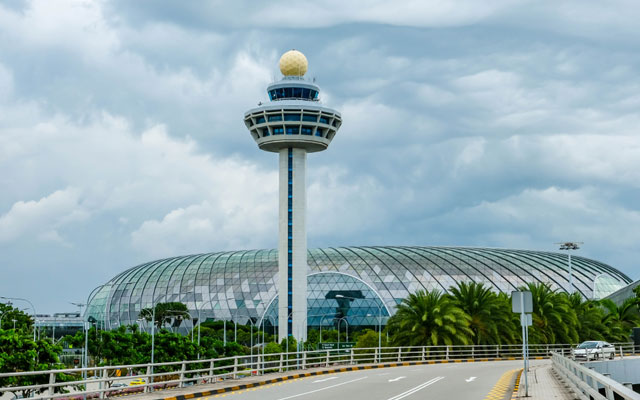
Singapore will introduce a Sustainable Aviation Fuel (SAF) Levy for all flights departing from the country starting October 1, 2026, with the levy applying to tickets and services sold from April 1, 2026.
The Civil Aviation Authority of Singapore (CAAS) said the levy will apply to all Origin-Destination passengers, as well as general and business aviation flights.
Passengers on flights departing Singapore will pay a new levy from October 2026 to support the nation’s goal of achieving net zero aviation emissions by 2050
The levy supports Singapore’s goal of achieving a one per cent SAF blend by 2026 and three to five per cent by 2030, as part of efforts to reach net zero aviation emissions by 2050.
Set according to flight distance, the levy is grouped into four geographical bands. Economy class passengers will pay S$1.00 (US$0.74) to Bangkok, S$2.80 to Tokyo, S$6.40 to London, and S$10.40 to New York.
Premium cabin passengers will pay four times the economy rate. Airlines must list the levy as a separate line item on tickets.
General and business aviation flights will be charged per aircraft, with rates from S$40 for a Cessna 404 Titan flying within South-east Asia to S$6,500 for an A380 travelling to the Americas.
CAAS said the lower-than-expected levy amounts reflect reduced SAF costs compared to earlier estimates. Funds collected will go into a statutory SAF Fund managed by CAAS and administered by the newly established Singapore Sustainable Aviation Fuel Company for SAF procurement and related costs.
CAAS director-general Han Kok Juan said: “The introduction of the SAF Levy marks a major step forward in Singapore’s effort to build a more sustainable and competitive air hub. It provides a mechanism for all aviation users to do their part to contribute to sustainability at a cost which is manageable for the air hub.”
In Asia-Pacific’s vibrant travel scene, payments are becoming as much a part of the journey as airports and attractions, with 60 per cent of South-east Asian consumers preferring to go cashless.
Travellers across the region are tapping, scanning and swiping their way through journeys that once involved costly currency exchanges and managing paper receipts. This transformation goes beyond convenience, reflecting a broader change in mindset where speed, flexibility, transparency, and choice define every transaction from booking to checkout.
Asia’s mobile-first economies and financial technology (fintech) innovation have accelerated this shift, with digital wallets like GrabPay becoming everyday essentials while Western markets still rely on traditional credit card infrastructure and even cash in some markets.
Still, the shift towards cashless travel in Asia-Pacific remains uneven. China leads with digital wallets making up 82 per cent of e-commerce while Singapore still favours credit cards in-store and digital wallets online. Cash still holds appeal in Japan and the Philippines, showing that flexibility and trust remain key in this evolving payments landscape where digital adoption does not always reflect economic development.
For the travel industry, this evolution presents both opportunity and complexity. With varying levels of digital payments across the region, digital travel platforms must balance innovation with inclusivity, modernising mobile-first payment experiences without leaving any traveller behind.
Bridging the cashless divide in Asia-Pacific with fintech The shift towards cashless commerce is transforming travel across Asia-Pacific, where digital payments are expanding financial access for travellers and merchants alike. Non-digital payments are expected to account for only six per cent of South-east Asia’s e-commerce transactions by 2028, with mobile wallets, domestic transfers, credit cards, and Buy-Now-Pay-Later (BNPL) options making up the rest. This rapid digitalisation highlights how quickly cash is fading from travel, while underscoring the need for inclusivity amid concerns over cybersecurity and data privacy.
Against this backdrop, Booking.com is leading the shift towards a cashless, frictionless travel economy. Guided by its fintech vision to remove payment barriers, the company’s Payments by Booking.com platform allows travellers to book stays worldwide using their preferred payment method, including e-wallets, credit cards and BNPL. In 2024, Booking.com processed 59 per cent of total gross bookings, reflecting travellers’ demand for seamless mobile-first payments.
Booking.com’s digital payment ecosystem actively fuels industry growth by simplifying cross-border payments and currency conversion, empowering travellers with greater choice while helping independent accommodation expand globally, improving cash flow and reducing operational hurdles.
This ripple effect strengthens the entire travel value chain. Booking.com’s partnership with Antom demonstrates how digital travel platforms can enhance cross‑border payments without excessive complexity, offering over 10 local payment options across eight key markets including PayPay, ShopeePay, NaverPay, AlipayHK, GrabPay, Touch ‘n Go, through a single integration.
Looking ahead As fintech and travel continue to converge, digital payments are becoming the invisible backbone of a truly connected trip, linking discovery, booking and post-stay experiences. For digital travel platforms like Booking.com, the goal is to harness innovation and partnerships to make travel simpler, safer, more local and more rewarding for everyone.
The Hari Hong Kong has partnered with White Cube Hong Kong to present Thresholds, a group exhibition showcasing contemporary artists whose practices are rooted in or connected to Indonesia.
The exhibition, on view at the hotel until March 31, 2026, explores cycles of life, death and transformation through painting, sculpture, textiles, drawing and silverware, with a focus on ritual, spirituality and reincarnation.
The exhibition features contemporary Indonesian artworks reflecting life, transformation and ritual
Thresholds brings together multigenerational artists whose work charts personal journeys of transformation – spiritual, political, physical or mythological – offering a chorus of experiences shaped by the crossing of a ‘threshold’.
Inspired by the black-and-white Balinese poleng cloth, the works reflect a harmony of opposites, showing that light and dark can coexist in balance.
Visitors can also enjoy Indonesian-inspired menu specials at The Hari Hong Kong. At The Lounge, where the exhibition adorns the walls, offerings include chicken karaage wrapped in pandan leaf, pandan coconut panna cotta, and the Threshold Special, a pandan-flavoured cocktail or mocktail.
Thresholds, curated by Galuh Sukardi, is on view at White Cube Hong Kong until January 10, 2026, and continues at The Hari Hong Kong until March 31, 2026.
The Philippines Department of Tourism (DoT) plans to conduct annual inspections of local restaurants as it anticipates the launch of the Michelin Guide 2026 Philippine edition to help revive the country’s declining tourist arrivals.
Tourism secretary Christina Garcia Frasco said institutionalising the Michelin Guide Philippine edition would involve yearly inspections of restaurants across the country, potentially expanding coverage to Western Visayas and Mindanao.
The new Michelin Guide is expected to highlight Filipino cuisine on the global stage
Currently limited to Manila, its surrounding areas and Cebu, the Michelin Guide 2026 has awarded two stars to Helm in Makati, one star to eight restaurants, the Bib Gourmand distinction (for good food at moderate prices) to 25 establishments, and the Guide’s Selected recognition (for quality cuisine, dining experience and consistency) to 74 establishments.
Philippine Hotel Owners Association (PHOA) executive director Benito Bengzon Jr. said the Michelin Guide Philippine edition “obviously raises the profile of the country as a whole as a culinary tourism destination as well as it provides direct benefits to our hotels and resorts where some of those restaurants were identified”.
“So I think overall this is good for tourism, for the hospitality industry and hopefully the list will expand in the years to come,” Bengzon added, noting PHOA supports efforts to feature as many destinations as possible because “what we want is to have a good distribution of travellers”.
Frasco said it took three years to bring the Michelin Guide 2026 Philippine edition to fruition, as part of efforts to place Philippine gastronomy on the global stage.
Feedback from the travel trade has described the Philippines’ inclusion in the Michelin Guide as a boost for tourism, with more tour operators now incorporating culinary tours and experiences as interest in Philippine cuisine grows.
The DoT’s Roadmap for Gastronomy Tourism, and its inclusion for the first time in the National Tourism Development Plan, have encouraged the development of market tourism, Binondo Chinatown food crawls, carinderia (small eatery) tours, farm-to-table experiences and similar offerings in tour packages.
Norwegian Cruise Line (NCL) is seeing a robust upswing in fly-cruise demand from Asia, with growing interest in shorter, immersive itineraries and a rise in multigenerational and incentive travel groups.
Damian Borg, senior director of sales, Asia Pacific at NCL, said: “We’re seeing increasing demand from this market into regions like Europe, particularly the Mediterranean and Northern Europe. Our new seven-day one-way open-jaw itineraries to the Mediterranean, starting and finishing on weekends, have really resonated with time-conscious Asian travellers.”
Borg: we’re seeing increasing demand from (Asia) into regions like Europe, particularly the Mediterranean and Northern Europe
Borg noted that itineraries featuring extended port hours averaging 10 hours per stop, and occasional overnight stays in cities such as Istanbul, Reykjavik and Santorini, are especially appealing.
He added: “They’re very immersive and allow guests to really explore and connect with destinations without feeling rushed.”
The line’s Haven ‘ship-within-a-ship’ concept continues to attract multigenerational families from Asia. Located on select ships, The Haven offers private suite accommodation with 24-hour butler and concierge service, an exclusive sun deck, pool, and restaurant, along with priority embarkation and disembarkation. Guests also enjoy access to all ship amenities outside The Haven, combining exclusivity with variety.
“It provides the convenience of a large ship with the exclusivity and personalised service of a small one. We’re seeing grandparents opting for The Haven’s comfort while their children and grandchildren enjoy the rest of the ship,” Borg explained.
To meet growing regional demand, NCL will reintroduce Norwegian Jade to Asia in October 2026 with 10- to 14-day cherry blossom sailings across Japan.
It is also strengthening its Australia and New Zealand offerings with Norwegian Spirit, which will feature the line’s first-ever four-night taster cruises from Sydney to Tasmania in January 2027, an itinerary Borg expects to be “extremely popular” among Asian travellers looking for short cruises in the region.
Travel for business events is also gaining traction.
Borg shared: “We’ve seen more than 10 per cent year-on-year growth in incentive groups out of Asia.”
He added that outbound incentive groups from Asia are increasingly choosing sailings in Alaska, the Mediterranean and Hawaii, with the latter particularly appealing for its convenient weekly departures from Honolulu.
He noted that the recently launched Norwegian Aqua in April 2025, and the soon-to-be-launched Norwegian Luna in early 2026, both sailing in the Caribbean, will enhance guest experiences and may pave the way for further ship redeployments to the Asia-Pacific region.
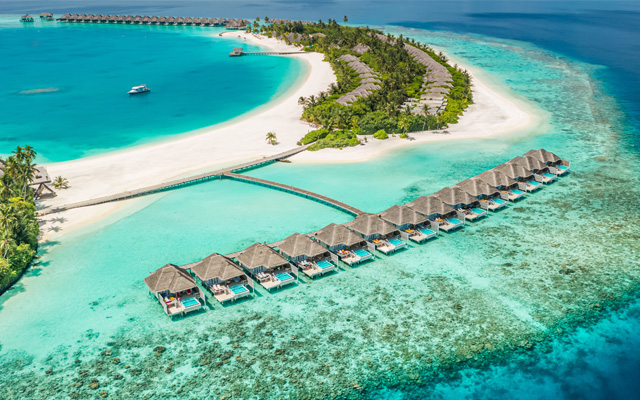
The Maldives is moving to diversify its tourism model with proposed amendments to the Special Economic Zones (SEZ) Act, introducing a new category of Sustainable Townships. These large-scale developments will integrate hospitality, residential real estate, healthcare, education, and renewable energy infrastructure to attract high-value, long-term investment and complement the traditional resort model.
The initiative aims to create opportunities in premium real estate tourism, wellness, and education while generating employment across multiple sectors.
Maldives’s new SEZ reforms aim to diversify tourism with large-scale, eco-integrated developments blending hospitality, housing, health, and education
For more than 50 years, tourism has been central to the Maldives’ economy. The SEZ reforms mark a move toward a new phase of development that links sustainability, innovation, and investment to support long-term growth and resilience. The shift beyond the resort model reflects a broader effort to diversify the economy and align with changing global demand for lifestyle, wellness, and integrated tourism experiences.
Only projects exceeding US$500 million will qualify, ensuring focus on high-impact developments. Developers will receive time-bound incentives, including a five per cent income tax rate for the first 10 years and 10 per cent for the following decade. A real estate transfer tax will start at one per cent for the first transaction, rising to four per cent by the third. Other taxes, including Green Tax, GST, and land lease rent, will remain applicable.
To qualify, projects must include education and healthcare facilities, renewable energy components, and food security initiatives. Linking incentives to these priorities ensures investments contribute to national goals such as sustainability, skills development, and energy transition.
The SEZ amendment also introduces a rules-based framework defining eligibility, investment thresholds, and project criteria to improve transparency and investor confidence while encouraging innovation and measurable socio-economic benefits.
Globally, tourism is shifting toward integrated, mixed-use developments that combine leisure, residency, wellness, and education. The Maldives’ Sustainable Township framework is designed to complement its resort industry, adding new revenue streams and strengthening market resilience.
Aligned with Vision 2040, the reforms support economic diversification, social development, and environmental sustainability. Integrated projects that meet these objectives will enhance infrastructure and build domestic capacity.
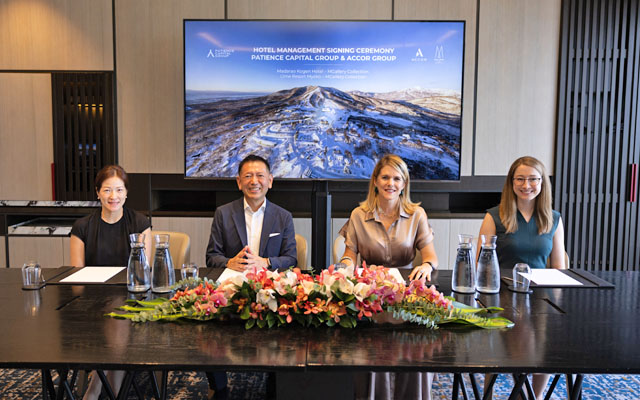
MGallery, Accor’s boutique collection of storied hotels, has signed Madarao Kogen Hotel and Lime Resort Myoko in Japan. Both properties form part of a strategic partnership with Patience Capital Group, a real estate and private equity firm with tourism-related investments across Japan.
Madarao Kogen Hotel – MGallery Collection is located on the slopes of Mt Madarao in the northern Japan Alps, an area famed for its powder snow and 15 official tree-skiing courses, the most of any resort in Japan.
From left: Patience Capital Group’s Maryanne Soo and Ken Chan, and Accor’s Agnès Roquefort and Carrie Oswald
The property will undergo a comprehensive transformation and is expected to reopen in late 2027 with 80 rooms, multiple dining options including a Ski Diner at the ski run crossroads, a lobby lounge, a destination pool bar, conference facilities, onsen baths, shops, and ski services.
Lime Resort Myoko – MGallery Collection sits near the base of Mt Myoko within Myoko-Togakushi Renzan National Park. Known for heavy snowfall and long ski runs, the resort will be transformed into a wellness-focused destination with 38 rooms, dining venues, onsen facilities, a fitness area, and a kids club. It is scheduled to open in Winter 2026.
The two resorts, located 30 minutes apart, will be linked by a dedicated shuttle service and connected to Patience Capital Group’s regional leisure assets, including Myoko Suginohara Ski Resort and Nagano Dunes Golf Club. Guests will have access to year-round activities such as skiing, hiking, cycling, and forest bathing. Both properties are approximately three hours’ drive or two hours by train from Tokyo. Renovations will prioritise sustainability, using local materials and energy-efficient technologies while respecting the natural landscape.
MGallery’s expansion in Japan follows the 2024 opening of Hôtel Sosei Sapporo – MGallery Collection. These signings mark the second and third MGallery addresses in Japan, reinforcing the brand’s commitment to authentic, story-driven luxury experiences in iconic natural settings.
“Madarao Kogen Hotel and Lime Resort Myoko joining MGallery Collection represents a new chapter for our collection in Asia… combining authenticity, sophistication, and well-being in one of the country’s most inspiring destinations,” said Maud Bailly, CEO Sofitel Legend, Sofitel, MGallery & Emblems.
“Our partnership with Accor reflects our shared belief in the long-term potential of mountain tourism in Japan. We aim to redefine the standard for four-season resort living,” added Ken Chan, founder, CEO and CIO of Patience Capital Group.
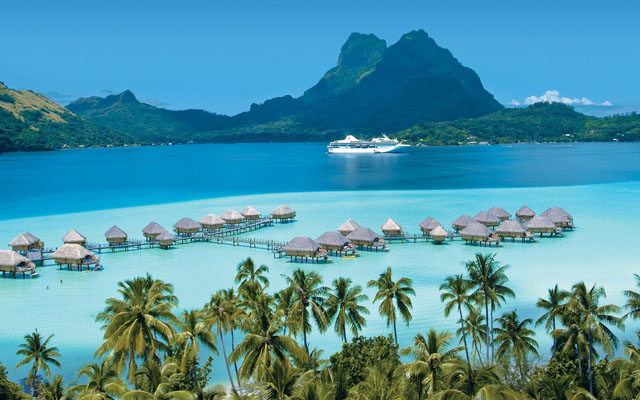
Ponant has expanded its partnership with The Explorers Club to include Paul Gauguin Cruises and Aqua Expeditions from late 2026, reinforcing Ponant’s commitment to educational enrichment across its cruise brands.
The collaboration, first introduced on Ponant Explorations in 2024, brings expert-led voyages to all three cruise lines within the group.
Ponant sails through Bora Bora as its partnership with The Explorers Club broadens to new horizons in exploration and discovery
The Explorers Club, with its 120-year legacy in field research, science and conservation, will feature scientists, filmmakers, authors and photographers on select expeditions.
The Explorers Club voyages on Paul Gauguin Cruises and Aqua Expeditions will begin in the winter 2026-2027 season, with two departures aboard the M/S Paul Gauguin and four on Aqua Expeditions. Ponant Explorations will also offer more than 15 voyages in 2026 and 2027, featuring guest speakers such as mountaineer Peter Hillary and filmmaker John Heminway.
Each voyage will include lectures and discussions led by Explorers Club members, along with opportunities for guests to join citizen science projects, particularly aboard Le Commandant Charcot, which hosts research teams in its onboard laboratories.
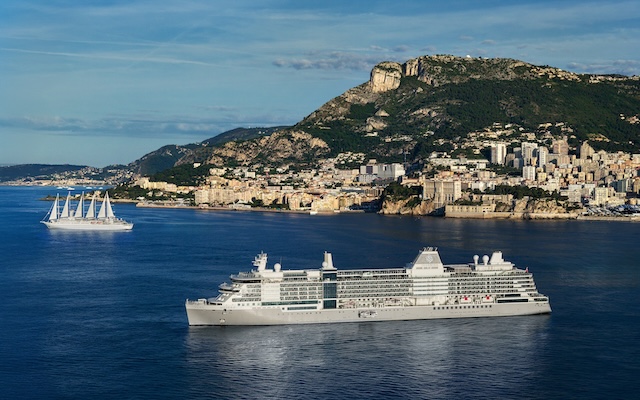
Silversea offers nearly 300 voyages to the Mediterranean, from the Iberian Peninsula to the Adriatic Coast
Dive into a region that takes its living seriously. Small ports and big cities. World-renowned food and World Heritage Sites. Fast-paced events and la dolce vita.
Welcome to Silversea’s home and heritage. To a timeless treasure chest of art, history, and architecture. To a renaissance of culture that revives your soul as you roam charming cobblestoned streets, seaside villages, and hidden islands. Uncover hundreds of UNESCO World Heritage sites and countless wonders beyond the beaten path. Journey through a living anthology, from the secluded corners of Seville and Salerno to the enchanting waters of the French Riviera and the Grecian Isles. Embrace the romance of La Dolce Vita as you discover remote ports and rediscover iconic cities. Here’s to your Mediterranean awakening. To the beauty of tradition, the diversity of culture, and the complexity of flavour. To experiencing it all with unrivalled access – and ‘To Finding More’.
The regions we call home
Cultural context is the essence of meaningful travel. Building on 30 years of experience and relationships throughout the Mediterranean, Silversea navigates this ancient sea with pride and purpose, connecting you to its roots and immersing you in its stories.
Celebrate local life from the Atlantic Isles to the Cyclades; from Italy to Iberia; and from the Turquoise Coast to the Côte d’Azur. Wander Morocco’s buzzing medinas, Malta’s limestone citadels, and Montenegro’s alpine trails. Vineyards beckon you to linger along the Italian Riviera and through the Azores. Feel the pull of lore and legend, the centuries of tradition unfolding across technicolour villages and citrus-scented cities. This is the Mediterranean as it was meant to be – unhurried, authentic, and transformative.
Linger longer, delve deeper
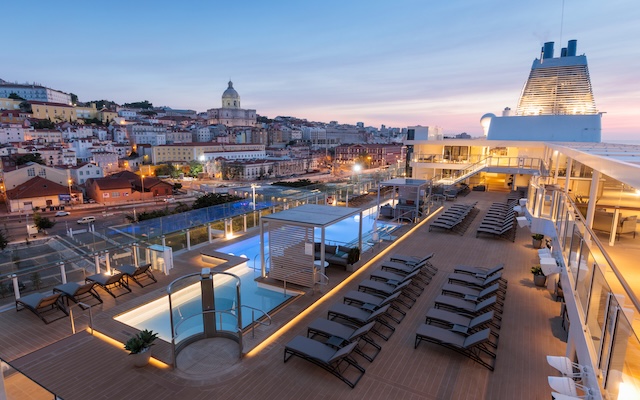
Soak in the sweet views of coastal Mediterranean cities as you sail past in comfort
From the Iberian Peninsula to the Adriatic Coast, Silversea’s itineraries reveal the authentic nuances and cultured traditions of each region with more overnights and longer stays in port. This means more time to wander quaint villages and experience nightlife in iconic cities, whether you’re on a seven-day voyage or a 55-day journey.
Explore hidden wonders
Silversea’s ships take you to the places that most miss. Cherish immersive experiences in smaller port cities like Saint Tropez and Portofino. Enjoy unique access to the heart of Seville and Valletta. And discover destinations exclusively visited by Silversea. Every journey brings you closer to wonders found along routes less travelled.
Discover the magic of the off season
Between October and March, the Mediterranean reveals its most authentic self. Locals reclaim beloved cafés, museums breathe with newfound space, and seasonal festivities inspire connection. Experience iconic landmarks, unobscured by summer crowds, and relish moments of tranquillity in the cradle of civilisation.
Savour culinary adventures
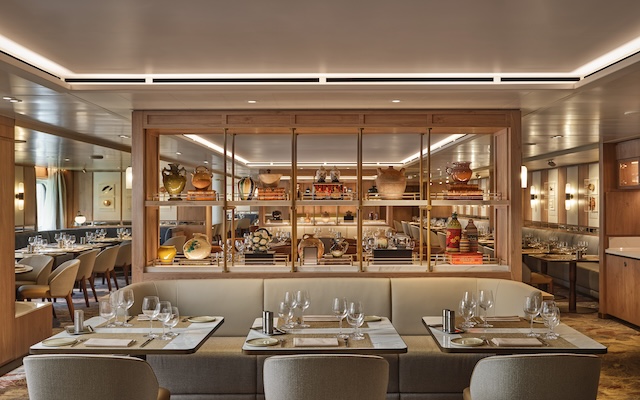
Salt Kitchen on Silver Moon
Embark on a culinary journey through the Mediterranean with our S.A.L.T. programme, which offers a range of enriching experiences on board and ashore. Taste your way across coasts at the tables of renowned chefs, local farmers, and the finest restaurants at sea. Discover the cultural identity of each region through the language of food.
Unrivalled ships, unforgettable experiences
Explore infinite possibilities with your choice of seven intimate ships – each designed to take you to the heart of iconic cities and along the shores of remote islands. With an industry-leading standard of more space and crew per guest, Silversea ships deliver the perfect blend of intimacy, immersion, and impeccable service. From lavish restaurants to laid-back lounges, our onboard venues allow you to relax, connect, and indulge in all your favourite ways. Expect to be pampered from the moment you step on board as our butlers tend to your every need, preparing you for the wonders to come.
With nearly 300 Mediterranean voyages to choose from, the world truly is your oyster. For further information, visit Silversea.com
Hilton has appointed Tal Shefer as senior vice president of brand management, Asia Pacific, overseeing the company’s brand strategy across the region.
He will lead growth across Hilton’s portfolio, including its expansion in the luxury and lifestyle segment from over 160 to more than 250 trading properties in the coming years.
Shefer brings more than 20 years of experience in hotel management and brand operations, having held leadership roles across Europe, the Middle East and Africa. Most recently, he was vice president of brand operations, EMEA, where he managed hotel openings and transitions, established a hotel openings structure, and oversaw the onboarding of over 500 Small Luxury Hotels of the World properties globally.



 In Asia-Pacific’s vibrant travel scene, payments are becoming as much a part of the journey as airports and attractions, with 60 per cent of South-east Asian consumers preferring to go cashless.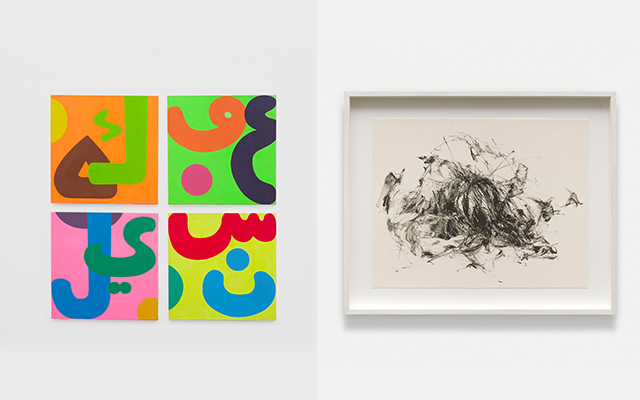





 Shefer brings more than 20 years of experience in hotel management and brand operations, having held leadership roles across Europe, the Middle East and Africa. Most recently, he was vice president of brand operations, EMEA, where he managed hotel openings and transitions, established a hotel openings structure, and oversaw the onboarding of over 500 Small Luxury Hotels of the World properties globally.