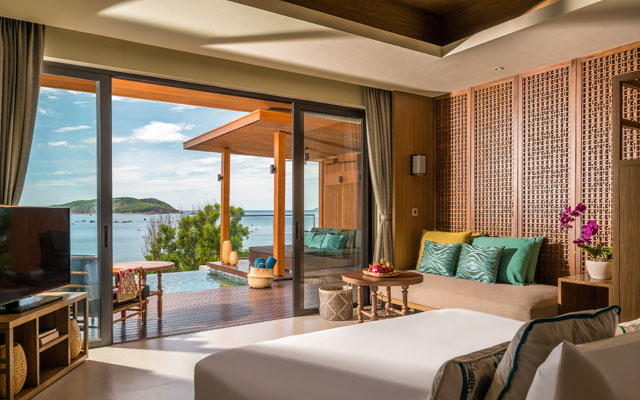
Minor is doing up a train carriage to transport guests from Anantara Quy Nhon Villas (pictured) to Anantara Hoi An Resort
Minor Hotels has bought a train carriage from the Vietnamese state-owned railway, with which it hopes to reimagine transportation between two Anantara resorts in a marriage of old-timey romance and modern-day comfort.
Mark Thomson, spokesperson for Minor Hotels, recalled that he had tried to travel from Quy Nhon to Hoi An by train, thinking “it will be the most romantic experience”, but this did not quite hit the mark.
Minor is doing up a train carriage to transport guests from Anantara Quy Nhon Villas (pictured) to Anantara Hoi An Resort
The Thailand-based hotel group now wishes to take the rail experience into its own hands, Thomson said on the sidelines of ILTM Asia Pacific.
“We still like the idea of train travel; it (strikes us as) quite romantic”, mused Thomson. “And so we approached the state railway asking if we could buy a carriage.”
Minor’s vision of glamorous rail travel from Anantara Quy Nhon Villas to Anantara Hoi An Resort could soon become a reality, with its own spruced-up carriage set to hit the tracks in July, according to Thomson.
The carriage is now in late stages of being decked out to “five-star standards”, complete with spa therapists, mixologists, lounge areas and more, he added.
More details including the carriage’s capacity will be announced at a later time. Thomson hinted that the carriage will be towed behind a public train along a fixed route from Quy Nhon before Minor guests break away en route to Anantara Hoi An Resort.
It remains to be seen if Minor’s touch of ingenuity will offer a more seamless and fuss-free way to travel between Quy Nhon and Hoi An compared to domestic flights.
But suffice to say, if this materialises, hotel guests will be introduced to another layer of the Anantara treatment and extra reason to pair the brand’s resorts during their visit to Vietnam.
The experience of travelling out of Quy Nhon by train could also help preserve parts of the quaint charm associated with the destination for Anantara guests, before this eventually gets chipped away by mass market tourism.
“We brought Anatara to Quy Nhon, which I believe is one of the last untouched parts of Vietnam that is not touristy. Today it has stunning beaches and the charming countryside. But this is going to change completely. In two or three years, there will be a new international airport, which I think will ruin (the destination’s charm).”
Japanese birdwatchers began arriving in Cagayan to see the grey faced buzzard
Birdwatching is the new tourism product of Cagayan in northern Philippines, thanks to the interest elicited by grey-faced buzzards that migrate from Japan to escape winter.
The town of Sanchez Mira in Cagayan is part of the flyway of grey-faced buzzards. When assistant tourism secretary Robby Alabado, an avid birder, referred Alex Tiongco, head of Raptorwatch Network Philippines to the Department of Tourism Region 2 (that includes Cagayan) in January last year, a group of some 20 Japanese birders immediately visited.
Japanese birdwatchers began arriving in Cagayan to see the grey faced buzzard
Two groups from Japan visited Sanchez Mira last year and another two this year, said Virgilio Maguigad, regional director of tourism for Region 2 at the sidelines of the PATA Annual Summit held recently in Cebu City.
The groups are composed of birders, academicians and scientists, both males and females, young but mostly older persons keen on watching the migratory birds, monitoring their numbers, learning more about them, and intent on conserving the species and their habitats.
Maguigad said bird-watching is a good fit for Cagayan because it involves small communities and is not a mass tourist activity.
The birders stay from one week to two weeks and include another region, the Ilocos, in their itinerary. Itineraries have been prepared for the birders including a side trip to indigenous communities in Cagayan.
And as people became aware of the tourism potential of birdwatching, they stopped hunting the raptors.
Feedback from Japanese visitors is that the practice of hunting grey-faced buzzards has decreased significantly and that they had never seen a change in people’s behaviour so fast.
Cagayan is currently stitching together several tourism circuits, including birdwatching, to attract tour operators to come on board and sell them as tour packages.
Alabado said the Philippines is one of the best places in the world for grey-faced buzzard watching because they can be seen by the hundreds in trees, unlike in Japan where they are hidden in mountains or nesting.
He was hoping that eventually other nationalities too will be drawn to the Philippines because there are also other raptor species migrating from Taiwan. Their flypath includes various points in the Philippines, Malaysia and Indonesia.
Alabado said the Philippines has many varieties of raptors including the Philippine eagle as well as the Philippine falconet, which can only be found in the country, as well as many species of endemic birds and a number that migrate from temperate countries.
The interest in raptors has led to the holding of the first International Summit on Grey-Faced Buzzards on May 25-26 in Japan’s Tochigi prefecture. The second summit next year will be in Miyako Island in Okinawa while the third will be hosted by Sanchez Mira in 2021.
The latter will coincide with the 500th year of Ferdinand Magellan’s circumnavigation of the world from Spain to the Philippines which will mean hefty marketing and promotions.
Gilmore: Singapore ideal when considering air links, visa regulations and ease of getting from hotel to venue
Staking its claim as the premier B2B luxury travel event in the region, ILTM Asia Pacific last week returned to Singapore “100 per cent bigger” than its inaugural edition, with a heightened stringency in buyer sourcing and matchmaking earning the satisfaction of many attendees.
The second ILTM Asia Pacific hosted 572 buyers from across the region, who took part in 30,422 one-to-one, pre-selected meetings. Apart from the standout market of New Zealand – from where the organisers reported 133 per cent increase in buyers – growth was also seen from Australia (nine per cent), South Korea (21 per cent), Malaysia (33 per cent), New Zealand (133 per cent) and the Philippines (38 per cent). First-time agents from Bangladesh, Moldova, Armenia and Belarus were also in attendance.
Gilmore: full schedules, tight business matching
Quiet aisle, quality business
The absence of idle crowds, or any crowding at all, was a common observation of attendees at this year’s show.
Alison Gilmore, head of ILTM said this is every bit what was intended, and the outcome of stringent scheduling and matchmaking.
“The aisles should be clear,” Gilmore remarked. “It’s a military operation. Everyone comes here to work and do business. We make sure everyone has a diary full of appointments, otherwise they would not be allowed to enter the show.”
While ensuring suppliers get face-time with a stream of qualified buyers, the organisers also want to present buyers with diverse luxury travel products. “Some clients will only stay in a Ritz. Others will want something off the beaten track. We need to give them a palette of different products and services.”
While it may be a tall order for smaller suppliers to take up booth space, Gilmore is upbeat about their continued presence in subsequent shows, whether it be standalone or as part of representation companies or NTO-led delegations.
“If you’ve got just two villas or seven rooms (citing the example of two exhibitors at this year’s show), it’s a big investment. You’ve got to sell a lot of rooms to get your money back. The fact that we have these people exhibiting here means we’re doing something right for them. Some of them have returned, which says to us that they are getting their ROI,” she added.
It’s a match
Extra steps were taken this year in the area of buyer sourcing and matchmaking, all going towards maximising quality and conversion. “There are more millionaires here in Asia than ever before. There are also lots of buyers out there, many with a certain level of quality. It’s about finding them.”
For this year’s edition, ILTM hired an expert in the Asian travel trade to deepen buyer engagement. “He has been able to find new buyers. With a real track record in the luxury travel trade and knowing all the agents, he’s a little diamond and a great asset,” Gilmore said. “He has helped not only to weed out (rogue buyers or those he knows to not convert), but also get on the phone with registered buyers when they’ve not made their appointments.”
It seems the rigour and expertise that went into this year’s show are paying off. In its own press release, ILTM Asia Pacific cited examples of satisfied attendees. One of them, Ninna Haflidadottir of Iceland Luxury, said: “We received good bookings and increased interest in our destination as a direct result of attending ILTM last year. This year the meetings have taken it to another level.”
As well, Jeannie Yom of The London West Hollywood told ILTM: “This is our first time at ILTM Asia Pacific and we are really meeting clients that matter. ILTM is very specific in marketing to both suppliers and buyers, matching decision makers with decision makers and I received booking requests while I was sitting at the show. This is one show you have to be every year.”
“Last year was excellent but ILTM Asia Pacific is a much better quality show again. All my clients have had a full agenda of very qualified appointments and a lot of genuine interest. We’ll be back bigger and better next year!” said Christine Galle-Luczak of Heavens Portfolio.
Developing a life of its own outside China
Looking back on the decision to carve up an 11-year-old show in China into two separate regional editions, Gilmore said taking that step is “absolutely the right strategy”.
“China is culturally very different. Consumers have different travel habits and travel agents buy differently. You could have a 24-year-old booking travel for his four friends and bring in millions to the supplier, which is not typical elsewhere in Asia. There are such big differences, and we are happy we now get to focus on what works in each show,” she said.
This year, the show in Singapore received just 20 Chinese buyers out of all 572. The plan is to bring this number down to zero over time, to continue to cater to the different sub-regional strategies of suppliers in a more targeted way.
“This is just the start. We’re only in our second year,” said Gilmore. Going forward, she plans to bring back The Retreat and keep the conversation going with buyers and suppliers. “We will continue to be guided by what buyers and suppliers want. This year, New Zealand was the No. 1 top requested buyer market from our suppliers. We went out and got those buyers. If our suppliers feedback that they want Vietnam buyers next year, that’s where we’ll be looking.”
ForwardKeys’ analysis of Chinese outbound travel in the first four months of this year revealed a 12.7% growth in FIT.
“The growth was extraordinary, given the ongoing trade tensions, currency inflation and a slowing economy,” remarked Olivier Ponti, vice president, Insights at ForwardKeys.
The strong performance is being fuelled by Shanghai, where FIT outbound bookings for a trip between May and August are 22.4% ahead compared to the same period in 2018; Guangzhou, where they are 28.7% ahead; and 11 second-tier cities which are collectively 25.8% ahead.
Chinese FIT to Europe on the up
The trends were particularly marked during the Chinese New Year, at the end of January and early February, which is the busiest time for Chinese outbound travel, accounting for around three quarters of total international air departures during the first three months of 2019.
Chinese FIT outbound travel grew by 18.8% during 2019’s Chinese New Year holiday, compared to the equivalent holiday period in 2018.
FIT travel has also surged – and is set to surge – over recent and upcoming public holidays, Qingming on April 5, Labour Day at the start of May and the Dragon Boat festival on June 7-9.
“The way the Chinese government has allocated public holidays has created more opportunities for people to take breaks abroad. For example, in 2019, the Labour Day holiday has been extended from one day to four days, May 1-4, for 2019, which means that, this year, Chinese travellers can take three days of paid leave and enjoy an eight-day vacation,” Ponti observed.
An increase in seat capacity has also helped to fuel the growth in travel to Europe. For example, between January 1, 2018 and June 30, 2019, seat capacity from China to London increased by 24.8%, compared to the equivalent period a year before, thanks to the addition of nine new routes.
Capacity to Paris increased 8.1%, thanks to five new routes and capacity to Rome increased 31.7% from one new route.
In 2Q2019, 88 flights per week are scheduled between China and the UK, up from 65 weekly flights in 2Q2018. And there is more to come, as bilateral trade agreements provide for further capacity growth from China to the UK, France and Italy.
Meanwhile, Ponti catutioned: “It is important to notice that trends can vary significantly from one year to the other and marketeers can’t just repeat what they have done the year before. Destination popularity can be heavily influenced by currency fluctuations and by immigration rules.”
This year, a few countries have eased their visa regulations in a bid to attract more Chinese visitors. For example, Ukraine has introduced an e-visa from January 1.
Singapore now allows Chinese travellers to enter visa-free for up to 96 hours, either on the way to a third destination or on the way back home. Japan has also further simplified the visa application process for Chinese students and repeat visitors.
Alipay has entered its first deal to integrate mobility solutions, partnering UK mobility startup, Splyt Technologies, to give Chinese travellers in-app access to a global ride-hailing inventory.
Chinese tourists are now able to hail taxis on demand when overseas through Alipay, without having to download a new app.
The Splyt platform, which reaches 1.5 billion users in over 50 countries and territories, will provide Alipay users access to its network of transport partners in over 1,000 cities.
At launch, Alipay users from mainland China are able to use mobility services from Splyt partners in the UK, the UAE and South-east Asia, with further coverage across the globe being rolled out later this summer.
All payment is processed in the user’s preferred currency. In addition to 24/7 customer support, an in-app chat function is available to help passengers communicate with drivers even if they don’t speak the same language.
“Consumers don’t want 100 different apps – they want tools that make their lives easier,” said Kiki Wu, director of business development, cross-border business, Alipay.
“This brand-new taxi hailing mini programme makes it possible to search, book and pay for taxi rides in our users’ native currency. Partnering with Splyt gives us unparalleled access to a roster of transport providers across the world that will make getting around when travelling easier.”
Infini's Kimio Uemura (left) with Sabre's Todd Arthur
Infini has been appointed the official distributor of the Sabre Global Distribution System (GDS) in Japan.
The Tokyo-headquartered ticketing and reservation system will now market and sell the Sabre GDS in Japan alongside the Infini distribution product.
Infini’s Kimio Uemura (left) with Sabre’s Todd Arthur
This agreement also gives travel agents across the market access to Sabre’s technology solutions that enable the delivery of compelling offers to travellers, provide access to a rich, global travel marketplace, and generate a more seamless customer experience.
With travellers to Japan numbering nearly 32 million in 2018, Infini has been supporting local travel agencies and OTAs as they expand their global footprint.
The new agreement with Sabre extends Infini’s portfolio to also include global functionalities that will provide solutions to agents with international customers.
WHY
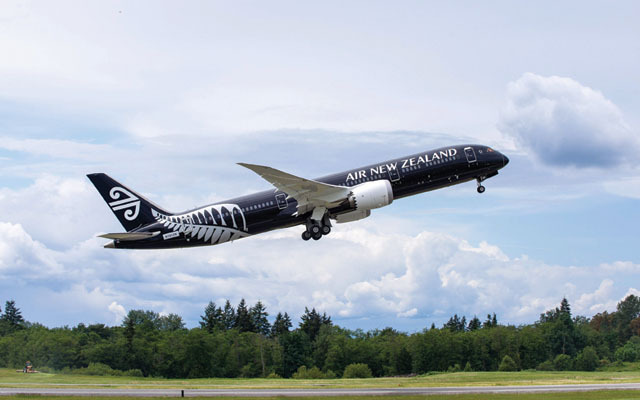
Air New Zealand was the first airline to fly the Boeing 787-9 Dreamliner aircraft in 2014. In 2017, Air New Zealand refreshed the cabin configuration by adding more seats to its two top classes in response to greater demand for these categories, particularly among longhaul travellers. The carrier’s Dreamliner planes now boast 27 business premier seats (up from 18) and 33 premium economy seats (up from 21).
Operating a daily service between Singapore and Auckland, the airline will launch seasonal flights to Christchurch from Singapore with the newly configured Dreamliner aircraft in December 2019.
WHAT
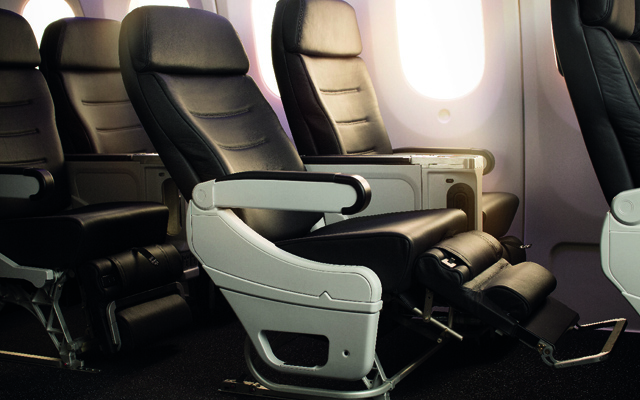
Air New Zealand offers four classes on board the B797-9 Dreamliner. The business premier features fully lie-flat beds, while premium economy seats are arranged in 2-3-2 configuration with a pitch of 41-42 inches and a nine-inch recline. The seat is 19.3 inches in width and five-inch wide armrest.
The economy class has a 3-3-3 configuration. The seat is 17.2 inches wide with a pitch varying between 31 and 33 inches, and a five inch recline.
The aircraft also features the Economy Skycouch, which is a row of three economy class seats turned into a couch after take-off. These seats are located on the left and right sides of the cabin.
HOW
Flying in premium economy, my black leather-upholstered seat was comfortable, offering ample space to stow my handbag and laptop under the seat in front of me. The stretched footrest allowed me to rest my petite feet throughout the flight.
The lower cabin altitude, large windows and wider aisle also gave the aircraft a more spacious feel.
I like the fluffy bedroom-sized pillow, which supported my head nicely when I adjusted the seat to its maximum reclining position for sleeping.
The personal touch screen in widescreen format serves both as an inflight entertainment device and an assistant. All information, whether it’s a tutorial on maximising our seats, flight details, weather at destination, cabin crew call button and personal light button, are located on the screen.
Air New Zealand’s inflight entertainment menu features over 1,700 hours of content, including latest movies, TV box sets, video, games and a dedicated kids’ selection.
During my evening flight to Auckland, I watched Aquaman during the first few hours of the meal service period and used the rest of the flight to sleep. My return flight, however, was a day flight so I could enjoy more films and some music.
In-flight entertainment does not have to be enjoyed alone on this flight. I had the option of enjoying the entertainment with company, simply by touching the Screen Share button. The Seat Chat button allowed me to chat with my fellow passenger on board.
A handheld remote is tucked beneath the armrest, while a power point and USB connection are also available to charge my gadgets.
The meals on board were fresh, tasty and generous in portion. I ordered diabetic meals and the catering team was creative in turning the limited variety of ingredients into tantalising meals.
Besides the two meals and a snack offered, passengers can also order crackers and cookies anytime during the flight. Wine lovers can also enjoy the wide range of quality New Zealand wine selections from the inflight cellar.
VERDICT
A business premier seat would be an ideal choice for a longhaul flight, but Air New Zealand’s premium economy does not pale in comparison, especially when it comes to the perks. Travellers get priority check-ins, free standard seat selection, two pieces of carry-on baggage for up to 7kg each and two pieces of checked baggage for up to 23kg each. Onboard, travellers also get an amenity kit with toiletries and comfort items inside.
Thale Noi in Phattalung province one of the 'rising stars' TAT wants to promote
Thale Noi in Phattalung province one of the ‘rising stars’ TAT wants to promote
As the number of international tourist arrivals into Thailand surged past 38 million in 2018, the South-east Asian tourism heavyweight is seeing a greater urgency to encourage travellers to visit lesser-known parts in the country to take pressure off travel hotspots and spread tourist revenues to smaller destinations.
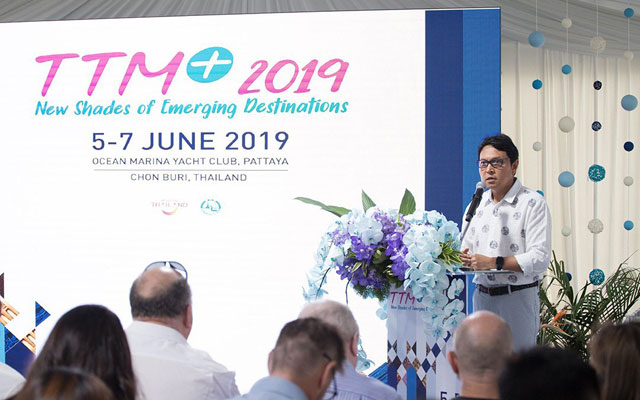
The Tourism Authority of Thailand (TAT), which finally removed arrival numbers from its annual target last year, again reiterated a “quality over quantity” focus for its international marketing strategies at the Thailand Travel Mart Plus (TTM+), which is currently taking place in Pattaya’s Ocean Marina for the second consecutive year.
Speaking at the TAT media briefing on the opening day of TTM+, TAT deputy governor for marketing communications Tanes Petsuwan said: “We are seeking a balance between quality versus quantity, marketing versus management… We are trying very hard to move Thailand from a mass to niche tourism destination.
Tanes: TAT ‘trying very hard’ to move Thai tourism from quantity to quality
“We are putting an emphasis on responsible tourism. The key is to manage numbers and create a higher level of environmental consciousness among the industry,” Tanes stated.
With sustainable tourism as its overarching goal, TTM+ 2019 is themed Open to New Shades of Emerging Destinations to put the spotlight on 55 provinces across Thailand, aligning with TAT’s marketing message of spreading international visitor footfall as well as revenue from major destinations to secondary destinations in the country.
According to Tanes, TAT’s emerging destination focus has reaped positive results, as the 55 provinces recorded six million trips in 2018, up 4.9 per cent from the year below.
Looking ahead, TAT is adopting the “ABC strategy” for its emerging destinations push, namely:
Additional (A), linking up major destinations with neighbouring emerging cities such as Chiang Mai and Lamphun and Lampang in the north, or Pattaya with Chanthaburi and Trat in the Eastern Seaboard;
Brand-new (B), promoting popular emerging cities with its own strong identity and positioning. A key example is Buriram, a province rich to strong Khmer heritage and is also up-and-rising global sports events destination with the launch of Chang International Circuit and MotoGP race;
Combine (C), co-promoting emerging cities with shared history or proximity, like bundling ancient Thai civilisations and kingdoms Sukhothai with Phitsanulok and Khampaeng Phet or Nakhon Si Thammarat together with Phattalung in a historical route.
In particular, Tanes also singled out Thale Noi, in Phattalung province in Thailand’s south, as “a rising star that TAT wants to promote”. Other emerging destinations rising in prominence are Chiang Rai, Trat, Sukhothai and Nong Khai, which are favoured among the Chinese, German, French and Laotian markets respectively.
But wouldn’t an emerging destination tack, besides spreading visitor footfall and revenue, also bring a host of issues such as visitor surge and congestion to smaller destinations, TTG Asia asked.
In response, Tanes didn’t deny the difficulty of maintaining the quality-quantity balance in emerging destinations, but he stated that TAT’s 29 offices worldwide and 49 domestic offices are “working closely to find the perfect match between the market and city”, and has also “invested in a lot of data and information to match demand and supply”.
Chiravadee Khunsub, TAT’s director of UK, Ireland & South Africa, shared that the UK market is particularly interested in culture and beaches, hence emerging destinations including Chiang Rai in the north, and Chumphon and Ranong have been promoted to this particular market.
Shwezigon Paya, a Buddhist temple located in Nyaung-U, a town near Bagan
Myanmar’s travel trade has welcomed a move that will see six longhaul source countries granted visa on arrival (VoA), but claim more needs to be done to have a major impact.
From October 1, visitors from Italy, Spain, Russia, Germany, Switzerland and Australia will be allowed to enter the country via Yangon, Mandalay and Naypyidaw international airports, as well as some land crossings, for US$50.
Shwezigon Paya, a Buddhist temple located in Nyaung-U, a town near Bagan
While the industry has welcomed the relaxation in restrictions, member say additional efforts are essential.
Melissa Tan, Khiri Myanmar general manager, said: “It sends the message of Myanmar being very welcoming to European markets.”
However, she added these nations can currently apply for an e-visa, which is approved with email confirmation within less than an hour and costs the same.
Said Tan: “From the DMCs’ point of view, there is little difference as we have been, and will still, encourage guests to get e-visas before flying.”
Sammy Samuels, Myanmar Shalom Travels’ managing director, said the VoA should stimulate “some” growth, adding every year marketing towards European markets is increasing.
He said: “VoA is not key to recovery, but it is a very good initiative and we do hope to see visa-free entry given to some western countries that would attract more travellers.”
While “something is better than nothing”, Hla Aye, managing director of Shan Yoma Travel & Tours, thinks more direct flights from Europe are necessary.
Tan added more regional flights are also needed, with many European visitors travelling to South-east Asia missing out Myanmar due to limited connectivity.
“We’re connected to large destinations like Thailand and Vietnam, but not smaller ones like Cambodia or Laos. The majority of trips we book from Europe to the smaller nations do combine a larger South-east Asian country, but we often miss being considered entirely by not having direct flights.”
As well, Bertie Lawson, Sampan Travel managing director, believes high prices remain a barrier. “The high prices of domestic flights and other transport and activities are larger stumbling blocks. In many aspects, Myanmar remains more expensive than its neighbours, and this is problematic for many would-be visitors.”
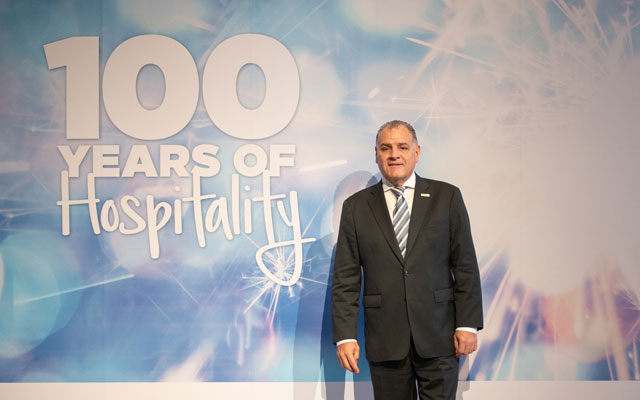
Hutton talks Thailand pipeline at Hilton's 100th anniversary event
Hilton is launching two new brands, Canopy and Hilton Garden Inn, into the Thai market to capitalise on tourism growth particularly in the lifestyle segment.
Scheduled to open its doors in 2022, the Canopy by Hilton brand will be located in Bangkok’s Sukhumvit area, with 176 keys, marking the brand’s second property in South-east Asia after Kuala Lumpur.
Hutton talks Thailand pipeline at Hilton’s 100th anniversary event
Hilton Garden Inn will open on the bank of Chao Phraya River, near the new luxury mall IconSiam, with 244 rooms.
Speaking to TTG Asia, Paul Hutton, vice president operations South East Asia, said bringing the Canopy by Hilton brand into top travel destination like Bangkok would help capitalise on the lifestyle segment, which has been increasing in Bangkok in recent years.
As part of the Canopy brand, a special team of enthusiasts will bring guests to explore unique local experiences in the areas such as food and drinks, art, shopping and running paths.
Hilton Garden Inn will offer customers an all-day-dining restaurant, fitness facilities, rooftop bar as well as meeting rooms.
“Thailand is a tremendous (successful) destination for tourism as arrivals keep increasing and it still has opportunity for further expansion. The quality of our airports and accessibility, as well as good infrastructure will drive growth,” he added.
The American hotel company also has five other projects in the pipeline and expects to start management within next three to five years.
Once all pipeline hotels open, Hutton said Thailand will become Hilton’s biggest South-east Asian market with the strongest brand presence – offering six brands in total.
Currently, Hilton manages 11 properties with over 3,000 rooms in total under four different brands – Waldorf Astoria, Conrad, Hilton and DoubleTree by Hilton. In the future, the group will be launching Curio Collection by Hilton into the region.
Regionally and beyond, the group operates hotels in nine markets: Indonesia, Malaysia, the Maldives, Myanmar, the Philippines, Singapore, Sri Lanka, Thailand and Vietnam. The group will soon be entering into two new markets, Lao and Timor-Leste.
Correction: This article earlier stated that the upcoming Canopy and Hilton Garden Inn properties in Thailand will be the biggest of both brands – that is incorrect. Thailand will hold the biggest brand presence within South-east Asia for Hilton when all pipeline hotels open. As well, Hilton does not have an existing pipeline in the destinations of Chiang Mai, Chiang Rai, Krabi and Rayong. The story has been updated to reflect that.