TTG Asia
Asia/Singapore Sunday, 14th December 2025
Page 1198

Airbnb keen to engage in dialogue as it tackles regulatory challenges

0
Blecharczyk: Airbnb keen to work with local regulators

Amid regulatory issues it faces in different parts of the globe, Airbnb is keen to work with local regulators to thrash out the issues and grey areas, according to its co-founder and chief strategy officer, Nathan Blecharczyk.

“Short-term home rentals are here to stay and of course there should be guidelines… and that is something we strongly recognise too,” said Blecharczyk during the PATA Annual Summit in Cebu City last Friday.

Blecharczyk: Airbnb keen to work with local regulators

“Every municipality and countryside has to draw the line”, and with issues in Asia vastly differing from Europe, for instance, Airbnb is very much keen to engage in dialogue, he added.

The sharing economy is a “new paradigm, (so) there are some bumps” but “overall it is going more smoothly” for Airbnb as it achieved global scale.

Blecharczy cited Airbnb’s experience in Japan where it had a tough period of transition a year ago but the country is now one of its fastest-growing markets. It is understood that Japan required Airbnb hosts to register their properties and limited home sharing to a certain number of days per year.

[tough period: https://www.ttgasia.com/2018/06/11/majority-of-airbnbs-japan-listings-frozen-ahead-of-new-rental-law/]

Blercharczyk, who is also the chair of Airbnb China, said it is now the biggest homesharing platform in China, with the domestic market making up a majority of demand although it started mainly for China outbound homeshare.

[Airbnb China: https://www.ttgasia.com/2017/03/29/inshare-airbnb-doubles-down-on-china-as-aibiying/]

Commenting on Airbnb’s strategic investments including buying into Oyo, Blecharczyk explained: “There is so much happening in the industry right now, so many new models emerging and there is basically a new ecosystem emerging and within that ecosystem, new alliances emerge”.

[buying into Oyo: https://www.ttgasia.com/2019/04/03/oyo-confirms-airbnb-deal/]

He also noted the “interesting trend” of hospitality groups like Marriott International moving to offer apartment-like accommodations and more entrepreneurs joining the fray. “All of these are emerging in new interesting ways and of course we want to be a platform that set them off”.

[offer: https://www.ttgasia.com/2019/04/30/marriott-officially-checks-into-home-sharing-business/]

Notably, Airbnb will soon expand into the “flights space”. “It’s going to be something about improving the experience,” said Blecharczyk, without divulging further details but added that it would not involve buying an airline or selling air tickets.

Keeping pace with change and growth

0
Thirayuth: Centara is looking into opportunities beyond the traditional hotel and resorts core

What have been the biggest changes in the hotel business since you started in the industry?
There has been a huge increase in the number of travellers coming to and travelling within South-east Asia. For example, there was virtually no outbound travel from China a few decades ago; now 10 million Chinese a year travel to Thailand. Consumer preferences have also evolved over time. Today’s travel consumers are not simply looking for a hotel room; they are looking for an experience.

What is your overarching vision for Centara?
Centara’s vision is to be the leading global hospitality group of Thai origin. We will accomplish that by providing locally-relevant, Thai-inspired experiences in each of our global destinations, delighting guests through a blend of innovation, authentic family values and the unique passion of Centara’s people, while maintaining a commitment to sustainability. Our imminent entry into new markets and further development in existing markets, including China, Cambodia, Laos, Indonesia, the Maldives, Qatar, the UAE and, of course, Thailand, are indicative of our commitment and path to realising our vision.

How do you see the business developing into the future?
Centara will continue to expand its international footprint beyond the company’s current portfolio of 68 properties in operation or under development. In addition to adding new properties, the company will identify and pursue new business opportunities outside its historic hotel and resort core. We will also expand into new territories, with the luxury segment being an important focus.

We continue to look for innovative ways to better serve our customers and grow our business. Most recently, the company introduced a travel health and wellness programme, Staying Well, featuring innovative products and services designed to improve exercise, nutrition and sleep experiences for our guests.

Our recently launched New Agenda: Meetings Redesigned programme represents an innovative approach to achieve more effective corporate meetings, conventions and off-site events, while taking full advantage of Centara’s unique destinations, venues and MICE-industry expertise.

How can Centara retain its edge in an increasingly competitive industry?
The challenge for us is to preserve the best aspects of our company culture while ensuring that during our current growth phase, we focus attention on making sure the company invests in our internal infrastructure to ensure it grows along with the top line.

We continue to invest in technology to stay at the forefront of the industry, bringing in new systems for people management, revenue management and central reservations. We are also revamping our online capabilities with brand new websites across desktop and mobile platforms to support our drive toward becoming best-in-class among leading hotel operators.

What trends will drive Asia’s hotel business into 2020?
The growth in Chinese outbound travel, which nearly tripled during the past decade, continues to be a significant driver for Asia’s hotel industry going forward. And one of South-east Asia’s prominent emerging markets, Laos, appears serious about developing its tourism sector, further adding to regional demand.

Meanwhile, personalisation will continue to become more and more important. The younger generation expects a highly personalised experience and offering, so we continue to align our services with our customers’ lifestyles.

What are the major challenges Asia’s hotels face in the modern age?
The industry has always been competitive, but the modern age has accelerated the pace of change, bringing with it new business models such as Airbnb that are disrupting the traditional hotel business. Additionally, hotels will have to make environmental sustainability a priority and push governments to do more. Infrastructure is another area which can have a lasting impact, positive and otherwise, on the hotel business.

Chinese develop greater appreciation for culture travel

0
Tourists at The Louvre, Paris

Chinese travellers show the highest willingness to spend on cultural travel compared to other holiday themes, according to the recently released ITB China Travel Trends Report.

The ITB China Travel Trends Report was created in collaboration with the international consulting and research company Kairos Future and will be presented at ITB China, set to take place from May 15 to 17, 2019 in Shanghai.

Tourists at The Louvre, Paris

Chinese travel agents surveyed see the fastest growth rate in culture travel, with 62% of the respondents reporting an expected growth of 30% or more over the next three years.

Local experience programmes and scenery are what travellers care most about when going on a culture trip, respondents expressed.

There is a strong desire to experience the local culture and to understand its history and customs. This can be either through cultural institutions such as museums, community immersions or cultural events.

Culture travel is also the theme for which travellers have the highest willingness to pay, according to survey respondents.

The stories of a place are important to inspire cultural travellers to visit a destination.

New travel products are becoming popular as demand gets increasingly diverse.

Many of today’s Chinese travellers visiting Europe, for example, are keen to experience local wine culture through visiting wineries and sampling local cuisine.

Overall, the experience offered through a culture travel product is increasingly targeting more specific demands, the report observed.

With many culture travelers – who are typically older than travellers opting for other themes – facing a language barrier when traveling abroad, Chinese-speaking guides will stay in demand and are described as an upgraded service for Chinese travellers.

Just like for sports trips, events are important for culture travel too. Three types of seasonal events are mentioned by the experts interviewed. One is art and music festivals, such as the Mozart Week in Salzburg. Another is food-and-drinks-related, for example, the Munich’s Oktoberfest. Finally, local festivals connected to local or national holidays – such as the Running of the Bulls during the San Fermín festival in Pamplona, Spain.

Remote Lands teams up with Bill Bensley to create US$37,888 SE Asia tour

0
Luxurious tented accommodation on the riverside

Luxury tour operator Remote Lands is presenting The Bensley Trail, a 14-day tour through South-east Asia that includes accommodation in resorts designed by Bill Bensley, a private soiree in the architect’s personal home in Bangkok, and more.

The Bensley Trail, taking place from February 16 to March 1, 2020, costs US$37,888 per person based on double occupancy, with places limited to 16 guests.

“I am passionate about conservation and helping folks and animals in need, and my inspiration in developing this trip was to use hospitality to help people that need it in a sustainable fashion,” said Bensley.

“We will be working with the Shinta Mani Foundation, which aims to enhance the lives and livelihood of people in the communities where they operate, to help families in a rural Cambodian village, providing quality water, a hospitality school and youth dentistry programmes.”

Luxurious tented accommodation on the riverside

Laos: glamping, Buddhism, and more
The journey begins in Laos at Bensley’s Rosewood Luang Prabang resort, the former estate of French colonial civil servant and diplomat Auguste Pavie, and the first luxury villa and tent resort within the UNESCO World Heritage Site of Luang Prabang.

Nestled in the Nahm Dong Valley, the 23-room resort is centred around a natural waterfall and has a Laotian-French tropical architectural style. While spending three nights here, travellers will get the chance to explore Laos, experiencing the nature and wildlife as they interact with elephants at the MandaLao Elephant Sanctuary, cruise downstream on the Mekong River and enjoy a temple walk with Rosewood’s resident Buddhism expert.

For cultural immersion, guests will also get the chance to participate in a farm-to-table cooking lesson at Rosewood, receive a blessing at the Wat Mai monastery, discover the cultural sites and attractions of Luang Prabang, participate in an alms giving ceremony and stroll the Hmong Night Market, shopping for textiles and other handmade creations.

Cambodia: bring clean water to rural communities, zipline arrival to resort, and more
Participants will then make their way to Cambodia where they will stay in two different properties in the Bensley Collection, including the Shinta Mani Siem Reap in Angkor, a private villa resort which offers a serene escape from the bustle while located close to the popular attraction; and the new Shinta Mani Wild, a 15-tent luxury adventure camp in the heart of the Cambodian jungle which plays a role in protecting a small part of Cardamom National Park.

As part of the collaboration with the Shinta Mani Foundation, a portion of the proceeds from this trip will go towards building a water well in the name of each guest in a remote Cambodian village, which provides a family and its immediate neighbours with easily accessible hand pumped clean water.

In Siem Reap, highlights include exploring the iconic Angkor Wat; visiting the rural Cambodian village where the constructed water wells are being built to meet the families whose lives have been impacted by these donations; enjoying a private temple dinner complete with gourmet Khmer cuisine and a traditional Cambodian dance performance; taking a helicopter tour over Siem Reap; and visiting the Conservatoire of Aspara Dance, which began as part of a humanitarian effort to deliver the essentials to the rural areas of Cambodia.

Following Siem Reap, the group will head to the Cambodia wild in Southern Cardamom National Park. Guests arrive to the resort on zipline, and during their stay may choose from the range of activities offered by the resort including Jeep safaris, motorbiking, boating, indigenous cooking lessons, visiting the naturalist’s research center, viewing wildlife and more. Guests can enjoy the Boulder Spa, alfresco dining or a cocktail party in Shinta Mani Wild’s Land Rover Bar, a WWII vehicle reimagined as a mobile bar.

Bangkok: meet the man himself, get spiritual ink, and more
The group will next head to Thailand’s metropolitan capital of Bangkok, where they will check into the brand new Rosewood Bangkok, an urban retreat in the heart of the city and the only non-Bensley designed property on the Bensley Trail.

This part of the journey includes an exclusive soiree at Bill Bensley’s private home, an exclusive hard hat tour of Bensley’s latest project by the river led by Bensley himself, exploring the Buddhist temples and shrines of the city, discovering authentic neighbourhoods, cruising on a private long-tail boat along the Chao Praya River, a Muay Thai lesson, and receiving an optional sank yant tattoo, a traditional form of tattooing magical ancient geometric and deity symbols with Buddhist prayers onto the body.

Vietnam: unscripted journey complete with personal driver and guide
The itinerary ends in Danang for three days of beachside relaxation after an adventure-packed trip. The final resort on The Bensley Trail is the Intercontinental Danang Sun Peninsula Resort. Participants will spend the final days at leisure, enjoying the resort’s luxurious facilities or heading offsite for a city excursion.

On this expedition, all touring is private and each guest or couple will have their own private car, driver and guide for all airport transfers and touring, along with highly personalised and customisable itineraries.

Dorsett links arms with China Mobile’s JegoTrip

0
DHI's Winnie Chiu and JegoTrip's Ji Yong signing the partnership agreement

Dorsett Hospitality International (DHI) has entered into a strategic partnership with JegoTrip, an integrated digital travel platform developed by China Mobile International (CMI).

The cross-platform collaboration will act as a one-stop shop for travel related services such as communication, accommodation, entertainment and more for Chinese outbound travellers.

DHI’s Winnie Chiu and JegoTrip’s Ji Yong signing the partnership agreement

A key project from this partnership is the member-matching programme, offering JegoTrip VIP members a free membership upgrade to the next tier when they sign up for Dorsett’s loyalty programme, The Dorsett – Your Rewards.

The Dorsett – Your Rewards memberships come in four tiers – Basic, Silver, Gold and Platinum; and member benefits include room upgrades, free cancellation, 50 per cent off the room rate during birthday month, late check-out up to four hours, free breakfast and more.

The two companies are also in talks about four different projects under this partnership which includes booking Dorsett Hotels and managing them through the JegoTrip app; online and offline interoperability; integration of DHI accommodation and JegoTrip’s online travel products; and cross-marketing, where DHI will produce travel programmes and share it on the JegoTrip app.

Onyx appoints GM for soon-to-open Ozo Phuket

0

Onyx Hospitality Group has appointed Paul Halford as general manager of the soon-to-open OZO Phuket at Kata Beach.

Halford joins Onyx with close to 20 years of hospitality industry experience at hotels and resorts in Australia, Vanuatu, Fiji and Thailand, including a 10-year tenure across multiple Radisson Hotel Group locations. Most recently, he was general manager of Park Plaza Bangkok Soi 18.

In his current role, Halford will lead the pre-opening and positioning of the brand-new Ozo in Phuket, scheduled to open in June 2019; the family-oriented resort will feature 255 rooms and suites.

Minor Hotels and Les Roches to open hospitality school in 2020

0
This collaboration will benefit future hospitality students who will get to learn the ins and outs of the industry

Minor Hotels has established the Asian Institute of Hospitality Management in academic association with Switzerland’s Les Roches Global Hospitality Education, with the first campuses set to launch in Bangkok and Chonburi in September 2020 to support Thailand’s growing tourism industry.

“Our decision to partner with Les Roches stems partly from Minor Hotels’ rapid expansion, both domestically in Thailand and internationally – a growth spurt that sees us recruit over 6,000 additional staff members every year just to keep up with our expansion plan,” commented Dillip Rajakarier, CEO of Minor Hotels.

This collaboration will benefit future hospitality students who will get to learn the ins and outs of the industry

“It also ties in with our vision to set up a world-class Thai hospitality institute independent of any hotel brand to provide best-in-class bachelor’s degree education for real-world application, in the context of a fast-evolving business environment,” Rajakarier added.

The institute will offer certificates, diplomas and bachelor degrees in hospitality management in academic association with Les Roches, ranked among the world’s top three higher education institutions for hospitality and leisure management.

The Asian Institute of Hospitality Bachelor degree will be modelled after the Swiss education system and can be completed in seven semesters, or 3.5 years, combining classroom studies and practical training. Students who qualify will be offered opportunities to transfer to Les Roches campuses in Bluche, Switzerland and Marbella, Spain.

The institute will also offer development training for hotel industry professionals.

Short-term rentals remain illegal in Singapore

0
Minimum of three months for private housing rentals still applies Minimum of three months for private housing rentals still applies

Singapore’s Urban Redevelopment Authority (URA) will not proceed with proposed changes to the rules for short-term stays, meaning the minimum stay duration of three months will continue to apply.

The decision was made after extensive consultations with different groups of stakeholders since 2015, announced URA in a press release.


Minimum of three months for private housing rentals still applies

A draft regulatory framework was proposed last April to allow owners at strata-titled developments to accommodate short-term stays if they have the consent of 80 per cent of the owners.

Under this framework, owners will also need to register their properties with URA, and observe an annual cap of 90 days per unit for short-term stays, among other requirements.

Results from a national survey commissioned by URA in the second half of 2018 showed the majority of more than 1,000 private homeowners were supportive of the proposed rules.

Only seven per cent expressed an intention to let out their homes or investment properties if short-term stays of less than three months were allowed in future.

Staying relevant in today’s changing travel market

0

Whether an OTA or travel management company, the focus for every business is more sales, greater efficiency and reduced costs. It’s a simple formula in a complex and highly competitive world, with competition continuing to turn up the heat. You’ve got to drive new business while at the same time keeping your existing customers happy without draining your resources.

The problem is, what may have kept customers with you 10 years ago no longer works today. New technologies have completely changed the way consumers behave and travel businesses have to adapt to stay relevant.

So, how do you increase profitability while maintaining customer loyalty? Here are three ways to ensure that you stay focused while operating in the best and most efficient way that maximises profitability and reduces poor time management.

Start by considering your sales funnel.

Provide an omnichannel touchpoint experience
Holidays are about personalisation and building great experiences. Consumers now spend more time researching and seeking inspiration, and this is before they’ve even considered their destination. So, make the journey with you as consistent as possible. Start with live chat on your site. You’ll be able to respond immediately to any concerns, questions or doubts at the important the early stages of the sales funnel and build that relationship with them. Social channels and bricks and mortar branches should be an extension of the experience and the process must be seamless.

Offering services through multiple channels is complex, however, every customer is unique. They want to communicate across channels of their choice. Adobe made the point that every screen and customer interaction is an opportunity to connect and travellers are interacting with your brand 24/7 in all kinds of places. Your brand must believe in and focus on all channels.

Omni channel approach translate to big gains

A recent Gartner study found that integrating four or more digital channels outperforms single- or dual-channel campaigns by 300 per cent. That’s huge, but many brands still provide a very divided approach. A “single view” of customers that can be tracked across their journeys from start to finish whether online, mobile or email, enables travel businesses to offer a service and a product that resonates with travellers and customer segments. Data is used to identify opportunities to further improve the customer experience.

By connecting with travellers through so many channels, at various points in their journeys, allows brands to be part of a holiday experience as well as building trust and connections.

Providing useful and compelling content also maintains the dialogue throughout. Destination guides either at the booking process, in airports or at the hotel continues the connection throughout and maintains that single view. These value add-ons are also a great opportunity to upsell as travellers consider what they are going to do when they arrive at their destination

Videos, reviews and customer engagement
Research company Forrester announced recently that 60 per cent of all traffic online comes from video. People who travel are an integral part of this process. They like to share their experience with friends and family with images and videos posted on social channels. This is great content and it’s capturing a wide audience.

Ask customers to share this with you by uploading on your website and social channels. You can encourage customers to leave their reviews by running a competition for the best safari or beach picture, then award a prize, give vouchers or a discount on their next holiday. Good reviews and images enable other travellers to get a clear idea of how the experience would be for them before making their choice.

Millions of people check reviews posted on OTAs and they want unbiased tips and advice.

So, make sure these are well managed. Take action on the negative comments and see them as ways to improve your services and better understand your market. It also helps to engage with your market and build relationships. Your brand may be working with the same customers for years because they trust you and know that they’ll get a great product.

This is what you want with all your customers, so keep them up to date with the latest deals, offers, hot spots to travel and so on. This will help them to find a travel product that fit them well. Good blog posts, local news channels and newspapers are also powerful tools you can use to engage your audience. Great customer reviews can improve your sales by five-fold

Can you automate parts of your business?
Now let’s look internally. In the World Economic Forum report of 2017, it was estimated that by 2022 automation in travel and tourism will generate a value of around US$305 billion. The report adds that US$100 billion is expected to be transferred from traditional players to new competitors over the next few years. The message for companies throughout the travel sector is clear “stay ahead of the competition by embracing digital innovation and automation or risk being left behind.”

There has been a great deal of research into automation for the traveller too and it’s clear that today’s holidaymaker and explorer prefers tailored solutions according to their past preferences. However, while it may seem tempting to automate everything you can, it’s very wise to have a plan in place.

If we look at the post-booking process, for example, there are so many processes that take up valuable time and resources. Think client communication, queue management, ticketing, checking fare prices before and after the ticket has been issued and many more tasks performed by staff. All of these tasks are costly, resource heavy and expose the business to inefficiencies and missed revenue opportunities.

You may want to consider automating these processes. So, find the best automation tool and assign a team in charge of testing and implementing it gradually. Make sure that you fully understand the process you’re automating, evaluate the process and change it.

Help your team to adopt automation. While the system may be intuitive and versatile, automation technology which takes years to develop will only work as well as the people who use it.

Change for every travel business is not easy, but as an OTA and TMC, in order to compete, you must continue to evolve and improve. Listen to your customers, look at your workflows and consider how technology can help to improve the way you currently run your operation.

Dusit unveils first all-suite hotel

0
One Bedroom Deluxe Suite

Dusit International has opened the Dusit Suites Hotel Ratchadamri, Bangkok – its first all-suite property – in the Baan Rajprasong building.

The rebranded property comprises 97 one- and two-bedroom suites. Each suite features contemporary Thai décor, an array of modern amenities, and two private balconies offering views of the cityscape or the Royal Bangkok Sports Club located just opposite.

One Bedroom Deluxe Suite

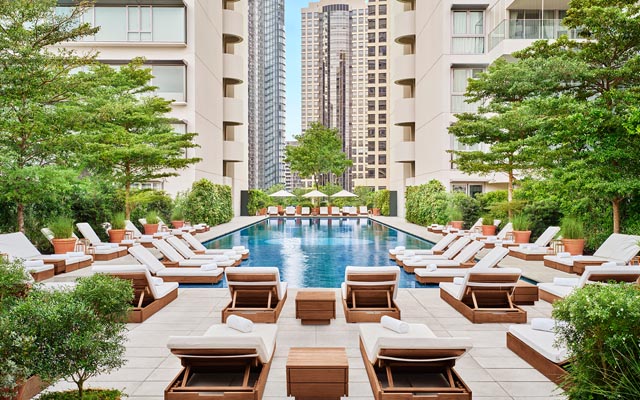
Facilities include a free-form swimming pool, a separate children’s pool, Jacuzzi, sauna, gym and a Dusit Gourmet outlet located on the ground floor.

Following the temporary closure of Dusit Thani Bangkok in January this year, Dusit introduced two new business units staffed by team members from its flagship hotel – Dusit Events, a high-end catering service for corporate, government and social events; and Dusit on Demand, an on-demand housekeeping, engineering, banqueting, and/or stewarding service for businesses based in Bangkok.

In 3Q2019, DTC will also launch Baan Dusit Thani, in a traditional Thai house on Soi Saladaeng in Bangkok’s Silom.