TTG Asia
Asia/Singapore Monday, 6th April 2026
Page 632

Trip.com’s Sustainable Travel Consumer Report underlines importance of sustainable travel

0

Trip.com Group’s inaugural Sustainable Travel Consumer Report 2022 sheds light on the increased acceptance of sustainable travel and its implications for the travel industry and the wider world.

Across the globe, sustainable travel as a concept and practice has moved from the back of travellers’ minds to claim a dominant position in the decision-making process, with close to eight in 10 travellers (78.7%) acknowledging its importance.

Respondents believe the responsibility of sustainable travel is to be shared

Sustainable travel an increasingly accepted idea
Based on a survey of 7,705 respondents across 11 markets in Asia and Europe, the report finds that the impact of travel has topped the list of reasons why travellers are increasingly drawn to sustainable travel.

Some 50.5% of respondents said they care about the impact of travel on future generations; a third (26.8%) cited its role in improving the travel experience; another 13.2% perceived it as trendy; and 8.4% admitted people opted for sustainable travel due to societal pressure.

Perception of sustainable travel also varies among the respondents. The report indicates a growing proportion of travellers now approach the term more holistically, emphasising the economic, cultural and biodiversity aspects in addition to the usual environmental considerations.

The more diversified understanding of sustainable travel manifests itself through several ways that travellers consider conducive to tourist destinations.

About 30% of respondents recognise the benefit of supporting local businesses and livelihoods, and a striking 43% believe respecting the culture and heritage of local destinations is also part and parcel of sustainable travel.

The rising awareness of sustainable travel
The pandemic is a key driver of a stronger desire to travel sustainably because of the shift in consumer mindset and behaviour.

The report points out that over two-thirds (67.8%) of respondents named Covid-19 as a catalyst for their increased appetite to choose sustainable options. About 38.3% said travel restrictions enhanced their appreciation for nature, and another 30.4% yearned to travel closer to home. The pandemic has led many travellers to discover shorthaul journeys and realises how it can help reduce their carbon footprint.

One of the report’s highlights is that it allows a glimpse into how Asian and European travellers understand and practise sustainable travel differently.

Notably, 21.3% of Europe-based respondents stated that people opt for sustainable travel because “it is trendy”, while the portion of Asian travellers who took this view is much smaller, at 7.1%.

They also differed in their attitudes towards paying a higher price for sustainable options, with 39.1% of European travellers reluctant to pay extra for them, compared to 29.5% among their Asian counterparts.

Despite the regional disparities, it is clear from the report that more and more people have practised sustainable travel in multiple forms.

Amid heightened sustainability awareness, more than half (59.2%) of respondents demonstrate a tendency to pay for carbon offsetting to reduce the impact of their travel.

Five per cent of respondents believe that travelling sustainably would be burdensome

A significant opportunity for OTAs
Notwithstanding a spike in the popularity of sustainable travel, only 20% of respondents didn’t report any barrier to sustainable travel, while the rest encountered various obstacles.

Inadequate visibility of sustainable options poses a significant barrier to their wider adoption. Travellers blame this on the difficulty of accessing information about sustainable travel products, with 32.9% stating there is a lack of sustainable options and 25.4% saying these are not clearly marked.

Accordingly, a little over half of them (50.7%) believed Online Travel Agencies (OTAs) should clearly label sustainable options, followed by 41.5% who called upon OTAs to make it easier to find these options, and 39.4% who suggested OTAs offer incentives.

While 67.7% of travellers are open to paying more to include sustainable options in their trips, they display varying levels of price sensitivity to the higher costs it usually entails, with only around 10% of them would be willing to pay over 10% of the total price for a sustainable option.

Against this backdrop, online travel agencies and booking platforms have a significant opportunity to tap into this by showcasing their sustainable travel credentials and endearing themselves to like-minded users. The report shows that an overwhelming 93.0% of respondents would consider booking via OTAs that provide sustainable options.

Jane Sun, CEO of Trip.com Group, said: “The results reaffirm our vision to educate travellers better and provide a greater volume and variety of reliable, sustainable travel options. Our findings are a clarion call to ourselves as to our allies in the travel sector.

“In the future, we will join hands with partners, travellers and other stakeholders to venture towards a more sustainable world.”

The full Sustainable Travel Consumer Report 2022 can be found here.

Luxury brands hedge their bets on health and wellness

0

A strong wellness angle is showing up in new hotels and resorts as well as revamped projects, as hotel companies continue to respond to the growing appetite among travellers for physical and mental care.

Capella Hotels & Resorts, for instance, is working on its first wellness dedicated resort in South Korea, scheduled to open in 2024. Located near Songjeon Beach in Yangyang, Gangwon province, Capella Yangyang will be the brand’s first luxury wellness resort, and the country’s only luxury resort with direct access to the beach.

RAKxa Wellness & Medical Retreat is Bangkok’s first fully integrative wellness and medical retreat

Commenting on the location choice, Monica Barter, corporate director of wellness, Capella Hotels & Resorts, told TTG Asia: “South Korea is highly regarded as a wellness destination. They are at the forefront of wellness and beauty programmes, producing trailblazing products, and are constantly innovating.”

She added: “Choosing Yangyang was a strategic decision for the group and offers us a first-mover advantage to create a superb beachside destination just two hours from the nation’s capital city, Seoul.”

Over in Thailand, the RAKxa Wellness & Medical Retreat opened its doors in December 2020 as Bangkok’s first fully integrative wellness and medical retreat. It operates as a standalone luxury property that offers Bumrungrad International Hospital’s doctor-supervised programmes and treatments.

On the inspiration behind this property, Dusadee Tancharoen, managing director of RAKxa, shared: “During my travels, I found that wellness retreats were either very holistic or very medical, and wanted to create one that could blend the two together. (I believe that) it is best to balance both the holistic and medical to obtain the optimum results for one’s body and mind.”

Both Capella and Rakxa indicated plans for more wellness-focused properties in the future.

Dusadee shared: “In 4Q2022, we plan to open another property under the brand RXV, targeting families and the younger generation. The property will be located near Bangkok, and offer an inclusive and accessible wellness experience for everyone. We also have several new wellness models in the pipeline to enhance our reputation as a Thai wellness brand globally.”

Meanwhile, Six Senses Hotels Resorts Spas is currently rebranding Vana, a wellness retreat in Uttarakhand, India, into the Six Senses Vana. Opening soon, stays range from a minimum of three nights up to a month, and guests will be able to detox their body and mind through ayurveda, yoga, and Tibetan medicine practices, all of which have been integrated with the latest complementary therapies.

Its CEO, Neil Jacobs, is confident that the wellness luxury market will “continue to grow”, as “more people take more responsibility for their own well-being” in this current climate.

“Post-pandemic, our guests are telling our wellness experts more about their loneliness, sleep, stress, weight gain, and their wish to detox both mentally, physically, and digitally. There is greater consciousness and willingness to dive deep into oneself, reconnect, regenerate, contribute more, and enjoy greater wellness in life. So, our vision of reconnecting has never been more important,” he elaborated.

Capella has also similarly seen an “uplift in spa and wellness demand”, and is currently working to evolve its existing Auriga Spa offering.

“Guests can look forward to an integrative wellness approach with our signature treatments complemented by customised nutritional plans, functional movement, mindfulness therapies, and life-coaching sessions,” Barter shared.

For Dusadee, luxury wellness and personalisation will be redefined in the near future, and it will be a “game of innovation”.

She said: “Everything will be hyper-personalised to your DNA. We will see the adoption of more gadgets and devices to expand the wellness experience. We can also expect to see the revival of old healing techniques (that will) evolve to keep up in this fast-changing world.”

Sustainability moves may ease hotels’ cost challenges: industry leaders

0

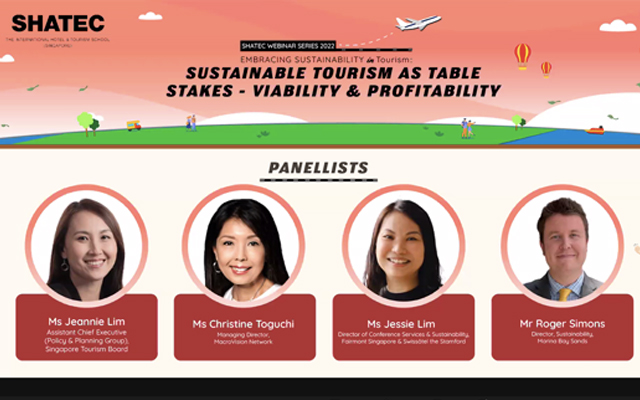
In the face of soaring energy cost, hotels in Singapore may find this the best time to consider alternative “renewable” sources, opined speakers at the recent Singapore Hotel and Tourism Education Centre’s (SHATEC) webinar Embracing Sustainability in Tourism: Sustainable Tourism as Table Stakes – Viability and Profitability.

While independent and small hotel players may lack the resources of big chains, speakers believe that they can start their sustainability journey by taking small steps like prioritising what they can control for maximum impact. At the same time, an assessment of existing assets should be conducted to allow them to optimise what they have before committing to huge investments.

Hotels looking to start their sustainability journey can take small steps and conduct regular progress reviews, advised industry leaders

Speakers also shared their achievements in the sustainability journey.

According to Roger Simons, director, sustainability, Marina Bay Sands, there are now 10 members on his team and carbon footprint at the massive integrated resort had been cut by 30 per cent since 2012.

Jessie Lim, director of conference services and sustainability, Fairmont Singapore and Swissôtel the Stamford, said an in-house app helped to identify goals and motivate colleagues.

She added that it was important to “clearly communicate and engage colleagues on the challenges”, make change “as easy as possible”, and also to “make (the process) fun”.

Earlier this year, the Singapore Hotel Association and Singapore Tourism Board (STB) jointly launched the Hotel Sustainability Roadmap.

Keynote speaker Jeannie Lim, assistant CE (policy and planning group), STB, reiterated Singapore’s goal was for 60 per cent of the 69,000-room inventory to attain internationally recognised Global Sustainable Tourism Council (GSTC) hotel sustainability certification by 2025.

The aim for Singapore hotels, she added, was to start tracking emissions by 2023, to cut emissions by 2030, and to achieve net-zero emissions by 2050.

Success in sustainability programmes requires “time and effort” rather than a “hard cost”, opined hospitality marketing and training consultant Christine Toguchi, managing director, MacroVision Network. She added that hotels will also need to analyse its progress and review next steps.

For now, STB is “identifying the gaps” and “setting clear targets” for sustainability, and will be announcing details of the GSTC certification by next year.

Ride the waves at Outrigger Surin Beach Resort

0

Laguna Phuket Triathlon set for November return

0

Indian travel agents confident of demand rebound for Sri Lanka

0

Indian travel agents are expecting a spike in demand for Sri Lanka in the coming months, especially as collaborative destination marketing efforts get underway with Sri Lankan tourism players.

Daniel D’Souza, president & country head – holidays, SOTC Travel said: “The island nation is a favourite with Indian consumers owing to its easy access and delightful diversity, and we are witnessing a gradual return of customer confidence. We are confident that strategic marketing and promotion efforts from the Sri Lankan authorities will provide Indian travellers with the much-needed assurance, and thus boost demand.”

Sri Lanka is a favourite with Indian consumers and travel agents are confident that demand will soon increase

With 80,132 tourist arrivals for the period January to August this year, India is the top source market for Sri Lanka followed by the UK with 65,555 tourist arrivals for the same period.

“We look forward to working closely with the tourism board, airlines and other stakeholders to build positivity and confidence across our India market segments of leisure, corporate and MICE and revive demand,” said Rajeev Kale – president & country head, holidays, MICE, Visa – Thomas Cook (India).

Kale added that they have also introduced special offers for the coming festive season to attract Indian travellers to the island destination.

Sri Lanka Tourism on its part has been working to regain the confidence of the Indian travel trade and consumers. The tourism board embarked on a three-city roadshow beginning with New Delhi (September 26) and followed by Mumbai (September 28) and Hyderabad (September 30).

A delegation of over 50 suppliers including DMCs and hotels are participating in the series, led by tourism minister Harin Fernando, and accompanied by Sri Lanka Tourism Promotion Bureau’s chairman Chalaka Gajabahu and Sri Lanka Conventions Bureau’s chairman Thisum Jayasuriya.

To spur demand, the tourism board will roll out special travel packages and joint promotions with partners including Indigo Airlines, Air India and MakeMyTrip.com, as well as organise major events to draw the attention of international tourists. There are also plans to promote new segments, such as golf tourism.

Fernando is confident that international arrivals will recover beginning next year, and emphasised that there is now no more shortage of fuel or electricity in the country.

Sri Lanka had agreed to a conditional US$2.9 billion bailout with International Monetary Fund negotiators earlier this month, and president Ranil Wickremesinghe is presently in Japan to see the possibility of reaching an agreement to restructure the nation’s debt.

International tourism back to 60% of pre-pandemic levels in January-July 2022

0

International tourism continued to show strong signs of recovery, with arrivals reaching 57% of pre-pandemic levels in the first seven months of 2022.

According to the latest UNWTO World Tourism Barometer, international tourist arrivals almost tripled in January to July 2022 (+172%) compared to the same period of 2021. This means the sector recovered almost 60% of pre-pandemic levels. The steady recovery reflects strong pent-up demand for international travel as well as the easing or lifting of travel restrictions to date (86 countries had no Covid-19 related restrictions as of September 19, 2022).

International tourist arrivals near-tripled in January to July 2022 compared to the same period of 2021, according to the latest UNWTO World Tourism Barometer

UNWTO secretary-general Zurab Pololikashvili said: “Tourism continues to recover steadily, yet several challenges remain, from geopolitical to economic. The sector is bringing back hope and opportunity for people everywhere. Now is also the time to rethink tourism, where it is going and how it impacts people and planet.”

An estimated 474 million tourists travelled internationally over the period, compared to the 175 million in the same months of 2021. An estimated 207 million international arrivals were recorded in June and July 2022 combined, over twice the numbers seen in the same two months last year. These months represent 44% of the total arrivals recorded in the first seven months of 2022. Europe welcomed 309 million of these arrivals, accounting for 65% of the total.

Europe and the Middle East lead recovery
Europe and the Middle East showed the fastest recovery in January-July 2022, with arrivals reaching 74% and 76% of 2019 levels respectively. Europe welcomed almost three times as many international arrivals as in the first seven months of 2021 (+190%), with results boosted by strong intra-regional demand and travel from the US. The region saw particularly robust performance in June (-21% over 2019) and July (-16%), reflecting a busy summer period. Arrivals climbed to about 85% of 2019 levels in July. The lifting of travel restrictions in a large number of destinations also fuelled these results (44 countries in Europe had no Covid-19 related restrictions as of September 19, 2022).

The Middle East saw international arrivals grow almost four times year-on-year in January-July 2022 (+287%). Arrivals exceeded pre-pandemic levels in July (+3%), boosted by the extraordinary results posted by Saudi Arabia (+121%) following the Hajj pilgrimage.

The Americas (+103%) and Africa (+171%) also recorded strong growth in January-July 2022 compared to 2021, reaching 65% and 60% of 2019 levels respectively. Asia and the Pacific (+165%) saw arrivals more than double in the first seven months of 2022, though they remained 86% below 2019 levels, as some borders remained closed to non-essential travel.

Sub-regions and destinations
Several sub-regions reached 70% to 85% of their pre-pandemic arrivals in January-July 2022. Southern Mediterranean Europe (-15% over 2019), the Caribbean (-18%) and Central America (-20%) showed the fastest recovery towards 2019 levels. Western Europe (-26%) and Northern Europe (-27%) also posted strong results. In July, arrivals came close to pre-pandemic levels in the Caribbean (-5%), Southern and Mediterranean Europe (-6%) and Central America (-8%).

Among destinations reporting data on international arrivals in the first five to seven months of 2022, those exceeding pre-pandemic levels were: the US Virgin Islands (+32% over 2019), Albania (+19%), Saint Maarten (+15%), Ethiopia and Honduras (both +13%), Andorra (+10%), Puerto Rico (+7%), the UAE and Dominican Republic (both +3%), San Marino and El Salvador (both +1%) and Curaçao (0%).

Among destinations reporting data on international tourism receipts in the first five to seven months of 2022, Serbia (+73%), Sudan (+64%), Romania (+43%), Albania (+32%), North Macedonia (+24%), Pakistan (+18%), Turkey, Bangladesh and Latvia (all +12%), Mexico and Portugal (both +8%), Kenya (+5%) and Colombia (+2%) all exceeded pre-pandemic levels in January-July 2022.

Tourism spending rises but challenges grow
The ongoing recovery can also be seen in outbound tourism spending from major source markets. Expenditure from France climbed to -12% in January-July 2022 compared to 2019 while spending from Germany rose to -14%. International tourism spending stood at -23% in Italy and -26% in the US.

Robust performance was also recorded in international passenger air traffic, with a 234% increase in January-July 2022 (45% below 2019 levels) and a recovery of some 70% of pre-pandemic traffic levels in July, according to IATA.

Stronger-than-expected demand has also created important operational and workforce challenges in tourism companies and infrastructure, particularly airports. Additionally, the economic situation, exacerbated by the aggression of the Russian Federation against Ukraine, represents a major downside risk. The combination of increasing interest rates in all major economies, rising energy and food prices and the growing prospects of a global recession as indicated by the World Bank, are major threats to the recovery of international tourism through the remainder of 2022 and 2023. The potential slowdown can be seen in the latest UNWTO Confidence Index, which reflects a more cautious outlook, as well as in booking trends which are showings signs of slower growth.

Tourism experts cautiously confident
On a scale of 0 to 200, the UNWTO Panel of Tourism Experts rated the period May-August 2022 with a score of 125, matching the bullish expectations expressed by the Panel in the May survey for the same four-month period (124).

Prospects for the remainder of the year are cautiously optimistic. Although above-average performance is expected, tourism experts rated the period September-December 2022 with a score of 111, below the 125 score of the previous four months, showing a downgrade in confidence levels. Almost half of experts (47%) see positive prospects for the period September-December 2022, while 24% expect no particular change and 28% consider it could be worse. Experts also seem confident about 2023, as 65% see better tourism performance than in 2022.

The uncertain economic environment seems to have nonetheless reversed prospects for a return to pre-pandemic levels in the near term. Some 61% of experts now see a potential return of international arrivals to 2019 levels in 2024 or later while those indicating a return to pre-pandemic levels in 2023 has diminished (27%) compared to the May survey (48%).

According to experts, the economic environment continues to be the main factor weighing on the recovery of international tourism. Rising inflation and the spike in oil prices results in higher transport and accommodation costs, while putting consumer purchasing power and savings under pressure.

End of Hong Kong’s quarantine restrictions draws mixed reactions

0

Hong Kong’s latest measures to scrap the hotel quarantine arrangement for passengers arriving in Hong Kong effective 26 September 2022 yielded lifted sentiment of travel.

Inbound travellers from Taiwan and other countries arriving at Hong Kong International Airport will no longer be required to undergo hotel quarantine with the new “0+3” measure which includes a three-day self-monitored medical surveillance arrangement – with the exception of access to high-risk areas like restaurants.

Travellers arriving at Hong Kong International Airport will no longer be required to undergo hotel quarantine

Corporate Travel Management Asia’s CEO Larry Lo said: “We welcome the ‘0+3’ policy and it will benefit those corporate and leisure travellers and boost outbound travels. However, it can’t help much with the Hong Kong economy since the inbound travellers can’t dine out and join public functions once they arrived in Hong Kong.”

The Federation of Hong Kong Hotel Owners’ association manager, Winnie Chan, said the measure would facilitate outbound travel more than it would lure overseas visitors. As a result, Hong Kong hotels can expect to lose about 20 per cent of local travellers to outbound trips.

“Without quarantine hotel bookings, hotels are back to compete with existing players in the staycation, long-staying package, F&B and banquet business. But (the) size of (the) domestic market is limited and (the) mainland Chinese market remains as our key source of business.

“The ultimate solution is (the complete) reopening of (the) border between Hong Kong and China,” Chan opined.

Regardless of business sentiments, airlines are leaping forward with improved services to facilitate travel. Cathay Pacific will add more than 400 flights in October to both regional and longhaul destinations.

Newly inaugurated Greater Bay Airlines will add an additional weekly frequency to Bangkok from October 4, and has plans to add more flights between Hong Kong and Thailand from November. The airline will also operate flights between Hong Kong and China, Taiwan, Japan and South Korea in the coming months, subject to approval from the respective authorities.

There is no clear roadmap on when all restrictions will be lifted, but Hong Kong chief executive John Lee said the government would continue to monitor the situation. Any changes would be done “progressively and in an orderly manner”, Lee said.

Ascott refreshes Citadines brand, expands portfolio

0

The Ascott has refreshed the Citadines brand with 80 properties under development across 56 cities, quadrupling its portfolio to 104 properties in operation, including its latest flagship property, Citadines Raffles Place Singapore.

As part of the Citadines brand refresh, a brand film titled For The Love of Cities will be shown on various digital and social channels, illustrating how each city offers its own unique sights, sounds and experiences.

Convertible features are one of Citadines’ signature, such as the lobby at Citadines Raffles Place Singapore that features a shared workspace with varying seating arrangements

Tan Bee Leng, Ascott’s managing director for brand & marketing, said: “We have always believed in the market potential of aparthotel living. Supported by its design versatility, favourable guest demographics and resilient market fundamentals, the growth of the brand has been exponential.

“Over the past few years, the serviced apartment business has transformed. We have likewise pivoted our offerings towards a hybrid model that would not only allow us to offer the option of both hotel rooms and serviced residences, but also a robust programme that better caters to the lifestyle needs of our guests.”

As part of the refreshed brand and its ambition to promote a well-balanced lifestyle, ‘activ∞’ will be a key brand signature across all Citadines properties. A curation of amenities and programmes to jumpstart city living, activ∞ will ensure guests can live, work and play seamlessly within the property and around the city, such as resident events, fitness amenities and programmes that encourage an active lifestyle.

Another signature programme is ‘For the Love of Coffee’, a collaboration with local communities to deliver unique coffee-related Citadines experiences to guests around the world. For the month of October this year, Citadines properties around the world will be launching a series of coffee activation activities.

Other brand signature initiatives include the café check-in experience at Citadines Raffles Place Singapore, and the social-lounge-turned-coffee-bar at Citadines Bay City Manila.

Convertible features are also another brand signature, transforming spaces to suit guests’ needs – for example, at Citadines Raffles Place Singapore, the residents’ kitchen is a private dining space which doubles up for both meetings and intimate dining events; and at the lobby, a shared workspace is fitted with varying seating arrangements.

Citadines associates, known as Citazens, will undergo barista training and double-up as baristas, in addition to providing guests with the best hacks to navigate city living. This programme has since been successfully rolled out at Citadines Sudirman Jakarta, and will be further expanded to other Citadines properties.

The refreshed Citadines brand will progressively roll out all initiatives across regions including the Americas, Asia-Pacific, Europe and the Middle East by 2025.

A regional TikTok campaign was also launched yesterday across eight markets: Australia, France, Indonesia, Japan, Singapore, Vietnam, the Philippines and the UAE.

Royal Caribbean to recruit 1,400 for onboard entertainment

0

Royal Caribbean International (RCI) will recruit more musicians and entertainers over the next year across its 26 ships, including its newest addition Icon of the Seas which sets sails next year.

With music and entertainment at the heart of Royal Caribbean holidays comprising nearly 800 music sets and 142 production shows performed each night, this move will help thousands of emerging artistes kickstart their career as they join the existing 3,000-plus cast members and production staff.

Royal Caribbean International will help thousands of emerging artistes kickstart their career by opening up 1,400 positions across its fleet (Photo: Royal Caribbean International)

Nick Weir, senior vice president, entertainment, RCI, said: “We keep pushing the boundaries of what is possible in entertainment in front of 105,000 guests each night, and the choice of career opportunities available to entertainment professionals is in the thousands.

“To continue raising the bar, we are expanding our incredibly talented roster of world-class vocalists, Olympic athletes, Broadway and West End stars, acclaimed producers and directors, to name a few. We are also committing more resources than ever before to music and entertainment for 2023.”

Performers have the opportunity to develop their talent with regular work – multiple nights a week – in front of an audience of thousands, all while travelling the world. As many as 25,000 performers from across the world audition for RCI every year, with many training at its 12,309m2 entertainment studio facility in Miami.