Airalo has signed a letter of intent with Busan Metropolitan City to support tourism initiatives and improve digital connectivity for international visitors.
The agreement includes plans to provide 100,000 free eSIM voucher codes for travellers visiting Busan, along with destination-specific eSIM packages designed to offer mobile data access during their stay.
Airalo and Busan will provide eSIM services and data insights to support tourism and improve connectivity for international visitors
The partnership also covers collaboration on tourism-related initiatives, including support for start-ups in the sector through marketing programmes, international expansion and technology development linked to eSIM services.
Airalo will also offer discounted eSIM services for Busan residents travelling overseas, including young professionals seeking opportunities abroad.
The agreement extends to supporting international events hosted in Busan, with foreign participants expected to receive free or discounted eSIM services. Both parties plan to run joint marketing campaigns aimed at increasing adoption of eSIM technology among visitors.
Airalo will provide aggregated data on international visitor connectivity patterns, including usage trends by nationality, activation timing and data consumption. These insights are intended to support tourism planning and policy development.
Busan recorded 3.64 million international visitors in 2025, an increase of 24 per cent compared with the previous year.
The signing ceremony took place at Busan City Hall and was attended by Busan mayor Park Heong-Joon and Melvin Ng, senior director, Asia-Pacific at Airalo.
“This partnership represents Airalo’s first collaboration with a local government in South Korea, and we are proud to support Busan’s vision of welcoming five million international visitors annually,” said Melvin Ng, senior director, Asia-Pacific at Airalo.
“This agreement will not only provide free eSIM services for international visitors to Busan but also offer benefits for Busan citizens traveling abroad. At a time when travel costs are rising globally, these initiatives will help reduce connectivity costs for travellers while strengthening Busan’s competitiveness as an international tourism destination,” added Park Heong-Joon, mayor of Busan.
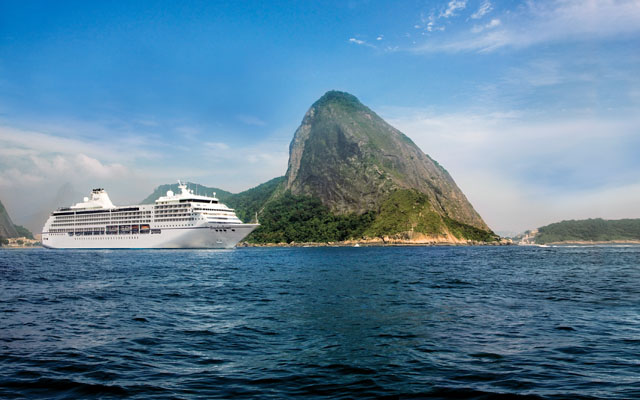
Regent Seven Seas Cruises is beckoning explorers with its new 2029 World Cruise, Eras of Exploration, a 150-night voyage departing January 6, 2029 aboard Seven Seas Mariner.
Sailing from Miami to Rome, the itinerary covers more than 37,000 nautical miles, visiting 70 ports across seven continents. The journey includes destinations in South America, Antarctica, Polynesia, Australia, South-east Asia, the Indian Ocean and the Mediterranean.
Seven Seas Mariner will sail a 150-night world cruise in 2029, visiting 70 ports across seven continents; photo by Regent Seven Seas Cruises
The cruise includes 326 shore excursions and 13 overnight stays in destinations such as Lima, Sydney and Singapore. Guests will also visit 57 UNESCO World Heritage Sites.
Seven Seas Mariner, which accommodates up to 700 guests, has undergone refurbishment with updated suites, redesigned bathrooms in selected categories and enhanced dining facilities, including a new culinary studio.
Fares start from US$99,999 per person for a Deluxe Veranda Suite and reach US$344,999 for a 186m² Signature Suite. Reservations open April 1, 2026.
Guests will begin the journey with a one-night hotel stay in Miami and a pre-cruise event. The cruise also includes services such as shore excursions, laundry and luggage handling.
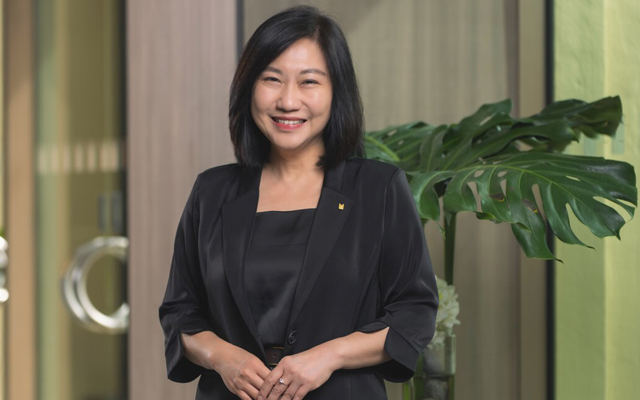
Millennium Hotels and Resorts has named Cinn Tan as chief commercial officer.
She brings more than 30 years of experience across Asia-Pacific, China, Europe and the US.
She joins from Pan Pacific Hotels Group, where she was chief commercial and marketing officer, and has previously held senior roles at Jin Jiang International and Ascott .
Far East Hospitality (FEH) has teamed up with JTB Singapore to introduce travel packages between Singapore and Japan, marking 60 years of diplomatic relations between the two countries.
The initiative includes packages for Japanese travellers visiting Singapore and Singapore residents travelling to Japan. JTB Singapore is the local arm of JTB Corporation, a Japan-based travel agency.
Far East Hospitality and JTB have introduced travel packages linking Singapore and Japan to mark 60 years of diplomatic relations
The programme is supported by the Singapore Tourism Board (STB) and is intended to encourage travel flows between both markets. In 2025, about 630,000 visitors from Japan travelled to Singapore, while 726,000 travellers from Singapore visited Japan.
For Singapore-based travellers, packages include a two-night stay at Far East Village hotels in Tokyo, Yokohama or Osaka. Transport options are included, such as airport rail tickets and metro passes, along with entry tickets to attractions including Tokyo Tower or Osaka Castle. A seven-day eSIM card is also provided.
Participating properties include Far East Village Hotel Tokyo, Asakusa and Ariake, Far East Village Hotel Yokohama, and Far East Village Hotel Osaka, Namba South and Honmachi.
Japanese visitors booking through JTB Japan will receive additional items depending on the booking type. Group travellers will receive a commemorative handheld fan and a luggage sticker, while individual travellers will receive vouchers for local food brands Old Chang Kee and Ya Kun, along with a luggage sticker.
The packages will be available through JTB Singapore and at the Natas Travel Fair from March 27 to 29, 2026, at Singapore Expo.
“The 60th anniversary of diplomatic relations between Singapore and Japan is a meaningful milestone, and we want to celebrate it by creating packages that bring tangible value to travellers in both countries. These exclusive packages reflect our commitment to building strong partnerships, enhancing cross-cultural exchange, and creating memorable travel experiences that go beyond accommodation,” said Tan Chia Hui, vice president, sales, FEH.
“We look forward to seeing increased travel between our two countries through initiatives like these, which will further deepen mutual understanding,” added Serene Tan, executive director, North Asia, STB.
Fuel price surge and conflict are hitting airlines and Middle East tourism, with arrivals forecast to fall by up to 27 per cent
Passenger confidence in Gulf carriers remains strong, with most willing to return within three to six months after the conflict
Higher airfares are shifting behaviour, with leisure travellers adjusting plans while business travel holds steady
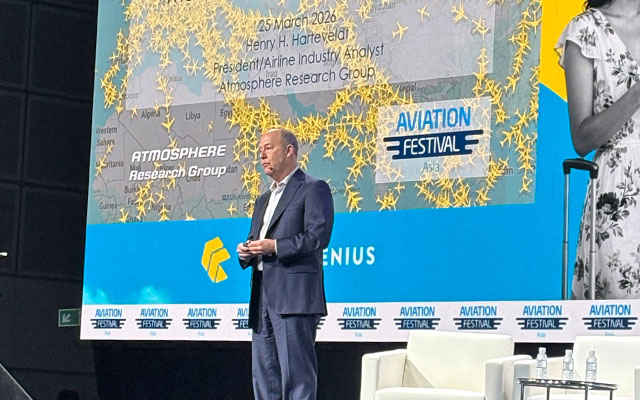
Harteveldt remarked that the Middle East aviation outlook may be messed up, but there is hope; photo by Caroline Boey
The Middle East aviation outlook following the war on Iran may be “messed up, but there is hope”, according to US-based Atmosphere Research Group, which conducted a survey across five key markets – Australia, Hong Kong, India, the UK and the US – shortly before last week’s Aviation Festival Asia in Singapore.
President and airline industry analyst Henry H Harteveldt, in his keynote address on March 25, described the 77.7 per cent jump in the US Spot Jet Fuel Index – from US$2.42 per gallon on February 27 before the war to US$4.30 per gallon on March 24 – as “unbelievable, unsustainable, unaffordable”.
Harteveldt highlighted Saudi Arabia’s warning that oil prices could exceed US$180 a barrel if the conflict continues, adding that attacks on energy infrastructure could cause long-term damage and that future price levels remain uncertain.
“Oil and jet fuel disruptions are impacting countries across the Indo-Pacific region,” he commented.
With Gulf tourism severely impacted and the WTTC estimating losses of US$600 million a day in visitor spending, arrivals in the Middle East could fall by 11 to 27 per cent compared to December 2025, translating to losses of US$348 million to US$568 million.
Emirates, Etihad Airways and Qatar Airways carry a significant share of Asia-Pacific traffic, particularly on Europe-Asia and Europe-Australasia routes.
Non-Gulf carrier capacity to the Middle East is mixed, with SAS, Air New Zealand, Cebu Pacific, United Airlines and China Southern cutting flights, while Norwegian, Air France-KLM, Lufthansa and Frontier Airlines have added capacity.
Atmosphere’s online consumer survey – with 1,000 respondents in Australia, 500 in Hong Kong, 1,500 in India, 1,250 in the UK and 1,500 in the US – shows Gulf carriers have maintained passenger confidence.
He said: “Despite the attack on Gulf airports, nearly nine in 10 passengers view Gulf region airlines as safe.
“Once fighting has stopped and the region is believed to be stable, five per cent of passengers would fly a Gulf carrier ‘immediately’, 51 per cent would consider flying a Gulf carrier within three months after the war ends, and 29 per cent would fly within three to six months after fighting ends.”
As for the ability to fund future travel, the survey shows that “passengers were struggling to save enough to travel even before the war on Iran began”.
In Australia, 33 per cent said it was more difficult, compared to 22 per cent who said it was easier; 27 per cent versus 25 per cent in Hong Kong, 42 per cent versus 29 per cent in India, 35 per cent versus 26 per cent in the UK, and 39 per cent versus 41 per cent in the US, bucking the trend marginally.
However, Harteveldt offered some optimism. “Of the few passengers with March/April travel plans affected by the war, most plan to travel.”
The survey showed four per cent of leisure passengers and seven per cent of business travellers had March/April trips affected by the war. Business travellers “show enormous conviction”, being 3.6 times more likely to change airlines than cancel, with 69 per cent proceeding as planned and 15 per cent cancelling.
Rising airfares are also influencing leisure travel decisions as passengers look to save money.
Harteveldt said 25 to 34 per cent will change travel dates, 19 to 28 per cent will cancel, 21 to 26 per cent will switch airlines, and 11 to 16 per cent will change destinations but keep their preferred airline.
“The risk of higher fares has prompted some leisure passengers to book flights earlier,” he added, as “passengers fear if inflation accelerates, they may not be able to take a summer holiday or vacation trips”.
Speaking at a panel discussion following the keynote, Richard Nuttall, president of Philippine Airlines (PAL), sees a window of opportunity, though it may narrow once Gulf carriers “gradually work their way back, buy back market share”, and return to normal within 12 months.
“The reality is we don’t know (when the region and airlines will rebound), but we need to take advantage when we can,” he commented.
Azim Barodawala, CEO of Volantia, a re-commerce platform that helps airlines drive new, measurable revenue on peak flights, called for “passenger flexibility”.
He noted that PAL and Saudia Airlines are still able to move passengers and are not overbooked.
Booking Holdings plans to restructure its B2B operations to create a single organisation serving global demand partners. The structural change will merge the strategic partnership units across its corporate portfolio.
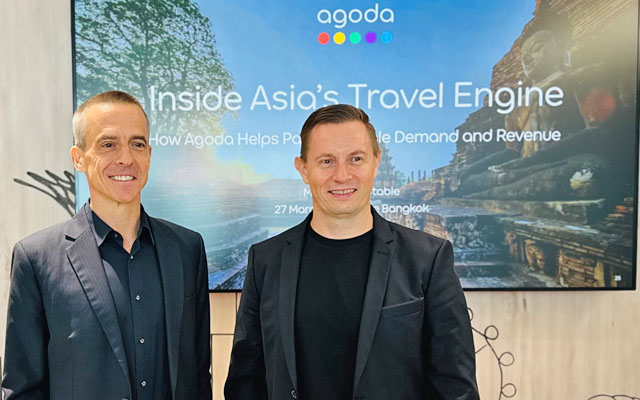
“Booking Holdings has made the decision to bring together the strategic partnership arms of Booking.com, Priceline and Agoda (a subsidiary of Booking Holdings),” said Damien Pfirsch, chief commercial officer at Agoda, addressing a media roundtable at Agoda’s new Bangkok office, which will officially open on April 1, 2026, in the One Bangkok development.
From left: Agoda’s Damien Pfirsch and Andrew Smith; photo by Anne Somanas
“Essentially, what is called Rocket Travel by Agoda today in the future won’t really exist – but there will be a single B2B organisation created by bringing together the three OTAs’ strategic partnership units under Booking Holdings,” he added.
He cited three main objectives for the transition.
“Firstly, we want to offer a more cohesive, streamlined experience to our partners – today, there are partners all around the world that work with Agoda and Booking.com, but they engage with different people, and some of the processes are different. We want to make it easier for partners to work with us,” he stated.
“The second is we want to make sure that we offer the best of Booking Holdings to our partners. That’s why we are bringing everything into one place – all the supply, all the technology and all the teams. The last point is innovation. As we are coming together, it increases our innovation capabilities to be able to engage more deeply with partners and develop additional solutions and services for them,” he elaborated.
While the new organisation has not yet been publicly named, Pfirsch described it as “a large transformation… that will take quite a bit of time, as it will bring people from the US, Europe and Asia together under a single new structure”.
Pfirsch noted that Agoda’s current B2B business is split evenly across three primary commercial structures: white-label solutions, API integrations for inventory exchange, and direct traffic routing to core B2C platforms such as Agoda and Booking.com.
For accommodation suppliers navigating Agoda’s B2B offerings, commercial flexibility is the core operational message.
“The top thing (we’d want our hotel partners to know is that) everything is possible. The fun part of partnership is not coming and saying you have a menu of three solutions and tick here and sign here and eventually I’ll send you a check at the end of the month. The fun part of partnership is building a business together,” said Pfirsch.
He urged trade partners to approach the platform with custom requirements rather than settling for standardised solutions.
Moving into 2026, Agoda will focus on integrating its disparate booking verticals into an automated consumer ecosystem.
The strategic roadmap centres on utilising AI to connect hotel, flight and activity inventory to function as a comprehensive digital concierge.
“If you look at the platform in six months, in one year, you will see more and more front-end usage of AI applications to help the customer plan their journey and book their journey through all those services,” Pfirsch concluded.
Dusit Hotels and Resorts has joined the Global Sustainable Tourism Council (GSTC), as part of its efforts to strengthen sustainability practices across its operations.
GSTC is a non-profit organisation that brings together public and private sector stakeholders to promote sustainable tourism standards and collaboration. Membership provides access to a global network focused on knowledge-sharing and the development of responsible tourism practices.
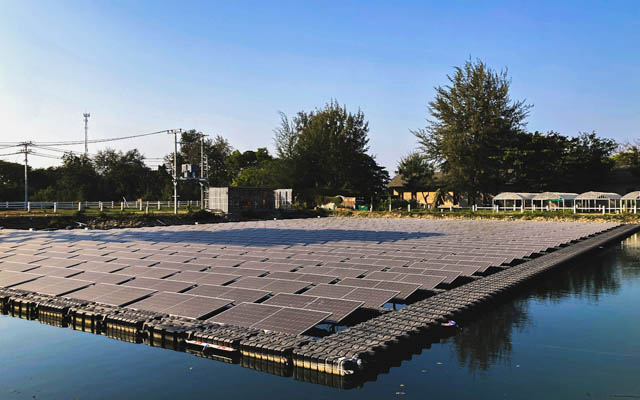
Dusit Hotels and Resorts has introduced renewable energy solutions, including solar photovoltaic installations, at several properties as part of its sustainability programme
Dusit International, founded in 1949, operates across hospitality, education, food, real estate and related services. Its portfolio includes 290 hotels, resorts and villas in 18 countries, representing more than 11,800 rooms across nine brands.
The company’s sustainability approach is guided by its Tree of Life programme, which aligns with United Nations Sustainable Development Goals, including climate action, responsible consumption and community engagement. The programme covers areas such as energy and water use, waste management and employee and guest well-being.
Energy management systems have been introduced at property level to improve efficiency and reduce emissions. Renewable energy solutions, including solar installations, are in place at several properties, including Dusit Thani Maldives, Dusit Beach Resort Guam and Dusit Thani Kyoto.
Water conservation measures include wastewater treatment and reuse for irrigation where possible. The group has also introduced initiatives to reduce single-use plastics, including refillable amenities and alternative packaging.
Food waste is addressed through measures aimed at reducing waste during preparation, redistributing surplus food through partnerships and composting organic waste.
Beyond environmental initiatives, Dusit has implemented policies related to responsible tourism. It joined The Code for the Protection of Children from Sexual Exploitation in Travel and Tourism in 2018 and has signed the WTTC Council declaration on illegal wildlife trade.
Community programmes include Dusit Smiles, which has raised more than 13 million baht (US$360,000) since 2010 to support medical care for children in Thailand.
“Sustainability is becoming an increasingly important consideration across the travel ecosystem, and it is important that we continue to learn, evolve, and engage with respected organisations helping to shape the future of responsible tourism,” said Chanin Donavanik, group CEO and chairman of the sustainability committee at Dusit International.
“GSTC warmly welcomes Dusit Hotels and Resorts as a GSTC member organisation. We value their commitment in supporting our mission and look forward to advancing together in the direction of this shared and significant goal,” added Randy Durband, CEO of GSTC.
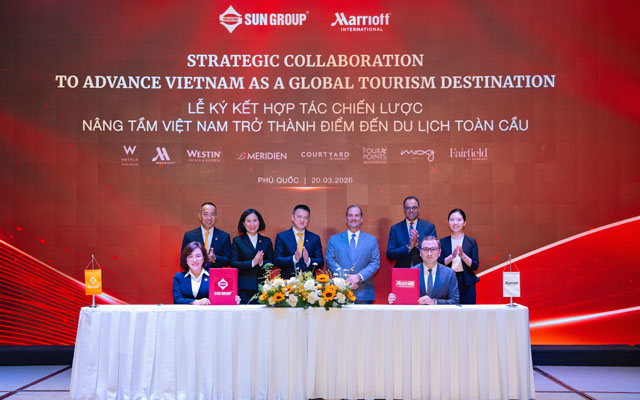
Marriott International has signed an agreement with Sun Group to develop 10 hotels and resorts across Phu Quoc and Vung Tau in Vietnam, adding about 4,500 rooms to its portfolio between 2026 and 2030.
The agreement includes projects under eight Marriott brands and will introduce W Hotels and Moxy Hotels to Vietnam for the first time. The developments are part of Sun Group’s integrated tourism projects in both destinations.
Marriott and Sun Group plan 10 new hotels across Phu Quoc and Vung Tau, adding about 4,500 rooms between 2026 and 2030
Seven of the properties will be located in Phu Quoc, including hotels under the W Hotels, Marriott Hotels, Westin Hotels & Resorts, Le Méridien and Courtyard by Marriott brands. Additional projects on Hon Thom island include Moxy Hotels and Fairfield by Marriott.
In Vung Tau, three properties are planned under the Marriott Hotels, Moxy Hotels and Four Points by Sheraton brands, within the Blanca City development. The destination is located near Ho Chi Minh City and will benefit from access to Long Thanh International Airport.
The projects are aligned with preparations for APEC 2027, which will be hosted in Phu Quoc. Sun Group is developing an 88.4-hectare mixed-use site at Ruby Beach, where five of the hotels will be located.
Phu Quoc has seen increased tourism development in recent years, supported by infrastructure projects and attractions including a cable car to Hon Thom island, theme parks and entertainment facilities.
Marriott currently operates 32 properties across Vietnam under 11 brands, with more than 50 additional projects in the pipeline.
Rajeev Menon, president, Asia Pacific excluding China, Marriott International, commented: “Marriott’s portfolio in Vietnam has doubled since 2022, as we cater to record numbers of international travellers and rising demand from domestic guests seeking world-class accommodation. Our continued collaboration with Sun Group… reinforces our commitment to the long-term future of Vietnam.”
“Phu Quoc’s hosting of APEC 2027 will be an era-defining moment… creating lasting benefits for the entire region,” added Dang Minh Truong, chairman of Sun Group.
Custom Travel Solutions (CTS) has introduced a platform designed to enable AI assistants to access live travel inventory and complete bookings within a single interaction.
The service, known as RouteStack, allows users of tools such as ChatGPT and Perplexity to search for hotels and be directed to a pre-filled checkout page with selected dates and pricing, where bookings can be completed.
AI assistants can connect directly to live travel data, allowing users to move from search to booking within a single conversation
The platform provides real-time availability and pricing data to large language model agents, addressing a limitation where AI systems have been unable to access live travel inventory. Until now, users searching for travel through AI assistants were typically redirected to external websites to complete bookings.
RouteStack connects AI applications to live supply, starting with hotel inventory. Additional services, including flights, car hire, holiday rentals and activities, are expected to be added from April. Cruises, rail and transfers are also planned.
The system is built using Model Context Protocol servers designed for AI environments. It enables AI tools to query inventory and return structured results within conversational interfaces.
A key feature is the use of deep links that direct users to pre-populated booking pages, allowing transactions to be completed without restarting the search process on another platform.
CTS said the platform is intended to support travel companies and developers seeking to integrate booking capabilities into AI applications. It allows suppliers to connect inventory while retaining control over pricing, customer data and fulfilment.
The launch comes as AI tools become more widely used in travel search and planning, while booking processes remain largely tied to existing distribution systems.
“This isn’t about building another chatbot,” said Mike Putman, CEO of CTS. “We’ve built the commerce layer AI agents were missing. The APIs, the deep links, the checkout infrastructure – those pieces already existed inside our broader ecosystem. We’ve now assembled them specifically for AI. This is the moment where conversational discovery becomes transactional.”



 She joins from Pan Pacific Hotels Group, where she was chief commercial and marketing officer, and has previously held senior roles at Jin Jiang International and Ascott .

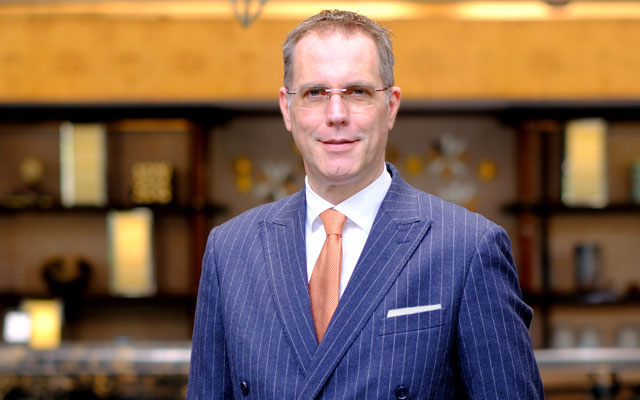
 He joins from senior roles with IHG, Wyndham and Rosewood, where he led hotel openings, repositioning and operational performance.