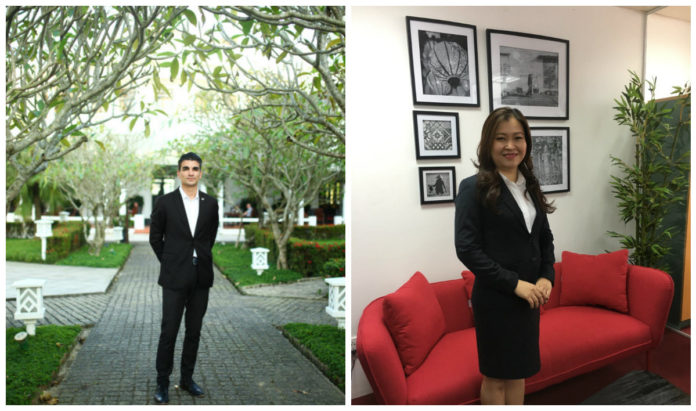
La Residence Hotel & Spa has appointed Adrien Marie as operations manager and Huynh Xuan Hanh as director of sales.
Reporting directly to general manager Phan Trong Minh, Marie will be based on-site in Hue and Hanh in Ho Chi Minh City.
From left: Adrien Marie and Huynh Xuan Hanh
Most recently, Marie was working in sales and business development at Sofitel Wanda, Beijing and at various hotels in his native France as well as in the US.
Hanh has had experience working with several hotels across Vietnam including Vinpearl, Sofitel Saigon Plaza and Renaissance Riverside Hotel Saigon.
Contrary to the belief that OTAs have now dominated hotel bookings, European wholesale/travel agency distribution still is the largest share of business for hotels in Thailand.
About 80 per cent of Banyan Tree Hotels & Resorts Phuket’s German bookings comes through the wholesalers, area director of sales & marketing Ludovic Gallerne told TTG Asia.
Banyan Tree Resort Phuket
Likewise, at The Rembrandt Hotel Bangkok, which boasts a strong North European market, the UK, Swiss, German and Danish wholesale markets have been traditionally strong and are still growing, said general manager Eric Hallin.
The UK and German-speaking markets also make up the strongest business from Europe for the Sala Hospitality Group, particularly for its Phuket and Samui properties.
Said group director of business development, Nicolas Reschke: “From the first year of opening we started great relationships with the major players who have supported us for 13 years since.”
The strong agent culture in Germany and Switzerland clearly has a role to play in driving contract bookings to Thailand hotels, said Klaus Sennik, general manager of Ramada Plaza Bangkok Menam Riverside.
“It is also important to recognise that Germany and Switzerland are home to some of the world’s most successful and influential tour operators such as TUI and Kuoni.”
The overall tendency for the European feeder markets to book further in advance through tour operators has helped Manathai Hotels and Resorts to be less reliant on last-minute OTA deals to fill rooms, according to group director of sales & marketing, Matt Fynch.
However, hoteliers in Thailand are not discounting the rising influence of OTAs, as outside of the German-speaking markets the travel agent holds less sway.
Banyan Tree’s Gallerne commented: “Trends are not similar in France with high online numbers and the rise of flash sales operators.
“The UK is a good mix but increasingly heading towards more online while Scandinavian operators remain strong in destinations with charter flights and not for luxury brands like Banyan Tree.”
Views also differ as to how the hotel-wholesaler relationship will pan out, with Phi Phi Island Village Beach Resort’s director of sales and marketing Pond Leartsinpakdee believing that key OTAs will “continue to gain market share from the traditional wholesalers in Europe and across the world” while the hotel grows its direct-to-website business.
Weighing in on the discussion, Ramada’s Sennik’s sentiments are more mixed. “There’s no doubt that more and more European travellers are using the digital space to book their holidays in Thailand,” he said.
“But the sheer strength, experience and determination of the agency wholesale market in Europe means that we expect to enjoy significant business from this traditional source for many years to come.”
Said Fynch: “I believe the agent/wholesale business will not go away soon or even shrink. The personal touch is still very much alive and well in European longhaul travel decisions to Thailand.”
Can there ever be too much tourism for a destination?
We asked this of UNWTO secretary-general Taleb Rifai and he said: “Growth is never the enemy. It’s about how we manage growth in a responsible and sustainable manner.” Something to think about this year, which is International Year of Sustainable Tourism for Development.
Who’s the next biggest disrupter for hotels after Airbnb?
We asked this of Peter Henley, president and CEO, Onyx Hospitality Group and he said: “Cruises may be the next big thing that hotels have to watch out for as competitors in Asia.” Not too off the mark, with cruise lines seeing the region as ports of gold.
Where are Britons going?
We asked this of Kritaka Kakkar, Mercury Travel UK and she said: “Outside Europe, with visa-free travel in EU perhaps no longer possible (for Britons) following Brexit.”
IATA has urged Japan to revamp its airport infrastructure for the 2020 Olympics and future tourism growth through collaborative thinking and extensive consultation with the industry.
Japan has set aggressive targets for attracting international tourist arrivals. Having welcomed around 24 million international tourists in 2016, the country now hopes to reach 40 million visitors in the 2020 Olympics year and 60 million visitors in 2030.
Kansai International Airport
“The Olympics are an important milestone and an impetus to get things done. But it must be part of a long-term joined-up planning process focused on the big prize of welcoming 60 million visitors to Japan annually – and keeping Japanese businesses and people efficiently linked to the world,” shared Alexandre de Juniac, IATA’s director general and CEO.
IATA stressed that infrastructure planning is key for the continued growth of tourism and welcomed the development of Tokyo-Haneda’s international network, the privatisation of Sendai and Osaka’s Kansai and Itami Airports, and continuous efforts to improve competitiveness by reducing costs and optimising infrastructure.
“Not that long ago Japanese airports were the most expensive in the world. They are not cheap today, but Kansai and Narita have dropped from among the 10 most expensive to 13th, and 23rd, respectively,” said de Juniac. “We are moving in the right direction and there is still more to be done – particularly at Haneda which is bucking the positive trend by raising charges.”
IATA also called for airports to be efficient and provide sufficient capacity to meet market demands. In preparation for this growth, IATA urged a comprehensive plan for the development of a more competitive Japanese air transport infrastructure in the areas of smart security, terminal efficiency, airspace efficiency, low cost terminals and coordination.
Cathay Pacific will step up the frequency of its services in Europe, North America and Australia to meet growing consumer demand, it said in a press release.
The carrier will add four weekly flights between Hong Kong and San Francisco on the new Airbus A350-900, while flights to Los Angeles will be reduced from 28 to 21 per week. As well, the airline had earlier announced additional services to Vancouver and Boston from late March.
San Francisco will mark Cathay Pacific’s first US and second North America destination to see the deployment of the A350. The new aircraft will feature a refreshed business class cabin as well as new premium economy and economy class seats.
During the Southern Hemisphere’s peak summer period from late October to March, the airline will replace its current four-times-weekly service to Brisbane via Cairns with direct flights to both cities. The switch means that Queensland’s capital will receive 11 non-stop flights from Hong Kong each week, while Cairns will be served non-stop thrice weekly.
Meanwhile, Cathay Pacific’s existing daily flight to Brisbane will be served by the A350 from March 26 while capacity on its four-times-daily Sydney route will be increased from late October by operating a third flight with the Boeing 777-300ER.
In Europe, Madrid will see an increase from four to five flights per week from late October, while a sixth weekly flight will operate to Manchester from early December. At the same time, Paris will see the resumption of an 11th weekly service.
Best Western has signed an agreement with Thai real estate company Habitat Group to bring its new upscale hotel concept BW Premier Collection to Asia.
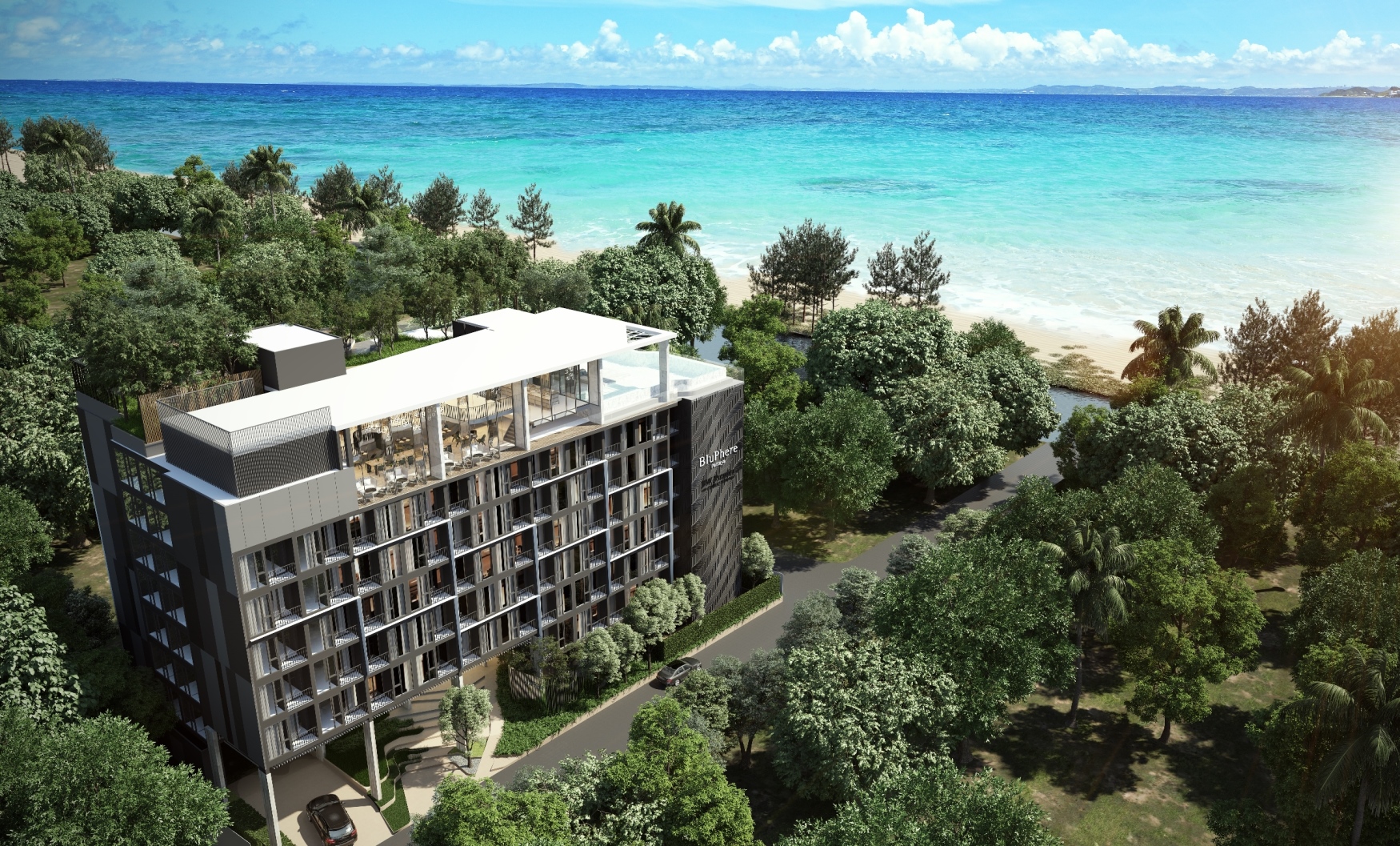
The BluPhere Pattaya will be a new-build eight-storey project in Na Jomtien providing 195 apartment-style units. The property will retain its existing branding and will be managed by Best Western as part of the BW Premier Collection, its upscale “soft brand”.
Olivier Berrivin, Best Western’s managing director of international operations – Asia, said: “BW Premier Collection is a great fit for Thailand. Designed for guests who crave individuality, character and local charm, this upscale concept is expanding into some of the world’s most sought-after destinations.”
This signing is the second collaboration between Best Western and Habitat Group, after the Best Western Premier BayPhere Pattaya.
Officially launched in 2014, BW Premier Collection is a selection of independent upscale and luxury boutique hotels in destinations such as San Francisco, New York, New Orleans, Vancouver, Paris, Rome, Stockholm, Edinburgh and Liverpool.
After Malaysia lost some key European connections last year when national carrier Malaysia Airlines cut these routes, agents in the country are finding a silver lining in niche products and secondary source markets from Europe.
“The market has been turned upside down – our main problem is losing connectivity from Frankfurt – and we can’t depend on old methods anymore,” said Uzaidi Udanis, president of Malaysia Inbound Tourism Association (MITA).
Ironman Malaysia. Credit: www.ironman.com
To convince Europeans to choose Malaysia despite the hassle of connecting flights, Uzaidi said offerings must be “niche” and go beyond “general sightseeing”. Examples, he said, are islands and beaches, the Ironman marathon (Malaysia and Japan are the only Asian countries to offer this), and for more mature markets, rainforest treks.
Ahmad Fathil Abd Ghani, manager (event and promotion), Tourism Terengganu, added: “Local content is more important to Europeans than to, say, mainland Chinese. For instance, Italians don’t like cold, hard, business-like hotels in Redang. They prefer Perhentian, where more hotels are homegrown and where they can mix with the local people.”
Fathil said there are also opportunities in markets like Hungary and Czech Republic, which enjoy connections to Kuala Lumpur operated by Turkish Airlines.
Admitting that awareness of Malaysia is lacking in these countries, he said they nonetheless warrant a serious look as some traditional markets are showing signs of plateauing. There has not been a big increase in German arrivals into Malaysia, which is now around 130,000 visitors, he said.
Uzaidi also saw “strong interest” at ITB Berlin and has secured a few groups for MITA members from Eastern Europe.
Esmadee Endut, managing director of Hedaco Travel & Tours, said: “I’m not worried about Malaysian Airlines cutting off (European) routes. People don’t mind making a transit, flying on Etihad, Qatar, Emirates, etc. A lot of my clients from France have told me they prefer and love these routes.”
Norwegian Joy, Norwegian Cruise Line’s (NCL) first cruise ship custom designed for China, was floated out of Meyer Werft’s building dock on March 4 in Papenburg, Germany.
The second ship in NCL’s Breakaway Plus Class, the 168,800-ton, 3,850-pax ship has been under construction since September 2015 with a hull designed by Chinese artist Tan Ping.
Following delivery on April 27, Norwegian Joy will sail from her homeports in Shanghai and Beijing (Tianjin) beginning in summer 2017.
InterContinental Hotels Group has appointed Rajit Sukumaran as chief development officer in the Asia, Middle East and Africa (AMEA) region.
Sukumaran brings with him over 12 years of experience as senior vice president, acquisitions and development for Asia-Pacific at Starwood Hotels and Resorts.
Prior to joining Starwood, Sukumaran worked in the corporate finance division of PricewaterhouseCoopers Singapore, dealing with several cross-border corporate transactions including mergers, acquisitions and initial public offerings.
The recent announcement by Malaysian prime minister Najib Abdul Razak that Sabah’s Sandakan Airport runway will be extended to handle both direct and chartered flights from China has been met with positive reception from the Malaysian Association of Tour & Travel Agents (MATTA).
MATTA’s vice president for inbound and domestic, KL Tan, said: “Increased tourists arrivals will boost the economy. There were 183 charter flights from China to Kota Kinabalu (Sabah’s state capital) in 2016 but none directly to Sandakan.”
Tan believes that Sandakan’s food and culture will appeal to Chinese tourists as the market is now more “mature and want to experience authenticity and nature”.
He indicated that there has been more enquires to eco-attractions like Turtle Island Borneo, Sepilok Orang Utan Rehabilitation Centre and Kinabatangan Wildlife Sanctuary.
But for Sandakan to be able to cater to the influx of Chinese tourists, Tan urged stakeholders to work faster to ensure there are enough F&B outlets, hotels and attractions. As well, Mandarin-speaking guides and an efficient transportation system are also required.
“A glaring setback for Sandakan is the lack of proper beaches for tourists to enjoy watersport activities. But it will ease the lack of accommodation for Chinese tourists to Kota Kinabalu during the peak season, and we certainly welcome a more balanced spread of Chinese tourists to other towns in Sabah,” concluded Tan.