Shockwaves are still reverberating across the Hong Kong travel industry over the hacking of WWPKG’s (Package Tours Hong Kong) customer database on November 6, with the cybercriminals brazenly demanding a seven-digit ransom to unlock the group’s system.
This is the first known case of its kind to smite the local travel industry, with the company estimating that personal information regarding about 200,000 clients was stolen, 10 per cent involving credit card information. The case was reported to the police and is being handled by the Cyber Security and Technology Crime Bureau. WWPKG also shut down all four of its branches for an urgent security upgrade that was expected to be completed by noon on November 8.
Agents remind of importance of cyber security
Its parent company WWPKG Holdings held a press conference on Wednesday. According to local newspaper reports, CEO Yuen Chun-ning shared that information exposed included name, identity card and passport number, telephone number, email address, postal addresses, credit card and purchasing record.
The group was locked out of company system on Monday morning (November 6) and then received a ransom email demanding money. The management decided to report the case to the police and later to the Travel Industry Council. On the same night they appointed two information technology security companies to assess and enhance security.
Founded in June 1979, the group offers outbound package tours with particular focus on Japan-bound tours. It went public in January.
In response to the hacking incident, local travel industry players reiterated the importance of securing client databases.
Miramar Travel general manager Alex Lee said: “We agents must always be on the alert at all times because these email viruses evolve (over time). That is why we have appointed a professional company to monitor our online system and give advice from time to time. Apart from backing up data daily, passwords and systems are changed and upgraded on a regular basis.”
Morning Star Travel Service general manager Dannia Cheung added: “This was a rare attack that had never happened before in our industry. In response we had our in-house information technology team check our system carefully to ensure it remains under tight security and gets a daily backup.”
Travel Industry Council chairman Jason Wong believed that this was an isolated case, adding: “We don’t see any developing trend of travel agencies being a target of hacking.
“However, the Council is always reminding agents about the importance of protecting consumers’ (information). In fact, experts were invited to our seminars in recent months to promote online security and if necessary, members may approach us for contact details of these experts.”
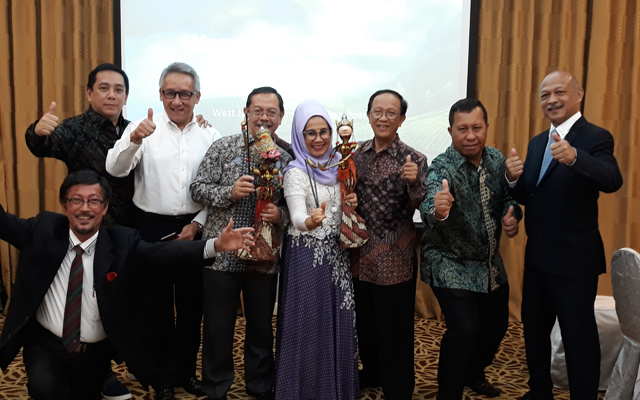
Spirits high at launch, West Java Government Tourism Office's Ida Hernida (in purple), WJTPB's Cecep Rukmana (to Ida's left), Life Style.Travellers Services Singapore's Mohamad Tahir Awi (second from right) and the rest of WJTPB board members
The West Java Tourism Promotion Board has opened a representative office in Singapore in a bid to attract more arrivals to Bandung and surrounding areas.
West Java TPB had a representative office in Kuala Lumpur, before deciding to set up in Singapore.
Spirits high at launch, West Java Government Tourism Office’s Ida Hernida (in purple), WJTPB’s Cecep Rukmana (to Ida’s left), Life Style.Travellers Services Singapore’s Mohamad Tahir Awi (second from right) and the rest of WJTPB board members
With the new office, the board targets not only Singaporeans and expatriates living in the city, but also international visitors.
Cecep Rukmana, chairman of the West Java TPB, said at the opening of the office in Bugis: “Singapore is a hub for the region. A lot of travellers are coming here, so we need to capture that and attract these travellers to come to West Java.”
“It is especially important for us to start promoting here now as we are expecting a new airport to open in Majalengka (about 90 km from Bandung) next year, and we are expecting more direct services,” he said.
The Kertajati International Airport is built to complement the limited capacity of Husein Sastranegara Airport in Bandung, and ease traffic at the Soekarno-Hatta International Airport Jakarta.
The new airport will enjoy links to the Light Rapid Transit between Jakarta and Cikampek, currently under construction, and the fast train between Jakarta and Bandung.
Speaking on the importance of funding for West Java TPB, Ida Hernida, head of the West Java Provincial Tourism Office, said: “West Java has a lot of tourist attractions and we need to get the message across to travellers.”
Herman Rukmanadi, a board member of the West Java TPB, added: “We assign our representative in Singapore to develop cooperation with the Singapore travel companies to create (extension) products, not only to Bandung but other parts of West Java.”
Mohamad Tahir Awi, director of Lifestyle Travellers Services, Singapore, who has been bringing golfers and other lifestyle travellers to West Java, opined that the office needs to come up with new products beyond Bandung and golfing, such as family-friendly experiences.
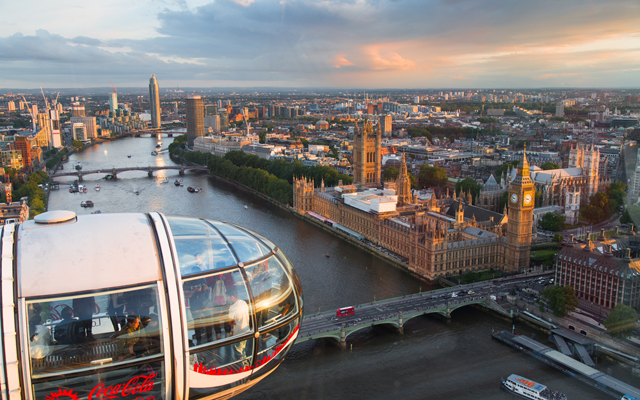
While uncertainty around Brexit and the impact of terrorism is expected to put pressure on London’s tourism sector in 2017, WTTC data suggests that the city is well placed to withstand these challenges.
Encouraging signs are also coming from Tourico, a travel booking company with contracts with nearly 2,000 UK hotels, which reported a 29 per cent increase year-on-year increase in UK hotel bookings in 2017.
Hopes for tourism sector resilience
The growth in UK bookings can in part be attributed to UK’s most consistent source markets, Tourico stated. Based on the company’s latest hotel booking report, the US increased its year-over-year bookings to the UK by 11 per cent, and Canada 35 per cent. South America increased its bookings by 38 per cent in 2017 and the Middle East by 22 per cent.
Asia-Pacific travellers continue to seek out UK travel products as well, increasing bookings by 31 per cent overall – with China up 69 per cent and Australia up 28 per cent.
Moreover, as the pound remains relatively weak, Europeans, in particular, are flooding to the UK, with an increase of 52 per cent. Specifically, Scandinavia has increased its hotel demand by 17 per cent, while Spain jumped 49 per cent. Tourico’s data also revealed that domestic hotel bookings or “staycations” within the UK have risen by 21 per cent year-over-year.
Offering further signs of healthy tourism performance, WTTC stated that London generates more spend from international visitors than any other city in Europe.
A new report launched by WTTC shows that international visitors in 2016 spent around £11.2billion (US$14.7 billion) in London, and domestic UK visitors contribute a further £1.74 billion. In terms of travel & tourism GDP contribution, London accounts for nearly 19 per cent of the UK’s total, according to WTTC.
The tourism body’s president and CEO Gloira Guevara expects international tourism spend to increase by seven per cent every year over the next 10 years.
Optimistic that London will show resilience in the face of Brexit uncertainty and terror concerns, she said: “London is a truly international city and the London is Open campaign has given a very strong message of welcome to tourists from abroad, which, with a great offering and unique experiences for tourists, means the UK’s capital has gained the top spot when it comes to international tourism to cities in Europe.”
Construction on Greater China's first Kimpton began last year
China’s leading electrical appliance retail giant, GOME, has ventured into the hotel business and appointed InterContinental Hotels Group to manage its first hotel in China.
Scheduled to open in 2020 along a southeast bay on Hainan island, construction on the RMB$2 billion (US$300 million), 13.6ha Kimpton Resort Sanya Haitang Bay kicked off last year.
Construction on Greater China’s first Kimpton began last year
When completed, the project is expected to offer 251 guestrooms, an outdoor swimming pool, restaurants and bars, and private beach access.
GOME Real Estate Group president, Long Xing told TTG Asia that a “huge space” will be set aside for F&B due to the destination being hot for weddings and MICE activities.
As the group makes its foray into hotel investments, Long disclosed: “We plan to open three to six hotels in China within the next five years. Most of them will be upscale properties located in first-tier cities. Negotiations are still on so we can’t disclose any locations at the moment. For sure, we opt for international management with InterContinental Hotels Group as priority.”
On the choice of the Kimpton brand for its first hotel venture, Long said: “The creative hotel and restaurant concept has been so successful in the US and Europe so its unprecedented entry to Asia (signals) a new level of standard.”
Airbnb announced at the APEC CEO Summit in Danang yesterday that it would invest US$2 million until 2020 to promote and support innovative tourism projects throughout Asia-Pacific.
The commitment is part of Airbnb’s vision to strengthen communities through “healthy tourism” and to empower hospitality entrepreneurs across the region.
Putting money into worthy tourism projects
An Airbnb statement defines healthy travel as authentic, affordable experiences that distribute the economic benefits to more people and more places, and that occur through use of people’s existing resources.
The fund will be available to organisations—including DMOs, NGOs, non- profit agencies and community social groups—in need of financial support for innovative tourism projects.
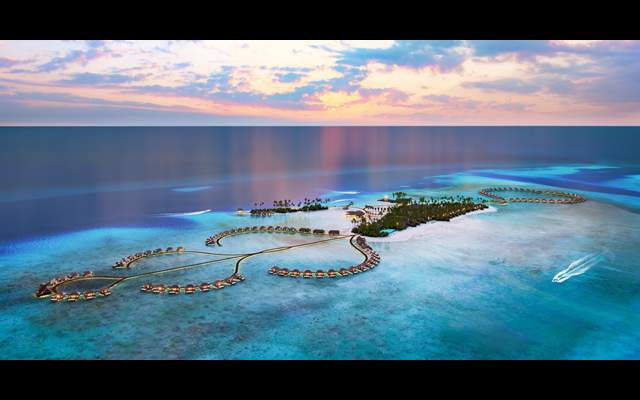
Carlson Rezidor Hotel Group is scheduled to launch the Maldives’ first Radisson Blu resort in 1Q2019, after recently signing a management agreement with Singapore-incorporated developer Chang Hua Holdings.
Located on the southern part of Maldives’ Alifu Dhaalu Atoll, Radisson Blu Resort Maldives is situated 105km from Male International Airport, and is accessible by a 30-minute seaplane journey or by a domestic flight from the Maamigili Airport, followed by a 15-minute speedboat ride to the resort.
The resort scheduled for opening in 2019
The resort will feature 128 villas including family villas, and a premium overwater villa; a sea sports and dive centre; a yoga pavilion and spa.
Carlson Rezidor’s Asia-Pacific portfolio includes 117 hotels in operation, including 51 Radisson Blu hotels.
Inspiring product managers and tour operators with lesser travelled destinations
Khiri Travel has announced its Asia Creative Series – eight new travel routes in South-east Asia with an emphasis on people and locations that are largely untouched by tourism.
Willem Niemeijer, the founder of Khiri Travel, said the new Asia Creative Series varies from 10 to 21 days and immerses guests in travel experiences, often cross-border, in Thailand, Myanmar, Indonesia, Vietnam, Sri Lanka, Laos and Cambodia.
Inspiring product managers and tour operators with lesser travelled destinations
For example, there is a 10-day trip through lesser-seen Sri Lanka, starting in Anamaduwa, ending in Kotugoda; or see the best of remote Indochina on a 16-day discovery trip from Luang Prabang to Hanoi.
The biggest trip is a 21-day odyssey around the Lesser Sunda Islands of Indonesia, starting in Bali and ending in Gili Meno.
The series also delivers in-depth experiences on circular trips starting and finishing in Bangkok and Yangon. Vietnam, Bali and Myanmar are fully represented too.
‘Overtourism’ is a vexing issue, said Niemeijer. “As tourism is booming in Asia, pressure is mounting on sustainability and capacity at certain places. Khiri wants to encourage visitor dispersal to where tourism visitation is limited.”
He added: “While these tours go very local, almost all overnights are possible in comfortable, or even luxury accommodations, making these tours accessible for a broad selection of travellers.”
Yogyakarta Marriott Hotel
Yogyakarta Marriott Hotel has opened its doors, giving the city its first Marriott branded hotel. With 347 guestrooms and suites, Yogyakarta Marriott Hotel features what’s said to be the largest club lounge in town; a spa; exercise room; outdoor swimming pool; all-day dining Yogyakarta Kitchen; the Taman Sari Bar & Grill specialty restaurant which looks out to the hotel pool; and a lobby lounge. Meetings and events facilities include a pillarless ballroom, which at 1,870m2 is the largest in Yogyakarta, a boardroom, seven meeting rooms and several pre-function areas. The hotel is located 20 minutes away from Adi Sutjipto International Airport and an hour from UNESCO World Heritage Site The Borobudur Temple.
Mövenpick Suriwongse Hotel Chiang Mai
Mövenpick Hotels & Resorts has launched the brand’s first property in Chiang Mai, located a 10-minute drive from Chiang Mai International Airport and 10km from Chiang Mai National Convention & Exhibition Centre. Mövenpick Suriwongse Hotel Chiang Mai offers 266 rooms across seven categories, namely Classic, Superior, Deluxe, Premier, Junior Suite, Suites, and Family Suites.
The hotel offers F&B options including at all-day dining venue Feung Fah Restaurant for Thai and international cuisines; Le Bistrot serving Italian-Thai fusion food and featuring a terrace looking out to the Night Bazaar; a lobby bar; a rooftop pool bar; and Sweet House for coffee and pastries. Two multifunctional venues are available on the property, including a ballroom for up to 400 pax.
Hilton Garden Inn Hangzhou Lu’niao
A Hilton Garden Inn property has opened its doors in Hangzhou’s Lu’niao Town, 45km from the city centre. Hilton Garden Inn Hangzhou Lu’niao features 230 rooms, including nine deluxe suites and eight family guest rooms with separate living rooms, a 24-hour gym, an outdoor pool and a self-service laundromat.
The hotel also houses 720m2 of multi-functional space, including five meeting rooms and a 365m2 banquet hall. F&B options include Garden Grille for Asian and international cuisines; The Noodle Bar; The Garden Lounge; and The Pavilion Pantry, which offers takeaway drinks, snacks and microwaveable meals around the clock.
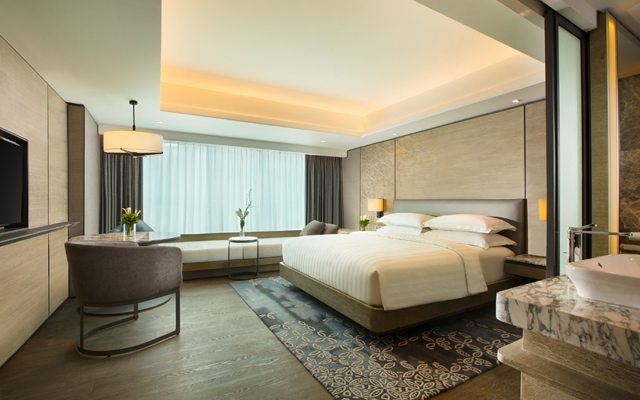
Cordis, Auckland
The Langham, Auckland has been rebranded to Cordis, Auckland, currently in the midst of a complete renovation. Enhancements include the addition of a “Double-Double” category to the hotel’s Superior and Deluxe rooms, which allows guests to opt for two double beds. Suites with kitchenettes will also be introduced to cater to families, independent travellers and long-staying guests.
Also newly refurbished is the 75-seater Lobby Lounge, which now serves up the Cordis High Tea of sweets and pastries complemented with a tea sommelier service, as well as three special Cordis-curated craft beers. Other new features include Handy smart phones all guests; free-to-book eZee electric bikes; and a programme of activities for children under 12. All 411 guestrooms and suites and the lobby will be refurbished by February 2018.
Le Méridien Seoul
Le Méridien Hotels & Resorts has launched its first South Korean property, a 336-key hotel in Bongeunsa-ro, one of Gangnam’s major thoroughfares. Le Méridien Seoul’s room inventory includes 109 club rooms and 29 suites, and offers a range of facilities from spa and indoor golf range to three F&B options.
For events and meetings, the property offers 1,650m2 of space across four indoor venues. The Da Vinci Ballroom, housed in the lower levels of the atrium, has capacity for up to 500 guests. The outdoor 525m2 Maple Garden can accommodate private parties and product launches. Le Méridien Seoul is approximately 60 minutes by car from Incheon International Airport, and allows for easy access to the COEX Convention and Exhibition Center and the office district in Samsung-dong.
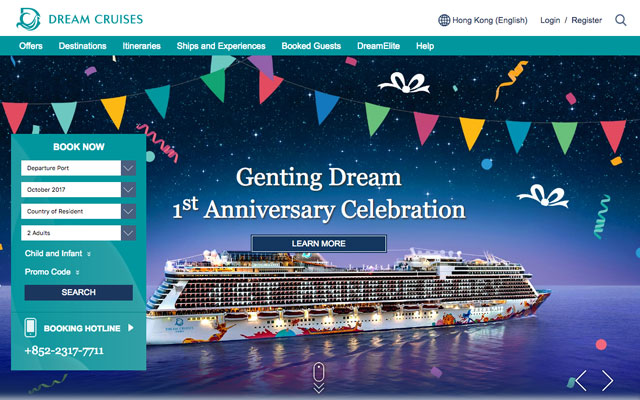
Airlines and hotels have gone direct to consumers with much success. Not cruise lines, especially in Asia, despite key players such as Star Cruises, Dream Cruises and Royal Caribbean Cruises (RCC) having enabled customers to book directly through their websites all along. Princess Cruises was the latest, launching an online booking facility for South-east Asian customers in February, the first Princess office in Asia to do so.
According to Princess, various sources estimate online cruise bookings to be less than 10 per cent of the market globally, and the percentage is lower for longer sailings. Imagine how small it is then for Asia.
None of the players in Asia would say what their website versus agency booking market share is, although they alluded that the majority of bookings still are from travel agents and that the website is only helping to create a new market, particularly millennials, and does not replace traditional agencies.
All are afraid to offend agents.
Farriek Tawfik
Princess Cruises director South-east Asia, Farriek Tawfik, said: “I would like to reiterate that the launch of our online booking is not meant to take business away from agents but (is meant as) an additional option for guests seeking a simple, convenient and informative online experience.
“We want to offer our guests more booking options and provide them with more information. The site is like an educational tool helping guests, especially first-time cruisers, to familiarise themselves with our products. It’s also designed to engage Internet-savvy millennials, who are starting to choose cruises over other vacations and prefer to get their information online.
“We encourage guests who have complex itineraries, such as those requiring airline bookings, hotel accommodation and visa applications to go through travel agents. We also recommend first-time cruisers to go through agents so that they can have access to first-hand knowledge face-to-face or through the phone.”
Six months after it introduced the online booking facility, Princess said the response is in line with expectations. Repeat passengers and first-time cruisers who are Internet-savvy and English-fluent (the website is in English) are the most responsive, along with a “pleasant surprise” comprising veteran cruisers in their 70s, most likely because these passengers are well-versed with the cruise product. However, majority of traffic to the site use it more to find information such as location of cabins, facilities and activities, then follow-up with bookings either online or with travel agents.
“So, most of them use the site as a tool to get more information on the itineraries and pricing,” noted Farriek.
Unlike North America, the UK and Australia, where guests are used to booking cruises online, this is new to Asia, added Farriek. “We have found that Asian guests still prefer face to face or phone interaction with travel agents, especially as there is no surcharge for booking through agents,” he said.
Indeed, cruise is one of the last bastions of commission income for agents. Unlike an airline seat or a hotel room, cruise is more complicated, not to say confusing, to agents themselves, let alone consumers, who must trawl through various staterooms of an ocean liner, figure out what’s included/what’s not in the price, compare prices and facilities, check if visas are needed, and so on. It is, in one word, a value-added sell, where agents are still needed to remove the pain points for customers.
Sean Treacy
Said Sean Treacy, RCC managing director Asia-Pacific: “While we cannot reveal the percentage of direct vs agent bookings, what we can share is that the percentage of customers in South-east Asia booking through their local agents online is generally higher, due to the agents’ own market presence and the language factor, especially in the non-English speaking markets.”
Treacy believes there is room for both. As more customers, especially the millennials, prefer the online booking mode, and the market base and distribution network expand, both will grow in tandem.
“We are always reaching out to new customers through various marketing and social media campaigns. At the same time, in many of our advertisements in Singapore, for instance, we feature our top agents’ contacts, as part of our efforts to publicise our other distribution channels,” said Treacy.
Likewise, Princess aims to reach out to both consumers and agents. Said Farriek: “While many people are accustomed to relying on travel agents, we have seen a positive response and believe there is potential for growth as guests become confident about booking online through a simple and informative online experience.
“We are also increasing our collaboration with travel agents, especially in areas where they have a wide reach.”
The good news for travel agents is also the entry of cruise technology firms in Asia that promise to revolutionise the way they sell cruises, for example, giving them access to multiple global products on a single platform. One such company is UK-based Traveltek, which has opened a regional office in Hong Kong.
According to Simon Leung, business development manager North Asia, Traveltek, it’s the absence of such advanced specialist cruise technology that hampers the ability of the region’s travel agents to sell cruises effectively and efficiently (see box).
With better cruise technology, agents in Asia can ensure cruise commissions will remain a major revenue earner for a long time to come.
As it happens, our two reports this issue are Asian family travel and cruises. There is a stronger correlation between the two markets today. If anything, imagine parents with little children who no longer need to monitor the ‘Child Boredom Quotient’ as they do on planes. It’s a term created by Emirates, which teamed with psychologist and boredom specialist at the University of Central Lancashire, Sandi Mann, on a study that found young flyers would take just 49 minutes and 47 seconds to ask the dreaded ‘Are we nearly there yet?’
There are other more compelling reasons why cruises and Asian families can be a match made in heaven. The picture of an Asian family as being small – a couple with two or three kids in tow – is hardly it now; instead, it’s multi-generational, or it’s a couple with kids travelling with other couples with kids whom they consider family. So cruise lines have been busy creating more interconnecting rooms to cater to multi-generational and extended family travel in Asia. And as competition for this segment hots up, they are busier jam-packing activities so no one will be bored on board.
Dream Cruises’ new holiday programme for Genting Dream, which arrives at her new Singapore homeport this month, includes workshops where children can don their own mermaid tails and splashing skills. There’s also a junior talent show (imagine the delight of grandparents watching them perform on stage) and a Christmas market at sea. “Taking care of families and offering them fun inter-generational activities are very important to us,” said Thatcher Brown, president of Dream Cruises.
Cruise lines are also trying to reach Asian families in more heart-tugging ways. Royal Caribbean International has just launched an “experiential” video which follows Asher Lim, son of Alvin Lim, founder of Alvinology.com, as junior enjoys the myriad of activities offered on the ship that only “child cruisers know and love”.
So expect cruises to be a strong competitor for the Asian family travel market, which has grown tremendously and will continue to grow. Just one indicator: Family holiday bookings from Hong Kong rose 124 per cent in 2016 over 2015, said Skyscanner. There are lots of capacity, and lots of F&B aboard – we all know how much Asian families love to bond over food, and more food.
While cruise specialists may benefit, other agents seeking to make some money from Asian family travel appear in for a rough ride. From their comments (see pages 17-18), the market has become more online savvy and more independent. Families can book home sharing accommodation, villas and hotels directly. They can buy activities and attractions easily online before or even after arriving at a destination, through platforms such as Klook.
I don’t have a clever idea how agents may overcome this structural change, beyond the obvious that they need to understand the psychology of Asian family travellers and create the trigger points that will compel them to use their services.





 Yogyakarta Marriott Hotel
 Hilton Garden Inn Hangzhou Lu’niao
 Cordis, Auckland