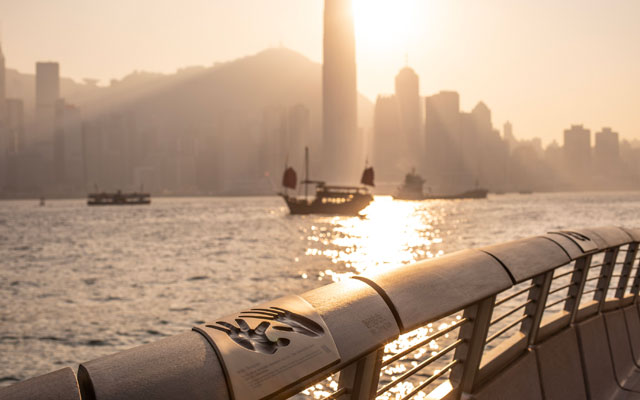
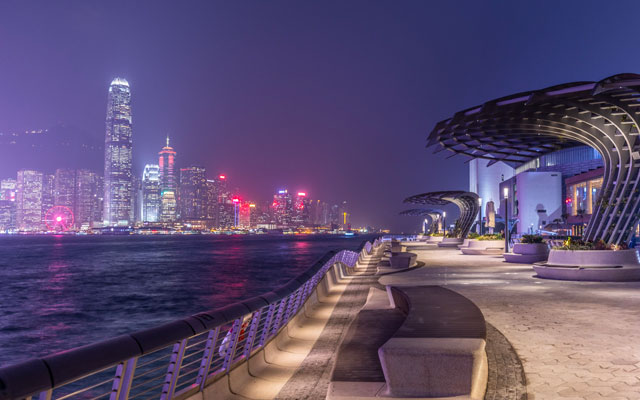
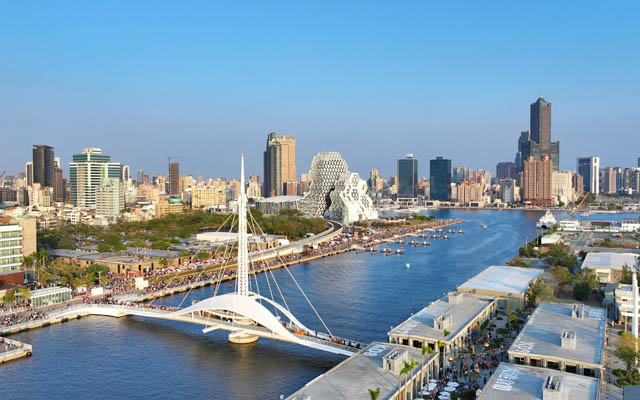
After three years of construction, Hong Kong’s waterfront Avenue of Stars (AoS) has reopened with new features including electricity generation by wave energy.
Funded by New World Development’s AOS Management Company, AoS is the result of close co-operation between Adrian Cheng, executive vice-chairman and general manager of New World Development, New York High Line architect James Corner and other famed designers.
Avenue of Stars
1 of 3
Bruce Lee statue
Handprints
View at night
The 457m-long promenade first opened in 1982, and in 2004, it was named the AoS and modelled after the Hollywood Walk of Fame. The revitalised AoS continues to offer views of the skyline and Victoria Harbour with new highlights.
This is the first pilot site in Hong Kong to generate electricity by wave energy; it will be used for demonstration and education purposes.
Sustainable materials include a durable, bio-based wood substitute used for the handrails and seats; recycled glass, which makes up 30% of the flooring; and light-coloured paving materials to reflect more sunlight and reduce the heat island effect.
Inspired by Hong Kong’s market stalls, Harbour Kiosk, designed by LAAB, automatically transforms its “gate” into an “awning” during the day and returns to its compact shape at night.
A special lighting system by Speirs & Majors is concealed inside the cladding, illuminating the water flowing beneath the pedestrian deck after dark.
Displayed on the wooden handrails are 117 famous handprints for convenient photo opportunities.
Visitors can scan QR codes on the handprints and four statues – Anita Mui, Bruce Lee, a replica of the Hong Kong Film Awards statuette, and McDull – to access the artists’ biographies and clips from their films. They can also take photos with the statues using augmented reality technology.
The attraction now also features multifunctional LED lampposts that include Wi-Fi and mobile signals for visitors.
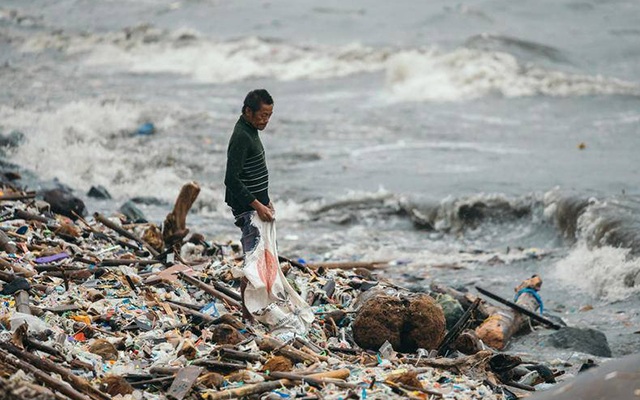
A clean-up of Manila Bay is underway, as the its shores were covered in heaps of wet trash, brought about by the onslaught of Typhoon Karding last August. Photo credit: Greenpeace Philippines
An extensive clean-up has kicked off at the badly polluted Manila Bay, Philippines, expected to cover 190km of coastline and a scope that includes sanitation infrastructure, resettlement and long-term education.
An industry source, requesting anonymity, said the Bay’s stench and brackish waters are a setback to cruising and there were several instances when hotels were heavily damaged by storm surges and flooding.
Shores of Manila Bay covered in trash brought in by Typhoon Karding last August (photo credit: Greenpeace Philippines)
“Even the famous sunset over Manila Bay is affected by pollution and tons of trash swept on the shore after the typhoons (have not been) good for our image,” he complained.
Manila Bay’s clean-up kicked off with the closure of several restaurants and other establishments found to have violated environmental laws by dumping their waste on the bay. On January 27, thousands of volunteers retrieved large amounts of trash from the bay.
Environment secretary Roy Cimatu announced the three phases of the rehabilitation: clean-up and improvement of water quality, rehabilitation and resettlement, and education and sustainment.
There’s no timeline yet for the mammoth project for Manila Bay which snakes around 190km of coastline, spanning three regions including National Capital Region to which Manila belongs.
The rehabilitation of the Bay will be on a larger scale than the ongoing clean-up of Boracay, as it is expected to also involve cleaning waterways, updating old sewer lines, relocating informal settlers, sustained law enforcement and monitoring, among other things.
“We support the initiative to clean up Manila Bay, one of the attractions of the capital. It’s a long time coming,” said Jojo Clemente, president, Tourism Congress of the Philippines (TCP).
“I’m really liking that businesses are now being called out for years of environmental damage. I hope this continues and that those found to have (inadequate or no) waste management systems are held accountable,” he continued.
Ritchie Tuano, newly elected president of the Philippine Travel Agencies Association (PTAA), said that “in principle, we support any initiative of the government that promotes and improves tourism”.
TCP plans to meet up with tourism stakeholders, while PTAA will organise a meeting with its members to tackle the Bay’s rehabilitation.
At least five tourists died in a single week, compared to 71 reported deaths in the whole of 2017, according to some reports
An unusual spate of reported tourist deaths in the Maldives has prompted the government to review safety standards and step up inspection of resorts, hotels and guesthouses.
In the December 2018 to January 2019 period alone, at least six tourist deaths and fires at five resorts were reported. Industry sources said that in most cases, deaths were from fire or drowning.
At least five tourists died in a single week in January, compared to 71 reported deaths in the whole of 2017, according to some reports
Authorities acknowledge need for more stringent, up-to-date regulations
“We have decided to inspect all tourist facilities in the Maldives in the next six to eight months. Regular monitoring must be done to ensure that regulations are followed. Some of these regulations are very outdated. They need to be modernised,” tourism minister Ali Waheed told reporters last week.
A special committee has been formed on the advice of president Ibrahim Mohamed Solih to address concerns, and review regulations, on operating resorts, guesthouses, travel agencies, as well as rules about water sports and fire safety.
Nature to blame?
Travel and hospitality players suggested that the higher accident rate may be linked to what they claim to be stronger currents that the Maldives has been experiencing recently.
President of the Maldives Association of Travel Agents and Tour Operators (MATATO) Abdullah Ghiyas remarked that currents were unusually strong this year, even in areas considered to be safe.
Meanwhile, president of Guesthouse Association of the Maldives, Abdul Karam, said the number of deaths in a single month was disproportionately high compared to his yearly estimates.
The association has been reminding members to stay vigilant in light of stronger water currents these days, according to Karam.
In October, three water villas were damaged in a fire at Adaaran Hudhurafushi. At another resort, a fire last month tore through seven water villas, a restaurant and a kitchen.
The cause of the fires have not been determined yet, and the resorts in question declined to comment, while authorities are still probing the incidents.
Karam surmised that strong winds could have accelerated the spread of fire to adjacent villas.
Can accommodation providers do better?
An unnamed tour operator remarked that the government needs to ensure that accommodation providers – particularly guesthouses – adhered to safety standards.
Karam said: “In recent times I have noticed resorts placing warnings boards and depth of the water on beaches, but (there are no staff members supervising), as guests like to have their privacy on the beach.”
For the manager of a high-end resort who declined to be named, new resorts tend to be more compliant in enforcing safety standards. The difficulty lies with older resorts, where much of the implementation hinges on whether the property has the will, or the funding to take safety more seriously, he opined.
He shared that as part of the agreement with tour operators it has contracts with (e.g. TUI, Kuoni, Thomas Cook), an independent two-day Health and Safety audit is conducted yearly. The resort has a fixed amount of time to resolve any issues that come up in the audit. Otherwise, the contract will be “under threat” and the tour operator could remove the resort from its programmes.
In early January, a Russian tourist drowned during a diving trip, adding to incidents in December which included the drowning of a Czech Republic national and a Korean man near resorts. Also in January, a Filipino couple drowned off a resort island.
The most recent reported tourist incident was on January 29, when a Chinese guest was found dead in his room at Paradise Resort, apparently due to a heart attack. On the same day, five water villas caught fire at the Taj Exotica Resort and Spa.
KAOHSIUNG, TAIWAN -- SEPTEMBER 29, 2018: Members of the indigenous Amis tribe in traditional costumes participate in the yearly harvest festival. - Image
The Asian Ecotourism Network (AEN) and Taiwan Ecotourism Association (TEA) have signed a joint declaration outlining the judicious management of indigenous peoples while reaping benefits for the ecotourism industry and communities alike.
The two organisations came together to carve out a set of sustainability principles on which mountain ecotourism can be built. This was at the end of AEN members’ five-day visit to central Taiwan, where the last three days were spent on inspecting indigenous villages and tourism offerings in the popular Alishan mountains.
Members of the indigenous Amis tribe participating in the yearly harvest festival in Kaohsiung, Taiwan
Masaru Takayama, chairperson of AEN, said association members will refer to the declaration as part of the “compulsory standards” as they engage in sustainable tourism.
“A lot of times, nature-based activities can overlap with the ancestral land of the indigenous communities. We find it vital to share the benefits and foster mutual respect when practising any types of tourism,” explained Takayama.
The AEN delegation comprised board and ordinary members from 12 countries including Cambodia, Thailand, Hong Kong, India, Japan, Laos, Malaysia, New Zealand, Singapore and Taiwan.
Speakers from these countries addressed attendees of the inaugural AEN Taiwan Conference themed Mountain Ecotourism and Indigenous People, held at the Chukou Visitor Centre in Alishan National Scenic Area Administration on January 19, 2019.
“It has been a great opportunity for AEN to ponder upon the issues related to mountain ecotourism and indigenous people. Asia is known for its biodiversity but at the same time we also embrace diversity in human races, ethnicity, culture, etc.,” said Takayama.
“We hope that other practitioners will also embrace the declaration to ensure our assets be passed on to the generations to come,” he added.
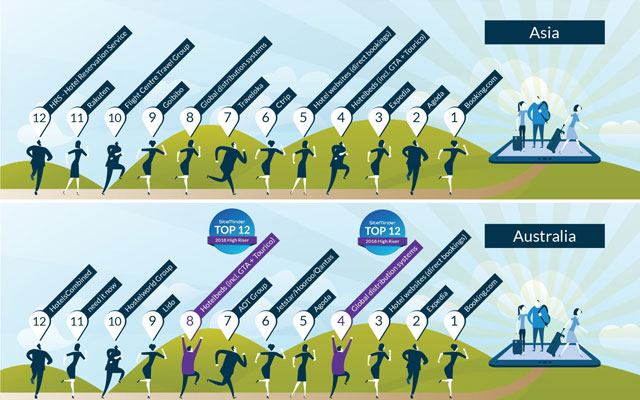
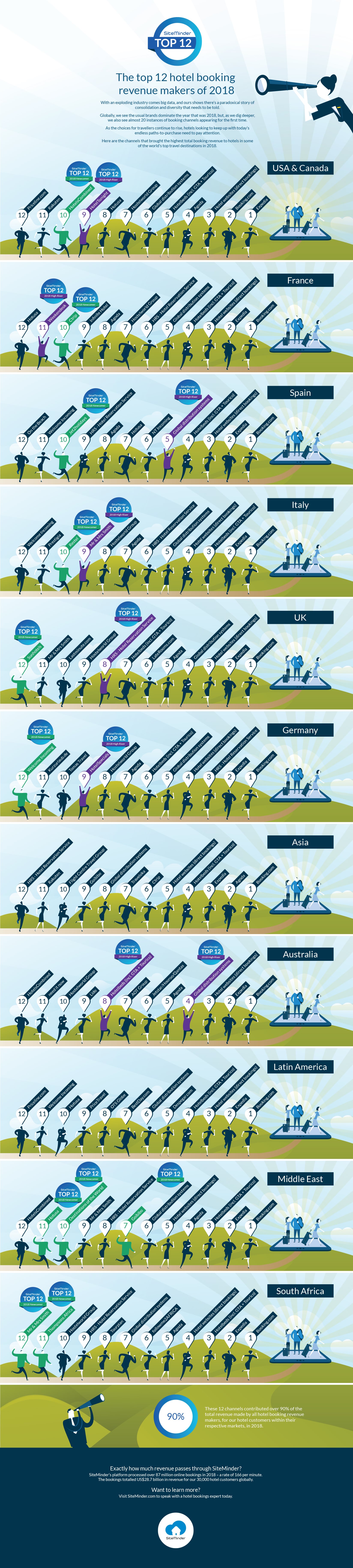
SiteMinder, provider of guest acquisition software solutions for the hotel industry, has unveiled its 2018 rankings of the channels that brought the highest booking revenue to hotels in some of the world’s top travel destinations.
Varying from direct hotel websites to a new host of third-party channels, the diversity of the lists this year reflects a rise in consumer choice that is forcing hotels to compete for business on more booking channels than before, the company said.
SiteMinder’s managing director, Mike Ford, said the increased diversity is also indicative of a booking landscape that has exploded in recent years and is showing no signs of slowing.
“This year we found almost 20 instances of booking channels making a first-time appearance in our lists. So, while the more popular brands continue to dominate, we are seeing a broader range of players emerging. This trend reflects not only the growing list of options now available to travellers booking their stay, but the subsequent need for hotels to be on more booking channels than ever to keep up with today’s endless paths-to-purchase.”
Based on total gross revenue made for those customers, the top 12 hotel booking channels in 2018 were:
Citing figures from Euromonitor International, SiteMinder shared that global online hotel sales surpassed US$264 billion to represent 170% growth in the last decade, including over 13% over the past year alone.
“While 2018 saw tourism slow in parts of the world, we are undoubtedly in an age where the travel industry, as a whole, is exploding. Yet, the growth we are witnessing in online hotel sales is one story that remains largely untold. Hotels are key enablers of travel and what our findings show is the unlocking of economies everywhere, from the outbound Chinese and Japanese markets to lesser known travel markets across Europe,” said Ford.
SiteMinder’s platform processed over 87 million online bookings in 2018 – a rate of 166 per minute. The bookings totalled US$28.7 billion in revenue for its 30,000 hotel customers globally.
ATM2018 takes place at the Dubai World Trade Centre this April
Reed Travel Exhibitions, organiser of the annual Arabian Travel Market (ATM) showcase in Dubai, has announced the launch of Arabian Travel Week – an umbrella brand comprising four co-located shows, including two that are debuting in the emirate this year.
Taking place at the Dubai World Trade Centre from April 27 to May 1, the Arabian Travel Week will include two first-time events – Connect Middle East, India and Africa 2019, a route development forum, and the consumer-led ATM Holiday Shopper.These will join Reed’s existing ATM and ILTM Arabia.
The Connect route development forum and a B2C sales event head to Dubai for the first time; Dubai World Trade Centre pictured
On April 30 and May 1, Connect Middle East, India and Africa will bring together airports, airlines and aviation suppliers in a format that offers one-to-one pre-arranged meetings, industry seminars, as well opportunities to mingle with existing clients and engage with new ones.
ATM Holiday Shopper, a one-day event happening on April 27, will see 30 travel and hospitality exhibitors offering discounted products to consumers.
At this year’s ATM, an annual event for the Middle East inbound and outbound travel industry, over 2,800 products and destinations from around the world will be showcased to over 28,000 buyers and travel trade visitors. The 2019 show will spotlight technology and innovation, integrating the theme across all show verticals, planned activities and seminars.
In its third edition, the International Luxury Travel Market Arabia (ILTM) will return on the first two days of ATM.
Other highlights taking place over the course of Arabian Travel Week include the UNWTO Ministers Summit which will be held on April 28 on the Global Stage; the Hotel Industry Summit; The Global Halal Tourism Summit and a dedicated Saudi Arabia Tourism Session.
Oakwood has partnered Amadeus’ TravelClick in a revamp of its reservations platform that allows consumers to make immediate online bookings.
“Our customers have asked for more streamlined solutions with fewer points of contact, real-time booking, and more transparency in pricing. Our new global reservation system will achieve those goals by providing a single, integrated system for pricing and inventory globally,” said Chris Ahearn, Oakwood’s CEO, in a statement.
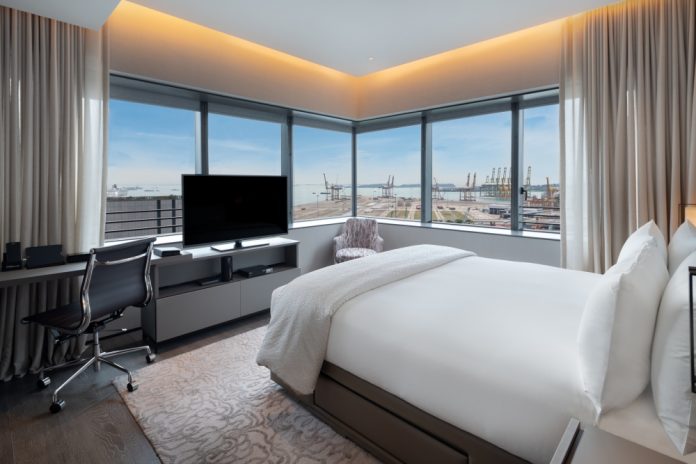
Oakwood Premier OUE Singapore – One-Bedroom Apartment
The partnership enables more seamless integration with mainstream travel and online booking platforms, as well as travel management platforms. According to Ahearn, the long-term deal with TravelClick represents “an important next step” in the serviced residences company’s technology initiative.
TravelClick’s proprietary iHotelier Booking Engine 4.0 provides a centralised e-commerce platform that enables Oakwood to guide guests through the booking process with interactive message displays, and targeted merchandising and add-on services.
In addition, TravelClick’s mobile-friendly experience will integrate into Oakwood’s recently-launched mobile app.
Hilton has moved its Asia-Pacific headquarters to Centennial Tower, adjacent to Millenia Walk and in the same integrated development as Hilton’s Conrad Centennial Singapore in the city’s CBD.
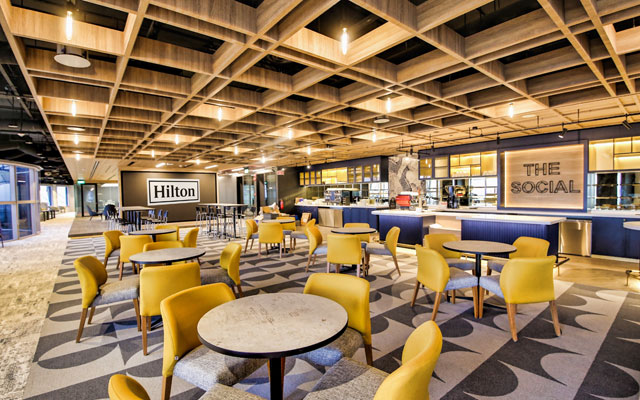
The new, custom-built office space spans three floors, and boasts a new façade, ocean views, spacious communal areas and meeting facilities with up-to-date technology.
Social space at the new HQ
From the new headquarters, Hilton manages its five subregions of Asia-Pacific, from India to Japan, China and Australasia. Centennial Tower is also home to the company’s South-east Asia office.
Alan Watts, president, Asia Pacific, Hilton, said the move creates a more “inspirational and inclusive environment” for team members.
The relocation comes amid a period of rapid growth for the company, which celebrates its 100th anniversary in May 2019.
Having doubled its footprint in Asia-Pacific in recent years, Hilton now has more than 750 hotels open and under development in the region, and for the first time will open more than 100 hotels a year in 2019.
Avani+ Samui, Thailand
This seaside resort on Koh Samui’s south-east shore by Taling Ngam Bay has opened, offering guests a choice of 25 guestrooms, 27 private pool villas, or six beachfront pool villas. Recreational facilities include the AvaniSpa, and swimming pool, while activities include island hopping, snorkelling, hiking to waterfalls, beach yoga, stand-up paddle-boarding, and mountain biking. There are also three F&B venues on-site.
Wyndham Grand Yangon, Myanmar
Rising on the shores of Kandawgyi Lake, this 20-storey, 291-key hotel forms part of the Kantharyar Centre, a new mixed-use project. Facilities include two restaurants, two bars, a fitness centre, spa, and an outdoor pool which offers views of the Kandawgyi Lake. For corporate guests and event planners, the hotel provides a 500-pax Grand Ballroom with a huge LED screen, five meeting rooms with a pre-function space for cocktail receptions, as well as an outdoor garden. The hotel also offers a shuttle service downtown, to landmarks such as Sule Pagoda and Bogyoke Market.
Iraph Sui, a Luxury Collection Hotel, Miyako Okinawa, Japan
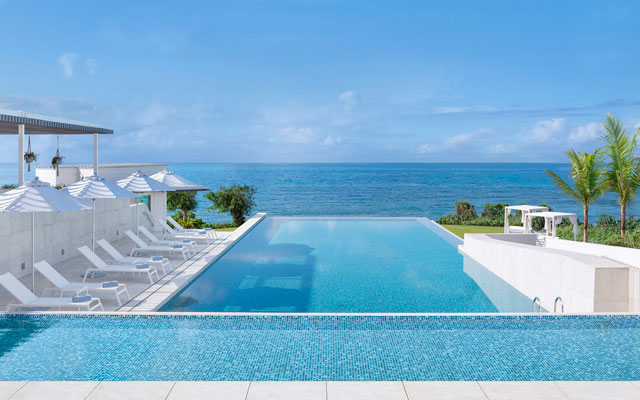
Iraph Sui has opened on Irabu Island, Okinawa, becoming the third hotel in Japan to join Marriott’s Luxury Collection. The seafront property offers 58 rooms ranging from 46m2 to 120m2, with several suites also featuring private swimming pools. Aside from international restaurant Tin’In, the property also has a spa and infinity pool. Guests can also arrange for excursions to nearby beaches or go scuba diving in the Okinawan Ocean.
Canopy by Hilton Chengdu City Centre, China
Hilton has introduced the Canopy by Hilton-brand to Asia-Pacific with a launch in Chengdu. Located next to Tianfu Square, the property offers 150 Just-Right rooms ranging from 50m2 to 100m2. Guests will be able to avail facilities such as the 24-hour fitness centre on the 32nd floor, two F&B options, and the all-day Canopy Lounge. The new property also boasts a Transfer Lounge, said to be the first-of-its-kind in China, where guests with early arrivals or late departures can use facilities including luggage lockers, a private changing cabin and showers. There are also complimentary bikes for hire.
Holiday Inn Express Singapore Serangoon
The latest opening by InterContinental Hotels Group offers 119 guestrooms in the vicinity of the Little India district. Amenities include a 24-hour gym, restaurant, meeting room, self-service business centre, Internet stations and a laundry room. Hotel guests will also enjoy a free buffet breakfast, as well as free Wi-Fi throughout the property.
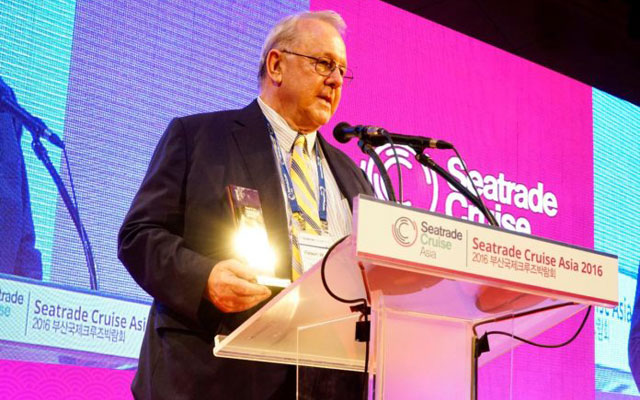
After nine years at Destination Asia that involved opening the Singapore office in 2010 and then Malaysia in 2011, Bob Guy has decided to fully step down at the company to enjoy retirement.
It was announced last year that he was concluding his role as managing director of Destination Asia in Malaysia and in Singapore. The latest announcement marks his full departure from the company’s Asian inbound, DMC, meeting and events and cruise business segments.
Guy speaking at a cruise event in 2016
At Destination Asia Malaysia, Guy is succeeded by Sadie Yeoh, general manager, who has led a team in the office since 2011. Yeoh will drive forward new initiatives to further develop the key sectors. She oversees all business activity from the four operational offices located across Malaysia (Kuala Lumpur, Penang, Langkawi and Kota Kinabalu).
Guy has had a 50-year career in the travel industry, with roles in the US, the Fiji Islands, Australia and numerous Asian countries including Singapore, where he was been based for nearly 40 years. His DMC experience began in Fiji in 1973.