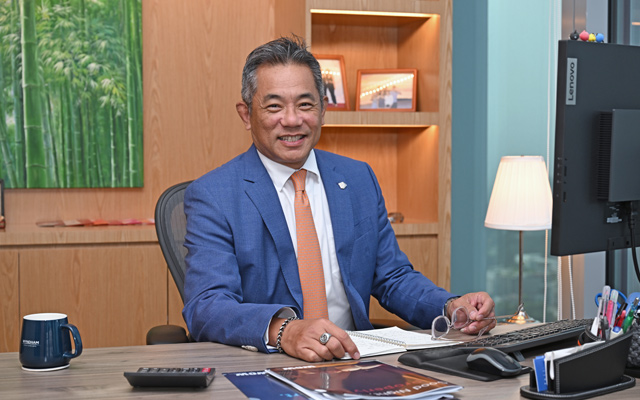
Joon Aun Ooi, president, Asia-Pacific at Wyndham Hotels & Resorts, believes that regional success stems from perfecting the art of hotel franchising, developing essential hardware and software that every traveller values, and keeping an open mind to new ideas that elevate guest experiences and hotel operations
 What do you see are Wyndham’s biggest growth opportunities over the next five years, and what strategic priorities will be key to capturing them?
I’ll start by saying that we are blessed because we are working in a very dynamic, fast-growth region. In Asia-Pacific, where the GDP has been growing about five per cent on an aggregated basis, the travel and tourism industry is forecasted to continue growing at about four per cent.
However, there are more than 20 different markets and territories in this region. Each market and territory is at different stages of growth. Yet, the beauty is the diversity of the market, and that has created a lot of opportunities for us.
We have signed more than 500 direct franchise and managed hotels over the past few years, and are on a strong trajectory of growth.
With regards to the sort of strategies in terms of moving forward, I’ll answer this question from two dimensions.
To grow the supply side, we need an arsenal of different strategies to deal with the different markets across Asia-Pacific. In Australia and New Zealand, there are predominantly conversion opportunities while in Vietnam we see many new builds. Singapore, given the land scarcity, presents more conversions and asset repositioning than new builds.
There is a common denominator among our different strategies. One, we are a leader in franchising; we have been doing it for many years in this part of the world, and we truly understand what it takes to do franchising.
Two, we have a collection of 25 iconic brands around the world. In this part of the world, about 19 have been deployed, and they range from upper-upscale luxury to extended stay.
Three, we bring the Wyndham Advantage, which is a collection of sales programmes, loyalty activities, digital marketing, digital distribution, and many other commercial tools that allow a franchisee to tap into our system to gain revenue.
Four, our business philosophy puts owners first.
Now, to grow the demand side, we recognise the complexity of consumers and that consumers have evolved rapidly. People used to travel and stay in hotels. Now, they are looking for experiences, which is more than simply seeing an attraction. People are also travelling in different ways – with immediate and extended family, with friends, alone, or as a leisure extension of their business trip. Furthermore, every source market in this region is different too.
So, we make sure that we are relevant to every traveller type. We want Wyndham to be the lifestyle companion of every guest on each of their journeys. Under the leadership of Eyvonne Lin (vice president of marketing and commercial performance, Asia Pacific), Wyndham has forged a lot of partnerships for our Wyndham Rewards loyalty programme that result in activities to enrich the travel experiences of our guests.
Wyndham offers both the franchise model and the management model. How do you determine which model is ideal for a specific owner?
First of all, we advocate franchising, because to us, it is the more cost economical model for the owner. Basically, the owner runs the operations as the game fits while still enjoying access to the Wyndham Advantage.
However, some owners may lack the experience to run the hotel themselves, and would therefore like us to manage it for them.
If you look across the markets, there are a lot of competitors who are very focused on management, and they push for that whether or not the owner wants it. But for us, we listen to what the owners want.
Does the franchise model work in Singapore, where it is a struggle to find the right people to run hotels? Would it be easier for the owner to leave hotel management to the experts and they just deal with the real estate?
Good question. I look at the labour issue this way: it is not a problem unique to Singapore. With all franchising, we look at the owner’s experience in hotel management. In the case of Singapore, owners here have extensive experience and so the franchising model works for them.
Now, on talent acquisition, we face the same tight market. If we are managing, we are responsible to hire. In a franchise arrangement, the owner is responsible. But that doesn’t mean we walk away and say, “your problem, not mine”. If the owner fails to hire, service will be impacted, our brand will be impacted. So, we still do provide support in talent acquisition.
What does Wyndham’s current and upcoming Singapore portfolio look like, and how does Singapore function as a hub for the group’s broader Asia-Pacific strategy?
Singapore is a vital market for Wyndham in Asia-Pacific, serving both as a premier global business hub and one of the region’s most connected travel gateways.
Our portfolio in Singapore spans a healthy cross-section of the market, catering to diverse traveller needs. At the upscale end, Wyndham Singapore Hotel caters to business, leisure, and MICE guests seeking prime city accommodation. Hotel Traveltine Downtown Singapore, Trademark Collection by Wyndham, offers a distinct lifestyle experience, while Days Inn by Wyndham Singapore Novena delivers trusted, value-driven comfort for practical travellers.
We hope to announce new developments in the near future, but our priority is always quality and sustainable growth over rapid, unchecked expansion. Every new property we introduce must enhance our overall brand awareness and bring tangible value back to our existing owners, rather than diluting the market.
Beyond hotels, Singapore functions as a critical hub for regional innovation and partnerships. Our landmark collaboration with Singapore Airlines KrisFlyer is a testament to this, strengthening the Wyndham Rewards ecosystem by connecting hospitality and airlines to create greater value for members and travellers.
You spoke earlier about the evolution of travellers. I see their expectations moving from prioritising convenience and price to seeking personalised, experience-led stays. How has this evolution influenced product design in your pipeline projects?
We have the technical services team that works closely with owners to design hotels. I have seen the shift in the range of technical services this team provides to owners over the past 20 years. It used to be just advice on building the room this way and that. Now, the team has to advise on the colour and design of the room so as to fit the theme of the hotel or the local culture or history, sustainability features, structure and location of gyms, and so on.
With conversion projects, hotel design is more restricted. There’s only so much you can do, but we try our best to incorporate (modern features that customers today and in the future would want).
Lastly, as a hotelier, what do you pay close attention to when you travel on personal time, and have your observations led to new ideas being implemented to Wyndham’s hardware and software?
When I travel, I make a conscious effort to experience a hotel as a guest first, not as an operator. This is not always easy, as I naturally notice the operational details behind the experience. I try to set those instincts aside and allow the stay to unfold as it would for any other guest. This gives me a clearer sense of what feels effortless, where friction arises, and what ultimately stays with me after I leave.
It’s often the small details that leave the lasting impression – how intuitive the arrival journey feels, whether technology genuinely makes the stay more seamless, how public spaces encourage guests to connect, and, most importantly, whether the service feels authentic rather than scripted.
One experience that comes to mind was a hotel where the front desk consisted of individual square tables rather than a traditional counter. The monitor was recessed beneath a glass surface, and the team member checking me in was standing adjacent to me, rather than on the opposite side behind a counter. It was a relatively simple design decision, but it removed a physical barrier and made the interaction feel more open, engaging and personal.
Observations like this influence how I think about both the physical and digital aspects of the hotel experience. The best hardware and software should remove friction and make it easier for guests and team members to connect. This may involve rethinking the arrival experience and the use of public spaces, or introducing technology that simplifies check-in, communication and other parts of the stay.
Not every observation translates directly into a new brand standard, but each one encourages us to challenge established ways of working. As we evolve Wyndham’s brands, we consider how these ideas can enhance the guest experience while remaining simple to operate and capable of delivering long-term value for our owners.
For me, travel remains one of the best ways to see our industry through the eyes of the guest. That perspective is essential to making better decisions.