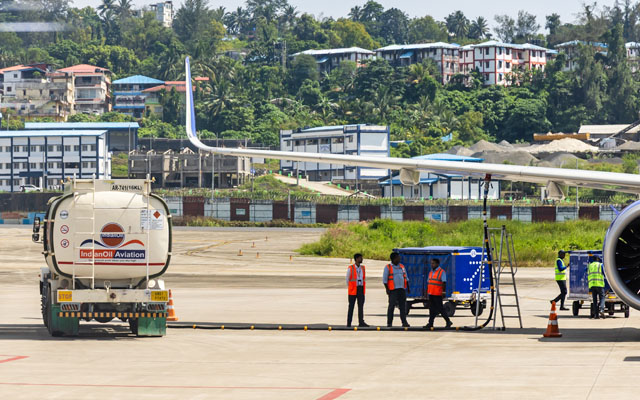
The Indian Union Cabinet, chaired by prime minister Narendra Modi, last week approved a one-time budgetary support package of 100 billion rupees (US$1.17 billion) for Oil Marketing Companies (OMCs) to help stabilise Aviation Turbine Fuel (ATF) prices for Indian airlines operating domestic and international flights.
The support will be provided as interest-free advances to OMCs and comes as Indian airlines grapple with rising operating costs. Industry stakeholders and aviation analysts believe the measure could provide short-term relief for carriers.
Subhash Goyal, chairman of STIC Travel Group and chairman of the aviation and tourism expert committee of the Indian Chamber of Commerce (ICC), said: “The budgetary support will help airlines avoid steep increases in airfares, therefore keeping air travel more affordable for passengers. While this initiative may not eliminate the challenges arising from high global fuel prices, it is certainly a positive step that can provide short-term stability and support the growth of the Indian aviation industry.”
According to Mayur Patel, OAG Aviation’s commercial and industry affairs leader for Asia-Pacific and the Middle East and Africa, the Indian aviation sector is facing several pressures simultaneously.
“When fuel already accounts for roughly 40 per cent of airline operating expenditure under normal conditions and can climb towards 60 per cent under extreme market stress, the arithmetic of running scheduled services simply breaks down,” Patel said.
He noted that airlines are contending with three major challenges: higher crude oil prices linked to the West Asia crisis, rupee depreciation that is increasing fuel procurement costs, and longer international flight paths following the closure of Pakistani airspace.
“The impact is already visible in airline capacity decisions. Air India has reportedly cut up to 22 per cent of domestic flights over a three-month period while IndiGo has reduced domestic capacity by five to seven per cent and international capacity by 17 per cent,” Patel stated.
Pushan Sharma, director at Crisil Intelligence, noted rising fuel prices continue to weigh on the sector’s profitability and growth prospects.
“Passenger traffic is expected to see only marginal growth in the current fiscal year as rising fuel costs keep airfares on the higher side. While Indian carriers are benefiting from capped ATF prices, up by 15 per cent only compared to doubling of ATF rates globally, still the pressure on sector profitability remains significant,” Sharma said.
Goyal added that airlines continue to face the challenge of balancing higher operating costs with the need to maintain affordable fares and support passenger growth.
While welcoming the government’s support package, industry experts said long-term structural reforms remain necessary.
Patel highlighted the need to bring ATF under the Goods and Services Tax (GST) framework to reduce the tax burden on airlines.
“The combined effective tax burden on ATF for domestic operations sits at approximately 24.9 per cent of the final inclusive price and because ATF was deliberately excluded from the GST framework when it launched in 2017, airlines cannot claim input tax credit on a single rupee of fuel tax. Every litre burned on a domestic route carries an embedded tax cost that no other comparable industry in India faces on its primary input,” Patel said.