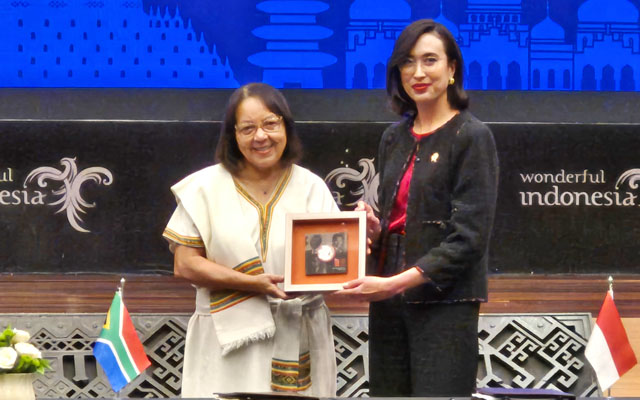
Indonesia and South Africa have agreed to strengthen synergy across a range of strategic tourism sectors, marking a new chapter in both nations’ commitment to building a resilient, inclusive and sustainable tourism industry.
The collaboration was formalised with the signing of a memorandum of understanding (MoU) between Indonesian minister of tourism Widiyanti Putri Wardhana and South African minister of tourism Patricia de Lille in Jakarta, as part of de Lille’s official visit to South-east Asia.
Widiyanti said the partnership builds on a 2015 bilateral agreement, which remains the foundation of the two nations’ diplomatic relations.
“This MoU reflects a shared commitment to strengthening tourism cooperation as a driver for economic growth, cultural exchange, and deepened mutual understanding between the people of our two nations,” Widiyanti said.
The partnership’s first concrete priority is enhancing accessibility, involving high-level coordination between the Ministry of Transportation and the private sector.
It also revives the spirit of the 1955 Asian-African Conference held in Bandung, which underscored the importance of solidarity, mutual respect and collaboration among Global South nations. The strengthened bilateral relationship is seen as a tangible continuation of that legacy.
Martini Mohamad Paham, deputy for tourism resources and institutions at the Ministry of Tourism, said the ministry will coordinate with InJourney, the holding company for state-owned enterprises in aviation and tourism, to improve connectivity. This effort also extends to visa policy, following a statement by Indonesia’s vice president Gibran Rakabuming Raka during his visit to South Africa last year.
“The vice president stated that Indonesia would provide visa-free entry, which is currently still in process; at present it remains Visa on Arrival (VoA),” Martini noted.
Beyond logistics, the collaboration places a strong emphasis on sustainability and education. Indonesia aims to learn from South Africa’s expertise in managing national parks and its successful approach to educating both local communities and visitors on environmental “dos and don’ts”. On the education front, Indonesia’s six tourism polytechnics will participate in exchange programmes.
“We will learn from one another regarding hospitality and tourism development, as well as MICE,” Martini said.
The two countries also plan to advance their digital and promotional strategies, with South Africa expressing strong interest in participating in the Bali & Beyond Travel Fair in Bali in June, following its participation at the ASTINDO Travel Fair in Jakarta last week.
Planned initiatives include joint familiarisation trips, digital marketing collaborations and exhibitions to increase visibility in both markets. While South Africa is not yet a top-tier destination for Indonesian travellers, Martini highlighted its strategic importance as a gateway to the African continent.
“Both countries believe that the signing of this MoU will strengthen bilateral tourism cooperation while opening opportunities for a more inclusive, sustainable, and resilient sector,” Widiyanti added.
De Lille welcomed the partnership, citing the strong historical ties between the two nations.
“The signing of this memorandum of understanding will further deepen the relationship between our two countries,” she said.
During the occasion, de Lille announced that South Africa is reforming its visa system, with Indonesian citizens now able to apply for visas online via digital devices, with processing times of less than 24 hours. She also invited Indonesian travel agents and tour operators to participate in familiarisation trips across South Africa.
She added that South Africa is committed to developing halal tourism and digital-based tourism, working with the Muslim Judicial Council and relevant authorities to ensure Muslim travellers feel safe and comfortable during their visit.
Data shows that 30,000 South African tourists visited Indonesia in 2025, while Indonesian arrivals in South Africa reached approximately 3,000.
“As part of this collaboration, we aim to increase tourist numbers in both countries. Indonesians will always receive a warm welcome in South Africa,” de Lille said.