Thailand has attracted global attention by securing international mega-events, but local organisers are reflecting on whether greater long-term value could come from investing in home-grown festivals – Pongsiri “Tom” Hetrakul, founder of Awakening Bangkok, shares his perspective on the potential of domestic events
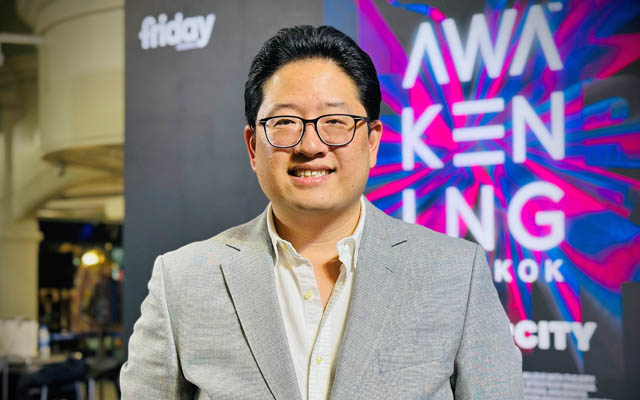
 Tell us more about the highlights of Awakening Bangkok 2025.
In the past two years, we focused on specific areas on the left side of Phra Nakhorn, like Museum Siam, Saranrom Park, and areas near to Bangkok. This year, we’re focusing on over 20 locations on the right circuit – landmarks like Yodpiman Flower Market, Khlong Ong Ang and Saphan Phut. We’ve highlighted new areas, because the Awakening Festival fanbase wants us to bring them to new locations.
This year, we’ve embraced a simple and approachable message centred on love, which inspired our theme: Lovevercity. After last year’s festival, I noticed a surge of TikTok content highlighting how romantic the atmosphere felt, often set to love songs. Taking a cue from our audience, we decided to lean into that energy and curate this year’s event specifically for couples and those celebrating love.
Thailand has invested heavily in bringing in global events like Tomorrowland. How do you view this strategy?
For foreign-owned events, people fly to Thailand to attend and book hotels. But ultimately, the money flows out of the country. We are paying license fees and supporting brands that aren’t ours. The government celebrates the numbers, but it’s not truly sustainable. If even a fraction of that budget went into home-grown events, Thailand could build its own world-class cultural draws that keep revenue here and strengthen our soft power.
What’s the current reality for local organisers like yourself?
Independent festivals rely on small grants and sponsorships. Meanwhile, state-owned celebrations don’t face the same commercial pressures, because they’re run by the government. The problem is that instead of empowering private organisers with funding and facilitation, the state has become an organiser itself. Budgets go into government-run events, with very little support reaching those of us who are innovating in the private sector.
You’ve drawn comparisons to global benchmarks like the Olympics and Vivid Sydney. What do these examples show?
Governments are willing to spend billions to host the Olympics, even though it’s a one-off event. In contrast, Sydney’s Vivid festival, which is backed consistently by public investment, attracts 2.4 million visitors every year – almost on par with the 2.7 million expected for the Tokyo Olympics (before Covid-19). That shows what’s possible when you build your own event. Thailand should focus on inventing our own Olympic-scale festivals instead of renting someone else’s brand.
What makes Bangkok, in particular, well-placed to develop these kinds of festivals?
Bangkok is already one of the world’s top cities for night tourism. We welcome 25-30 million visitors a year, and they want to go out after dark: to see, eat, and experience. Our cultural depth, heritage districts, and creative energy make us a natural stage for lighting and cultural festivals. Unlike cities that rely on generic backdrops, Bangkok offers authenticity. We have the raw material to stand alongside the world’s cultural capitals if we invest wisely.
What is the main challenge to achieving this vision?
Time and consistency. Festivals don’t become global attractions overnight; it takes about 10 years to build a true mega draw. But in Thailand, government transitions every few years often disrupt cultural strategies, leaving projects vulnerable to gaps in support. 10 years can pass quickly – if we don’t act now, we’ll miss the chance to create world-class Thai festivals that belong to us.
What’s your ultimate message to policymakers?
Stop thinking only about imported spectacles. Home-grown festivals generate the strongest soft power because they reflect our identity and keep money in the country. Thailand has the talent, the culture, and the audience; we just need long-term commitment. If the government can shift even part of its resources to nurturing private organisers, we can create something every bit as powerful as Tomorrowland, and it will truly be ours.
How do festivals like yours help to support the Tourism Authority of Thailand and Bangkok Metropolitan Authority’s focus on the night-time economy? What are some of the trends that you’ve observed on the festival scene?
There is a growing sense that people in Thailand are eager to reclaim the streets. While our malls are world-class, Bangkok is a city dominated by vertical architecture and enclosed spaces. People are looking for a change of pace; they want to walk on level ground, under an open sky, and experience the city’s natural breathability in a wide-open landscape.
Additionally, Bangkok is a city that’s very beautiful once it’s illuminated. There are so many corners, angles, and silhouettes revealed once light is shone on them. Lighting festivals draw people out to walk about at night and in the evenings. They are also very suited for year-end. Awakening Bangkok 2025 brought over 17,000 visitors per day over a 10-day period from December 12 to 21 last year. The 2024 edition brought over 20,000 visitors per day.
What other projects do you have in the pipeline?
Based on the demand, I’m trying to create a lot more festivals. We hosted the Overland Inflatable Art Festival in late December 2025 at the Chulalongkorn University Centenary Park with Nylon Group. With lights off, the park was illuminated by luminescent inflatable art structures.
We also have another festival called Bangkok Music City with eight stages located around Charoenkrung on January 23-25, 2026. With every event, we try to focus on the cityscape. We highlight different spots in the city for people to walk around.
In 2025, we launched the first edition of Awakening Song Wat, and we will reprise it this year. We plan to bring back Awakening Chiang Mai around May 2026, and Awakening Bangkok around the beginning of December.