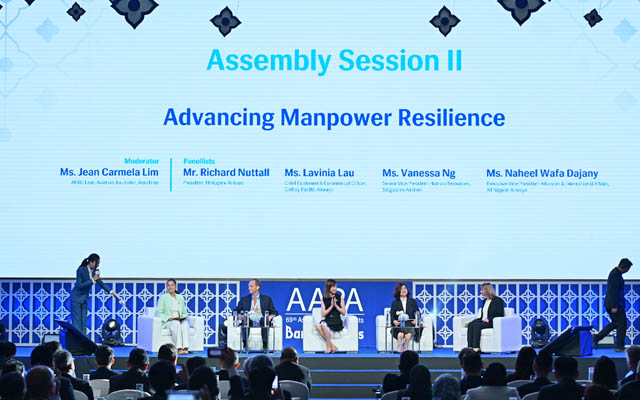
Asia-Pacific airline leaders are refining workforce strategies as the region faces a tight labour market and a widening generational divide.
“Asia-Pacific will need approximately 300,000 pilots, 70,000 air traffic controllers, 300,000 aircraft maintenance engineers and 500,000 cabin crew by 2037,” International Civil Aviation Organization (ICAO) regional director Tao Ma stated at the AAPA 69th Assembly of Presidents. “As of today’s situation, many countries in the region cannot produce that many aviation professionals unless we start to prepare this workforce now,” he warned.
To support this, ICAO has completed a regional training needs survey and developed a training programme to support the Asia-Pacific roadmap. Airlines, however, also face shifting career expectations.
Cathay Pacific Airways chief customer and commercial officer Lavinia Lau said younger workers must be engaged earlier.
“One of the ways to tackle this is to really inspire and engage youth at the very beginning,” she said, noting the airline’s I Can Fly programme, which introduces students to operations, crew and engineering roles. Lau pointed out that “around 30 per cent ended up joining the aviation industry, and among the 30 per cent, 50 per cent joined Cathay”.
Lau added that the programme highlights the breadth of aviation careers. “In the beginning, everyone says (they want to be) a pilot or cabin crew, but after the programme, many tell us they want to be customer service representatives or engineers,” she shared.
Singapore Airlines (SIA) senior vice president for human resources Vanessa Ng said millennials and Gen Z already form 65 per cent of the airline’s workforce.
“They look for pro-growth and pro-balance. Lifelong employment is not something they care very deeply about,” she said.
SIA launched its Soar Higher Together employer-branding campaign, centred on “a sense of pride”, “learning and growing” and a flexible culture.
Ng continued: “We offer opportunities for people to transition into new areas, and even no-pay leave so they can care for their families. These value propositions set us apart and resonate strongly with the new generation. They are credible, sustainable and aligned with our enterprise values, which is what enables us to stay competitive in this talent war.”
For Philippine Airlines, generational gaps manifest differently. President Richard Nuttall remarked the carrier manages a split workforce.
“Some of them see that they can go elsewhere and earn more money,” he said, but argued mobility should be embraced. “Let them go, learn, and gain experience… many of them will eventually return with broader skills and perspectives, and the industry can benefit by welcoming them back.”
Naheel Wafa Dajany, executive vice president for alliances and international affairs, All Nippon Airways (ANA) said Japan faces an ageing workforce. ANA is raising pilot age limits and accelerating digital tools. “Right now 85 per cent of our employees work beyond the age of 60,” she said.
The airline recorded 650,000 use cases of generative AI in June 2025. “This helps us look forward to ensuring a sustainable, resilient workforce in the future,” she added.
As airline executives discussed strategies for new-generation talent, the message was clear: aviation must rethink how it presents itself.
Ng concluded: “A strong employer brand narrative is important. It’s appealing to the new generation, it’s credible, and it’s symbiotic to our enterprise value to win in this talent.”