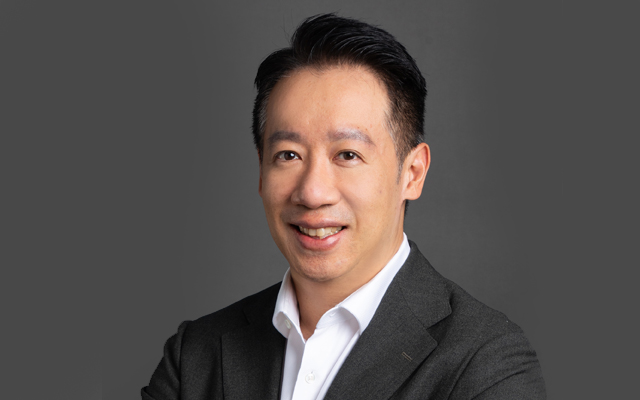
Kenny Toy joins Rosewood Hotel Group as senior vice president, commercial, global, based in Hong Kong.
Reporting to COO Anthony Ingham, Toy will oversee the group’s global commercial strategy, including sales, marketing, distribution, revenue management, partnerships and e-commerce.
Toy has more than 20 years of experience in commercial strategy, marketing and digital transformation, and joins Rosewood from Accenture Song.
The Japanese government has pledged to promote travel to Kyushu in response to the devastating losses incurred by its tourism industry following a magnitude-7.1 earthquake that struck Kumamoto Prefecture on July 28.
Central eastern towns, including Uki and Hikawa, were hardest hit, though other parts of the prefecture and neighbouring areas also experienced strong or moderate shaking.
The Mount Aso area in Kumamoto remains unaffected by the recent earthquake and open to visitors
Damage to the buildings, equipment, and hot spring infrastructure of hotels and inns near the epicentre is estimated at four billion yen (US$25.1 million), according to the Kumamoto Prefectural Government. A further two billion yen in revenue shortfall due to cancellations by roughly 146,000 guests for trips this summer and autumn has been reported by Kumamoto’s tourism industry.
Roughly 60 per cent of the relinquished bookings were for accommodation in parts of the prefecture largely unaffected by the quake, including the popular Aso area, prompting Kumamoto Governor Takashi Kimura to urge people not to cancel trips based on fear or rumours.
Other Kyushu prefectures have also suffered cancellations. Kagoshima logged the highest number at 111,749, largely due to severed transport links and the popularity of joint Kumamoto-Kagoshima touring packages. Fukuoka followed with 28,000 cancellations, alongside Nagasaki (14,259), Miyazaki (11,357), Oita (7,810), and Saga (1,820).
With the Kyushu Shinkansen still suspended between Kumamoto and Shin-Minamata stations and operating on a limited schedule between Shin-Minamata and Kagoshima-Chuo stations, the tourism industry is bracing for further cancellations in the coming weeks.
The national government’s aid package is expected to be launched by the end of August, featuring a travel fee discount campaign for Kyushu, according to a government spokesperson.
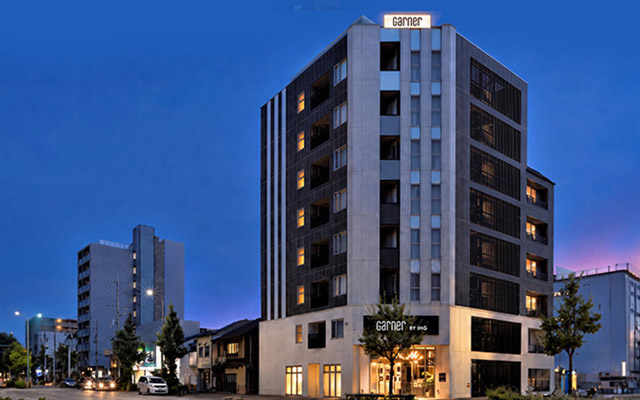
IHG Hotels & Resorts has signed a portfolio agreement with long-term partner GCP Hospitality, the hospitality arm of Gaw Capital Group, to add 14 hotels in Kyoto.
The deal covers 1,063 rooms comprising 12 Garner hotels, one Holiday Inn Express, and one unbranded hotel. All properties will undergo phased openings over the next 12 months following renovation and rebranding. The agreement represents one of the largest conversion portfolio deals in Japan in recent years.
The agreement with GCP Hospitality will add 1,063 rooms across key city districts through 12 Garner properties, one Holiday Inn Express, and an unbranded hotel
The expansion boosts IHG’s presence in Kyoto, adding to an existing portfolio that includes Six Senses Kyoto, ANA Crowne Plaza Kyoto, Holiday Inn Kyoto Gojo, and Garner Hotel Kyoto Shijo Karasuma. The properties are situated in primary districts, including areas around Kyoto Station, Shijo, and Gojo.
Commenting on the appointment, GCP Hospitality CEO Erwann Mahé said the firm was pleased to expand its partnership with IHG. He added that GCP Hospitality would manage the 14-hotel portfolio, leveraging IHG’s global scale and brand strength to reposition the properties in Kyoto.
Abhijay Sandilya, managing director, Japan & Micronesia, IHG Hotels & Resorts and CEO of IHG ANA Hotels Group Japan, said: “Following the successful Garner brand launch in Japan around 18 months ago in Osaka, this deal demonstrates the growing interest from owners to rebrand hotels and benefit from quick access to IHG’s leading enterprise, including our marketing, technology and distribution platforms, and the scale of IHG One Rewards globally.
“We are just starting to tap into Garner’s full growth potential in Japan as the business hotel segment is under-penetrated by international brands.”
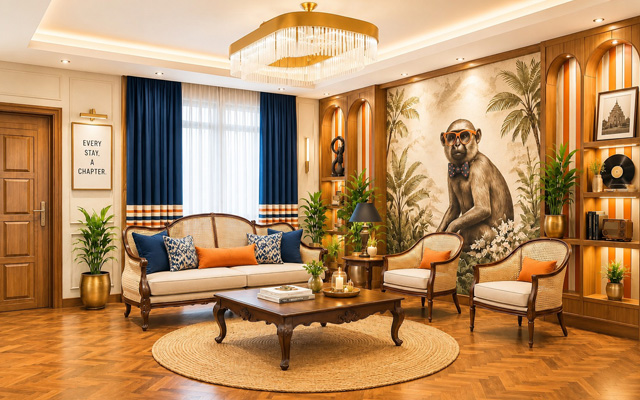
Polo Hotels Group has introduced Chapter Hotels & Resorts, an upscale boutique brand targeting younger, experience-led travellers in North-east India.
The home-grown brand debuts later this year with Chapter Lakeside, Tripura, a 17-key property situated on the shores of Rudrasagar Lake, 90 minutes from Agartala airport. Featuring views of Neermahal Palace, the resort will offer boat transfers, a lake-view pool, a poolside bar, and dining focused on regional Kokborok and Mui Borok culinary traditions.
Chapter Lakeside, Tripura, a 17-key property on Rudrasagar Lake, will mark the debut of the home-grown group’s new boutique brand
A second property, the 37-key Chapter Resort Upper Shillong in Meghalaya, is set to follow as the city’s first pool resort. The group’s expansion pipeline includes sites across West Bengal, Nagaland, and other locations in the region through owned, managed, and retrofit models.
Properties under the new brand will feature the Cassette kitchen & bar concept, serving food and beverages made with ingredients sourced from regional tea gardens, hill markets, and local growers.
Founded in Shillong in 1986 by Kishan Tibrewalla, Polo Hotels Group operates properties across three tiers: Polo Hotels & Resorts in the upscale segment, Chapter Hotels & Resorts in the boutique tier, and Max in the midscale sector.
“We called it ‘Chapter’ because every hotel opens a new part of the destination for the guest. Same brand energy, different local story. The plan is to build more soon – each with its own voice,” said Deval Tibrewalla, WTD & CEO, Hotel Polo Towers.
“Upscale is not expensive wallpaper. It is good decisions. Put the pool where the view is. Cook food from the region. Build a bar with a point of view. Keep it sharp, warm and local. That is Chapter.”
Having debuted in 2023, Hong Kong-based TTT Culture Group specialises in bridging traditional artisans, cultural knowledge, and the commercial market by building a tapestry of cultural workshops.
Founder and CEO Eric Chiang believes that Hong Kong culture should not only be preserved in museums or archives, but also experienced in daily life. The company fills this gap by supporting local artisans, designing accessible cultural experiences, and helping transform intangible cultural heritage (ICH) into meaningful education, tourism, and retail products.
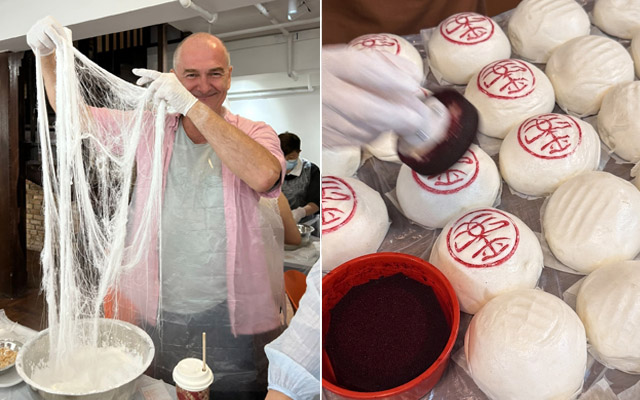
Visitors try their hand at crafting traditional lucky buns as part of TTT Culture Group’s immersive heritage experiences
Currently, the brand offers over 30 categories of workshops, including sugar blowing, dragon’s beard candy making, neon light decoration, and Jiaodong woodblock print horse fabric ornament crafting. By collaborating with seven to eight ICH veteran partners, the group turns traditional skills into visitor-friendly workshops and retail products. These initiatives create new income streams for artisans while offering schools, corporates, and tourists a more engaging reason to explore the destination.
According to Chiang, the city possesses rich cultural stories that require the right format to reach modern audiences.
“At TTT Culture, we believe the future of heritage is not only preservation but participation. If people can touch it, make it, taste it, photograph it and understand it, culture becomes alive again. That’s the role we hope to play for Hong Kong,” Chiang said.
“We see ourselves as a guardian, supporter, and facilitator of local cultural experiences. We respect the original form of every craft, but at the same time, we make it easier for the next generation and international visitors to understand, participate in, and remember Hong Kong culture. For instance, we use AI technology to record an elderly craftsman’s lectures and skillsets to cater for larger classes, or for when he is unavailable.”
Chiang brings an established network from previous workshop ventures and the revitalisation project of Cheung Chau Theatre. Co-founder Martin Kwok represents the second generation of Kwok Kam Kee’s lucky buns in Cheung Chau. Their bun workshop holds the largest market share, attracting between 40,000 and 50,000 local participants, with plans now focused on expanding into international markets. Beyond crafting a bun-shaped souvenir, participants learn the history behind the ICH Cheung Chau Jiao Festival and the local community.
From lucky bun making to traditional dragon’s beard candy crafting, TTT Culture Group offers hands-on workshops that preserve Hong Kong’s local crafts
“Our workshops are not just DIY activities. Each programme is built around a real cultural story, a recognised craft or a local heritage partner. We put strong emphasis on authenticity, structured teaching, good materials, professional training and storytelling,” Chiang said, adding that venues in Central and Cheung Chau can accommodate groups from 20 to 1,000 people for a 60- to 90-minute experience. The group’s retail outlet at Hong Kong International Airport, which opened last year, stocks over 500 cultural items, ranging from DIY mask painting kits to limited-edition handmade crafts.
Looking ahead, the brand plans to strengthen its physical touchpoints by opening a retail store at The Peak in September 2026, offering neon light workshops alongside cheongsam rental, photography services, and cultural merchandise.
Concurrently, Chiang is exploring scalable partnership and franchise models, including overseas workshop partners, cultural retail corners, pop-up stores, and licensed experience centres. By the end of this year, the first franchise outlets are expected to launch in Malaysia and Singapore, supporting Chiang’s goal to introduce Hong Kong’s intangible cultural heritage to international markets while maintaining authentic, professionally managed content.
Etihad opens daily Abu Dhabi–Tashkent service with Uzbekistan Airways codeshare
Etihad Airways touches down in Tashkent, adds Uzbekistan codeshare
Etihad Airways has launched its first service to Uzbekistan with a daily non-stop flight connecting Abu Dhabi and Tashkent. The new route is accompanied by a codeshare agreement with Uzbekistan Airways, allowing Etihad passengers to connect through Tashkent to eight domestic destinations—Andijan, Bukhara, Fergana, Namangan, Nukus, Samarkand, Termez and Urgench—as well as select international points on the Uzbek carrier’s network. In return, Uzbekistan Airways places its code on Etihad’s daily flights between Tashkent and Abu Dhabi.
Scoot
Scoot introduces Guiyang route, expands regional network
Scoot will launch a new three times weekly service from Singapore to Guiyang on October 26, 2026, using Airbus A320neo aircraft.
The addition brings the carrier’s China network to 81 weekly flights across 16 cities, while expanding its global network to 86 destinations across 18 countries and territories.
As part of its Northern Winter 2026/2027 schedule running from October 25, 2026 to March 27, 2027, the airline will also increase regional flight frequencies across the Asia-Pacific region. Services to Hat Yai will rise from 12 to 14 weekly flights, Phuket from 17 to 21 weekly flights, and Okinawa from four to five weekly flights. From December 2026, Clark flights will expand from seven to 10 weekly, and Tiruchirappalli from 12 to 14 weekly. Kota Kinabalu services will increase from 10 to 13 weekly flights starting January 2027. Additionally, daily Phu Quoc services will progressively transition from Embraer E190-E2 aircraft to larger Airbus A320 family aircraft to increase seat capacity.
Philippine Airlines
Philippine Airlines ramps up Melbourne flights to daily frequency
Philippine Airlines will increase its Manila to Melbourne service from five weekly flights to daily operations starting November 19, 2026. The expanded frequency provides additional passenger options between the Philippines and Australia.
The carrier also operates daily flights to Brisbane and Sydney, alongside a three times weekly service to Perth.
Vietjet has introduced direct flights from Ho Chi Minh City to Colombo
Vietjet expands international route network, resumes domestic services
Vietjet is broadening its international network with new direct services connecting Vietnam with Sri Lanka, the Philippines, Thailand and Japan.
The airline officially launched a direct service connecting Ho Chi Minh City and Colombo, operating three round-trip flights per week. From November 10, 2026, the carrier will introduce three weekly round-trip flights each on routes connecting Ho Chi Minh City and Hanoi with Cebu, and Ho Chi Minh City with Clark. The airline will also resume its Ho Chi Minh City to Chiang Mai route from October 25, 2026, operating four weekly round-trip flights. Additionally, a new service linking Danang with Osaka Kansai will launch on December 20, 2026, operating four times per week. Domestically, Vietjet resumed services connecting Dalat with Hanoi, Ho Chi Minh City, Hai Phong, Vinh and Danang on August 19, 2026, following the reopening of Lien Khuong International Airport.
The Tourism Authority of Thailand (TAT) has unveiled The Year of Transformation as its strategic tourism direction for 2027, targeting revenue growth of at least five per cent over 2026’s goal of three trillion baht (US$94.7 billion).
The roadmap aims to secure a 60:40 visitor distribution between established and emerging destinations while positioning Thailand among Asia’s top three destinations for traveller loyalty, working towards the goal of becoming “Asia’s No. 1 High-Value & Meaningful Destination”.
TAT’s Thapanee Kiatpaibool unveils new tourism mascots Nong Rak Yim and Nong Sukjai at the TAT Strategic Direction 2027 event on August 24, 2026; photo by TAT
At Bangkok’s Rajadamnern Stadium, TAT governor Thapanee Kiatphaibool unveiled the direction under the banner The Ultimate Fight: Transform for the Win!, using Thailand’s historic Muay Thai arena to signal the sector’s need to adapt and compete in a shifting global market.
“The Year of Transformation is a clear commitment to reshape Thai tourism around quality, value and long-term competitiveness,” Thapanee said, adding that “we’ve moved beyond volume alone”.
The strategy rests on four strategic moves.
Rebalance Market Portfolio will steer the market split to 58 per cent international against 42 per cent domestic, and rebalance longhaul and shorthaul demand to 44 and 56 per cent, respectively, reducing reliance on any single source. TAT will refine its segmentation portfolio around Mainstream at 35.3 per cent, Premium at 28.1 per cent, High Value at 18.5 per cent and Experience at 18 per cent, while pursuing new longhaul potential in Eastern Europe and Latin America. Under “The Link Plus”, it will match segments to 19 priority areas, targeting a 10 per cent arrivals rise and a 60:40 flow between major and emerging destinations.
Shape Experience Platform shifts brand messaging from a value-for-money position to a meaningful one under Healing is the New Luxury. TAT has introduced mascots Nong Sukjai and Nong Rak Yim, will extend the UNESCO Thailand Network across 29 areas and more than 55 community tourism destinations, and roll out Signature Destination Branding in Chiang Rai, Ubon Ratchathani, Songkhla, Trat and Samut Songkhram.
Build New Growth Engine will convert Thailand’s strengths into value through four Life Economy engines, connecting tourism to health, wellness, culture, food, sport, creativity, festivals and sustainability. These span the early-2027 “Unseen Luxperience 2027” for premium travellers, Well-being Tourism positioning Thailand as a global health and healing destination, a “365 Days of Celebration” festival economy featuring S2O, Wonderfruit and Tomorrowland, and sustainable-destination prototypes in Nan and Wellness Valley areas.
Transform Together recasts TAT from tourism promoter to ecosystem orchestrator, using Tourism Value Intelligence across 45 domestic offices, two coordination centres and 29 overseas offices, with support for start-ups, technology and AI.
“Through these four strategic moves, TAT is sharpening the country’s tourism ecosystem to innovate, compete and deliver a stronger future,” Thapanee concluded.
In an increasingly digital world, the younger generation is seeking to switch off when travelling, with industry experts noting a strong uptick in demand for nature-based experiences, spiritual tourism, and soft adventure.
Prasoon P Sankar, corporate general manager of Kerala-based Intergrande Hotels, which curates experiences for guests, said younger travellers want to trade technology for nature while engaging in travel that boosts their well-being.
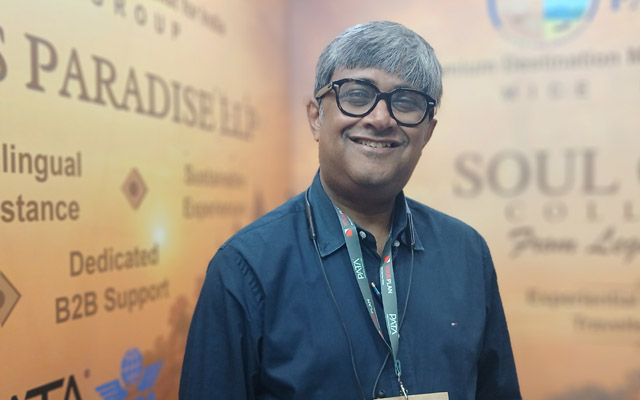
Nayek noted that young travellers are increasingly driving the surge in demand for spiritual tourism across India
“The new generation are looking for back-to-basics travel. They want to switch from the blue screen to the green screen of nature, so it’s important to provide them with opportunities to connect with nature and people,” he said.
Activities proving popular with younger travellers include exploring tea plantations, backwater boat adventures, accompanying flower farmers, one-day rural bicycle experiences, and meeting traditional beekeepers.
“Often young urban travellers today don’t know where they come from and they’re looking to get back to nature and to have meaningful experiences. We’re seeing an increase in demand for natural heritage, soft adventure and responsible tourism. The younger generation have more of a desire to be responsible for the future generations,” Sankar said.
Rozillah Matsahini, revenue manager at Borneo Nature Tours, noted an uptick in young honeymooners seeking to immerse themselves in nature and soft adventure, especially from the European Union, the UK, and the US, where there is no access to ancient rainforests that date back 130 million years.
“Young honeymooners are more active today. They really want to experience something different with nature and wildlife,” she said, noting that the average minimum stay is three days and two nights in jungle accommodation, with the canopy walkway, river rafting, and night safaris all popular activities.
Dagelje Sherpa, expedition director at Expedition Himalaya, said the Covid-19 pandemic coupled with climate anxiety is driving demand for health- and wellness-oriented trips among youth.
“Young people are more conscious about their health, so we’re seeing more demand for soft treks combined with meditation, culture and wildlife,” he said, adding that younger travellers are mainly opting for a three- or four-day trek in the Himalayas combined with a nature safari and soft adventure experiences.
In India, Arnab Nayek, co-founder of Travellers Paradise, has curated a series of spiritual and wellness tourism packages in response to growing demand, especially from the younger generation. These range from yoga and meditation retreats to local therapies such as panchakarma and shirodhara.
“We’re seeing a rise in demand for spiritual tourism among young travellers, so we’re trying to develop that market to promote India as a spiritual tourism destination.”
Qamar Zafeer, managing director of India-based Earthen Experiences, is also curating more products geared towards the younger generation.
“They are increasingly looking for experiences related to spiritual tourism and wellness, as well as in-depth cultural experiences. They spend so much time online that when they travel, they want to be able to switch off and experience real life.”
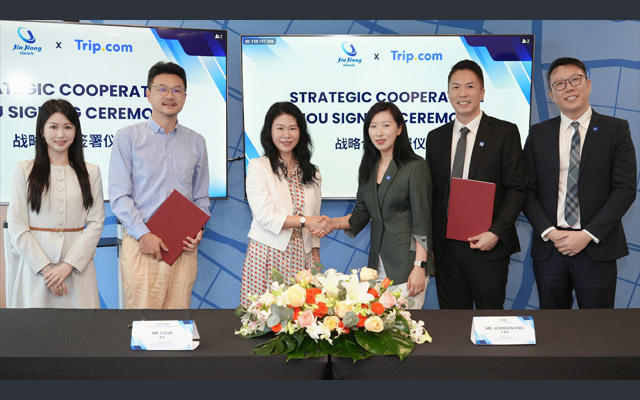
A subsidiary of Jin Jiang Hotels has signed a three-year memorandum of understanding (MoU) with Trip.com Travel Singapore to expand its hospitality ecosystem across South-east Asia.
The agreement covers Singapore, Thailand, Malaysia, Indonesia, Vietnam, the Philippines, Cambodia, Myanmar, Laos, and Brunei. A key component of the alliance is the implementation of a unified fixed commission structure for participating franchisee properties, replacing traditional floating models to improve commercial transparency and cost predictability.
The strategic partnership will introduce a unified fixed commission model for participating hotels across ten South-east Asian nations
The collaboration connects Jin Jiang’s regional property portfolio with Trip.com’s online traffic, aiming to streamline customer acquisition and drive occupancy rates. The partnership will focus on co-marketing, resource integration, and developing an end-to-end booking and stay network.
In tandem with the partnership, the Jin Jiang Hotels subsidiary has established local development and operations teams in Malaysia, Indonesia, and Vietnam to support upcoming openings and regional supply chain integration via its Global Purchasing Platform.
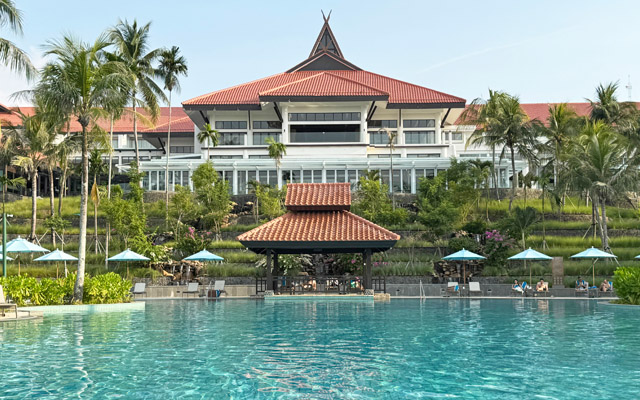
Mövenpick Resort & Spa Bintan Lagoon; photo by Melissa A Tan
Location: Convenientbeachfront access
Just an hour by ferry from Tanah Merah Ferry Terminal in Singapore, Mövenpick Resort & Spa Bintan Lagoon is set on the island’s northern coast with direct beachfront access. The location makes it an easy getaway, combining convenience with a relaxed island setting.
Accommodation: Spacious rooms with soothing interiors
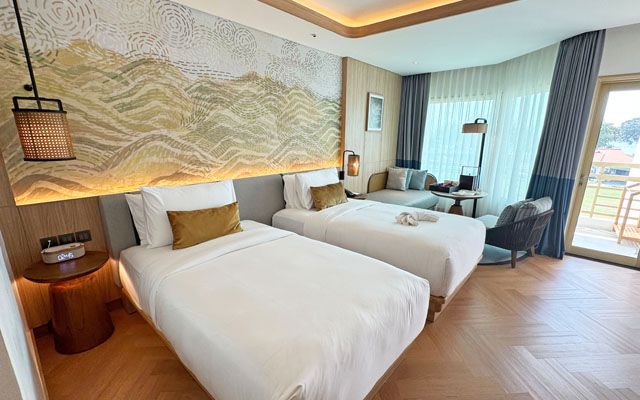
The resort features 408 rooms and suites, each with a private balcony or terrace overlooking the gardens or the sea. Options range from Deluxe Rooms and Premium Terrace Rooms to Junior, Executive, Ambassador and Presidential Suites. Families can also choose to have adjoining rooms.
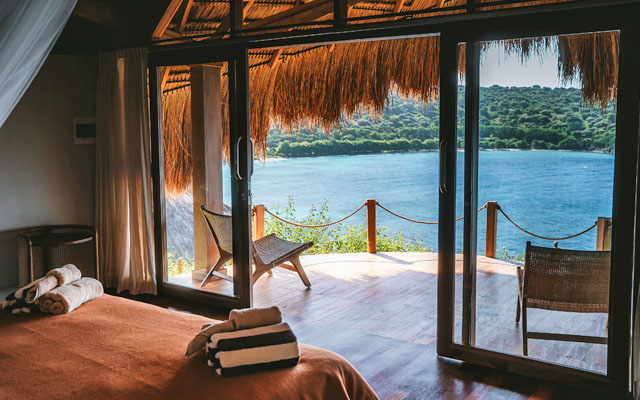
I stayed in a Deluxe Twin Ocean View room with a balcony facing the sea. The room felt comfortable and welcoming, with a neutral wood palette that gave it a calm, homely feel. Amenities were thoughtfully provided – a hairdryer, kettle, coffee capsule machine, plush bathrobes and slippers. There was even an umbrella in the room, and more placed around the resort near lifts and in the lobby.
The pillow menu was a nice touch, offering different options including a bolster, which definitely improved my sleep. The bathroom featured an eco-washer and Yuni Aromatherapy toiletries. Each room also had a smart clock that doubled as a wireless phone charger, while the bedside outlets were universal and included USB-A ports on both sides.
F&B: Wide variety of dining venues
Food and drink really shape the Mövenpick stay, with plenty of options spread across the resort.
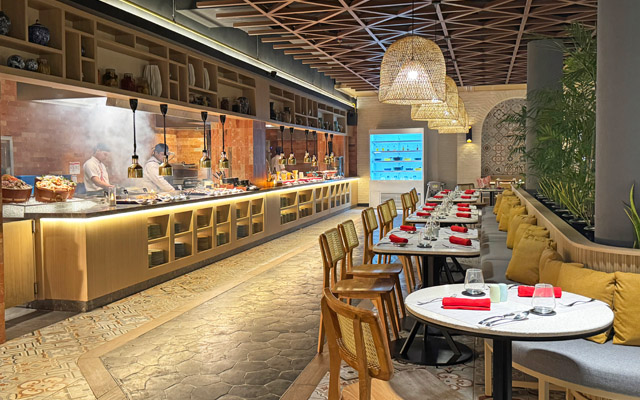
Port 19 is the main spot for breakfast, with Indonesian, Asian and international dishes prepared at live cooking stations. I enjoyed the variety here — different types of milk (soy, almond, chocolate, low-fat, full cream), plus yoghurt, salads, charcuterie and cheese, and even ice cream in local flavours. The jamu counter was especially popular, as was the live noodle station. There’s even a section set aside just for children.
My first dinner was at Yokatta Izakaya & Bar, serving Japanese fare. The Wagyu beef steak stood out, and the chicken karaage was light and crispy without being oily. The maki roll of the day mixed mango, black tobiko and avocado, which was refreshing. Set meals come with miso soup and dessert, and the sake ice cream was a real highlight.
Klon-Tong Deli has a nostalgic feel, inspired by Bintan in the 1980s. It’s where you’ll find pastries, ice cream, local favourites and coffee. It’s also the venue for Mövenpick’s Chocolate Hour – a daily ritual with chocolate fondue, waffles, cakes and more.
The Recreation Village Sports Lounge is casual, with burgers, finger food and fresh coconut drinks, while the Ocean Pool Bar serves refreshments from its swim-up counter.
For my second dinner, I went to Soñada Beach Club. It’s right on the beachfront, spread over two levels, with Pan-Asian and Italian dishes, cocktails and a wine selection from the cellar. I’d recommend the Soñada pizza with beef chorizo and burrata, and the croquetas. Eating here with the sea view and weekend DJ music made for a lively atmosphere.
Mövenpick Resort & Spa Bintan Lagoon
1 of 11
Deluxe Twin Ocean View; photo by Melissa A Tan
Port 19; photo by Melissa A Tan
Dining at Soñada Beach Club; photo by Melissa A Tan
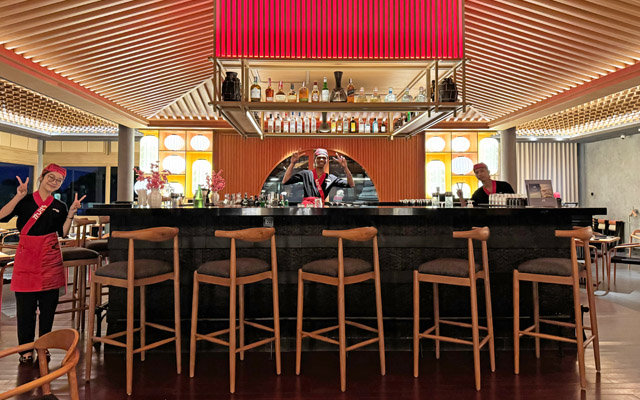
Yokatta Izakaya & Bar; photo by Melissa A Tan
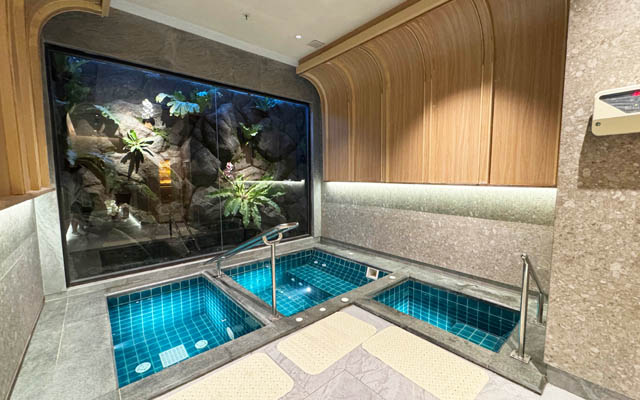
Jacuzzi, hot and cold plunge pools at Shantara Spa; photo by Melissa A Tan
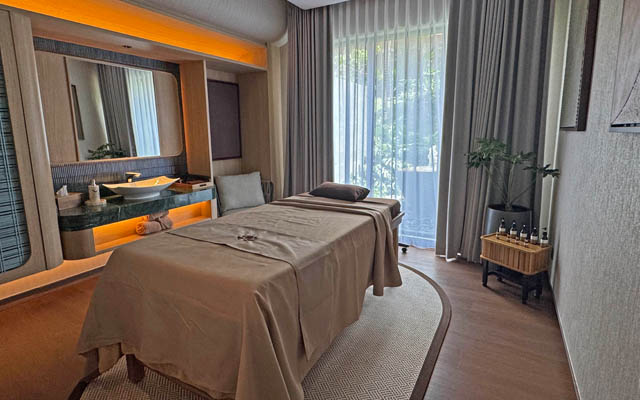
Spa treatment room; photo by Melissa A Tan
Soñada Beach Club pool; photo by Melissa A Tan
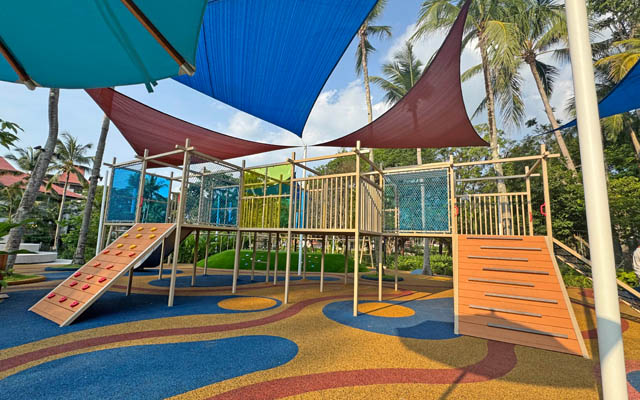
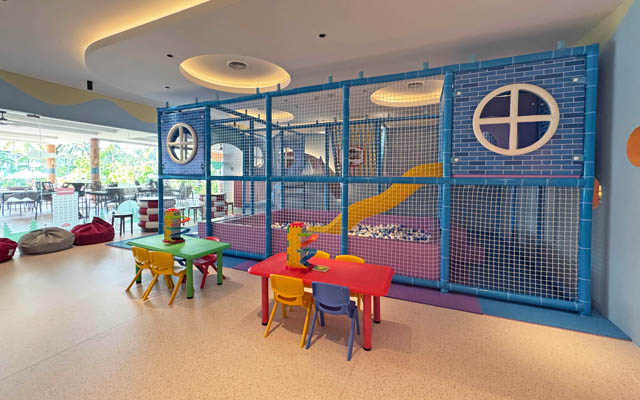
Recreation Village playground; photo by Melissa A Tan
Little Birds Kids Club; photo by Melissa A Tan
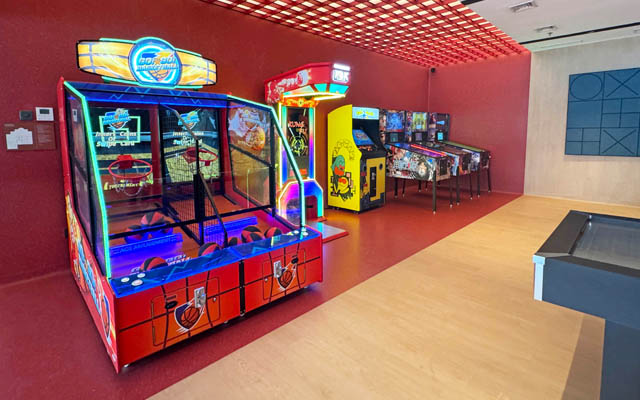
Arcade; photo by Melissa A Tan
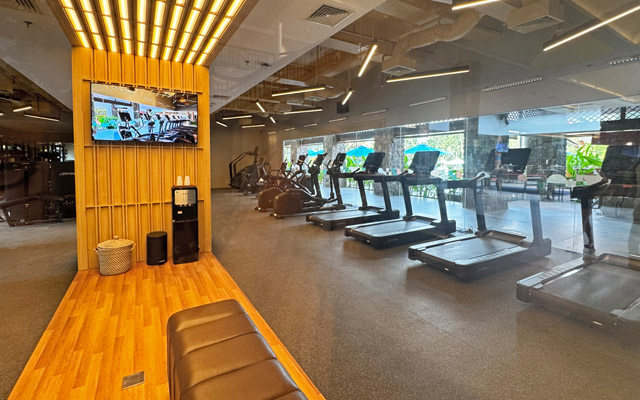
24-hour gym; photo by Melissa A Tan
Facilities: Activities for all in the family
Just a short walk, or a buggy ride, away is the Recreation Village which brings together fitness, sports and family activities, with yoga and Pilates sessions, a 24-hour gym, and spaces for guests to join organised programmes or simply relax. I took part in a batik painting workshop and had fun learning how to create my own art piece to bring home.
For younger guests, the Little Birds Club offers indoor and outdoor play areas, arts and crafts and interactive activities. Around the resort, there are swimming pools along with options for paddleboarding, bodyboarding and kayaking. A highlight is the transparent canoe, where you can paddle across clear waters while looking down to spot marine life.
Shantara Spa & Wellness is a calm retreat, with private and couples’ treatment rooms, reflexology and facials, plus a sauna and steam room. Hot and cold plunge pools and a jacuzzi add to the experience, while a dedicated room with accessibility features makes the spa inclusive for all guests.
The resort also has more than 2,000m² of meetings and events space, centred on a 900m² Grand Ballroom and supported by flexible function rooms. Outdoor areas across the beachfront add further options for team activities and celebrations.
For those who enjoy time on the green, golfers have access to Bintan Lagoon International Golf, home to two 18-hole courses designed by Jack Nicklaus and Ian Baker-Finch.
Service: Warm and friendly
It was all smiles throughout the stay, with staff eager to please and make sure guests had a great experience. I particularly appreciated the buggy ride service which brings guests easily around the resort while enjoying the breeze and sprawling grounds.
Verdict: Is Mövenpick Resort & Spa Bintan Lagoon worth a stay?
Overall, it was a pleasant weekend escape – a beach paradise only a short ferry ride from Singapore. The resort has something for everyone: romance for couples, family fun with children, and easy-going time with friends. My two nights there flew by far too quickly, so next time I’ll be back for a longer stay to soak it all in.
How do I get to Mövenpick Resort & Spa Bintan Lagoon from Singapore?
Hop on a 60-min ferry ride from Tanah Merah Ferry Terminal in Singapore to Bandar Bentan Telani Ferry Terminal in Bintan, and a 15-min complimentary resort land transfer will take you to the hotel.
Does Mövenpick Resort & Spa Bintan Lagoon have family rooms?
Families can choose to have adjoining rooms at Mövenpick Resort & Spa Bintan Lagoon.
Does Mövenpick Resort & Spa Bintan Lagoon offer free activities for children?
The kids’ club offers free activities to keep children occupied, including arts and crafts, Zumba, dance and games. Paid options such as cupcake decorating and pizza making are also available.
Is the breakfast at Mövenpick Resort & Spa Bintan Lagoon halal-certified?
While the hotel serves halal-friendly food, the resort’s F&B venues are not halal-certified.


 Toy has more than 20 years of experience in commercial strategy, marketing and digital transformation, and joins Rosewood from Accenture Song.