Radisson Hotel Group (RHG) plans to double its South-east Asia portfolio over the next five years as it seeks to better align its regional presence with growing demand from key source markets.
Armand Steinmeyer, the group’s vice president of development for South-east Asia, said the company sees significant room for expansion in the region. RHG currently has nearly 100 properties across Asia-Pacific, comprising 41 operating hotels and 48 under development, but its footprint remains smaller than in Europe, India and China.
“We want to double our portfolio here within the next five years. Our current distribution in South-east Asia is insufficient regarding the demand we receive from our key feeder markets, including Europe, the Middle East, India, and China, where Radisson already maintains a very strong presence, and neighbouring South-east Asian countries, such as Indonesia and Malaysia,” Steinmeyer said.
The company’s growth strategy is focused on strengthening brand relevance in local markets while capturing increasing intra-regional demand.
“We see South-east Asia as an integrated region. While global travel is significant, intra-regional travel will become the key tourism demographic of the future as the region sits at a crossroad between India and China,” he added.
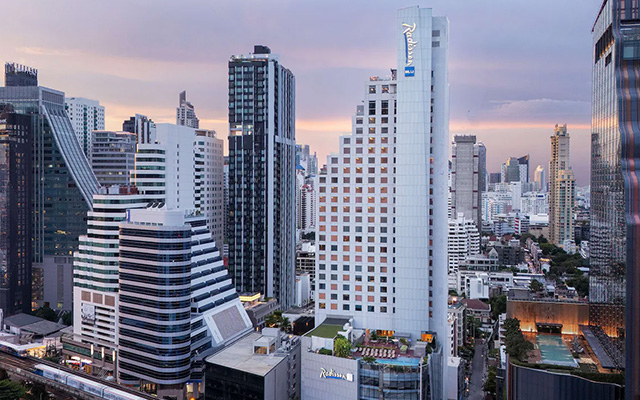
In Thailand, where Radisson currently operates nine properties, including five in Bangkok and four in Phuket, the group is targeting expansion in Bangkok’s Sukhumvit and riverside districts, as well as resort destinations such as Phuket, Krabi, Hua Hin and Hat Yai.
The company is also preparing to introduce the Radisson Collection brand in Thailand, targeting luxury heritage properties through both branded and affiliated models.
Across the wider region, Radisson’s next phase of growth will focus on building a network of properties in major gateway cities.
“These strategic urban hubs serve a dual purpose. They immediately capture inbound demand from primary global feeder markets. Crucially, these major metropolitan areas also provide the concentrated talent pools necessary to recruit and train a workforce,” Steinmeyer said.
The company also sees hotel conversions as an important avenue for growth.
“Brands are organic and should never be fixed in stone. An existing hotel allows us to creatively reposition the asset and add value, providing an opportunity to showcase how a brand can breathe new life into a conversion,” he explained.
Steinmeyer remains optimistic about the region’s development prospects, citing the mix of established and emerging markets across South-east Asia.
“South-east Asia is one of the most exciting regions, because it’s fast-growing and diverse. Not only is the ownership very diverse; there are institutional funds, frontier markets, and established markets all in one place. There’s not many markets that can cover so much breadth of experience in so few kilometres,” he concluded.