Some Asia-Pacific airports are transforming from mere transit hubs into immersive, restorative spaces that combine design, nature and wellness
In The Magician’s Nephew, the first novel in C S Lewis’s Chronicles of Narnia, the author imagined a world between worlds – a tranquil forest dotted with mirror-clear pools, each a portal to another realm. The best of Asia-Pacific’s airports now conjure something similar, transforming the turbulence of transit hubs into restorative environments of calm and sensory renewal.
Destinations, not detours
Designed with nature’s materials and interwoven with cultural themes, these new terminals are portals in their own right: artful, biophilic sanctuaries that allow travellers to move through calm instead of chaos, while quietly steeping them in the sense of place.
“Airports are now the leaders out of all sectors in design and development. They want to make memorable environments – to introduce garden concepts in cities,” observed Patrick Keane, founder of Enter Projects Asia (EPA).
At Bengaluru’s Kempegowda International Airport Terminal 2, Keane’s studio has reimagined the post-security landscape as a living organism. Opened in 2024, the 12,000m2 departure hall, crafted from nine kilometres of hand-woven rattan, feels more arboreal than architectural. Sculptural pods are surrounded by hanging gardens, vines, and 700-year-old olive trees.
“If you think of rattan structures, bamboo framing, handmade elements and wood – you think wellness retreat, somewhere remote. But now you’re seeing that in an airport that welcomes 20 million visitors a year. If you touch a pod, it feels like a tree, not a wall. Wellness has become mainstream,” Keane reflected.
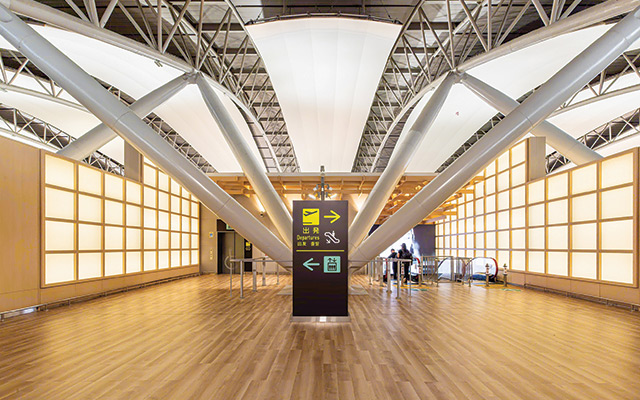
Across the East China Sea, global design firm Populous has brought similar material sensitivity to Japan’s Kansai International Airport, renewed ahead of World Expo 2025 Osaka Kansai.
“The T1 renovation project was envisioned as the symbolic gateway to the World Expo – the ‘first pavilion’ that sets the tone for visitors’ experience of Japan,” explained Ben Dawson, Populous’ principal and head of aviation, APAC. “The renovation prioritised openness, clarity, and cultural immersion.”
A once-enclosed immigration hall now bathes in natural light. Timber finishes and exposed trusses recall Japanese craftsmanship, while intuitive sightlines – literally framing the passenger journey – create ease and orientation.
Techo International Airport (KTI) in Cambodia’s Kandal province introduces a new vernacular to Cambodia’s aviation. Developed by Cambodia Airport Investment Co. (CAIC) and spanning 2,600 hectares, its sweeping scalloped wooden roofline and vaulted timber lattices reinterpret Khmer architecture in a distinctly contemporary key. The interior will feature a traditional wooden Cambodian house for passengers to visit – a cultural touchpoint amid the choreography of departure.
In Vietnam, the vast Long Thanh International Airport is taking shape. Designed for a final capacity of 100 million passengers annually, its first phase will debut in 2026 with what is expected to be the world’s largest bamboo structure – a glulam (glued laminated timber) canopy of interlacing bamboo arches. More than sustainable, the design draws on the material’s deep cultural resonance in Vietnam.
Across these projects, new airport terminals in Asia-Pacific are no longer conduits of motion but living works of architecture – immersive ecosystems of plant-based materials that refresh, restore, and reawaken the senses before flight.
Portals of calm
If Bengaluru and Kansai express biophilia through material empathy, Singapore’s Changi Airport has turned sensory design into science. With 600,000 plants, a signature Orchid Tea scent, and the aptly named Quiet Terminal Initiative, Changi orchestrates fragrance, light, and sound into what it calls “wellness through seamlessness”.
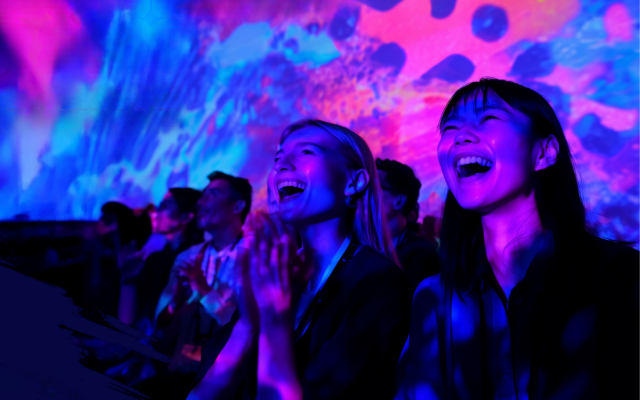
Carpeted floors hush the terminal’s tempo, while immersive installations such as Dreamscape and Wonderfall sync movement with nature’s rhythms, transforming waiting into wonder.
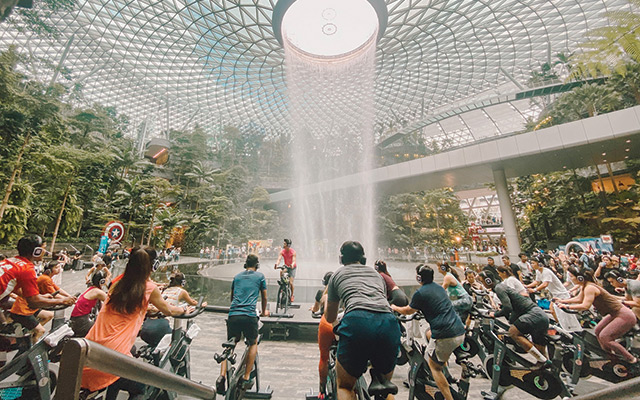
Wellness extends beyond design: the Minmed Wellness Collective at Jewel’s Canopy Park offers yoga, barre, and Pilates, while rhythm cycling classes in the Forest Valley overlook the Rain Vortex. Travellers can even rent a bike and cycle outdoors from Terminal 2 to Jurassic Mile, where life-sized dinosaurs line a 3.5-kilometre park connector – proof that wellness can be playful as well as peaceful.
Behind the scenes, Amadeus technology powers Changi’s biometric bag drops, translating operational efficiency into a subtler kind of well-being: freedom from friction.
In Australia, Woods Bagot’s design for Western Sydney International (Nancy-Bird Walton Airport), opening 2026, takes this idea of emotional ergonomics to heart.
“Our approach has been to create a space for everyone – a place that is easy to navigate and in which people feel calm,” said Jodi Archer, Sydney aviation lead at Woods Bagot.
Filtered sunlight softens through slatted ceilings, changing hue through the day. Wide circulation paths, clear sightlines, and sensory rooms desensitise tension points. Seating areas adapt to individual rhythms – from contemplative corners to communal zones.
“Wellness services are scattered throughout. People find what they need, when they need it,” Archer added.
Here, architecture choreographs emotion as much as movement, immersing passengers in tranquil, light-filled environments that ease transitions between destinations.
Harmony with the planet
Wellness now extends beyond the traveller – it encompasses the planet itself. At Western Sydney, the terminal’s roof generates solar energy, harvests rainwater, and filters daylight through energy-efficient skylights designed to limit heat gain. “Sustainable and recycled materials will be used throughout the terminal, including the structure, finishes and furniture,” noted Archer.
At Kansai, Populous’ approach to adaptive reuse – increasing capacity without expanding the footprint – is a quieter but equally powerful act of sustainability.
“That decision alone has massive benefits in terms of energy, materials, and cost,” Dawson explains.
For its work in Bengaluru, EPA merged digital precision with handcraft, collaborating with Thai artisans to handweave each section at its Bangkok studio before assembling them using bespoke logistics software that streamlines production and shipping.
This fusion of digital precision, handmade craft, and natural materials defines the firm’s approach to sustainable innovation – an act of ecological as well as cultural regeneration.
And at Changi, sustainability quite literally takes root. The airport’s dense horticultural network serves as both air filter and acoustic buffer, moderating temperature and humidity while softening the sensory impact of travel itself.