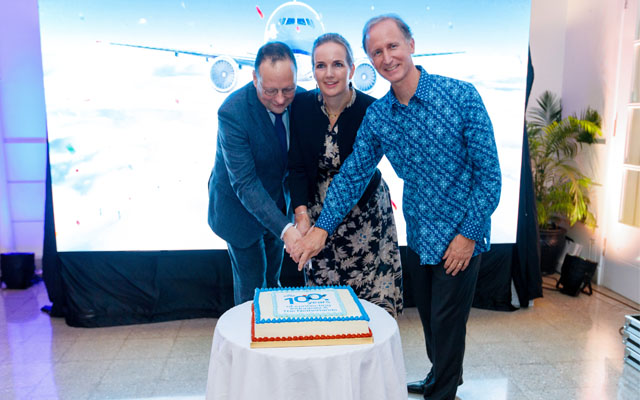
KLM Royal Dutch Airlines celebrated 100 years of connections between the Netherlands and Indonesia last November, marking the airline’s enduring presence and ongoing innovations.
From a pioneering 55-day journey between the two countries in 1924 to today’s 15-hour flights, the airline has witnessed and played a significant role in the advancements of the aviation industry.
While the first flight took several days and required 26 stops between the two continents, it is now possible to fly to Amsterdam in just 15 hours.
In a written interview with TTG Asia in conjunction with the celebration, KLM COO Maarten Stienen stated: “KLM Royal Dutch Airlines has always been present in Indonesia and innovated along the way.
“After the first flight to Jakarta 100 years ago, we have had continuous scheduled flights since 1930, with a disruption during World War II. KLM (has been flying) to Bali since 1988,” he pointed out, adding that the fact that KLM has been continuously serving these destinations for such a long period highlights their importance.
Stienen continued: “In summer 2024, over 250,000 passengers flew with KLM to and from Indonesia, showing how big the demand is for this route. (It is) not a surprise, given that business is booming in Indonesia and the country has a lot of beauty to offer to visitors.”
Now part of the Air France-KLM Group, which includes Air France and Transavia, KLM’s extensive network covers over 300 destinations in 125 countries, with primary hubs at Amsterdam Schiphol Airport and Paris Charles de Gaulle.
While the airline was a pioneer in longhaul service a century ago, its current focus on innovation is centred on sustainability.
Stienen said: “KLM is the oldest airline still operating under its original name (but) we are no longer pioneering distances in aviation – however, we aim to be a responsible airline group (and) continue to connect people with destinations all over the world, (believing) that through innovation, we can reduce the long-term impact of flying on our planet.”
The airline aims to have over 80 new-generation aircraft in its fleet by 2030, which are more fuel-efficient and produce fewer emissions per passenger kilometre than their predecessors. Additionally, the new aircraft are quieter than the previous models.
“Sustainable aviation fuel (SAF) is also one of the most promising levers that will help us reduce CO2 emissions. We plan to use more than 10 per cent SAF on board our aircraft by 2030, exceeding the obligations by the European Commission,” he shared.
When asked about his vision for the future of the airline industry over the next century, Stienen said: “Our aim is to be in business for the next 100 years and give future generations the opportunity to travel, to connect people and cultures from all over the world.
“Flying is vital to our economies and brings wealth to communities worldwide. We need to reduce our impact on the planet and grow in a way that is balanced with our environment, among other innovations with cleaner and quieter aircraft.”
He explained that, as an industry, the first step taken by the airline was to increase the use of SAF: “At KLM, we mix 1.2 per cent SAF into our fuel, and the Air France-KLM group purchases the most SAF worldwide, accounting for 16 per cent of the global supply in 2023. We are working on projects to radically improve the fuel efficiency of flying in the longer term, such as our cooperation with Delft Technical University on the Flying V and our collaboration with ZeroAvia to fit hydrogen-powered engines to an existing plane.”