TTG Asia
Asia/Singapore Tuesday, 31st March 2026
Page 2248

Asiana receives first Airbus A380

0

SOUTH Korea’s Asiana Airlines took delivery of its first Airbus A380 aircraft yesterday, which it plans to deploy on routes from Seoul to Tokyo, Hong Kong and Bangkok for a start.

Eventually, the airline will use it on Los Angeles-bound services as well.

The aircraft is the first of six A380s Asiana has on order, powered by Rolls-Royce Trent 900 engines. Each aircraft comes with a premium three-class layout for total seating capacity of 495 passengers, with 12 private suites in First Suite, 66 fully flat seats in Business Smartium and 417 seats in Travel Class. All seats are equipped with the latest on-demand in-flight entertainment systems.

“We are delighted to receive our first A380 today, which is key to our future vision and fleet modernisation strategy,” said Park Sam Koo, chairman of Kumho Asiana Group at the occasion yesterday.

“I am confident that Asiana can further enhance its level of customer service and that the A380 will play a significant role in helping us to remain at the forefront of the airline business.”

Asiana also has on order 30 of the all-new A350 XWB, which promises 25 per cent lower operating costs than the competition.

Changi Airport and Jetstar pilot self-service check-ins

0

CHANGI Airport Group (CAG) has begun trials for its self-service initiative in collaboration with Jetstar Asia, aimed at reducing the airport’s manpower requirements and offering passengers a more hands-on check-in.

As part of Fast and Seamless Travel at Changi (FAST@Changi), CAG has installed two self bag-drop units and four self check-in kiosks alongside the LCC’s check-in counters at Terminal 1. At the self check-in kiosks, passengers print their boarding pass and baggage tag. They can then deposit their tagged baggage at the self bag-drop counter and obtain a receipt for their luggage.

Passengers on selected Jetstar flights are invited to use the self-service options, and instructional videos, signs and personnel will be on site to guide them through the process.

Local daily The Straits Times reported that CAG will continue the trials for the next three months until August.

Tan Lye Teck, executive vice president, airport management, CAG, said in a press release: “Against a backdrop of growing passenger raffic and the current manpower situation in Singapore, such as in the groundhandling sector, the adoption of self-service initiatives will help alleviate some of the pressure faced by the industry.

“The implementation of FAST@Changi is in line with a wider global push towards increasing automation at airports to improve productivity and efficiency, while providing passengers with greater flexibility and convenience.”

FAST@Changi will be rolled out in phases throughout the airport’s existing facilities as well as the upcoming Terminal 4 (TTG Asia e-Daily, November 6, 2013).

The maturing of meetings

0

The meetings market in Asia is maturing. Raini Hamdi finds out in this Roundtable why companies want more accountability and transparency from their meetings & events, and what it means for industry players
23may_p11-business_travel
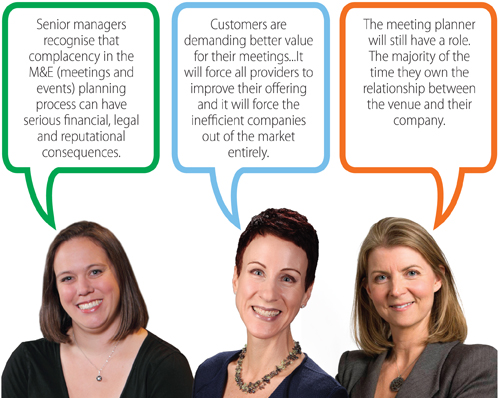
From left: Danielle Puceta, director, AMEX Meetings & Events, Asia-Pacific;Kelly Kuhn, president, Asia-Pacific, Carlson Wagonlit Travel; Amanda Hanlin, director of global sales, HRG Meetings, Groups and Events

Flat or just modest growth is expected this year of the corporate meetings and events market in Asia-Pacific, and senior management is more eagle-eyed than ever in watching compliance, cost and reduced time from the office. But this is good news for firms that provide solutions to help companies manage their meetings spend, which in the region, is still a fairly new idea. TTG Asia’s Roundtable asks: Is the industry maturing in Asia?

What are you seeing in the meetings & events (M&E) industry in Asia this year?
DANIELLE PUCETA Overall, we are seeing a greater focus from senior management with regards to policies, and management of finances and suppliers. They are also seeking greater transparency into company-wide meeting activity.

KELLY KUHN Overall the APAC economy is still growing at an impressive rate, and we expect overall growth in meeting volumes of two to five per cent, mostly driven by increased spending in China, India and Indonesia, but with other markets showing strong buying patterns, including Singapore. The nature of events is evolving, as are the objectives and measurement of corporate meeting programmes, but there is a lot of pent-up demand for meetings in the region.

AMANDA HANLIN Meeting bookings in Asia has increased by about four per cent from this time last year with China gaining real momentum. Having seen hotel rates drop by 30 per cent in 2011, Tokyo rose by 11 per cent in 2012 with a continual rise in 2013 as meeting activity increases following new reconstruction after the natural disasters. Singapore is also seeing rising venue rates due to the mega conferences and exhibitions taking place in the city.

The need to have visibility of meetings around the what, why, who and how was heightened recently, and has been a contributing factor to companies turning their attention to meeting consolidation.

So there’s still some growth but senior management wants more accountability and transparency from meetings. Why?
PUCETA This is partly due to overall business sentiment in this region which has been a little more cautious in the past six months than it had been in the previous few years, leading to a greater focus on spending control. It is also partly due to the current environment of increasing regulatory scrutiny and heightened awareness around security and safety issues. Senior managers recognise that complacency in the meetings and events planning process can have serious financial, legal and reputational consequences.

Any examples of how control and transparency were lacking before and what senior management is insisting now?
HANLIN Yes, for starters we are moving from operating without contracts, which has been typical in the area of meetings, groups and events, to working within a contractual agreement just as we would on the transient (corporate travel) side.

We now have clients signed up to work with us for three to five years on a contractual basis. This has resulted in stricter and clearer SLAs (Service Level Agreements), KPIs (Key Performance Indicators) and a more focused approach on process for areas such as risk management, escalation and 24-hour support. A consistent pricing model across multi markets, where feasible, is also a growing requirement.

The scope is increasing and we are seeing bids include requests for venue sourcing, meeting registration, small events and payment solutions. In some cases we’re seeing RFPs for both transient and M&E, as companies look to get full leverage from their supplier programmes.

PUCETA In this region we are seeing a greater focus on formalised M&E policies and adherence to policy in order to achieve greater visibility into where spending and activity is actually occuring.

A comprehensive and explicit meetings policy is at the core of the most successful and strategically focused M&E programmes. What is particularly important is to have a policy that includes explicit language regarding meetings-related payment methods and processes. Similarly, language pertaining to the procurement of meetings-related goods and services is absent in most of the existing policies.

KUHN With the increasing role of corporate procurement departments in the decision-making process, the onus is being placed more firmly than before on agencies that can offer a higher standard of accountability, responsibility and transparency over meeting programmes.

With the rapid emergence of strategic meetings management (SMM) programmes in the region, we can see a real desire on the part of our clients for a new degree of rigour around meetings. If you ask a travel manager about their company’s annual travel spend, they will know it to the nearest dollar, but ask them the same question about their meetings spend and they may not have the full picture.

When we implement SMM solutions for our clients, we start off by giving them clarity and visibility over their overall spend, and then build a programme from there. Without that level of visibility and understanding, it is impossible for companies to make smart decisions about the future of their meetings programmes.

Would you say this is part and parcel of the maturing of the meetings and events industry in Asia?
KUHN The bottomline is that companies are now paying serious attention to their meeting programmes. As M&E remains the biggest area of unmanaged spend for most companies, that can only be a good thing. Customers are demanding better value for their meetings – which means better outcomes as well as a lower price – and this is a good sign for the industry. It will force all providers to improve their offering and it will force the inefficient companies out of the market entirely.

This is a normal and positive feature of any maturing industry, and we welcome it. As has happened elsewhere in the world, we would expect the consolidation of agencies to continue in the coming years and for large agencies such as CWT to come to the fore. These bigger agencies will need to retain their creativity and nimbleness to compete with niche players, but the greater buying power and wider networks will be a boon for clients.

What’s the role of meeting planners then if companies such as yours are managing the spend?
KUHN Meeting planners remain, and will always be, the key people in the meeting industry. The role of a good agency should be to support and enhance the work of the meeting planner and to enable him to deliver outstanding events. The end client still wants that personal touch and to see a familiar face throughout the meeting process, and the meeting planner is the person in that space.

HANLIN The meeting planner will still have a role. The majority of the time they own the relationship between the venue and their company. Where we can help is by taking away the admin function of the venue sourcing – the T&Cs (Terms and Conditions), the negotiation of the venue. This means that the client/company is better protected as the risk of an employee agreeing to T&Cs that maybe they don’t understand is minimised and the planner still keeps the relationship with the venue.

PUCETA Meeting planners need to be focused on collecting information for reporting purposes at an enterprise level. They need to get a holistic view of where meetings and events activity is occuring for internal and external reporting purposes, and in order to ensure the safety of their meeting attendees in times of disruption or crisis, for example.
In order to get a sufficient view of where meetings and activity is occurring, there will also be a greater focus on more sophisticated data collection.

Do you think in this climate of greater control on spending, companies will resort to other ways to meet, such as video-conferencing?
KUHN With the increasing sophistication and ease of video-conference and telepresence solutions, our global clients are already substituting video conference for face-to-face meetings. It tends to apply to small meetings or those occasions where it just doesn’t make sense to jump on a plane due to time, cost and discussion content. It remains a small portion of a client’s overall meeting portfolio but we are suspecting to see small and consistent growth in this area.

In the more mature Asian locations, we are also seeing clients use laptop technology more, such as the document-sharing facility through Microsoft Outlook. For example, contract discussions or presentations which would typically have been held face-to-face are now performed through document-sharing technology, Webinars and conference calls.

PUCETA In Asia, according to our 2014 Meetings and Events Forecast, meeting planners cite ‘cost savings’ and ‘reducing time out of the office’ as the most compelling reasons when it comes to using virtual meetings. However, what we have seen over the past year is that the actual adoption rates of virtual meetings remain quite low. In fact, the results in our 2014 Forecast point to only a modest increase in adoption of these solutions, perhaps due to the fact that the virtual/digital toolkit has gotten more sophisticated and associated costs are moderating. In our 2013 Forecast, 56 per cent of the audience projected that virtual or hybrid meetings would represent more than 10 per cent of their meetings activity, however, this year only 26 per cent of the planners surveyed reported more than 10 per cent of their meetings were virtual or hybrid meetings.


Real-time aircraft tracking not on the immediate horizon

0

CONVERTING all airlines to a global standard of real-time tracking may take up to three years to realise, said an ICAO official, despite Inmarsat offering an airline tracking service for free.

News agency Reuters reported Nancy Graham, director of ICAO’s Air Navigation Bureau as saying: “Typically a global standard can take two to three years to put in place.”

Her comments came after a conference of aviation regulators and industry officials in Kuala Lumpur, where costs of the new system, problems of implementation and passing on the cost to passengers were some issues raised.

The ability to track aircraft positions in real time has become a hot topic following the mysterious disappearance of Malaysia Airlines’ flight MH370. IATA convened in April a task force for global aircraft tracking and passenger data to prevent a repeat of the tragedy (TTG Asia e-Daily, April 1, 2014).

The Reuters news report quotes IATA as saying its members would voluntarily implement measures in the meantime.

Global mobile satellite communications services provider Inmarsat also announced that it has proposed to ICAO a free global airline tracking service for immediate implementation (TTG Asia e-Daily, May 15, 2014).

France strives to become Chinese-friendly

0

FRENCH tourism stakeholders are rolling out initiatives for the Chinese market given the three-fold increase in arrivals since 2010.

In 2013, France welcomed over 200,000 Chinese tourists or two per cent of total arrivals.

Patricia Barthelemy, leisure marketing manager for Paris Convention and Visitors Bureau, noted: “If we look at data from the region Ile de France where Paris is located, Chinese travellers are the number one among Asians.” Shopping in Paris remains a prime attraction for the Chinese.

Beyond Paris, the Chinese are now exploring destinations such as the Bordeaux wine region, the Rhone-Alpes, Nice and Cannes, according to Atout France.

Jose Henrique Goncalves, general manager of Paris-based Abako Productions, said: “The younger generation of Chinese visitors is demanding more experiential travel. The French tourism industry is responding to these changes and adapting constantly to meet the specific needs of this growing market. We are designing innovative programmes that incorporate gastronomy, art and culture.”

Tour operator ParisCityVision has also begun to provide its Chinese clients with translation services and Chinese guides.

Meanwhile, ICC Paris and Comité Régional du Tourisme Paris Ile-de-France launched the Do You Speak Tourist initiative in 2013 that enrols staff in courses covering languages such as German, Mandarin, Spanish, Italian and Japanese, etc. It also includes a map and dedicated website educating industry members on how to better receive foreign visitors.

Penang convention bureau to get off the ground by end 2014

0

PENANG is likely to set up a state convention bureau by the end of 2014, but this is subject to the hiring of a consultant to start work in August on its structure and funding.

If all goes well, this will be almost two years since the Penang chief minister, Lim Guan Eng, mooted the idea in January 2013.

The convention bureau is to be known as Penang International Convention & Exhibition Bureau (PICEB).

Plans now hinge on getting the approval of the chief minister and the board of directors of Penang Global Tourism to hire a consultant who will be tasked with drawing up a structure and a sustainable funding model for the bureau to fund its team as well as marketing and promotions, and to support the travel trade in bidding for business events to Penang.

The state government will not provide financial assistance to the bureau but will support it by other means.

Ooi Geok Ling, managing director of Penang Global Tourism, said the delay in setting up the bureau was because the pro-tem committee, comprising local private players in the MICE industry, and the government could not agree on a sustainable funding model for PICEB.

“The hotel room levy in Penang will be taken under consideration for the funding structure of PICEB,” said Ooi.

The state government will be collecting RM2 (US$0.62) levy per room, per night on three star hotels and below, while a RM3 levy is charged on four-and five-star hotels (TTG Asia e-Daily, May 22, 2014).

Content marketing key for travel businesses leveraging Google

0

TRAVEL companies must begin to think of themselves as content publishers to survive Google’s landmark shift to a semantic search algorithm.

Speaking yesterday at the EyeforTravel Travel Distribution Summit Asia 2014, Bronwyn White, director of MyTravelResearch.com, said: “Search is the one constant tool that travellers use in every stage of the path to purchase.

“Semantic search is an algorithm that uses true meaning, intent and context to identify and prioritise websites with relevant content (to the user).”

Google now does this by drawing on a user’s personal information including geographic location, previous search history and social media behaviour.

“(Because search results are now highly personalised), we’re no longer chasing the holy grail of page one on Google, but people who are potentially really interested in what we say and do,” White noted.

“If your content is likeable and shareable, Google says: ‘Hey! You must be an expert on your topic, we’ll trust you.’ Search engines will increase your authority ranking and will more likely present your page when users are looking for a related topic,” she elaborated.

When asked how travel companies should respond, White told TTG Asia e-Daily: “You’ve got to get the basics right. So make sure your website is structured right, your Google accounts are linked, your social media profiles all have the same website address associated with your company, so there is consistency in your social signals.

“From there, just keep creating interesting content. Be clear about who your customer is and who you’re going to be talking to, then gear your content towards that. Create little personas.”

Talking about things that are related would also provide context and take advantage of the “serendipity of search engines”, she added.

Companies that do not have the funds to conduct large-scale research could also drill down to a fundamental principle of the industry – talking to the customer.

Said White: “There’s no harm asking your customers as they come through the door what they want to talk about, what interests them.

“It’s not expensive and the thing is – there are a lot of unemployed journalists out there looking for work. There are (also) content marketing agencies, but for smaller operations, practise doing it yourself.”

It’s also important to know where the market is, she emphasised. “Where do your customers hang out on social media? Are they on Facebook, Twitter?”

“For time-poor travel industry people, work on one platform. Get it right! Do one and engage properly rather than spreading yourself thin because that’s going to increase the quality of your content,” she advised.

Adventure Travel Trade Association offers access to research

0

THE Adventure Travel Trade Association (ATTA) has launched an online store that gives its members and other travel industry organisations access to research papers and data.

While most of its offerings are free for download for ATTA members, the site also offers single purchases for non-members.

The store is available on the AdventureTravel.biz website and initial research offerings include the recently released 2014 Industry Snapshot, a comprehensive health check of the adventure travel industry created by surveying several hundred tour operators in 69 countries.

ATTA has participated in research since 2006 and produced titles including Voluntourism, Booking Systems and several destination spotlights. Products will be added to the library as they are produced.

Shannon Stowell, president of ATTA, said: “ATTA strives to highlight best practices that will influence the strategic direction of the industry toward protecting natural and cultural capital.”

“By offering research reports we can make this knowledge accessible to a wider community who can help move the industry in the right direction.”

Organisations that are interested in trying out ATTA membership before committing will also be allowed to download reports.

HNA after bigger share of Spain’s NH Hoteles

0

CHINA’S HNA Group will strengthen its control over NH Hoteles through a 132 million euro (US$179.6 million) agreement to buy over the stake held by Italian investment bank Intesa San Paolo.

Already the biggest shareholder (TTG Asia e-Daily, February 7, 2014), HNA will boost its stake to 29.5 per cent of the budget business hotel chain if it gets permission for the deal from the Chinese government.

The move stops just short of the 30 per cent share that would have obliged the Chinese group to make a full takeover bid.

“At this moment (we have) no intention of drawing up a takeover bid,” HNA said.

A spokesman for NH said the two groups were still working on creating closer commercial ties between the two.

An announcement had been expected late last year that would see NH becoming directly involved in the management of HNA properties. “The latest deal demonstrates the interest of HNA in NH and will no doubt strengthen the viability of this project,” he said. “It won’t take much longer.”

WTTC wants you to tell the world why #TourismMatters

0

MEMBERS of the tourism industry have been called to pick up their smartphones and change the world’s perception of the industry one Instagram video at a time.

The World Travel & Tourism Council (WTTC) is rallying the trade to create and upload their own 15-second video to explain why they enjoy working in travel and tourism.

Participants are invited to answer one of the following questions:
1. How or why did you decide to start a career in the travel and tourism industry?
2. What has been the most fulfilling (or inspiring) moment in your travel and tourism career?
3. Who has been most influential to you in your your travel and tourism career?
4. Why would you recommend a career in your travel and tourism to someone?
5. How has a career in your travel and tourism affected/changed your life?

They can then tag WTTC with @WTandTC and use the hashtag #TourismMatters, putting them in the running to win the first prize of US$1,000, second prize of US$500 and US$250.

Said David Scowsill, president and CEO of WTTC: “Travel and tourism helps transport people to all corners of the world, immerse them in different cultures and experiences, and provides a livelihood to millions worldwide. It’s a fantastic industry to work in but we need to increase awareness of career opportunities.

“Graduates need to be moved away from always only considering banking or finance or law as careers with opportunities for progression and security and see travel and tourism as an excellent career option. We believe this campaign can play its part in doing that.”

This is especially so given new research from WTTC that shows the industry can create jobs and help solve problems such as youth unemployment and gender inequality across the world. Travel and tourism has been proven to employ a higher proportion of women and young people on average as compared to the entire workforce.

Said Scowsill: “Travel and tourism offers work-life balance, international opportunities, travel and good benefits. But we need people to realise this. People in the travel and tourism industry have a great thing in common….we love travel! So there are no better people to sell the sector and be brand ambassadors to help shift perceptions”.

http://youtu.be/rgISUCCkNZw