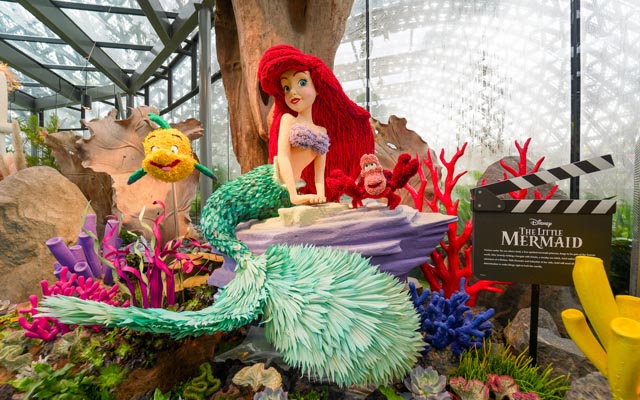
The Disney Garden of Wonder has debuted at Singapore’s Gardens by the Bay in the Floral Fantasy exhibit. Organised in collaboration with Disney and supported by the Singapore Tourism Board, this floral spectacle transforms Disney and Pixar characters such as Mickey Mouse, Snow White, Mike and Sulley from Monsters, Inc., and more into eight stunning topiary sets.
The exhibit, which took 17,000 man-hours to create by hand, will run until March 31, 2025.
To create Ariel’s iconic look, Amaranthus caudatus formed her flowing red hair, Ruscus hypoglossum shaped her glossy tail, and blue-magenta hydrangeas crafted her seashell top, photo by Gardens by the Bay
Highlights include The Little Mermaid with Flounder, Ariel, and Sebastian; a three-metre-tall Mickey Mouse sculpture; Steamboat Willie; Winnie the Pooh; Snow White; Mike and Sulley from Monsters, Inc.; Carl, Russell, Dug, and Kevin from Up; and Buzz Lightyear, Woody, and the Aliens from Toy Story.
A special Flavours of Singapore zone celebrates the city’s culinary delights with Disney characters reimagined in vibrant floral displays, including Donald Duck with Chilli Crab, Stitch with Durian, as well as Minnie Mouse and Daisy Duck with Ice Kachang.
As an extra treat for Disney fans, Hidden Mickeys will appear on the rain curtains in Floral Fantasy. Visitors can also explore the Floral Fantasy gift shop, now Disney-themed, and discover exclusive merchandise such as Mickey-shaped bak kwa (Chinese BBQ pork), plush toys, bags, keychains, and more, in collaboration with local brands.
Additionally, Mickey and Minnie Mouse have unveiled brand-new outfits inspired by Singapore’s national flower, the Vanda Miss Joaquim. Fans can meet these special Disney characters in their Singapore-inspired designs on select dates in 2025.
Tickets are priced at S$24 ($18) for adults and S$16 for children or senior citizens, and include a round-trip shuttle service between Bayfront Plaza (location of Floral Fantasy) and Flower Dome.
Experience the festive season in style with Marriott Bonvoy’s hotels across China, where holiday magic comes alive through indulgent dining experiences, wellness treatments, and exclusive stay offers.
The Ritz-Carlton, Hong Kong transforms into a magical Arctic kingdom, offering a host of festive delights. Guests can indulge in the Frosted City of Dreamlight Afternoon Tea and savour a six-course Christmas Eve and New Year’s Eve dinner at the hotel’s Michelin-starred restaurants, Tin Lung Heen and Tosca di Angelo. Join in the New Year’s Eve countdown party, or unwind with the Christmas Body Bliss Ritual at the spa for a rejuvenating holiday experience.
Enjoy the Frosted City of Dreamlight Afternoon Tea at The Ritz-Carlton, Hong Kong
At W Macau – Studio City, the all-day dining restaurant Hawker Hawker presents a Christmas-themed buffet featuring seasonal sides, paired with complimentary free-flowing beer, sparkling wines, and more. Meanwhile, W Shanghai – The Bund offers a vibrant holiday atmosphere with a buffet brunch and chef’s special set dinner, paired with free-flowing champagne. Guests are also invited to celebrate New Year’s Eve at its WOOBAR Countdown Party.
Celebrate a Whimsical Scandi-Land Christmas at Renaissance Hong Kong Harbour View Hotel, where the lobby welcomes guests with a 4.5-metre Christmas tree and a festive cabin decked with goodies from Finland. Enjoy Nordic-inspired delights at Café Renaissance’s buffet, afternoon tea at Mirage Bar & Restaurant, and more.
For those seeking a festive getaway, The St. Regis Shanghai Jing’an offers an exclusive stay package featuring a private dining experience at The Manor Lounge, located on the 55th floor, along with access to five daily private dining experiences. Guests can also enjoy a 25 per cent discount on spa treatments to unwind during the holidays.
Air capacity continues to recover season on season, with OAG schedules data showing 33.4 million scheduled flights between January 1 and November 24 this year, or an average of just over 101,000 commercial flights per day. This volume, while significant, represents only a 6.4 per cent improvement over the same period in 2023.
According to Mayur Patel, head of Asia with data specialist OAG Aviation, markets have lost a lot of growth over the last five years – typically, mature markets should be registering at least 12 to 15 per cent of capacity growth during this period.
In this episode of TTG Conversations: Five Questions video news series, Patel details his outlook for air capacity improvements, his confidence in low-cost carriers catalysing Asia-Pacific tourism industry’s recovery and expansion, airfare movements in the new year, growth opportunities for commercial aviation in Asia, and much more.
The long-awaited Three-Runway System (3RS) at Hong Kong International Airport, commissioned on November 28, is set to reinforce the city’s status as a regional aviation hub, providing the capacity to meet the projected air traffic demand of 120 million passengers by 2035.
In fact, the new North Runway officially became operational in November 2022, while the Centre Runway was temporarily closed for reconfiguration. The 3RS encompasses the operation of the existing South and North Runways, the reconfigured Centre Runway, along with the associated taxiways and supporting facilities.
The 3RS will reinforce the Hong Kong’s status as a regional aviation hub; photo by Hong Kong International Airport
Welcoming the development, Tommy Tam, managing director of Arrow Travel Agency, stated: “Additional capacity means more time slots for foreign carriers, and for end users, we hope airfare will become more attractive to stimulate travel demand next year. We also see opportunities for more transit flights in Hong Kong – a high-yield segment for airlines. In short, the 3RS will (strengthen) the city’s role as an aviation hub.”
Emphasising that the 3RS increases air capacity, Larry Lo, CEO of Corporate Travel Management Asia, commented: “It reinforces Hong Kong’s position as an economic powerhouse and a stronger aviation hub in the region, connecting East and West—particularly in the fast-growing Greater Bay Area, where seamless transport links are essential.
“In fact, we foresee (that) this significant infrastructure enhancement will provide additional capacity for both passengers and cargo, (while offering greater) flexibility to airlines to add new destinations or restore routes. It will improve airport efficiency, especially during peak seasons and weather disruptions, and elevate the overall travel experience, enhancing Hong Kong’s competitiveness. As a result, we anticipate it will boost the city’s appeal for foreign investment, business activities, leisure visits, and talent recruitment.”
Lo added: “In the long term, we expect Hong Kong to expand its route network, increase flight options, and enhance the airport experience to cater to global demands. As the airport serves as visitors’ first impression of Hong Kong, we believe the third runway will create new opportunities to showcase the city and deliver memorable experiences.”
Cathay Pacific Airways noted that its group airlines are expected to resume 100 per cent of pre-pandemic flight levels by January 2025.
Nikki Pang, head of business at Lightfoot Travel, pointed out that with increased flight routes – and often lower-cost options – available from nearby airports in Guangzhou and Shenzhen, Hong Kong risks losing passengers unless it quickly increases both flight frequency and routes. She described the 3RS as a welcome addition to the city’s aviation sector, underscoring the energy and resources Hong Kong is investing in building its reputation as a premier aviation hub.
“The third runway, combined with new flight routes (to destinations like Saudi Arabia and Cairns) and intensive pilot training conducted by the various airlines, should speed up Hong Kong’s air capacity recovery, which has lagged behind other Asian cities in the post-Covid phase… these developments (will help meet) our clients’ surging demand for a variety of destinations, flight frequency, and value of flights.”
The Singapore-born travel cashback app in Asia, azgo, has launched azgoXplore, their new AI-powered price comparison website designed to help global travellers find the best deals across more than a thousand cities worldwide.
azgoXplore leverages AI and data-driven insights to offer real-time price comparisons for attractions and activities, creating a comprehensive travel planning tool for consumers. Early adopters and partners of the platform include notable regional travel players such as Trip.com, GlobalTix, Ryde, Museum of Ice Cream Singapore, and Wink+. These partners have integrated their offerings into azgoXplore, allowing users to easily access and compare the best deals on a single platform.
From left: azgo’s Yan Yuan Sng and Oliver Hua, NTUC’s Desmond Tan, azgo’s George Yang, TongCheng Travel’s Frank Wang Qiang, and azgo’s Monica Zhao
In addition, businesses in the travel ecosystem can collaborate with azgoXplore to develop co-branded white-label solutions that integrate seamlessly into their apps. This integration empowers users to access attraction deals alongside their everyday services, enhancing both convenience and user engagement.
azgo launched earlier this year with their travel cashback app, offering a one-stop platform that connects users to top travel brands across multiple segments, including hotels, flights, car rentals, and experiences. With the launch of azgoXplore, the travel technology company aims to empower tech-savvy travellers in search of value-for-money experiences.
azgoXplore also addresses a market gap for a price comparison platform tailored to the attractions and experiences sector. Led by azgo’s team hailing from Booking.com and Skyscanner, azgoXplore will first focus on the growth of its attractions and experiences pipeline. Long-term plans include expanding the platform to cover the entire travel journey, from flights to hotels.
Officially launched in Singapore, Hong Kong, Vietnam, Malaysia, and China, azgo also has its sights set on launching in new markets such as Brazil and the US.
During the launch event, Desmond Tan, senior minister of state at the Prime Minister’s Office, and deputy secretary-general of National Trades Union Congress (NTUC), stated: “AI is redefining the tourism and hospitality industry, from our travel plans to attractions, and physical and digital infrastructures. azgo demonstrates how companies are leveraging AI to enhance their operations and deliver value to consumers. It is also important to recognise that AI is transforming jobs and has an impact on the workforce. We are committed to supporting businesses in advancing their AI capabilities and supporting workers to enhance their AI skills through training.”
Oliver Hua, advisory board member at azgo, shared: “Singapore is a global hub for innovative tourism, always ready for smarter change and optimised experiences, especially in the competitive travel space. By combining azgo’s mobile-first rewards offering with our new price comparison platform, we aim to empower travellers to travel smarter – both within Singapore and beyond.”
Jetstar Asia cabin crew and pilots debuted their new uniforms on November 28 at Changi Airport, alongside Jetstar staff from Australia, New Zealand, and Japan.
Designed by Australian designer Genevieve Smart, co-founder of Ginger & Smart, the new collection was created over two years with input from 40 Jetstar staff members. The updated colour palette features softer orange and blue tones, inspired by sunset views from an aircraft window.
Jetstar Asia’s new uniforms will be worn by over 6,000 frontline staff across Singapore, Australia, Japan, and New Zealand
The new uniforms will be worn by over 6,000 frontline staff across Singapore, Australia, Japan, and New Zealand.
The cabin crew uniform offers various options, including blazers, shirt dresses, tailored skirts, trousers, polos, and overcoats, allowing for personal style and comfort. Pilots will transition to a blue uniform with modern cuts and new epaulettes. Jetstar Asia’s old uniforms will be sustainably managed in partnership with a Singapore-based social enterprise.
Travel marketers and communicators are paying attention to sustainability, wellness, and quality experiences when building their products and messaging
Destinations and tourism brands should play up existing charms through creative and mindful marketing and communications
Partnerships between destinations and travel specialists will be especially precious for building awareness and bookings
Travel and tourism marketers are keeping many travel trends and growing traveller preferences in mind as they shape their business and branding strategy for the year ahead.
Benoit Badufle, founder of Horus Development & Consulting, which is engaged to market destinations like Monaco and Brisbane in Asia, told TTG Asia that recent interactions with clients and travel advisors across Asia have underscored several travel trends that command attention in 2025. They include experiential luxury, wellness, sustainability, personalised experiences, multi-generational travel, and bleisure travel.
Travel and tourism marketers are shaping their products, services and messages to respond to travellers’ quest for sustainability, wellness, and local experiences
Besides attention to these travel trends, destinations must also focus on personalisation and digital engagement. He said these areas of focus are crucial, as “travellers from Greater China, South-east Asia, and South Korea are increasingly seeking authentic journeys that align with their values and aspirations”.
Similar observations are also made by Joleena Seah, managing director for South-east Asia with GHC Asia, one of the region’s most recognised PR specialists for hospitality and lifestyle brands.
“From luxury hospitality to cruises, almost every client had similar iterations of these three themes: sustainability, wellness, and locally immersive guest experiences. It’s evident that these words are no longer considered as trends, but an essential element of the guest journey towards living well,” Seah told TTG Asia.
Seah’s participation in Further East 2024 in November also brought home a realisation that luxury travellers are choosing to go “completely off the grid”, creating demand for secluded and private travel experiences that are known to a privileged few.
“This is aligned with recent reports on the growing demand for quiet luxury in high fashion brands – affluent travellers want bespoke experiences that only they can enjoy. Keywords like private islands, private charters, and complete buy-outs were repeated quite often during Further East this year,” Seah elaborated.
She added: “The desire to go off the beaten path also applies to growing demand for conquering extreme frontiers of tourism. More people are now investing huge sums of money for once-in-a-lifetime experiences, like expeditions to Antarctica, Amazon River quests, and even space travel. I’m very excited about the PR opportunities that innovative brands will offer in 2025!”
Play up strengths
To respond to these trending travel motivations, destinations should identify and enhance available charms and convey these points of appeal through creative marketing and communications.
Monaco, as an example, is a destination that is attuned to these critical considerations while its tourism infrastructure and facilities are well positioned to cater to new travel motivations. Monaco has established spas, wellness retreats, and nature-driven experiences while the country’s leadership has long been prioritising sustainability, inspired by Prince Albert II of Monaco’s far-sighted environmental vision spelt out two decades ago. The destination is also ready to welcome multi-generational travel groups and bleisure guests, thanks to its variety of leisure attractions and business facilities.
While Monaco is no stranger to creating exclusive and unforgettable moments for visitors, Badufle revealed plans to collaborate with travel influencers in 2025 to amplify its promise of experiential luxury.
To be successful in the new year, Seah encourages brands to “manifest the ‘travel is a force for good’ message in a holistic way by curating experiences that benefit the environment, local community, and self-care for the traveller”.
She said: “Brands which can demonstrate their appreciation for genuinely mindful and healthy travel experiences will do well in the years ahead.”
Leverage AI
Both Badufle and Seah acknowledge the use of AI applications in their work across sales, marketing, and communications.
Badufle believes that “incorporating AI-driven personalisation, interactive virtual tours, and mobile-friendly campaigns can enhance engagement”, especially in a region populated by tech-savvy consumers.
He said: “Monaco Tourism Board is currently working on an entirely new version of its website, which will integrate such tools, and we will continue to leverage influencers and digital campaigns on platforms like WeChat, Instagram and TikTok to capture international attention.
“Strengthening Monaco’s digital presence is also essential. With AI-driven travel planning and social media platforms like WeChat and TikTok influencing decisions, Monaco is now putting more emphasis on innovative strategies such as virtual tours, personalised content, and seamless booking systems to engage travellers effectively.”
In the space of public relations, generative AI can create visual assets like videos and images within minutes, saving communications practitioners precious time so that more effort could be directed to strategy, ideation and raising the quality of work, reflected Seah.
Go together to go further
With travellers expected to add less crowded and lesser-known destinations to their 2025 holiday itinerary, Expedia Group’s chief commercial officer, Greg Schulze, told TTG Asia that partnerships between destinations and travel specialists will be especially precious for building awareness and bookings.
“We at Expedia Group have to think about how we can help travellers discover secondary and tertiary destinations, perhaps by building new experiences into our product range or working with destinations to promote their cities and regions to our customers,” said Schulze.
One of such partnerships is with Australia, where Expedia Group works with Tourism Australia and several states in the country to help travellers discover more of what the country and its different destinations can offer.
Expedia Group also has a campaign to drive more tourism traffic to Fukuoka, Japan.
“Nearly every campaign that Expedia Group runs for destinations has resulted in incremental bookings. Some of the outcomes are simply discovery – we educate travellers about their options so that they can make the right decisions,” he added.
Tourism authorities at South Korea’s Gyeongnam province are working to raise the region’s profile among travellers, playing up the many natural attractions and cultural sites through targeted marketing strategies to attract first-comers as well as repeat visitors.
Kim Yong-man, director, Gyeongsangnam-do Tourism Policy Division, said: “Gyeongnam has high potential for growth in the tourism industry. We are confident that if tourists experience the beauty of the province’s many areas, they will want to revisit.”
Suseonsa Temple offers healing experiences for travellers wanting rejuvenating holidays
Gyeongnam comprises 18 cities and counties, and is home to an abundance of nature, with many coastal areas and national parks, thousand-year-old temples and historical relics. Visitors can enjoy various recreational activities throughout the year, such as trekking in the Jirisan National Park, island trekking, yacht tours, and surfing.
“Additionally, Gyeongnam hosts seasonal flower festivals in the spring and summer, featuring cherry blossoms, azaleas, and hydrangeas, while the autumn months bring breathtaking foliage,” he added.
The Gyeongnam government is focusing on four main marketing strategies – specialised tourism products, on-site marketing, incentive grants to travel agencies, and promotion through its own website and social media channels that are run in English, Japanese and Chinese.
At the same time, the province is hoping to capitalise on its many wellness destinations to attract travellers searching for rest and rejuvenation. Korean Tourism Organization has identified seven wellness destinations in Gyeongnam alone, namely the Donguibogam Village in Sancheong, Sky-lake in Geochang, Hanwha Belvedere in Geoje, Napoli farm in Tongyeong, Odo-san Healing Forest in Hapcheon, Anti-Aging Healing Land in Geochang, and Sup-ae-seo in Yangsan.
The province itself has selected four additional sites – Hwangmaesan National Park in Hapcheon, Worasan Forest in Jinju, Natural Recreation Forest in Geoje, and Namsa Yedamchon in Sancheong.
These destinations offer programmes featuring traditional medicine, healing, meditation, and nature and forest therapy.
Notably, Donguibogam Village, South Korea’s first herbal medicine-themed park at the foot of the Wangsan, is a popular spot for healing tours, and provides educational and interactive experiences.
There are also temples, such as Suseonsa Temple, that offer stay programmes and venues that offer healing experiences.
“Gyeongsangnam-do boasts numerous exceptional wellness tourism sites, offering visitors the opportunity to relax both physically and mentally while enjoying the province’s stunning natural landscapes,” said Kim.
By 2025, Gyeongnam Province hopes to attract 400,000 tourists, twice as many as the 200,000 it received in 2023.
As Gimhae International Airport is the most direct way to reach Gyeongnam, the office is focusing on source markets that have direct flights, such as Japan and China.
Tour bookings and travel searches for China out of Singapore are surging, as travellers gain new-found love and interest in exploring the middle kingdom.
According to Hilton’s 2025 Trends Report, China ranks among the top favourites for Singapore travellers this holiday season.
The Lux Collective’s properties on China’s Tea Horse Road ancient trade route are especially popular with guests from Singapore; Lux* Tea Horse Road Benzilan in Yunnan province pictured
Based on search data from Singapore-based travellers for the December 21 to January 3 holiday period, Hilton’s research found a significant surge in interest for travel to China, with Beijing seeing a 48 per cent rise in interest compared to a year ago, Shanghai up 81 per cent, and Guangzhou up 87 per cent increase.
The report stated that 23 per cent of Singapore’s Generation Alpha and Generation Z cited strong interest in China.
Over at Chan Brothers Travel, one of Singapore’s leading outbound travel agencies, travellers’ interest has translated into firm business. According to Jeremiah Wong, spokesperson for Chan Brothers Travel, bookings at press time for year-end tours to China in November and December 2024 have nearly tripled compared to the same period last year.
These bookings are for group tours, which the agency excels in, as well as free-and-easy packages, private tours, and corporate trips.
Wong told TTG Asia that “demand for travel to China is surging”, adding that his customers are attracted by China’s “increasing visibility of its vibrant offerings popularised on social media”.
He noted that “each region offers distinct attractions tailored to diverse traveller interests”, but pointed out that Chongqing, Chengdu, Beijing, and Shanghai in particular are hot.
“(These cities are) captivating travellers of all ages with their blend of visually stunning landscapes and vibrant urban experiences, all easily accessible on our thematic duo-city tours,” said Wong.
“We are also observing an uptick in interest from younger travellers looking to immerse in China’s rich heritage, such as in the ancient capital of Xi’an. Off-the-beaten-path locales such as Xinjiang, Tibet, and Yunnan are also top of travellers’ bucket list,” he added.
To cater to family groups this year-end, Chan Brothers Travel created the Fab Fam Fun series, which offers snow play and skiing adventures. These have been selling well, remarked Wong.
Singapore’s strong market potential for China is also benefitting The Lux Collective, which has nine luxury properties in operation across the middle kingdom, with the bulk located along the scenic and historically-rich Tea Horse Road ancient trade route. The group has six more hotels in the pipeline for China.
Nitesh Pandey, chief operating officer – Asia Pacific of The Lux Collective, told TTG Asia that the number of Singapore tour groups arriving in China has grown fivefold from June 2023 to June 2024, with the Yunnan-Guizhou-Sichuan route being the most popular.
“Yunnan is fast becoming one of the most popular destinations for Singaporeans, given its scenic natural beauty and rich local culture, where 25 of China’s 56 minor ethnic groups live in this region. Last month, we have welcomed a group of Singapore travellers visiting Lux* Tea Horse Road Benzilan and Lux* Tea Horse Road Shangri-La, followed by Lux* Tea Horse Road Lijiang for a leisure getaway,” said Pandey.
He said the company’s collection of hotels on the ancient trade route allows guests to “focus on the journey that is the destination in itself”. They are located in some of the world’s most majestic settings, complete with mountain peaks, lush valleys and deep gorges.
“They are perfect for travellers who wish to explore learn more about history and culture while have a holiday that is full of adventure and curiosity,” he said.
The Indonesian Hotel and Restaurant Association (IHRA) has warned that the government’s plan to raise value added tax (VAT) would weaken consumers’ purchase and dent business earning, ultimately leading operators to shed manpower for sustainability.
This warning was expressed in response to the government’s plan to adjust VAT from 11 per cent to 12 per cent as of January 1, 2025, so as to feed the state budget.
Leaders of Indonesian Hotel and Restaurant Association urge the country’s government to reconsider its upward adjustment of VAT, which will come at a time of declining consumer spend
Sri Mulyani, minister of finance, said during parliament that the VAT increment was decided upon following thorough considerations.
However, hospitality industry players are of the opinion that the policy would come at a time of declining buying power.
IHRA has called for a reconsideration of the implementation.
Hariyadi Sukamdani, IHRA chairman, said the higher VAT would lead to lower sales, especially among the lower- and middle-class consumer segments.
This would deal an additional blow to Indonesia’s hospitality businesses, as the government is also planning to slash travel budget by 50 per cent in 2025.
“This could threaten the sustainability of hotel businesses,” said Hariyadi, adding that the impact would be especially felt in secondary destinations.
Government travel contributes significantly to the industry, as it makes up about 40 per cent of business for economy and mid-scale hotels. In destinations like Sulawesi and Papua, government travel can contribute up to 70 per cent of business.
Haryadi said destinations that enjoy a higher volume of international tourists, like Bali and Batam, might be better able to cope with the new VAT.
Once the VAT increment is in place, Haryadi said business would need to “implement survival mode through spending management or financing control”.
One of such measures would be to reduce daily manpower.