TTG Asia
Asia/Singapore Thursday, 12th March 2026
Page 2009

‘Girls only’ staycation deal at Shangri-La Hotel, Singapore

0

SHANGRI-LA Hotel, Singapore is offering a Girls’ Night Out promotion for ladies and their best friends from now till March 31, 2016.

Starting at S$745 (US$547) per night, guests can enjoy a weekend staycation in one of the hotel’s Garden Wing rooms and are entitled to a complimentary breakfast everyday, 60-minute Biologique Rechercher Face Treatment at the spa and three-tier English afternoon tea at the Lobby Court.

girls-only-staycation-deal-at-shangri-la-hotel-singaporeCredit: Shangri-La Hotel

They will also receive personalised bathrobes for two, welcome amenities and a bottle of sparkling wine. Free Wi-Fi and a scheduled shuttle bus service to shopping belt Orchard Road will also be provided.

Block out dates apply.

Suite Escapes at The Okura Prestige Bangkok

0

THE Okura Prestige Bangkok has launched the new Suite Escapes Package aimed at leisure and business travellers.

The new package applies to reservations made for either a Deluxe Suite or a Prestige Suite for two consecutive nights.

Free laundry or pressing (two pieces per day), high speed Internet access and unlimited use of the hotel’s exclusive Okura Club Lounge with all-day refreshments, Japanese tea corner, evening cocktails, free use of the meeting room (up to two hours per stay, subject to availability) are all included in the package.

suite-escapes-at-the-okura-prestige-bangkok
Credit: The Okura Prestige Bangkok

In addition to the choice of a daily international buffet breakfast at Up & Above or Japanese set breakfast at Yamazato, the package includes a THB2,000 (USD$58.70) voucher that is redeemable at any of the hotel’s three restaurants or at The Okura Spa.

Members of the Okura One Harmony rewards programme also enjoy a 20 per cent discount on all a la carte spa treatments.

Rates start at THB17,700 per room, per night. Rates are subject to 10% service charge and 7% government tax.

Other terms and conditions apply.

For reservations, visit reservations@okurabangkok.com

Study finds performance gains needed in Chinese state-owned hotels

0

CHINESE state-owned hotels need to enhance their performance and market competitiveness, according to Kam Hung and Hanqin Qiu of the School of Hotel and Tourism Management (SHTM) at The Hong Kong Polytechnic University, along with co-researchers, in a recently published research article.

Having conducted interviews with both managerial and non-managerial hotel staff, the researchers have identified that little distinction between the ownership and management of the hotels, the lack of a profit motive, the absence of staff incentives, and the inability to match private sector competitors are the causes of inefficiencies.

Due to the lack of a clear distinction between ownership and management of the state-owned hotels, managers are not free to make their own decisions without interventions from the government. Any decisions that are made are usually subjected to lengthy delays while waiting for approval.

There are also accusations from interviewees that priority is given to providing hospitality services to government officials.

Despite these complaints, the interviewees also noted that managers of state-owned hotels are more loyal to their employers compared to those in the private sector, and the style of management is more “humanised”.

Furthermore, high staff turnover rates do not seem to be a problem among employees of state-owned hotels. They seem to enjoy regular staff meetings, social activities, and “abundant training and internal promotion opportunities”.

Nevertheless, researchers note the lack of staff motivation in state-owned hotels. These positions may provide job security but offer no incentives for employees to excel.

The researchers conclude with the suggestion that management be shifted to the regional level to remove competition among local state-owned hotels, to elevate their competitive power in the market, and to take advantage of the ”premium geographical location” of many state-owned hotels.

Best Western pierces Solo’s skyline with newest hotel

0

best_western_premier_solo_baru_external
Credit: Best Western

BEST Western Premier Solo Baru has debuted in Solo, Central Java.

Rising 82m from the streets of the emerging Indonesian destination, the property is now Solo’s tallest hotel.

Facilities provided in the hotel include a spa, infinity pool and fitness centre.

For diners, the Chrystal Sapphire Coffee serves up Indonesian and international dishes all day, while drinks can be enjoyed at the Pool Café and top floor Sky Lounge.

Meetings and events can be held at the Ruby Convention Hall which can handle up to 2,500 people, and eight other function rooms, each of which can accommodate 200 to 300 delegates.

The Luxury Collection expands to Nanjing, marks seventh hotel in China

0

THE Luxury Collection Hotels & Resorts, part of Starwood Hotels & Resorts Worldwide, today announced the opening of The Grand Mansion in Nanjing, China.

Located near Nanjing’s iconic Presidential Palace, this marks the brand’s seventh hotel in the country, in addition to existing sites in Hangzhou, Dalian, Hengshan, Shanghai, Sanya and Tianjin.

The new property boasts a total of 158 guestrooms, including 15 premium suites and a presidential suite.

For dining options, guests can enjoy a large selection of teas at the Xi Lounge, all-day Nanjing cuisine and international dining at The Atrium, or Chinese delicacies at Xuan Ling Ge.

Facilities include a fitness center, an indoor heated pool, a spa and a library. For event spaces, there are seven meeting rooms as well as a grand ballroom measuring 557m2.

New cable car line launched in Singapore’s Sentosa island

0

cable-car-sky-network-sentosa-line
Credit: Sentosa Development Corporation

A NEW Sentosa Line, an extension of the existing Mount Faber cable car line, was officially launched on Tuesday. Together, the two lines form the Singapore Cable Car Sky Network.

The new line is one of several infrastructural enhancements that Sentosa Development Corporation (SDC) has embarked on to improve connectivity and accessibility on the island.

“It (the new cable car ride) offers a serene ride over our beautiful island, while also greatly improving access between Merlion Plaza, Mount Imbiah and Siloso Point,” said Mike Barclay, CEO of SDC.

“We expect it will become the preferred mode of transport for our guests wishing to access the western tip of Siloso Beach, as well as the Shangri-La Rasa Sentosa Hotel, Underwater World Singapore and Fort Siloso,” he added.

Guests who wish to ride on both lines are able to buy a Cable Car Sky Pass with an option to top up for unlimited rides. Overseas guests will enjoy a bonus as the new Sentosa Line will be included in the new Standard Sky Pass with no increase from the current price of S$29 (US$21.20).

As part of Sentosa’s SG50 celebrations, rides on the Singapore Cable Car Sky Network will be free for Singaporeans and local residents from 9am to 9pm on August 10.

Aviareps to represent Centara in Singapore, Malaysia, Philippines

0

CENTARA Hotels and Resorts has appointed Aviareps as its representative in Singapore, Malaysia, and the Philippines.

The appointment was made as Centara seeks to widen and strengthen its brand engagement and awareness among South-east Asian travellers and travel industry leaders.

Aviareps will be responsible for sales and marketing activities which develop the brand awareness of Centara Hotels and Resorts within the region, as well as driving business to Centara’s properties worldwide.

Chris Bailey, senior vice president – sales and marketing of Centara Hotels and Resorts said: “Singapore, Malaysia and the Philippines have long been important markets for the Centara group.”

“Commensurate to this, and demonstrating our commitment to these markets, we are delighted to announce the appointment of dedicated sales directors in each of these countries to closely and passionately communicate the benefits and unique experiences that Centara properties have to offer.”

Amadeus strengthens mid-office portfolio with Athena Innovations partnership

0

AMADEUS travel agencies in Asia Pacific have partnered with Athena Innovations to bring travel management solution, Athena Bookings, to travel agents across Asia Pacific, starting with Malaysia.

Agents will benefit from full automation from front to back office, as well as superior reporting capabilities, regardless of whether their focus is corporate ticketing, leisure travel, tour operators or wholesale. Importantly, Athena’s partnership will entail agile customisation and time to market improvements.

Frederic Barou, vice president, distribution products and operations, Amadeus Asia Pacific, said: “The middle and back offices are important and often complex aspects of a travel agency’s business. We are excited to partner with such an innovative company to provide a valuable addition to the Amadeus suite of agency solutions and more choice to our customers.”

Athena Bookings is already available to travel agencies in Malaysia and will be made available to other markets progressively in the coming months.

India needs aviation policy that benefits airlines: IATA

0

IATA has called for the development of a comprehensive aviation policy aligned with the Indian government’s stated intention to make it easier to do business in India.

“Onerous regulation and processes, debilitating taxes and expensive infrastructure are holding back the industry’s ability to deliver greater economic benefits to India,” said Tony Tyler, IATA’s director general and CEO.

Delivering a keynote address at the Aviation Day India organised by IATA together with India’s Ministry of Civil Aviation (MoCA) and the Confederation of Indian Industry, Tyler highlighted three areas where work is needed to reduce costs in India.

Firstly, India needs to reduce its tax burden. It should not apply service tax to services rendered outside of India, including those for global distribution systems, extra baggage fees and international tickets. Also, the incoming GST regime should protect airlines from double taxation on income.

Next, fuel needs to be priced competitively. As state taxes on jet fuel can be as high as 30 per cent, Tyler urged the government to grant “declared goods” status for jet fuel which would limit taxation.

Lastly, India should allow the Airports Economic Regulatory Authority (AERA) to do its work independently. For example, India needs to overcome legal challenges that prevent AERA’s recommendation for a 78 per cent reduction in Delhi’s airport charges from being implemented.

Tyler also pointed out that Indian regulation is out-of-step with global standards and best practices, holding back the development of the sector.

Instead, India needs “smarter regulation” that can address real issues, meet the public interest, be consistent with global standards and be implemented efficiently.

Hotels in an empty capital

0

Myanmar’s new administrative capital, Nay Pyi Taw, has a mismatch in room supply and demand that is bigger than Kanye West’s ego. Greg Lowe reports why hotel groups are in there

17jul-greg-analysisOn first impression, Nay Pyi Taw is a model of efficiency: on arrival at the airport you can clear immigration, collect your luggage, change dollars into kyat and sit in your transfer vehicle within 15 minutes. The 16km drive into the capital passes quickly as you journey along tree-lined, multi-lane roads that are practically devoid of traffic. Then there’s the impressive sight of the hotels: long driveways lead up to massive resorts where the buildings are dispersed over large tracts of land. Everything appears bigger and more spread out. They have the space, so why not use it?

There’s also plenty of data to show the city is built for business: Nay Pyi Taw International Airport has a capacity of 3.5 million passengers a year; Myanmar International Convention Centre features 29,000m2 of floor space and can hold 1,900 people in its plenary hall; and there’s no shortage of accommodation – there were 4,884 rooms spread across 58 properties at the end of last year, according to Ministry of Hotels and Tourism (MHT) data.

What is lacking however is – people.

Nay Pyi Taw is a young city. Construction of the new administrative capital started in secret around 2002. The announcement that power would shift from Yangon was made in 2005, with the official naming of the city taking place the following year. The biggest influx of people, mostly government officials, was in 2008 and the population has grown ever since. While the city has netted a number of large-scale events, such as the World Economic Forum in 2013 and the ASEAN Tourism Forum 2015, reality appears to be falling short of the dreams of the generals who designed Myanmar’s new centre of power.

Andrew Langdon, executive vice president Thailand and Indochina of Jones Lang LaSalle, explained the gap between supply and demand in the hotel sector.

“Nay Pyi Taw witnessed a significant increase in room supply in the lead up to hosting ASEAN events in 2014. With the conclusion of these events, some of the facilities are now significantly under-utilised,” he said.

“Existing branded supply in Nay Pyi Taw is very limited but growing. Existing hotels are primarily categorised in the upscale segment and include Parkroyal (90 keys), Kempinski (141 keys), MGallery (165 keys) and Hilton (202 keys).”

Authorities are trying to fill this gap by promoting the city as a MICE destination. They also recently announced plans to develop it as a multi-development tourism market. This is no mean feat given the current lack of content: a quick search on TripAdvisor yields six attractions, eight restaurants, 30 hotels and not a whole lot more.

Official data reveals tourism performance which can only be described as dismal. While MHT statistics show international arrivals to the city rose from 5,521 in 2011 to 19,261 last year – up by about 52 per cent per year – growth would need to continue at this rate for 11 years, with no new supply, for hotels to run at full occupancy. In other words, last year’s international arrivals would have been enough to fill every hotel room in the city for only four nights.

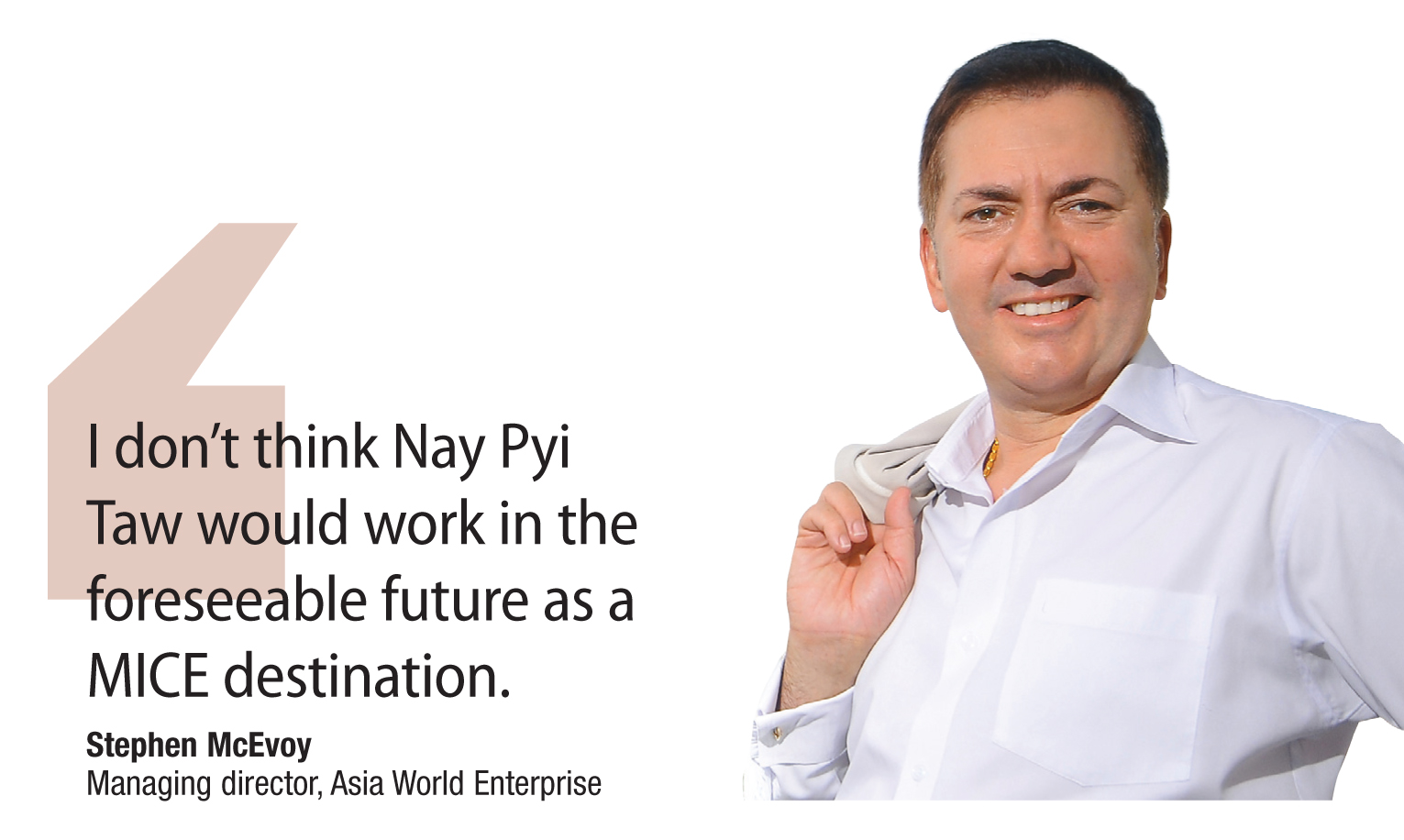
Action is clearly needed to improve performance; however, the trade is far from optimistic about government initiatives to bring in more people. Stephen McEvoy, managing director of Asia World Enterprise, said: “I don’t think Nay Pyi Taw would work in the foreseeable future as a MICE destination.

“For one thing the international airport is very new with no major airlines flying in… There is a choice of hotels in the destination, but no world famous cultural sites or areas of natural beauty nearby as a hook for selling the destination. Apart from accommodation, restaurants, meeting venues and meeting technology would need to be upgraded.”

Given such weak performance, why are international hoteliers opening shop in the capital? Especially given the overall decline in Myanmar’s hotel sector at the national level: STR Global reported that Myanmar suffered Asia-Pacific’s largest decrease in RevPAR (-22.4 per cent) in February, driven largely by a 16.9 per cent decline in occupancy to 67.8 per cent.

A senior executive at an international tourism business with more than 15 years experience working in Myanmar said major hotel groups need a presence in Nay Pyi Taw to strengthen government relations and help secure licences elsewhere in the country.

“If international hoteliers want licences to operate in key destinations like Yangon, Mandalay and Inle, they need to partner a hotel in Nay Pyi Taw,” he said. “The authorities need the big brands here to make the place look credible. I doubt it’s written down anywhere as a requirement, but everyone knows giving them face will ease the licence process elsewhere. What other explanation can there be?” the source said.

Tourism authorities deny the claim, as does AccorHotels, while Hilton and Pan Pacific did not directly respond to the question.
Timur Senturk, vice president operations ASEAN at Pan Pacific Hotels Group, said: “The management contract for Parkroyal Nay Pyi Taw was signed with Shwe Taung Group, one of Myanmar’s leading corporations in real estate and infrastructure development. Shwe Taung Group is also our joint venture partner for the development of the first Pan Pacific hotel in Myanmar, Pan Pacific Yangon, which is scheduled to open in 2017.”

William Costley, vice president of operations for South-east Asia at Hilton Worldwide, said: “As Nay Pyi Taw increasingly (becomes) an appealing destination for travellers, we want to be where our guests want to be.”

None of the hoteliers approached gave performance data for their properties in the capital. And until performance in Nay Pyi Taw matches the vision of its founders, doubts about its viability as a destination are likely to continue to echo around its empty streets.17jul-greg-analysis_quote


This article was first published in TTG Asia, July 17, 2015 issue, on page 5. To read more, please view our digital edition or click here to subscribe.