HONG Kong Airlines is set to launch its first direct flight to New Zealand on November 10.
Services depart daily from Hong Kong International Airport at 15.20 and will arrive at Auckland Airport at 07.30 local time. The return flight will depart daily from Auckland at 09.30 and will reach Hong Kong at 15.55.
The flights will be operated by an Airbus A332 with 283 seats, including 24 business class seats.
Li Dianchun, chief commercial officer of Hong Kong Airlines stated that the route is being launched to ride on the rise in number of Hong Kong and China travellers visiting New Zealand.
“According to official figures by the New Zealand Government, as of March 2016, the total number of visitors from Hong Kong and China has recorded rises of 19.1 per cent and 27.8 per cent respectively,” he said.
“Leveraging on our connectivity in Asia via the international hub in Hong Kong, we believe this new service to Auckland will be welcomed by passengers from Beijing, Shanghai, Tianjin, Chengdu, Nanjing, Hangzhou, Okinawa, Tokyo, Bangkok and Taipei, offering them more travel options.”
CARLSON Rezidor Hotel Group has acquired Country Development & Management Services (CDMS), a joint venture between Country Inns & Suites by Carlson and Chanakya Hotels that was set up to pioneer the Country Inns & Suites By Carlson brand in India.
The acquisition includes operation of four Radisson Blu hotels managed in India by CDMS.
With this deal, the Country Inns & Suites By Carlson brand in India will now be managed by Carlson Hotels (South Asia), the Indian affiliate of Carlson Rezidor Hotel Group.
Explaining the decision to acquire CDMS, Raj Rana, CEO, South Asia, Carlson Rezidor Hotel Group, said: “India is an important market for Carlson Rezidor Hotel Group, where we offer seven brands from mid-scale to luxury. Country Inns & Suites By Carlson is an integral part of our brand portfolio in the mid-scale segment. This consolidation will help us in directing our resources more efficiently to support our hotels.”
Commenting on the move, Thorsten Kirschke, president, Asia-Pacific, Carlson Rezidor Hotel Group, added: “This acquisition, resulting in the full ownership of CDMS, is a strategic move to further strengthen our position as the leading international hotel operator in India.
“We aim to have 170 hotels in operation and under development by 2020 in the country.”
CHINA Eastern Airlines’ commencement of daily flights between Brisbane and Shanghai this December has been hailed as a “huge victory for the whole of Queensland”.
The daily schedule is a marked increase to the thrice-weekly service originally planned.
Welcoming the move, Julieanne Alroe, CEO and managing director, Brisbane Airport Corporation, said: “Connecting China’s busiest international hub with Queensland’s biggest international airport is a significant step for the city and state in positioning Brisbane as a major Asia-Pacific centre.”
According to Alroe, the Chinese visitor market, the second largest for Brisbane Airport, has experienced 23 per cent growth in the last 12 months.
Latest statistics show that a record 400,000 Chinese travellers visited Queensland in 2015, contributing almost A$1 billion (US$729 million) in visitor expenditure, which is a 51 per cent increase on the previous year.
Alroe said: “Regular direct flights into Brisbane will help capture a portion of this substantial and important market as well as direct visitors to some of Queensland’s most desirable tourist destinations.”
Likewise, Brisbane Airport’s head of corporate relations, Rachel Crowley, said: “There is so much potential for Brisbane to be developed as a gateway city instead of Sydney or Melbourne because of its position on the map.
“We are foreseeing a huge volume of Chinese traffic to start using Brisbane with this new development,” she said, adding that Beijing is being targeted as the next Chinese city to develop daily direct connections.
China Eastern Airlines currently operates a seasonal service between Shanghai and Cairns, providing access for up to 13,000 visitors each year to tropical North Queensland, the state’s northern gateway to the Great Barrier Reef.
AFTER bringing satellite operator Thaicom from nowhere to eighth in the world and increasing its market cap five to six times in the four-plus years she headed the company, new group CEO of Dusit International, Suphajee Suthumpun, is on a mission to put the homegrown hotel group on the world stage.
Suthumpun joins Dusit at a time of tremendous growth. The chain operates 29 properties today but has a pipeline of 40 hotels that will open in the next three to five years across AMEA. The target is to sign another 20 hotels this year, she said.
Hospitality education is also growing great guns with eight projects in six countries.
But Suthumpun’s goal is incalculable and larger than just number of hotels, schools, company size and other such performance indicators. “I could grow Dusit to 100 hotels and have more education projects, but I’m looking for more impact than just that,” she said in an interview.
“My goal is first, for everyone of our 4,000 employees – and this will grow to 12,000 as we open more hotels – to be proud of being a part of Dusit and to believe in our mission. Ultimately, for Dusit to be seen as the homegrown asset of the country which all Thais can be proud of. If a Thai were to visit, say, the Dusit Thani in Dubai, he or she would be filled with pride that Thailand has produced such a brand.”
Her priority is to strengthen the foundation of the company to support “quality” growth. The pillars centre around five key areas, namely, people, process, property & branding, technology and financial capability, she said.
Marking a new chapter at Dusit, Suthumpun is the first CEO who is non-family and only the third CEO since the business was found by Thanpuying Chanut Piyaoui in 1949. The founder’s son, former CEO Chanin Donavanik, has stepped down but remains chairman of the executive committee.
Asked why he decided to handover the baton to Suthumpun, Donavanik said with the business growing so rapidly, the company had to be managed and led differently.
“I don’t think I have the energy to do detailed work anymore. I also think technology will be important if the company were to do well and I am not good with that. And when she said yes, I felt comfortable to retire as I have someone who has the passion and reputation to look after Dusit, the company I love as my mother founded it.”
– Read how Suthumpun plans to strengthen Dusit’s foundation in View from the Top, TTG Asia’s June issue
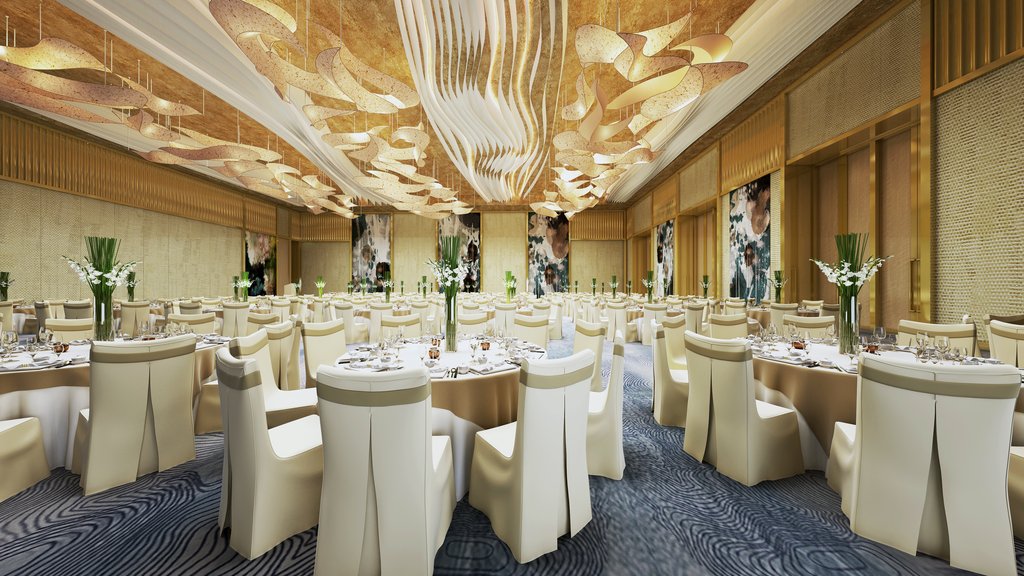
The ballroom at the upcoming Radisson property can seat up to 1,600 guests
RADISSON Golf & Convention Center Batam will elevate Batam’s appeal as a MICE destination when it opens in 3Q2016 with 240 guestrooms and flexible event spaces.
Owned by Adhya Graha Wisata, the property will be one of the first international branded hotels to be launched on the small Indonesian island just an hour by ferry from Singapore.
Located in the upscale Sukajadi area, Radisson Golf & Convention Center Batam is part of Bukit Indah Sukajadi, a 220-hectare development that includes residential units, offices and commercial and retail spaces. The property sits adjacent to the 18-hole Sukajadi championship golf course and is close to Kepri Shopping Mall, Nagoya town, the offices of Batam Center and Muka Kuning Batamindo industrial park.
Event spaces at the hotel will include a ballroom that can accommodate up to 1,600 banquet guests, and a number of meeting spaces with state-of-the-art audiovisual equipment. Customisable banquet menus will be available.
Other hotel facilities include a 152-seat all-day-dining restaurant, an outdoor pool, an indoor pool, a fitness centre, a Kid’s Club and a spa.
“The opening of Radisson Golf & Convention Center Batam is redefining the hospitality landscape in Batam, providing extraordinary stay, play and meeting experiences for travellers,” said Veronique Sirault, general manager, Radisson Golf & Convention Center Batam.
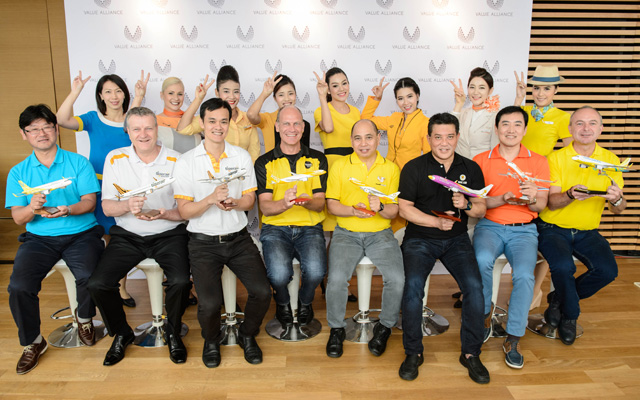
EIGHT budget carriers yesterday formed the world’s largest and first ever pan-regional LCC alliance.
The Value Alliance’s founding airlines are Cebu Pacific (including subsidiary Cebgo), Jeju Air, Nok Air, NokScoot, Scoot, Tigerair Singapore, Tigerair Australia and Vanilla Air.
CEOs and stewardesses of all eight partner LCCs
Explaining the nature of the partnership, Campbell Wilson, CEO of Scoot, said: “This is a sales and distribution alliance. It is to expand our distribution reach beyond each of our departments, to open the networks we ourselves operate in.”
This means that customers will be able to view, select and book flights from any of the eight airlines in a single transaction, directly from each carrier’s website, once the technology is fully implemented.
Developed by Air Black Box (ABB), this new technology also offers guests the full suite of ancillary choices available from all the LCCs in one itinerary.
Wilson elaborated: “You’ll be able to book one, two, or more than two airlines in a single transaction and payment. You’ll be able to select your seats, baggage requirements, meals (and other inflight features) on all of the carriers. You’ll be able to complete your entire booking in a single website, in a single transaction, and receive a single itinerary. It’s basically a one-stop shop.”
Michael B. Szucs, Cebu Pacific’s chief executive adviser, added: “This is about giving visibility to our partners’ products on our own respective websites. (It is about) making (the booking process) seamless and providing one transaction for those who want to connect on a multi-leg journey.”
According to Wilson, there was no good technology in the market that allowed interline sale of ancillary products, hence the need for ABB.
He said: “GDS distribution is not exactly desirable. We wanted to avoid some of the challenges that exist with other systems. There are existing products out there, but they do a poor job of interline sale of ancillary products, and ancillary products for Scoot (and the other LCCs) is more than 20 per cent of our revenue. There is a clear opportunity cost, and that’s why it is so critical to develop technology that facilitates sale and real-time pricing.”
For example, Lee Lik Hsin, CEO of Tigerair Singapore said that his company and Cebu Pacific already have an interline partnership in place. However, ancillaries cannot be booked on the current platform. With the new alliance and platform, the booking of ancillaries has been made possible.
“That is the added advantage,” said Lee.
Szucs said: “The emphasis (of this alliance) was to leverage off each partner here, in terms of the power of their own web distribution.
“In each of our markets, our dot com web distribution is powerful. Cebupacificair.com is powerful in the Philippines, but it not the first place some will go to in Korea or Thailand or Australia. But I have partners here who have powerful brands in those markets, and that efficient technology that links to their own web distribution is what we’re trying to achieve.”
Yet, two notable LCCs – AirAsia and Jetstar – were not present at the unveiling.
When asked about their absence, Wilson said: “The objective is to expand our distribution and our network. We do this for our own strategic reasons, so the fact you don’t see some airlines here is self-explanatory.”
He added: “However, this is not a closed alliance. We are open to new members joining the alliance. Who and where obviously we cannot say yet.”
A shared loyalty programme is also absent in the Value Alliance, and there are no plans to have one as of now.
When asked why, Szucs said: “At the moment, we need to focus on the huge value we can bring to each other in terms of sales distribution. What is core to what we do is maintaining the lowest cost, as that means we can pass on the lowest fares to the consumers. We’re about low fares to stimulate travel for people who have never flown before.”
The Value Alliance airlines will serve more than 160 destinations with a collective fleet of 176 aircraft across the Asia-Pacific. In 2015, the eight airlines collectively carried 47 million travellers.
Currently, Scoot, Nok Air and NokScoot are already offering each other’s flights and fares powered by the new ABB technology. Other alliance members will come online in the next six to nine months.
ROBERT Guy, managing director Singapore and Malaysia at Destination Asia, has been awarded the Rama Rebbapragada Award for Outstanding Contribution to the Cruise Industry during the Seatrade Cruise Asia Gala Dinner last week.
According to a statement by Seatrade, Guy received the accolade “in recognition of his long, outstanding engagement within the cruise industry in Asia”.
Zinan Liu, chairman, Cruise Lines International Association, and who presented the award to Guy, said: “He has been involved with cruising since its absolute beginning in Asia.
“His experience with the industry and his encyclopedic knowledge of the geography of Asia made him a natural point of contact for the cruise line leaders who first came to Asia at that time, such as Adam Goldstein, Arne Bakkelund, Peter Cox, Stein Kruse and Bruce Krumrine, and of course the man whom this award is named after, Rama Rebbapragada.
“As cruise tourism now moves to centre-stage, his long experience and deep understanding of it gives him a special place in the Asian cruise industry.”
Seatrade Cruise Asia took place on May 12 to 13 at the Busan Port International Passenger Terminal in Busan, South Korea.
Nadda Buranasiri, CEO, Thai AirAsia X (fourth from left); Kamarudin Meranun, Group CEO, AirAsia X (centre); and Benyamin Ismail, CEO, AirAsia X Berhad (fourth from right)
AIRASIA X will launch new routes from Kuala Lumpur and Bangkok to Tehran starting next month.
Flights to the Iranian capital from klia2 and Don Mueang International Airport will be operated thrice-weekly, with commencement on June 21 and 22 respectively.
“The recent lifting of sanctions opens up exciting new prospects for Iran as a tourist destination,” said Benyamin Ismail, CEO of AirAsia X.
“We believe that the revival of direct flights to Tehran from Kuala Lumpur is timely and we foresee that our direct flights from both ASEAN cities of Kuala Lumpur and Bangkok can improve bilateral relations while encouraging trade and tourism activities between the cities.”
To celebrate the launch, promotional fares are now being offered starting from 299 ringgit (US$74) one-way on Economy and from 999 ringgit one-way on the Premium Flatbeds for flights departing from Kuala Lumpur.
Meanwhile, Thai AirAsia X offers fares starting from 2,990 baht (US$84) one-way on Economy and from 9,900 baht one-way on the Premium Flatbeds for flights departing from Bangkok.
Promotional fares are available for booking online from now until May 29 for travel from flight commencement until May 22, 2017.
A NEW A$80 million (US$58 million) cable car project linking Elizabeth Quay to Kings Park could inject more than A$30.5 million into the Western Australian economy and help boost Perth’s tourism appeal.
According to Western Australian Tourism Council’s CEO Evan Hall, Perth needed a major attraction to bring together the city’s newer developments, which includes Perth Stadium and new hotels that are planned in Elizabeth Quay.
“What is missing is a signature attraction that will become the must-do experience in the city and encourage visitors to stay longer and spend more,” said Hall.
The council estimates that the cable car could carry about 650,000 passengers each year.
Explaining the need for the attraction, Hall said: “Research shows that visitors to Australian capital cities who use tourist rides and man-made attractions stay longer at their destination.
“There would also be further profit from new visitors who would be drawn to Perth by the attraction.”
But for now, it is imperative for the state government to bring together all relevant agencies involved to approve the Perth Cable Car project in order to select the route and expedite the approvals process, said Hall.
AUSTRALIAN developer Crown Group has unveiled Skye Hotel Suites, a new hotel brand set to debut in Sydney’s Parramatta suburb in 2017.
Skye will form part of the 29-storey V by Crown Group development known as Parramatta’s vertical village, and features 72 studio, one-bedroom and two-bedroom suites. A sky bar will also reside on Skye’s 26th floor.
Guests at Skye will get access to the pool, gym, conference room, restaurant, sauna, business centre and alfresco dining and retail piazza at V.
Iwan Sunito, Crown Group’s CEO, additionally revealed plans to expand and bring the brand onto the international stage.
“Asia is booming and with it more and more people travel to Australia for holidays and for business. This has created a gap in the market as the demand increases for luxury hotel-style serviced apartments in Sydney and Australia,” he said.
“Expanding into the transient short-term accommodation market will provide a strong foundation for our continued expansion both locally and across the region.”