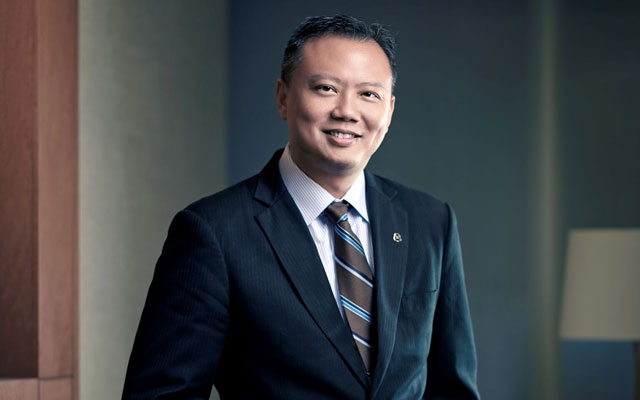
Crown and Champa Resorts has appointed Brad Calder as general manager of Hurawalhi Island Resort Maldives and Kudadoo Private Island, opening February 18, 2018.
Calder has over 20 years of industry experience, having spent time at a number of top hotels and restaurants across the globe, including Home House Private Members Club & Hotel (London), Stamford Hotel (New Zealand), HPL Hotels (Bali), Gili Lankanfushi (Maldives) and Warwick International Hotels (Fiji).
General Hotel Management (GHM) has named Deasy Swandarini general manager of The Chedi Club Tanah Gajah, Ubud, Bali.
Balinese by birth, Swandarini joins the GHM family after having spent a large part of her hospitality career in several of Bali’s resorts including Kayumanis Nusa Dua, The Royal Santrian Luxury Beach Villas, The Mulia and The Ritz-Carlton Bali.
She was most recently general manager of Kamandalu Ubud.
Silangit Airport is currently undergoing upgrading. Credit: silangit-airport.co.id/
The Indonesia Ministry of Tourism is offering cash as incentive for charter operators to open new routes to the archipelago.
A decree issued by the ministry in August stipulated that the incentive, available until December 31, is given to the airline or travel company (charterer) who bring tourists either from a new original city in other countries or to a new destination in Indonesia.
Silangit Airport is currently undergoing upgrading. Credit: silangit-airport.co.id
Each charter flight must stay a minimum of three nights for travellers from ASEAN countries and Asia, and 11 nights for travellers from Europe and the US.
The incentive amount ranges from US$15 to US$25 per passenger depending on the origin of the flight and the length of stay.
I Gde Pitana, deputy minister for international marketing development, Ministry of Tourism, said: “For the first time ever, the Ministry of Finance has approved (our) proposal to give incentives to the (private sector) in the form of cash.”
Usually government agencies only support the programmes of the private sector, for example, by doing joint marketing.
“Our aim is to widen the market origins and (open new) destinations in Indonesia,” he said.
As part of the development of 10 ‘New Bali’s’, the government has been developing and upgrading airports in various cities in the country.
Some airports are being upgraded to international gateway status. They include H.A.S. Hanandjoeddin International Airport in Tanjung Pandan, Belitung, and Silangit in North Sumatra, which is targeted for launch on October 28. Both destinations are among the 10 New Bali’s.
While charter flights are expected to fly to these new destinations, the minister’s decree does not limit the incentives to only the 10 destinations.
HK Express has fired its CEO Andrew Cowen and put in place Zhong Guosong from sister carrier Hong Kong Airlines as executive chairman and acting CEO.
The LCC cancelled 18 Golden Week (October 1-8) flights to Seoul, Osaka and Nagoya just two days before the holidays, leaving about 2,070 passengers stranded. Its image got a bruising, although sources suggested refunds and alternative flight arrangements via Sunflowers Travel and Hong Thai Travel Service were made.
Cowen no longer with HK Express
Zhong’s first order of business is to “work on understanding what has transpired in the airline recently, in order to implement any necessary improvements to ensure HK Express continues to serve the Hong Kong public in its unique role as the sole low-cost carrier”, said a statement.
Zhong is working with the airline’s board and leadership team to develop strategies and policies. He is planning to meet with the company’s management and employees, and to liaise with the relevant local authorities, including the Civil Aviation Department, to establish a more efficient communications channel and implementation mechanism.
Tommy Tam, managing director, Arrow Travel Agency, believed the impact to the airline’s reputation would be short term. “I don’t believe this incident would deter people from flying HK Express as its prices are so attractive and many clientele are not bound by time constraints. In fact, the LCC trend prevails in the Hong Kong market so travellers have really adapted to the business model.”
Worldwide Package Travel Service CEO, Yuen Chun Ning, added: “According to the airline, the cancellations accounted for only three per cent of total weekly flights. It was blamed because of the late announcement, hotspot destinations chosen, as well as the Golden Week holiday effect. If they cancelled connections to secondary cities, it might not have stirred up such immense criticisms.”
Update [October 6, 18.09]: SilkAir has clarified that it is not the first Asian airline to operate the aircraft.
SilkAir has introduced the Boeing 737 Max 8 into its fleet, putting it alongside Malindo Air as one of the first Asian airlines to operate the aircraft.
The carrier will have two of the aircraft by end-October. The first flight using the aircraft will be from Singapore to Hiroshima on October 30. The only non-stop route between the two cities will run thrice weekly.
Foo: growing interest in Japan travel brings SilkAir to Hiroshima
“Hiroshima was one of the stops in our evaluation that showed a very compelling business case,” said Foo Chai Woo, chief executive of SilkAir. “There’s been growing interest in travel into Japan, and Japan has always been very strong in outbound (traffic).”
With 14 per cent fuel savings compared to the Boeing 737 NG, the Max 8 allows the airline to operate flights up to six-and-a-half to seven hours, giving it the opportunity to look at introducing more routes beyond the South-east Asia region, said Captain John Lee, chief pilot Boeing.
The 156-seat Max 8 aircraft will feature an enhanced business class cabin, and refinements such as a 25 per cent increase in seat pitch to 49 inches and additional seat recline from eight to 12 inches.
The economy class seats will feature tablet and phone holders on the seat back and in-seat USB ports.
The inflight entertainment service, SilkAir Studio, has also been upgraded to offer more than 100 international movies.
The cabin is newly furnished with Sky Interior highlights, sculpted sidewalls and LED lighting.
SilkAir expects to operate three Max 8 aircraft by the end of 2017, with another 34 on order. Aside from Hiroshima, the fleet will be deployed on other existing longer-haul destinations such as Cairns, Kathmandu and Bangalore.
CEO Sean Menke (pictured) led the company through a restructuring which reportedly saw 900 jobs cut
Sabre’s president and CEO Sean Menke wants to leverage IATA’s NDC but is quick to point out that this won’t be at the expense of the company’s historical technology leadership role.
Speaking at The Beat Live in Dallas recently, Menke said that the development of NDC standards was just the first step in a series of changes that would impact the way airlines market their services and how travel agencies retail those services to consumers.
Menke: value creation for airlines and agencies
But there are a host of other implications, he stressed, including airline revenue management, ticketing fulfilment and servicing and other back-office functions that travel agencies provide in support of airlines, especially TMCs that support business travellers.
“Sabre has a history of bringing together the interests of travel suppliers and travel retailers and finding ways for technology to move the industry forward. The conversations we have today with airlines and agencies are very different from our discussions even a few years ago. The forward-thinking people are focused on driving value creation for airlines and agencies alike. That’s how we will make NDC work,” said Menke.
He observed that while there is a perception of airline industry consolidation steering airline financial results, “the real impact on airline economics has been the explosive growth of LCCs, impressively moving beyond the leisure travel market and successfully driving pricing and competition across both the business and leisure travel segments”.
Such factors will require traditional carriers to differentiate their offerings and find new ways to drive revenue growth while still competing for the price-conscious traveller, he added.
He reiterated Sabre’s commitment to NDC standards, saying that the company is already Level 1 compliant with a roadmap to become Level 2 and Level 3 compliant in 2018.
Rosewood Phuket
Rosewood Hotels & Resorts will be unveiling the Rosewood Phuket, its first South-east Asia resort, on November 2. Situated along a 600m-long beachfront in Phuket’s Emerald Bay, the property offers 71 pool pavilions and villas. Rooms start at 130m2 for the Ocean View Pool Pavilion and go up to 796m2 for the standalone two-bedroom Ocean House. Asaya, Rosewood’s holistic wellness concept, will debut at the resort with a programme of alternative therapies, lifestyle coaching and fitness activities. Other recreational facilities include a fitness centre, children’s facility and beachside infinity pool. There will also be four F&B venues, and 243m2 of event space. The hotel is open for bookings.
InterContinental Hanoi Landmark72
Perched atop the Keangnam Landmark72 building from the 62nd to 71st floors is the InterContinental Hanoi Landmark72. Billed as Vietnam’s tallest hotel, its 359 rooms, including 34 suites, all offer panoramic views courtesy of their floor-to-ceiling windows. Aside from the property’s four F&B options, the hotel also offers guests access to a swimming pool, business centre, fitness centre and a variety of small and large meeting spaces, including the largest pillarless ballroom (920m2) and largest ballroom foyer area (1,020m2) in Hanoi.
ibis Styles Ulaanbaatar Polaris
AccorHotels has debuted its first property in Mongolia, the 95-room ibis Styles Ulaanbaatar Polaris. The property stands in the capital’s Khan Uu District, a 15-minute drive to Chinggis Khaan International Airport. The hotel has one restaurant, the ibis Kitchen, on-site, and leisure facilities include a children’s play area and a gym (to open in 2018). It has two meeting rooms that can host up to 100 guests.
The Ritz-Carlton, Langkawi
This oceanfront resort has opened amid the Malaysian island’s lush rainforest. Aside from the 70 rooms, 15 suites and 29 villas on offer, the property also has Villa Mutiara that can accommodate up to eight pax and comes with two pools and access to a private beach. Facilities include four dining venues, a Ritz Kids club, outdoor tennis court, fully-equipped gym, infinity pool, spa and indoor/outdoor yoga space.
Hilton Garden Inn Shiyan
The Hilton Garden Inn in the Chinese city of Shiyan in northwestern Hubei province offers 152 guestrooms, including 16 family guest rooms with separate living rooms, and one deluxe suite. Guests can expect bedding with hypoallergenic pillows, 43-inch HDTVs, work spaces with ergonomic chairs, mini-fridges, and complimentary Wi-Fi access. Amenities include three F&B options, a 24-hour gym and self-service laundromat. For meetings and events, the property has 210m2 of space, spread across four meeting rooms.
Ayana will launch Komodo’s first five-star resort on Labuan Bajo’s Waecicu Beach, along with a nine-bedroom phinisi ship sailing from the property.
In operation by next summer, Ayana Komodo Resort, Waecicu Beach features 12 suites and 189 guest rooms, an 11th floor check-in and a rooftop wedding and function venue with an ocean view terrace accommodating about 200 guests.
Labuan Bajo
F&B includes an all-day dining serving Asian cuisine and International food, a seafood barbecue restaurant, a Japanese restaurant, a rooftop bar, the Pier Bar and Lobby Bar.
The resort also offers a private beach, two main swimming pools and a children’s pool, a spa, a gym and kid’s club.
A 54m-long and 11m-wide, nine-bedroom phinisi ship will sail from the private pier to around the island on two- to three-night explorations.
Labuan Bajo is located just an hour’s flight from Bali in West Flores and overlooks the Komodo National Park, a UNESCO World Heritage Site since 1991.
With 15 million arrivals expected this year, and 20 million by 2019, Indonesia believes the need to spread tourism beyond Bali has become more critical.
As pointed out by tourism minister Arief Yahya, of 34 provinces in the country, Greater Bali gets 40 per cent of international arrivals, Greater Jakarta 30 per cent and Riau Islands 20 per cent.
Mount Bromo, East Java, Indonesia
The 10 new destinations the ministry hopes to nurture as new Bali’s are Lake Toba (North Sumatra), Tanjung Kelayang (Belitung), Tanjung Lesung (Banten), Kepulauan Seribu (Jakarta), Borobudur (Jogjakarta-Solo-Semarang, Central Java), Mount Bromo (East Java), Mandalika (Lombok), Komodo National Park (East Nusa Tenggara), Wakatobi National Park (Southeast Sulawesi) and Morotai (North Maluku).
It’s been a long try. The government has, for instance, given a Special Economic Zone status to places such sa Tanjung Lesung, Mandalika and Morotai, enticing investors to develop infrastructure there. But, take Lombok’s Mandalika project – fact is, it has not taken off in over a decade.
While players such as AccorHotels, Archipelago International, Santika Indonesia and Sahid Hotels have entered some of these destinations, a hospitality investment conference held in Jakarta last May revealed that many investors still see Bali and Jakarta as fertile grounds.
Kevin Wallace, managing director Asia-Pacific of Dream Hotel Group, said: “I don’t think Bali is saturated. Tuban and Sunset Road perhaps yes, but we are looking at Pecatu and Canggu – beautiful up there.”
MNC Land, which has a huge project on a 110ha land near Tanah Lot temple, also believes Bali is still feasible. In partnership with Trump Organization, it is redeveloping the former Pan Pacific Nirwana Bali Resort in Tuban into a “six-star” hotel and redesigning the golf course there.
Ivan Casadevall, MNC Land’s deputy COO hospitality, said: “We are going into Bali but way out of where everything is happening. The toll road is not even close to start being built. It takes a little bit of longterm vision.”
But Indonesian travellers actually do look for new destinations in the country. Erastus Radjimin, CEO of Artotel Indonesia, said: “For Indonesians, especially my (millennial) generation, we are bored with Bali. It is interesting to see what is being promoted in these 10 destinations.
“However, at the end of the day, it will be back to infrastructure development, which is more important than promotion (at this stage). When you have good infrastructure, everybody will start coming in, we will see good asset value – the developers will automatically come.”
Matt Gebbie, director of Horwath HTL Pacific Asia, said there are clients, mostly Indonesians and some mainland Chinese, that are looking for destinations other than Jakarta and Bali. But most are small-scale investments.
Gebbie said: “The islands around Bali (such as Lombok and Labuan Bajo, gateway to Komodo Island) are talked about more, but plots that have been sold are small.”
Wallace questioned if it was not wasteful to spend money opening as many as 10 new destinations. “Why not choose just three or four and do those well?”
Better still, focus on the domestic market, he added. “I think the real game here is where the Indonesian market wants to go, how to stop them from going to Singapore,” he said.
Samudra Hendra, owner of Milestone Pacific Hotel Group, Indonesia, which operates hotels in many cities in Indonesia, said he focuses on business rather than leisure hotels and goes “where new infrastructure developments are, even if those are in destinations like Purwokerto, Tegal or Cilacap (Central Java)”.
“I will rush and open a hotel there and make money, well, at least until others follow,” he said.
Hiramsyah S. Thaib, team leader of the acceleration for the development of priority tourism, Ministry of Tourism, said infrastructre development isn’t the responsibility of the ministry alone.He said the transport ministry and airport authorities are developing airports, while the public works ministry has worked with the World Bank for a loan to develop roads. Indonesia’s financial institutions too are providing loans for hostels and homestays, while the education ministry is lending its hand on human resource training.
Citing an example, he said Silangit Airport near Toba was reopened last year declared an international airport last month.
Travel time between Jakarta and Toba has been cut down to two hours with a direct Jakarta-Silangit flight, served by Garuda Indonesia, Sriwijaya Airlines and Lion Air. Then it’s only less than an hour’s boat ride to Lake Toba.