This month, the Singapore Tourism Board’s (STB) Open Hotels Weekend programme returned for a second run with registration numbers soaring 50 per cent.
Over two weekends, 22 hotels opened their doors to jobseekers and the general public, offering a behind-the-scenes look at working in the hotel industry. Participating hotels include Amara Singapore, Hilton Singapore, Pan Pacific Singapore and Shangri-La Hotel Singapore.
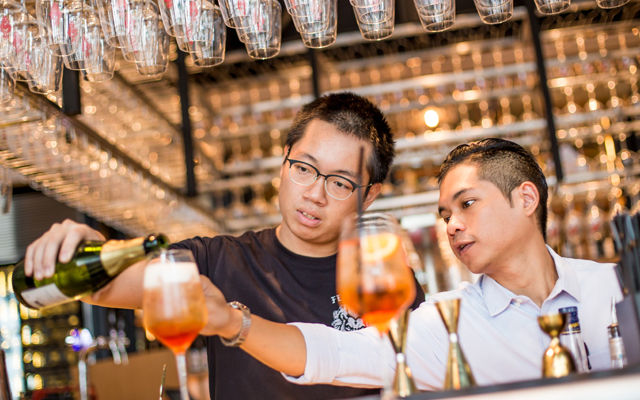
Participants get hands-on during the Open Hotels Weekend
1 of 3
Photo credits: Debbie Y Photography
Some 1,250 participants registered for these tours, 50 per cent more than the number of registrants in the first run of the programme in October last year.
“The hotel industry is a very dynamic and exciting one and the sense of satisfaction that one gets from working in this industry is like no other. By bringing jobseekers and the general public on a hotel tour, we hope to show first-hand the wide and diverse variety of roles in the hotel industry and hopefully generate interest in these roles,” said Ong Huey Hong, director, hotels and sector manpower, STB.
The tour itineraries varied from hotel to hotel, with some organising cocktail mixing masterclasses and tea appreciation sessions, and others showcasing their housekeeping robots and herb garden.
Networking sessions and on-the-spot job interviews were also available at most hotels, expediting the hiring process for hotels and jobseekers. More than 500 job vacancies are available, with over 100 roles ranging from front-of-house positions such as concierge, guest relations executive and restaurant manager, to back-of-house roles such as housekeeping coordinator, sales manager and communications executive.
The Open Hotels Weekend programme comes under the Hotel Careers Campaign that was launched in July 2017 by the STB, in partnership with the Singapore Hotel Association (SHA); Food, Drinks and Allied Workers’ Union; and the hotel industry.
Also part of the three-year campaign, which seeks to create awareness and improve perceptions of careers in the hotel industry, is the 100 Ambassadors of Happiness initiative. The stories of 100 hotel employees – handpicked from front office operations, F&B, data analytics and revenue management roles, among other vocations – are currently shared on the campaign website and marketing materials, as well as with jobseekers during recruitment events. So far, about one-fifth of these ambassadors have been announced; the remaining ones will be rolled out progressively.
Another initiative is the Work-for-a-Stay training programme targeting millennials. First held between December last year and March this year, the training programme saw participants completing a 10-day stint at a hotel, and receiving allowance and a complimentary one-night hotel stay at the end of their stint.
The soon-to-launch Ayana Lako di’a, a phinisi ship that will sail around the Komodo Island
The Indonesian government’s ‘10 New Balis’ directive is poised to open up myriad tourism opportunities across the country, but investors, hotels and tour operators are seeing varying levels of readiness on the ground that are as distinct as the destinations themselves.
Dadang Rizki Rahman, deputy minister for destination and industry development, Indonesia Ministry of Tourism, said: “Based on our experience in the last three years, there is a strong correlation between investment and the growth of arrivals. The more arrivals a destination gets, the bigger the investment poured into it.
The soon-to-launch Ayana Lako di’a, a phinisi ship that will sail around the Komodo Island
“That explains why Bali, Jakarta and Riau Islands (the top three destinations in the country) continue to attract investments and the number of hotel rooms keeps growing.”
Belitung, an island east of Sumatra, is a clear illustration of this. The destination rose to fame among Indonesian travellers after Belitung novelist Andre Hirata’s Laskar Pelangi (The Rainbow Troops) trilogy became a bestseller and movie hit.
The close proximity of Belitung to Jakarta (an hour’s flight away) facilitated its growth as a tourist destination, attracting hotel brands like Golden Tulip, Fairfield by Marriott and Santika Premiere.
Adjie Wahjono, operation manager of Aneka Kartika Tours & Travel Services said: “It was the domestic market that fostered the growth of the island’s tourism, attracting investors to open hotels to meet demand.”
The government’s strong promotion of the ‘10 New Balis’, which Belitung is part of, has helped to draw interest of both travellers and operators to the destination.
Indonesia’s Sriwijaya Air launched a charter service from Singapore between December 2017 and January 2018, while Garuda Indonesia is planning a daily charter service between Belitung and Bali in October using CRJ aircraft with 100 seat capacity.
Garuda Indonesia, director of cargo and international commercial, Sigit Muhartono, said: “We will start with a chartered service to create demand and support the government’s efforts to open up new tourist destinations.”
Sigit said it is part Garuda’s network development strategy to connect the “New Balis” with the world, and Singapore’s hub status will also be tapped to drive traffic into these emerging destinations.
And with Belitung queries from overseas partners now on the uptick, Adjie sees the need for more attractions and activities suitable for international travellers to be launched, in order for the island to continue down its tourism growth trajectory.
Similarly, Komodo is seeing pent-up demand for the destination since the tourism authority started promoting the island intensely since the late 2000s, but infrastructure and facilities still lag behind.
With Komodo Airport’s passenger traffic growing at 30 per cent annually, the authorities are expanding the runway of the airport from 2,250m to 3,200m to accommodate wide-body aircraft, coming on top of the new and bigger passenger terminal opened in 2015.
More hotels are opening in Labuan Bajo, the gateway to Komodo, and mid- and upmarket cruises are entering the market to offer day and live-aboard cruises around Komodo National Park.
Set to open on September 15 is the five-star, 205-key Ayana Komodo Resort, which will be followed in October with the launch of Ayana Lako di’a, a specially built phinisi ship for cruising around Komodo Islands.
Amid the visitor surge, Komodo needs better management to prevent visitor congestion and strains on the infrastructure, cautioned Ng Sebastian, managing director of Incito Vacations.
“Management needs to be stepped up. For example, the pier (at Rinca Island) can be overcrowded with boats at times. There needs to be a queue management system or schedule for boats.”
However, infrastructure development alone does not always immediately convince investors to put their money into a destination.
Lake Toba has been improving its infrastructure in recent years, with the Silangit International Airport now in operation connected by direct flights from Singapore and the Kuala Tanjung harbour built.
The Lake Toba Tourism Authority has reportedly received domestic and foreign investment interest, but is yet to announce any materialised hotel or projects.
It’s a similar story for the Mandalika Mega Project in Lombok, which took a long time to take off. For more than a decade the government has undertaken numerous ways to attract investment, but despite the growth of arrivals to the destination, the flow of investment in facilities did not pour in as expected.
Hospitality investors and operators TTG Asia interviewed over the years were often quick to paint Lombok as an up-and-coming destination with a bright future, but in reality they would adopt a wait-and-see stand when it comes to actual investment on the ground.
Seeing this, Indonesia Tourism Development Corporation (ITDC), which spearheaded Mandalika’s development in 2015, took the initiative to invest in hotels by working together with state-owned developers Wijaya Karya and Pembangunan Perumahan, as well as international operators Accor (for the Pullman brand) and Club Med. Both hotels are now under construction with a targeted opening in 2020.
Henri Giscard d’Estaing, CEO of Club Med, said in a statement regarding the Lombok property: “We foresee Club Med Lombok to receive a high volume of international attention and clients, and raise global awareness for Lombok as a premium holiday destination.”
Abdulbar Mansoer, president director of ITDC, said: “By investing in these hotels, we expect international travellers, hotel operators and investors to develop properties in Mandalika.”
ITDC’s hotel investment strategy, which comes on top of the government’s incentives for investors – like providing land title for up to 80 years and one-stop licencing office on site – appears to have built up the confidence of hospitality investors and operators.
Edwin Darmasetiawan, director of ITDC said: “Today, we have 2,500 hotel rooms in the pipeline within the next five years, attracting international investors (among others) from the US, South Korea and France.”
Other hotels coming up in the pipeline include Royal Tulip, Aloft, Mysk by Shaza and Shaza hotels.
Overseas tour operators have different views on how these developments would work for them.
Karine Hosan, owner and manager of Travel Truck France, opined that tourism stakeholders in Indonesia needed to promote these new destinations extensively to create international awareness, even at this stage when the developments were still under progress.
“Clients look for new destinations and we believe Indonesia has a lot to offer, but we need to be informed of these destinations,” she said.
Ram Samtani, general manager of Singapore-based Ramesh Travel Service, said: “There needs to be the right (supporting) infrastructure in the destinations. There is no need for an (international) airport if airlines do not see it feasible to fly to a destination, for example.” – additional reporting by Tiara Maharani
As part of a rationalisation exercise, the Ministry of Tourism, Arts and Culture Malaysia (MOTAC) is considering the closure of Tourism Malaysia offices in Osaka (Japan), Auckland (New Zealand) and Almaty (Kazakhstan).
The closures are seen as a way of reducing operating costs, which range between RM67 million (US$16.3 million) to RM70 million annually for each of the three offices under review, said deputy minister, Muhammad Bakhtiar Wan Chi.
The tourism ministry is hoping to bring down operating costs with the closures
There are currently two Tourism Malaysia offices in Japan, one in Osaka and the other in Tokyo. Should Tourism Malaysia decide to close the Osaka office, its promotions in Japan will be taken over by the Tokyo office. Similarly, its office in Sydney will manage promotions for both Australia and New Zealand.
Raaj Navaratnaa, general manager at New Asia Holiday Tours & Travel, opined: “The MOTAC should not emphasise on cost-cutting measures but instead look at the value that these tourism offices can bring. It is no point closing the Osaka office and making Tokyo office look after the Japanese market if it does not include getting additional staff and having proper marketing plans in place to tap the Japanese market.
“I think the reason Tourism Malaysia offices are not doing well is because they failed to tap the potential of these markets. We have to re-engineer packages to meet the needs of each market.”
Commenting on the closure of the Almaty office, Asutra Convex managing director, Azizi Borhan, remarked that Central Asia is a market with great potential for growth, despite it is also a seasonal market. He said: “Tourism Malaysia should develop a long-term strategy on how to further develop this market.”
In the first four months of 2018, arrivals from Japan saw a small decline of 0.8 per cent to 131,241 tourists while New Zealand saw a growth of 4.8 per cent to 16,747. Inbound arrivals from Kazakhstan remains small at 5,642, although this represents a significant 44.7 per cent growth from the preceding year.
Team Frozen Lime Asia (from left): Pow Zhi Hoe, Aileene Thangaveloo, Serene Lam, Jagdish Sandhu, Adelina Pillai, Kenji Chen
Team Frozen Lime Asia (from left): Pow Zhi Hoe, Aileene Thangaveloo, Serene Lam, Jagdish Sandhu, Adelina Pillai, Kenji Chen
Singapore-based Frozen Lime Asia (FLA) has been appointed GSA for Small Luxury Hotels of The World (SLH) member hotels in Asia.
The specialist in revenue, distribution as well as sales & marketing for hospitality and tourism in Asia will focus on generating corporate meetings and leisure group leads for SLH member hotels from Singapore, Hong Kong, Malaysia and Indonesia.
SLH, a collection of independent hotels around the world, has over 120 hotels in its Asia-Pacific stable.
Following a year in his role as director of sales at The Sanchaya, Jared Green will now assume an expanded capacity as director of sales and marketing.
In his new role, he will handle strategic partnerships with Amex Fine Hotels & Resorts, Preferred and other consortia accounts, while developing global marketing initiatives.
The beachfront estate in Bintan features 29 villas and suites plus a private residence. It is also home to two restaurants, a bar, wine cellar with an ocean view, library and 50m infinity pool, among other facilities.
The PATA Adventure Travel and Responsible Tourism Conference and Mart 2019 (ATRTCM 2019) will be held in Rishikesh, Uttarakhand, India from February 13-15.
The three-day event, hosted by the Uttarakhand Tourism Development Board, comprises a one-day travel trade mart and one-day conference that brings together public and private sector tourism professionals involved in adventure travel and responsible tourism.
Rafting in the River Ganges, Rishikesh
“The PATA ATRTCM has enjoyed outstanding success in recent years in Thimphu, Bhutan; Chiang Rai, Thailand; Luoyang, China, and Al Ain, Abu Dhabi, UAE and we (now have) the opportunity for the first time to focus upon the opportunities for adventure travel and responsible tourism in Rishikesh, Uttarakhand, India,” said PATA CEO Mario Hardy.
Guarded by the hills of northern Uttarakhand, the city of Rishikesh has been dubbed `Yoga Capital of the World’. It shot to fame in the 1960s when The Beatles came to stay with their guru, the Maharishi Mahesh Yogi.
But besides its temples, pilgrimage sites and the Ganges River, Rishikesh is today becoming known for adventure sports such as white-water rafting, cliff-jumping, kayaking and camping. It also serves as a gateway to the Garhwal Himalayas, being a designated starting point for treks to numerous Himalayan pilgrimage centres and shrines.
PATA is offering early bird discounts for all registration fees until October 31, 2018, while special rates are available for Uttarakhand delegates.
For more information or to register for the event, please visit www.PATA.org/ATRCM or email ATRTCM@PATA.org.
Artist impression of the 18-storey InterContinental Shanghai Wonderland
Artist impression of the 18-storey InterContinental Shanghai Wonderland
The InterContinental Hotels Group (IHG) has unveiled two new signings in Asia-Pacific, an underground hotel project on the site of a former quarry in Shanghai and the other with a waterfront location in Auckland.
Scheduled for opening in 4Q2018 is the InterContinental Shanghai Wonderland, an 18-storey hotel with two floors above ground, and 16 below ground, including two floors underwater.
The Shimao Group development will reach 88m underground in a deep pit of a former southwestern Shanghai quarry, standing out in the current architectural landscape dominated by high-rise buildings, IHG said in a statement.
With a construction area of more than 61,000m2, the hotel features 336 rooms and suites that all boast balconies looking out to waterfalls from the surrounding cliffs.
Rendering of the InterContinental Auckland
Meanwhile in New Zealand, the group has partnered Precinct Properties to open the InterContinental Auckland, the brand’s second signing in the country after the InterContinental Wellington.
Set to become the brand’s flagship in the country, InterContinental Auckland will feature 244 guestrooms, 90 per cent of which will offer water views, several F&B options, a gym, and meeting facilities.
The hotel will form part of the Commercial Bay mixed-use development on the city’s waterfront at 1 Queen Street, which also features shopping and dining outlets, as well as a 39-level office tower.
The hotel is within easy reach from the New Zealand International Convention Centre, Viaduct Harbour, Britomart precinct, Wynyard Quarter, Vector Arena, the international cruise ship terminal, Sky City and Sky City Casino. Auckland Airport is 20km away.
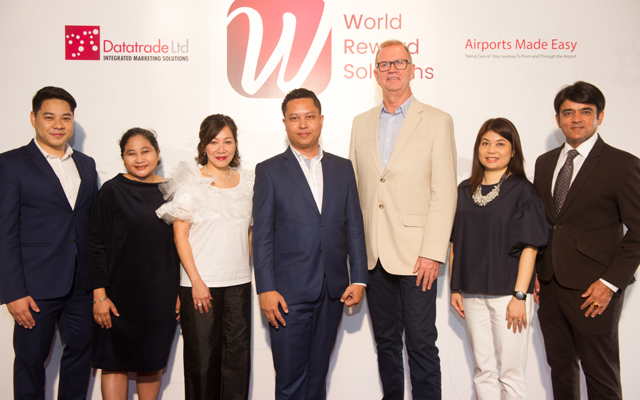
Middle three, from left: World Rewards Solutions' Jakkapan Rattanapet, Airport Made Easy's David Dennis and Datatrade Group, Hong Kong's Monica Chan
A tripartite agreement to expand reach into Asia’s upscale lifestyle segment has been inked between World Rewards Solutions, Airport Made Easy and Datatrade Group, Hong Kong.
The recent MoU creates two new strategic global partnerships for World Rewards Solution as it aims to expand in Asia, with Hong Kong-based Datatrade serving as the exclusive reseller of loyalty programme solutions while Airport Made Easy will contribute to expanding the customer base in Asia and drive business growth as an exclusive partner.
Middle three, from left: World Rewards Solutions’ Jakkapan Rattanapet, Airport Made Easy’s David Dennis and Datatrade Group, Hong Kong’s Monica Chan
Jakkapan Rattanapet, founder and managing director of World Reward Solutions, revealed that his lifestyle service company, a provider of a complete-cycle rewards programme, was launched to seize the promise of an industry currently valued at US$4 billion globally with an average annual industry growth rate of four per cent.
World Reward Solutions’ service hence has a focus on customer relations management, which entails building a strong relationship with organisations and premium clients, often including foreign business travellers coming to Thailand from China and other countries around Asia.
Today, organisational sales make up about 80 per cent with a strong increase in the segment of foreign business travellers coming to Thailand from countries including China and South Korea in the region, the statement from World Reward Solutions read.
The first year of business will be dedicated to growing the company’s customer base in the country. Following this, the plan is to tap into the markets of neighbouring countries with new branches in Singapore, the Philippines and Indonesia to achieve the goal of a 500 million baht (US$15.1 million) turnover by 2020.
World Reward Solutions uses a digital solution to look after customers with a specially created platform which can analyse client demands to custom-design a set of services. This includes creating reward and loyalty programme solutions which match the purpose of the organisation.
A key part of the strategy is in collaborations aimed at tailoring service offerings to customers. This includes the personal assistant service and car and driver rental service at airports around the world.
“We may not have branches around the world, but our team’s experience, as well as our global partnerships, provide us with a network which permits us to perfectly look after our customers both inside and outside of the country,” Jakkapan said.
South Korea will have its first paperless mobile tax refund solution with a partnership between Alipay and Global Tax Free (GTF), a tax refund agency.
Paperless tax refund has been making headway in destinations around the world in recent years. Shortly after Tourego launched its paperless tax refund platform in late 2017, Alipay and GTF rolled out a similar service for Chinese tourists in Singapore early this year. Alipay also initiated a real-time tax refund service in Europe in early 2017.
Incheon International Airport
The new service in South Korea simplifies the process by enabling Chinese tourists to skip in-city and airport tax refund counters.
To process tax rebates and receive RMB refunds, Chinese tourists need only to scan their passports at self-service kiosks prior to leaving South Korea and scan tax refund receipts on the Alipay mobile app within 90 days of purchasing.
“Since 2013, Alipay has continuously explored ways to expedite tax refunds for Chinese tourists to enhance the outbound travel experience. Alipay users can already receive tax refunds at more than 80 airports and a growing number of in-city shops globally after processing at a tax counter,” said Danny Chung, general manager of Alipay Korea.
“With this unique new function, Alipay users can skip the queue and process tax refunds on their mobiles, without filling out and submitting any paper work. This will both save time and make it easier to claim refunds,” added Chung.
According to a statement from Alipay and GTF, South Korea is now the world’s most convenient destination for tourists to claim tax refunds. Approximately 10,000 merchants in South Korea support the GTF tax refund service.