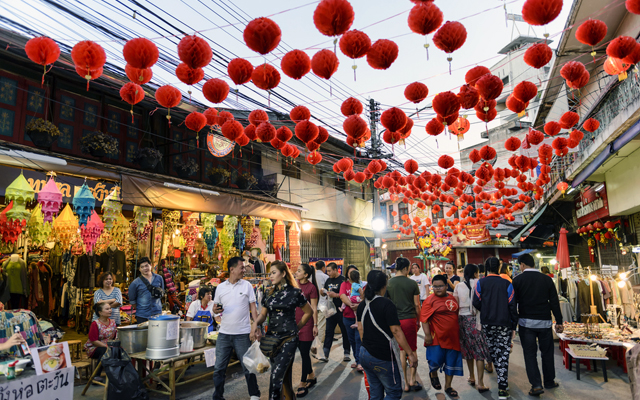
With Chinese New Year round the corner, travel companies reveal the top holiday picks in the Asia-Pacific markets during the holiday period starting on Monday, February 4.
At Hotelbeds, Chinese traveller booking data from its platform shows Thailand is the most popular destination, with Japan and Singapore ranked second and thirdly respectively.
These are followed in order by Malaysia, the US, Indonesia, Philippines, Australia, Vietnam and South Korea.
The wholesale giant also observes Chinese travellers visiting a wider range of countries, with hotels in 102 countries reserved, up from 88 last year.
Around seven million Chinese travellers are expected to venture abroad during this festive period.
Spain and Italy this year dropped out of the top 10 countries – replaced by Vietnam and South Korea – but remain popular at 11th and 12th spots respectively this year.
Meanwhile, in the Hong Kong market, the top longhaul destinations booked through GDSs are Australia, the US and Canada, according to analysis by Travelport.
For return flights between January 28 and February 13, the top 10 longer haul destinations (and corresponding number of GDS flight bookings from Hong Kong) are as follow:
1 Australia (17,103)
2 US (7,666)
3 Canada (5,608)
4 UK (5,279)
5 New Zealand (4,416)
6 UAE (2,590)
7 India (2,330)
8 Germany (2,230)
9 Italy (1,800)
10 Switzerland (1,729)
The top longhaul destinations which had seen the greatest year-on-year percentage increase in flight bookings around the Chinese New Year period were Germany, up 72% to 2,230 bookings (ranking from 12th to eighth); New Zealand, up 29% to 4,416 bookings (ranking from sixth to fifth); and the UAE, up 20% to 2,590 bookings (ranking from seventh to sixth).
Ming Foong, regional managing director of Asia, Travelport, said: “This year, long-distance travel has been particularly popular among Hong Kong travellers, because the almost full-week public holiday makes it easy for travelers to plan a long vacation.”
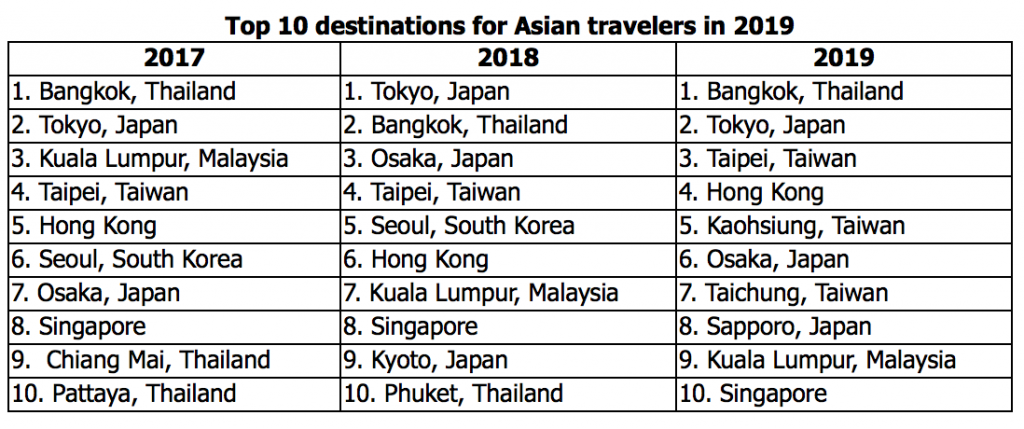
For Agoda, which analysed its own Asia-Pacific booking data, top destinations for the holiday period are Bangkok, Tokyo and Taipei.
This year, Osaka slipped from third spot in 2018 to sixth. Taiwan scooped three of the top 10 destinations with Taipei in third place, and Kaohsiung and Taichung in fifth and seventh respectively.