TTG Asia
Asia/Singapore Thursday, 2nd April 2026
Page 1330

Cybersecurity spend on the up in aviation amid threats

0

Cybersecurity remains high on the agenda and is a spending priority for both airport and airline CIOs, even though faster progress towards implementation of concrete cyber prevention and management initiatives remains a challenge, according to new research released by global IT provider SITA.

The 2018 Air Transport Cybersecurity Insights shows that 89% of airline CIOs plan a major programme around cybersecurity initiatives in the next three years, up from 71% last year.
There is a heightened focus on cybersecurity in the air transport industry

This is even higher for airports, with 95% of them planning major programmes by 2021. Business continuity, through the protection of operational systems and processes, remains the priority for more than half (57%) of airline and airport executives.

As a result of the heightened focus, spend on cybersecurity is increasing year-on-year, reaching US$3.9 billion in 2018.

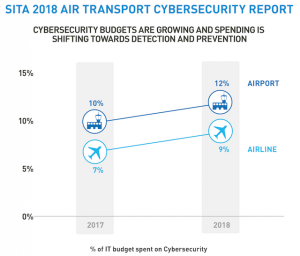
SITA’s research shows that airlines will spend an average of 9% of their overall IT budget on cybersecurity this year, up from 7% in 2017.

Similarly, airport investment in cybersecurity in 2018 is set to rise to 12% of their overall IT budgets in 2018, up from 10% last year.

The research also highlights that many executives are keenly aware that greater strides need to be made to implement proactive cybersecurity measures.

Barbara Dalibard, CEO, SITA, said: “The importance of cybersecurity is well recognised and airlines and airports are investing in building a solid security foundation. However, the number of cyberthreats continues to grow exponentially every year, as does the sophistication of those threats. Given the complexity and integrated nature of the air transport industry, we need to move far quicker in establishing proactive defences to ensure we stay ahead of the game.”

The most common cybersecurity spending priorities among airlines and airports today are; employee awareness and training (76%); achieving regulatory compliance (73%); and identity and access management (63%).

However, SITA’s insights identified several focus areas that need more attention over the next few years. These include proactive network monitoring and protection, securing the extended enterprise (Cloud, IoT) and protection from internal threats such as data leaks.
SITA’s research also indicates more can be done to raise the importance of cybersecurity. Today only 41% of respondents capture cybersecurity as part of a global risk register, while a further 42% of respondents plan to include cyber risk in their registers by 2021. Only 31% of the responding organisations have a dedicated chief information security officer, which is seen as crucial to ensure visibility of cybersecurity at executive level and effective implementation. Proactive monitoring through a security operations centre is also a core topic for many respondents with the majority having plans to quickly implement such services.

The biggest barrier to implementation is a lack of resources which affects 78% of air transport industry organisations. Another significant challenge executives face is the retention and recruitment of specialised skilled staff (47%) and the capacity for staff training (56%).
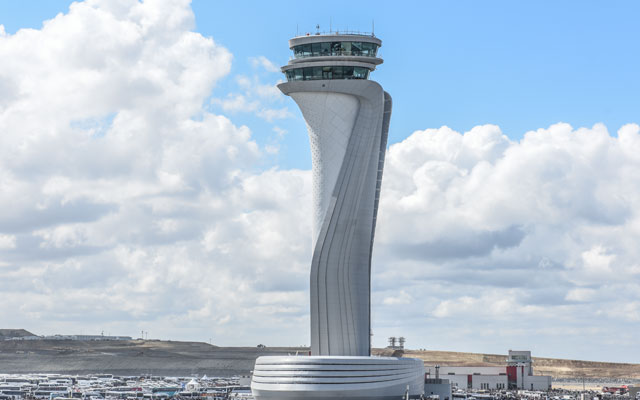
New Istanbul airport raises Turkey’s Asia-Europe hub ambitions

0
The new airport's observation tower

With the opening of Istanbul’s new airport last month, hopes are high among the Turkish travel trade that the country’s transit hub status will be reinforced and draw more connecting flights from Asia, especially China.

Toyou Turkey’s partner, Oktay Lin, told TTG Asia: “I hope more Asian traffic will stop in Turkey, (from where it’ll only take) three hours to reach three quarters of Europe.”

Lin hopes to find surrounding destinations like Egypt and partners to work with to co-promote the airport as good stopover point.

The new airport’s observation tower

Ace Travel’s managing director, Sayed Abdal Ghany, welcomed the new infrastructure, stating that the older airports was not able to cope with the growing demand for Turkey.

He elaborated: “The old airport can only handle 90 million passengers a year, but the new airport would handle more than double that number, and accommodate 200 million passengers.

“Moreover, set between Europe and Asia, Istanbul is one of the main transit hubs. Turkey is also a top destination, we’ve welcomed 40 million travellers (this year) and expect the number to grow to 55 million in 2019.”

For South Marmara Development Agency’s specialist Kerem Oner, he hopes that the new airport will draw more connecting flights from China. The organisation focuses on supporting and developing the Balıkesir and Çanakkale provinces, both located south of Istanbul.

This is because Oner hopes that with the new connections, Chinese travellers will be able to visit Canakkale, located less than an hour’s flight from the capital. He said: “So far, only a small part of Chinese travellers come to reputable Troy, as most of them just travel to Istanbul.”

Oner added that should China Southern Airlines fly direct from Beijing to Istanbul next year, he hopes that this will encourage more Chinese travellers to explore beyond the capital.

Chinese outbound interest in Turkey is steadily building up, observed Blueland Tours’ co-founder, Fuat Karakas. “Apart from the soon-to-launch Istanbul-Beijing services by China Southern Airlines, Onur Air (an Istanbul-based LCC) will also start flying to Chengdu. So far, we’ve some high-end tours from China booked for February 2019,” he shared.

Centara strikes deal for three hotels in Laos

0
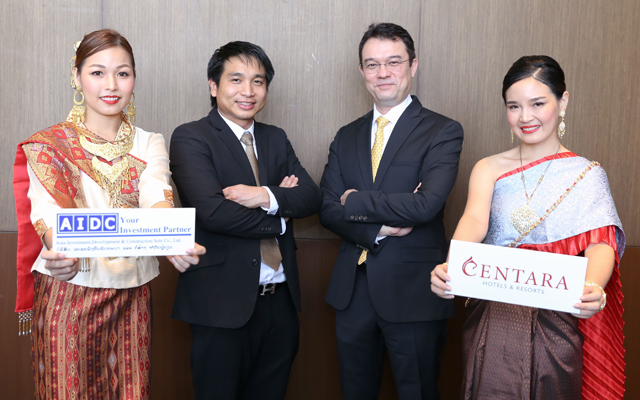
AIDC's Pheutsapha Phoummasak (left) and Centara's Thirayuth Chirathivat

Centara Hotels & Resorts has announced three upcoming openings in Laos, set to add 216 keys to the destination.

In the UNESCO World Heritage site of Luang Prabang, Centara plans to open an upper upscale Centara Grand Luang Prabang and a midscale Centra by Centara property, both near the town centre.

AIDC’s Pheutsapha Phoummasak (left) and Centara’s Thirayuth Chirathivat

The third property in Vientiane will be under Centara’s new lifestyle brand, COSI, catering to the growing segment of independent travellers.

The management agreement with Laos’ Asia Investment, Development & Construction Sole (AIDC) comes as the country pursues greater tourism growth, with a target of five million visitors in 2018 and more in the years ahead.

“This partnership with AIDC is a great opportunity to expand our footprint into a distinctive country,” said Centara CEO Thirayuth Chirathivat. “Laos is on the list of more and more travellers to this region, and we want to serve them with the distinct and varied accommodation options to match the travel experience they are seeking.”

The Laos signings are part of Centara’s plans to double its management portfolio over the next five years. This latest development will see Centara’s hotel count in Laos reach four with Centara Plumeria Resort Pakse already under development and scheduled to open in 2020.

Two more Mövenpick hotels signed in Vietnam

0

Shortly after completing its acquisition of Mövenpick Hotels & Resorts, AccorHotels has announced it will continue expanding the brand in Vietnam with two latest signings in Van Phong and Halong Bay slated to open in 4Q2021.

“The addition of Mövenpick Resort Van Phong and Mövenpick Resort & Spa Halong Bay will bring our total pipeline of Mövenpick properties to nine in Vietnam,” said Patrick Basset, COO for AccorHotels Upper Northeast & Southeast Asia and the Maldives.

Mövenpick Resort Van Phong

AccorHotels is the biggest international hotel operator in Vietnam with 6,101 rooms across all its brands. The group will be opening another 13 hotels across the country in the next two years, bringing the total portfolio to 41.

Nestled on a stretch of coast 130km from Cam Ranh International Airport, Mövenpick Resort Van Phong will feature 200 rooms and suites plus 100 villas, two restaurants, an outdoor pool, spa and fitness centre. For corporate events and weddings, the resort features a 300 seater ballroom and a range of meeting rooms.

Located in the UNESCO World Heritage site of Halong Bay in Northern Vietnam, the 325 room Mövenpick Resort & Spa Halong Bay will offer access to the area’s main tourist attractions and activities on Halong Road and Halong Bay Cruise Port.

The resort will feature two restaurants, a rooftop pool and lounge with a view of the bay, a spa, fitness centre, a 300-seater ballroom and a selection of meeting rooms.

As part of the brand signature, the hotels also feature the Mӧvenpick Chocolate Hour which allows guests to sample delicious Swiss chocolate daily in the lobby.

Mövenpick Hotels & Resorts has more than 80 properties in 24 countries . Mövenpick Resort Van Phong and Mövenpick Resort & Spa Halong Bay will complement the company’s existing collection of hotels in Vietnam, including Mövenpick Resort Cam Ranh and Mövenpick Hotel Hanoi.

20% off stays at Hyatt Regency Bangkok Sukhumvit

0
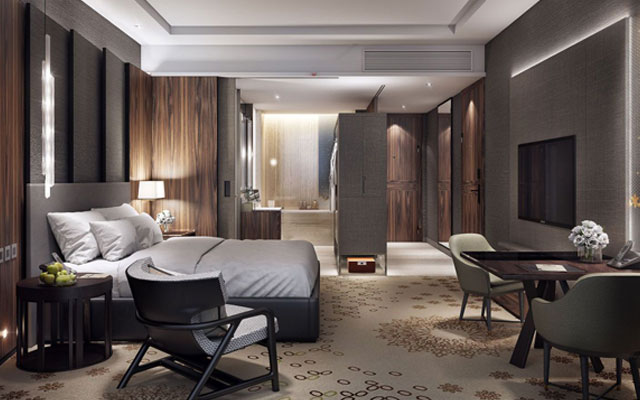
One of the 273 guestrooms in the hotel

Hyatt Regency Bangkok Sukhumvit is offering a 20% discount on accommodation and complimentary breakfast for guests booking two nights or more.

One of the 273 guestrooms in the hotel

The deal is valid for stays from December 21, 2018 to March 31, 2019.

Click here to access the offer.

Big hike proposed for Komodo entrance fee raises eyebrows

0
Padar Island in Komodo National Park

The regional government of East Nusa Tenggara has announced plans to charge international travellers to Komodo National Park an entrance fee of US$500 per head, nearly 50 times the current Rp225,000 (US$16), causing some concern within the travel trade.

For domestic tourists, the entrance fee is currently US$10.

Padar Island in Komodo National Park

Viktor Laiskodat, the new governor of East Nusa Tenggara, was quoted by detik.com last Saturday as saying: “The (proposed) price is reasonable as the Komodo dragon is a rare species and (its) habitat is only found here, therefore, (the entry fee) should not be so cheap.”

Citing Bhutan as an example, the governor said: “You enter Bhutan immigration check point, you pay US$250.”

As the national park is a conservation area, Viktor stated that “it needs protection, and protection needs a high budget”. The funds will be used for tourism development as well as the conservation of the Komodo dragon and its habitat, he added.

Responding to the report, Leonardus Nyoman, director of Flores Exotic Tours, said: “What the governor is saying is a vision, but it is a sensitive issue that caused reactions from our business partners from Germany and France.”

The regional government could propose the tariff but had no authority to set its own prices, remarked Leonardus. Indonesia’s national parks come under the Ministry of Forestry, and all entry fees to national parks are determined by the central government according to categories and classes, he added.

“I wish the governor would discuss with local stakeholders before making (such a shocking) public statement,” he said.

With Komodo growing in popularity only in the last few years, Ng Sebastian, owner of Incito Vacations, opined it was not time to increase the entrance fee yet.

“I understand the aim is to prevent the national park from becoming a mass tourist destination,” he commented. “However, the first thing to do is to set the carrying capacity of the national park, which we do not have. Next is to open more gates to the Komodo and Rinca islands so that boats are not flocked at the existing ones, creating congestions.”

Ng suggested that discussions to be held between the governor and central government first before imposing a “single charge”. Currently, multiple charges including ranger and camera fees are now levied on top of the entrance fee, he explained.

In defence of the governor’s statement, Rocky Praputranto, chairman of East Nusa Tenggara Tourism Board, said: “The US$500 mark represents the governor’s vision of positioning Komodo National Park at par with international parks and destinations overseas. He used Bhutan as an example, and I do not think the price proposed was fixed. He just thinks that the current price is much too low for a park like Komodo.

“The Komodo dragon is the main but not the sole attraction of the national park; it has great underwater wealth too. The governor wants the park to be well maintained and facilities, such as public toilets, improved too.”

High-speed rail opens doors to rail-cruise opportunities in Hong Kong

0
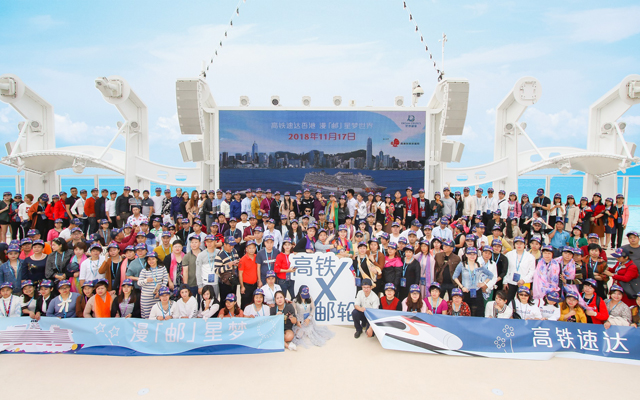
Guests sailing with Dream Cruises on the company's first rail-cruise programme

Rail-cruise travel has gotten off the ground in Hong Kong as the city gets on board China’s high-speed rail network connecting to 44 cities in the mainland, according to Dream Cruises.

Dream Cruises collaborated with the Hong Kong Tourism Board to roll out its first rail-cruise campaign, launching a rail fare rebate programme in August this year.

Guests sailing with Dream Cruises on the company’s first rail-cruise programme

The partners offered a rebate of up to RMB400 (US$58) per cabin to the first 1,000 rail-cruise guests embarking World Dream in Hong Kong last month. According to Dream Cruises, the rebate quota was full within two weeks of the programme’s launch.

Thatcher Brown, president of Dream Cruises, said: “We are very excited about the new rail-cruise opportunities that the High Speed Rail (Hong Kong section) brings to the city, especially in the advancement in connectivity between inland cities of China which drives the development of cruise industry in Hong Kong.

Brown shared that most of the rail-cruise guests were from cities in mainland China now connected to Hong Kong via high-speed rail without interchange, including Changsha, Guiyang, Wuhan, Nanning, Guangzhou and Shenzhen.

He said: “We observed a 10 per cent surge in traffic since the new infrastructure opened in September. So far, we’ve got three rail-cruise groups ranging from 300 to 400 pax, which are good sizes for us.

“This concept provides a whole dimension of growth together with the Hong Kong-Zhuhai-Macau Bridge. While the fly-cruise concept is so successful in markets such as Singapore, Hong Kong is now also benefitting from rail-cruise. The connection to 44 mainland Chinese cities by rail (is boding) a huge multiplier effect for cruises.”

The cruise company hopes to to penetrate inner cities like Chengdu and “encourage them to come to down to Southern China and experience the Silk Road at sea”, Brown said.

To further facilitate rail-cruise journeys between mainland China and Hong Kong, Dream Cruises will launch Hong Kong’s first in-town check-in counter for cruising guests in West Kowloon station, scheduled to be in operation in the first quarter of 2019.

Pushing local experiences in secondary destinations

0
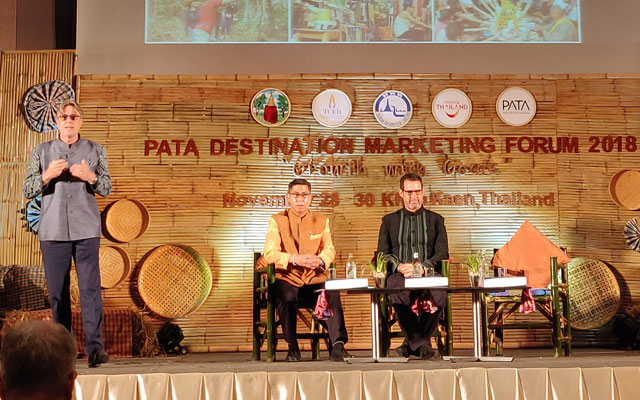
From left: Yaana Ventures' Willem Niemeijer, PATA's Paul Pruangkarn and Las Vegas Convention and Visitors Authority's Michael Goldsmith (photo credit: Ernelsa Villalba-Abelgas)

Localism, or local experiences, is something DMOs should invest in when it comes to the marketing of secondary destinations, shared speakers at the PATA Destination Marketing Forum 2018 in Khon Kaen last week.

Michael Goldsmith, vice president of marketing, Las Vegas Convention and Visitors Authority, said: “As a visitor to a destination, local experiences are vitally important. We want to experience what life is like, or what we think what life is like. The experiences that visitors remember are experiences with people and local experiences in their destinations.”

From left: Yaana Ventures’ Willem Niemeijer, PATA’s Paul Pruangkarn and Las Vegas Convention and Visitors Authority’s Michael Goldsmith

This view is supported by Willem Niemeijer, Thailand-based Yaana Ventures’ CEO, who said: “Travel is all about authentic encounters. It’s about going local.”

For instance, the Intrepid Adventure Travel Index 2018 revealed that adventure travel these days equates to local experiences, with only 22 per cent of the responses equating adventure travel to high-adrenaline sports.

Similarly, in the 2018 Tourism Outlook: The Exploration of Today’s Modern Traveler survey conducted by American Express, 25 per cent of respondents stated that learning about culture and history is their most important travel goal, while 72 per cent enjoy learning about different cultures, and 43 per cent look for local dining experiences.

Richard Cutting-Miller, executive vice president of US-based Resonance consultancy, added that people now care less about material possessions, instead placing more emphasis on experiences, the places one travels to, and how one uses their free time.

“For example, North America was all about Budwiser and Millerbeer. Now, if you go to Portland, Oregon, it’s all about craft brew. It’s about speciality products people enjoy, and they choose destinations to experience these,” he elaborated.

“There’s a tremendous amount of interest, especially from millennials, who want to experience what life is like in a city like Las Vegas. What we have to do is to market and talk about the unique attributes (such as kayaking or hiking), and not just the internationally-recognised tourism attractions, which are often buildings or landmarks (like the Bellagio fountain),” Goldsmith added.

That is why Thailand’s latest tourism campaign also revolves around local experiences, in addition to the launch of a new strategy to lure travellers to other destinations in the country.

Srisuda Wanaphinyosak, Tourism Authority of Thailand’s (TAT) deputy governor for international marketing (Europe, Africa, Middle East and the Americas), shared: “This PATA event is complied with TAT’s latest campaign of Amazing Thailand Go Local – which is a landmark project to promote the kingdom’s lesser known destinations – as well as the Hub and Hook strategy, with the main city acting as a hub and hook to the nearby lesser known destinations. Khon Kaen is a great example of a hub city, and (while nearby hook destinations are) Udon Thani, Nong Khai and Kalasin.”

Aside from developing local experiences, the forum also highlighted that for the betterment of the entire society, a close working relationship with locals was also crucial.

Niemeijer pointed out: “A primary mistake that well-intended destinations make when deciding on their marketing plan is not involving the local community. It needs to be from grassroots up. Is (the marketing of the destination) welcome by them? The locals have to be part of the process, or even take the lead.”

SIA picks up stake in data tech company after launching travel retail JV

0
Data Republic's Danny Gilligan, Singtel Innov8's Edgar Hardless and Data Republic's Paul McCarney

Singapore Airlines (SIA) has acquired a minority stake in Australia-founded Data Republic, which facilitates “shared data projects” between organisations, shortly after launching a joint venture that will see KrisShop, formerly the Singapore Airport Duty-Free Emporium, transform into an e-commerce platform.

Data Republic’s governance platform, Senate, enables organisations to “collaborate on shared data projects in a secure environment”, leveraging technology to protect privacy, provide audit trails and ensure data security, according to a statement released by the airline.

SIA participated in a Data Republic funding round led by Singtel Innov8; pictured, Data Republic’s Danny Gilligan, Singtel Innov8’s Edgar Hardless and Data Republic’s Paul McCarney

“SIA recognises the increasing importance that data plays in allowing organisations to have an enriched understanding of customers’ preferences,” said the airline’s senior vice president, information technology, George Wang.

The airline will work with Data Republic as well as its partners to provide opportunities for data collaboration.

This follows the launch of a joint venture between SIA, 3Sixty (formerly DFASS Group) and SATS on December 1.

It was announced earlier this year that the joint venture will cover activities commencing under the existing KrisShop and Scootalogue in-flight sales brands, transforming KrisShop into an e-commerce platform.

Activities include in-flight duty-free and ground-based duty-paid goods, as well as pre-order services, with onboard and ground-based deliveries.

The companies signed a share subscription agreement under they will jointly invest about S$35 million (US$25.6 million) in KrisShop. SIA holds 70 per cent of the entity, while 3Sixty (Singapore) and SATS each holds 15 per cent.

Firefly suspends flights into Singapore over airport move issues

0

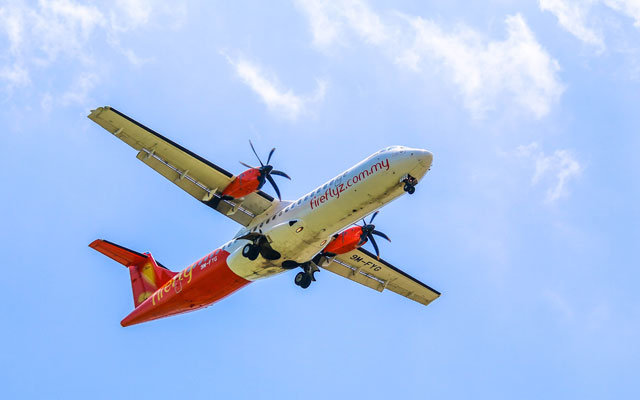
Firefly on December 1 suspended flights into Singapore over issues in relation to the transfer of small aircraft operations from Changi to the newly opened Seletar Airport, the Malaysian carrier announced in a notice on its website.

While Firefly and Malaysia’s transport ministry were in 2014 informed of the relocation – which the former agreed to – the Civil Aviation Authority of Malaysia did not give the green light, the Civil Authority of Singapore told Channel NewsAsia.

The Malaysia Airlines subsidiary is unable to relocate to Seletar Airport without approval from Malaysia’s civil aviation regulator

Firefly is unable to resume flights into Singapore until it obtains the necessary approvals. The airline added that it has not been provided any definitive timeline by the authorities for the delay.

At Changi Airport, Firefly operates 20 daily turboprop flights to and from Subang, Ipoh and Kuantan.

In a notice on its website, the airline said arrangements were being made for affected passengers.

For Subang-Singapore and Singapore-Kuantan routes, Firefly would accommodate passengers on Malaysia Airlines at no cost or offer a full refund within 30 working days, according to Channel News Asia.

On the Singapore-Ipoh route, full refunds will be made within 30 working days as well, or passengers can change to another destination operated by Firefly at no additional cost.

The airline will not provide compensation for missed tours, connecting flights with other airlines, hotel booking cancellation or any other out of pocket expenses incurred due to the route suspension.