UOB Travel has chosen Amadeus as its digital transformation partner to modernise its travel technology and provide seamless end-to-end experiences for clients.
The upgraded technology will allow UOB Travel to offer faster service, richer content, and a more connected experience, supporting both customer satisfaction and business growth.
The collaboration aims to streamline operations and enhance end-to-end travel experiences for clients; photo by United Overseas Bank
The Singapore-based travel management company, a subsidiary of United Overseas Bank (UOB), serves cardmembers and banking customers with business travel, bespoke itineraries, cruises, and more. The collaboration will deliver a modern, integrated travel system, giving consultants automation tools and access to broader travel content, including New Distribution Capability, to enhance booking efficiency and service quality.
Steven Ler, executive director of UOB Travel, said: “Amadeus’ holistic travel technology offering has transformative potential for UOB Travel in Singapore. Through a suite of digital retailing, automation, productivity, and back-office solutions, we are building a future-proof business system with scalable, efficient solutions. Together, we are better able to serve the evolving needs of our customers.”
Javier Laforgue, executive vice president, travel unit & managing director of Asia Pacific at Amadeus, added: “UOB Travel and Amadeus have a shared vision to make the travel experience better. Together our two organisations are well-placed to show how the next generation of travel technology can streamline operations, maximise efficiency, and unlock new revenue opportunities – all within a seamless end-to-end workflow. Amadeus looks forward to working closely with the UOB Travel team to deliver on this shared vision.”
Kuda Villingili Resort Maldives will host its 2025-2026 festive programme, Through the Decades, from December 23, 2025 to January 7, 2026. The schedule includes Christmas and New Year events, family activities and seasonal wellness offerings.
The celebrations begin on December 23 with a tree-lighting ceremony and carol singing, followed by a Christmas Eve gala dinner and entertainment. On December 25, children can meet Santa Claus and join cookie-making and craft sessions.
Kuda Villingili celebrates the festive season with island-wide fun and family activities
The resort’s spa will offer its regular treatments, including Balinese, Lomi Lomi and Ayurvedic options, along with seasonal wellness add-ons.
New Year’s Eve will feature a cocktail event, gala dinner and countdown party with decade-themed attire, live performances and fireworks, followed by a late-night DJ after-party.
Guests can book ocean activities such as fishing, water sports and scuba diving, provided by MSTS Watersports and Diving. The Kuda Fiyo Kids Club will run a Time Travel Adventure programme with era-themed games and activities.
New Year’s Day brunch will be held on January 1, with the festive programme concluding on January 6 with a sunset cocktail and gala dinner.
Entertainment throughout the season will include fire performances, acrobatic acts, magic shows, live music and dance performances.
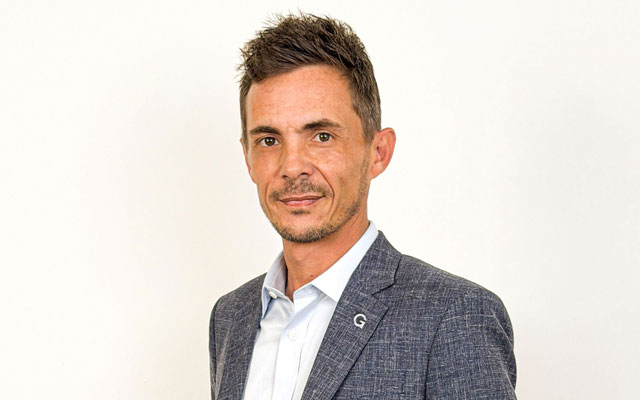
Pullman Bangkok Hotel G has appointed Pierre Betourne as its new general manager.
In his new role, Betourne aims to elevate the guest experience, strengthen team culture, and refine the hotel’s lifestyle-driven market positioning.
He joins with over 20 years of international hospitality experience, most recently leading the recovery of four Accor properties in Phuket and Hua Hin following an 18-month Covid-19 closure.
Marriott International has appointed Silvio Rosenberger as market vice president for Maldives, effective January 1, 2026.
He will oversee the company’s portfolio and strategic operations in the Maldives while continuing in his current role as vice president of operations, Asia-Pacific excluding China, based in Singapore.
In his most recent role, Rosenberger has supported multi-market operations and regional performance across Asia-Pacific, strengthening cross-brand execution.
His experience includes leading properties such as JW Marriott Hong Kong, JW Marriott Seoul, The Shanghai Edition, W Shanghai – The Bund and JW Marriott Hotel Shanghai at Tomorrow Square.
Asia-Pacific airlines are heading into 2026 with a strong performance outlook, but industry leaders warn that governments must shift from short-term tourism gains to long-term industrial competitiveness to sustain growth.
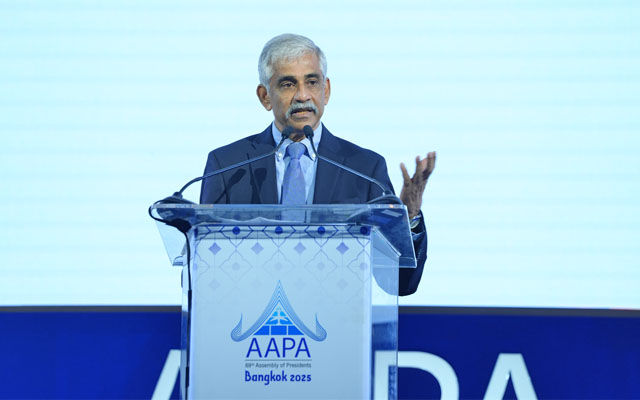
At the close of the 69th Assembly of Presidents in Bangkok, the Association of Asia Pacific Airlines (AAPA) reported that carriers posted a 10 per cent rise in international passenger traffic in the first nine months of 2025, outpacing global averages and reinforcing confidence in the region’s recovery momentum.
Menon: bright aviation outlook overshadowed by supply-chain bottlenecks; photo by AAPA
“Asia-Pacific airlines continue to demonstrate agility in managing supply chain constraints, with capacity growth keeping pace with demand. However, Asia-Pacific economies are among the hardest hit by higher US tariffs. Further escalation of tariffs could exacerbate these bottlenecks,” noted AAPA director general Subhas Menon.
AAPA leaders also urged governments to strengthen maintenance, repair and overhaul (MRO) capacity and accelerate aviation manufacturing, warning that the region’s fragmented industrial footprint risks constraining future growth. While International Air Transport Association (IATA) data shows Asia-Pacific accounts for more than one-third of global passenger traffic, much of the world’s heavy maintenance and aviation manufacturing remains in North America and Europe, forcing airlines to route high-complexity engine work offshore.
The supply chain squeeze is worsened by ageing aircraft, rising shop-visit volumes, and a persistent labour shortage, with skilled engineers drawn to higher-paying hubs in the Middle East. Menon warned that without intervention, the region risks permanent constraints on growth.
“When we look at supply chain pressures, there are many aspects to it. But what can you do in the interim to improve the situation? For example, the region simply does not have enough MRO capacity, and only government investment and support can close that gap,” Menon stated.
Menon highlighted that some administrations still take aviation resilience for granted. He cited Asia’s prolonged pandemic border closures as an example of governments assuming airlines would cope, and warned that fragmented policymaking is emerging again, with MRO expansion, workforce development, industrial incentives, and regulatory measures pursued separately rather than strategically.
He emphasised that building a resilient supply chain requires coordination across industry, finance, trade, and manpower agencies. Signs of progress include Thailand’s coordinated approach to its one per cent SAF blend for 2026, involving the energy ministry, civil aviation authority, and fuel suppliers.
“From a long-term standpoint, if this is the largest air transport sector in the world, and the fastest growing, governments should take an interest in it and invest in the infrastructure that is needed for airlines to be able to support the growth. Yes, we do not have a common regulator, so it is a challenge. But that should not stop us from doing the right thing,” he summarised.
The Assembly adopted four resolutions, reaffirming the five per cent SAF target for 2030, urging governments to accelerate production, calling for investment incentives and harmonised regulations to expand MRO and manufacturing, endorsing stronger lithium battery safety measures, and cautioning against non–cost-related taxes that could undermine long-term growth.
Twenty-two representatives from the Tourism Promotions Board (TPB) Philippines Membership Program took part in a three-day Corporate Social Responsibility (CSR) activity in La Union from November 5 to 7, 2025, putting sustainable tourism into practice through hands-on projects with local communities.
Now in its fourth year, the programme engages members directly in initiatives that support environmental protection, community development and responsible tourism across the country.
TPB members participated in hands-on projects in La Union to promote community development and sustainable tourism
Participants visited towns across La Union to observe climate-related disaster preparedness, environmental responsibility, marine conservation and sustainable community development. In San Juan, members visited the Coastal Underwater Resource Management Actions (CURMA), a community-based sea turtle, or pawikan, conservation organisation, and attended an educational session on safeguarding marine biodiversity. They also explored Lotus Valley Farm, a nine-hectare eco-tourism and agriculture hub powered by solar energy. Once a land of rice terraces, the farm has been replanted with native trees and provides a water source for families and nearby schools.
In Bauang, members joined a tree planting activity at the Bakawan Eco-Tourism Park to expand mangrove areas, which act as nature-based solutions to climate-related disasters. A disaster preparedness session was conducted by environmental and sustainability advocate Rafael Dionisio. The community of Isla Solomon, whose main livelihood is fishing, received essential supplies through a ceremonial turnover.
TPB also partnered with the Immuki Island community to support the local tourism industry. Activities included repainting bamboo rafts, and donating uniforms, equipment, tools and life vests for community guides. Members learned pottery making at the Taboc Mannamili Association in San Juan and silk processing at Don Mariano Marcos Memorial State University-Sericulture Research and Development Institute in Bacnotan, gaining insight into the province’s crafts and the role of local artisans.
On the final day, participants visited the Naguilian Tourist Rest Area, which houses a souvenir centre featuring farm products and bamboo crafts that reflect local resources and sustainable practices.
The TPB Members’ CSR Program demonstrates the agency’s focus on responsible tourism and projects that support local communities while creating opportunities that sustain the industry.
TPB COO Margarita Montemayor Nograles said: “Our CSR initiatives are a reminder that every destination’s success is reliant on the people who nurture it. By working alongside our partner communities, we not only protect our natural beauty but also help create opportunities that allow tourism to flourish responsibly.”
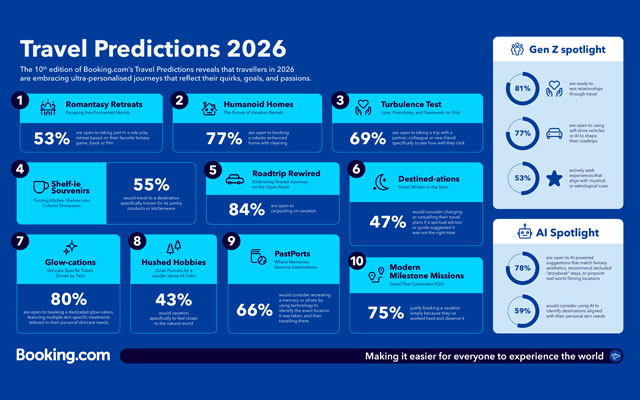
Travellers in 2026 are expected to embrace highly personalised trips that reflect their quirks, goals, and passions. Booking.com’s 10th Travel Predictions report highlights 10 trends showing Asia-Pacific travellers seeking experiences that prioritise individuality and technology-driven convenience.
The report shows that 2026 travel will centre on personal expression, combining technology, creativity, and immersive experiences to allow travellers to define their own journeys.
Top travel trends for 2026 show Asia-Pacific travellers seeking personalised, immersive, and memorable experiences
The research, based on responses from over 29,000 travellers across 33 countries and territories, shows that vacations are becoming more experimental, immersive, and unapologetically personal. Asia-Pacific travellers are open to innovative experiences: 86% would consider staying in robotic-enhanced homes, with 48% influenced by cleaning bots, 37% by robotic chefs, and 26% by robots managing sustainability. Road trips are also evolving, with 85% open to carpooling, 63% willing to use apps to connect with fellow travellers, and 72% considering AI to map scenic routes.
Wellness travel is transforming, with 82% interested in glow-cations focused on skin-specific treatments, AI-guided destination choices, hydration stations, smart mirrors, and sleep-enhancing suites. Nostalgia travel is rising, with 75% willing to recreate memories using AI-powered location mapping, while 79% are intrigued by fantasy- and “romantasy”-inspired immersive retreats.
Souvenir trends are also changing, with 74% considering design-led kitchenware and pantry items as cultural keepsakes. Travellers are using trips to test relationships, with 72% open to travel as a compatibility check, and exploring astrology, with 60% considering travel plans based on spiritual guidance. Quiet, nature-focused hobbies will be sought by 46% of travellers, including birdwatching, foraging, and insect spotting, supported by technology for guidance and tracking.
Finally, milestones are being redefined: 66% of travellers book trips without a traditional reason, 75% travel to reward themselves, and others mark achievements such as a promotion (26%), tax refund (14%), breakup closure (14%), new outfit (9%), or health milestones like sobriety or fitness transformations (24%).
Laura Houldsworth, managing director, Asia-Pacific, at Booking.com, shared: “Travel continues to be a top priority for Asia-Pacific travellers, as journeys increasingly reflect their identities and interests. They are eager to pursue their passions and embrace new adventures, from immersive fantasy worlds to technology-enhanced rentals.
Onyx Hospitality Group has partnered with SENA HHP Co. to launch Shama Sukhumvit 101 Bangkok, a premium serviced apartment in one of the city’s well-connected districts.
The launch positions Onyx for further growth in Thailand’s serviced apartment market and supports its long-term goal of becoming a leading mid-sized hospitality management firm in South-east Asia.
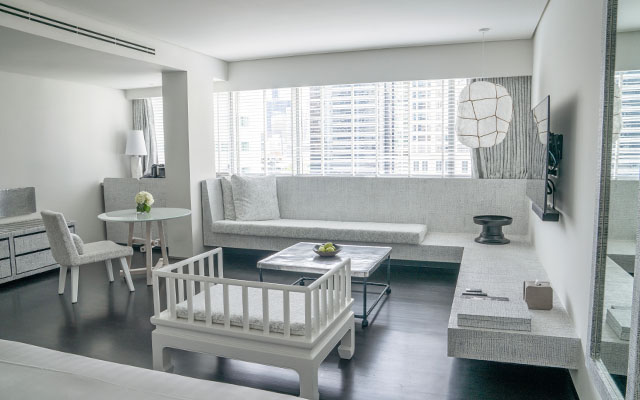
Onyx teams up with SENA to launch and operate the new Shama Sukhumvit 101 Bangkok
The 86-unit property, set to open in January 2026, will offer long-stay residents contemporary interiors with layouts from 40 to over 60 square metres, alongside amenities including a fitness centre, swimming pool, first aid room, EV charging stations, and automated parking.
Shama Sukhumvit 101 Bangkok is located near Punnawithi and Bangchak BTS stations, with nearby landmarks including True Digital Park, M Tower, and Bhiraj Tower at BITEC. The area also provides access to international schools such as Anglo Singapore International School and Wells International School, as well as industrial and logistics hubs including Bang Phli Industrial Estate and Frasers Property Logistics Park.
The property will feature the Shama Social Club, the brand’s lifestyle programme designed to encourage community engagement and interaction among residents. Onyx will oversee project management, including service quality, marketing, sales, operations, human resources, staff training, and technology integration to ensure international standards.
Yuthachai Charanachitta, CEO of Onyx Hospitality Group, said the partnership reflects growing demand for long-stay accommodation in high-potential areas of Bangkok.
“We see Sukhumvit 101 as a high-potential location. It offers convenient access to the city centre via public transportation and is surrounded by business districts, office buildings, educational institutions, and regional logistics centres. These factors contribute to strong residential demand, especially among business travellers and expatriate families, making it a suitable location for serviced apartment development.”
Kessara Thanyalakpark, managing director of SENA Development, added: “This collaboration between SENA HHP and Onyx Hospitality Group stems from a shared vision to elevate Shama Sukhumvit 101 Bangkok to international standards of management and service… we are confident that this property will resonate with Thai and international residents, business professionals, and families seeking a second home in Bangkok.”
Emirates’ retrofit programme is entering its next phase, with 60 A380s and 51 Boeing 777s scheduled for cabin updates.
From August 2026, the airline will introduce new onboard features, a next-generation in-flight entertainment system and upgraded Wi-Fi connectivity with Starlink as part of wider fleet modernisation.
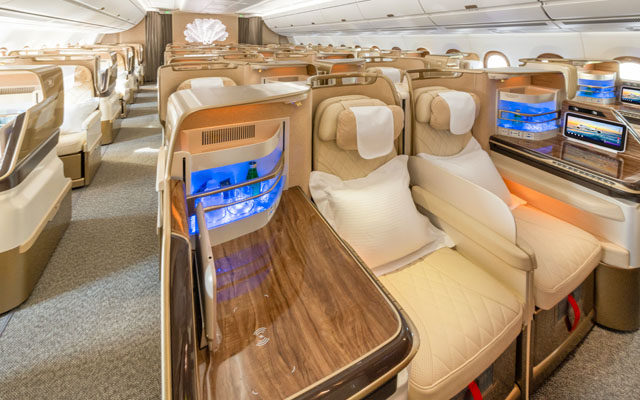
The airline will introduce new seating, in-flight entertainment and Starlink connectivity across 111 aircraft starting August 2026
Emirates Engineering, working with Airbus, Safran, Recaro, Panasonic, Starlink and UUDS, will install new seating designs and an onboard lounge on 60 A380s, paired with Panasonic’s Astrova in-flight entertainment system. The work covers 111 aircraft and supports the airline’s longer-term plans for product consistency across its fleet.
Business Class on the A380 and Boeing 777 will be fitted with Emirates’ latest seating based on Safran’s S Lounge design used on A350 aircraft. Seats will include wireless charging, customisable lighting, storage, minibar amenities and multiple charging options, including USB-C and wireless ports. Customers will have access to 4K ice entertainment. Premium Economy will feature Recaro seating with a mechanical recline system, leg and footrests, adjustable headrests, in-seat charging, a side table and a 13.3-inch screen. Economy Class will feature Safran Z400 seats with an adjustable eight-way headrest.
The Astrova system will be installed on A380s and Boeing 777s, offering 4K OLED displays, Spatial Audio, Bluetooth and 67W USB-C charging. It includes a 3D moving map and personalised content recommendations through Emirates’ Skywards programme. Starlink Wi-Fi will also be added across both aircraft as part of the retrofit.
The programme was announced in 2021 for 120 aircraft and expanded to 191 aircraft in May 2024, before increasing to 219 aircraft later that year. To date, 76 aircraft have been refurbished. Each A380 requires about 22 days and each Boeing 777 about 18 days to complete, with two refurbished aircraft returning to service each month.
“Emirates’ retrofit programme is about continuously elevating standards across our entire fleet. Our customers expect an excellent experience every time they fly Emirates, and this investment ensures we deliver on that promise in the years to come, wherever they travel with us,” said Emirates Airline president Tim Clark.
Google is developing hotel and flight booking through AI Mode, building on the agentic tools it introduced two weeks ago for restaurant, event and wellness reservations. The company is working with partners including Booking.com, Expedia, Marriott International, IHG Hotels & Resorts, Choice Hotels International and Wyndham Hotels & Resorts.
Details on booking flow and payments are still being finalised, and Google has not given a launch date. Partner companies will manage transactions and service bookings made in AI Mode.
Google will soon add hotel and flight booking to its AI Mode travel tools; photo by Subh Naskar
The update follows Google’s recent AI shopping rollout ahead of the holidays. The company has also been expanding its agentic payments work, including a partnership with PayPal in October and the launch of an Agent Payments Protocol in September. Google is exploring how to use information previously provided by users, with permission, and said advertising is likely to follow only after establishing product-market fit.
Investor concerns emerged about potential risk to online travel agencies following the announcement, but BTIG described those concerns as overstated.
Google has added trip-planning tools to Google Canvas, allowing users in AI Mode to request recommendations and create itineraries that can be saved in Canvas. The feature is available to desktop users in the US who have opted into the AI Mode experiment in Google Labs.
The company has also widened access to its AI-powered Flight Deals tool within Google Flights. Previously available in the US, Canada and India, it is being rolled out to more than 200 countries and territories, including Germany, the UK, France, Indonesia, Japan and South Korea, and now supports more than 60 languages.
Other companies are also developing agentic booking and commerce tools. OpenAI launched ChatGPT apps last month with Expedia and Booking.com as early partners. Perplexity partnered with SelfBook in the spring to offer hotel booking. Stripe and OpenAI launched Instant Checkout in ChatGPT in September, and Visa and Mastercard have introduced tools to support agentic commerce.
Julie Farago, Google’s vice president of engineering for travel and local search, said: “Our goal is that you’ll be able to also book flights and hotels directly in AI Mode. We’re not going to rush this out the door because we want to make sure that it’s a seamless experience and that people have all the control that they need and expect.”
“We’re committed to partnering with travel companies of every size, so you have all the best options at your fingertips.”





 He joins with over 20 years of international hospitality experience, most recently leading the recovery of four Accor properties in Phuket and Hua Hin following an 18-month Covid-19 closure.
 In his most recent role, Rosenberger has supported multi-market operations and regional performance across Asia-Pacific, strengthening cross-brand execution.