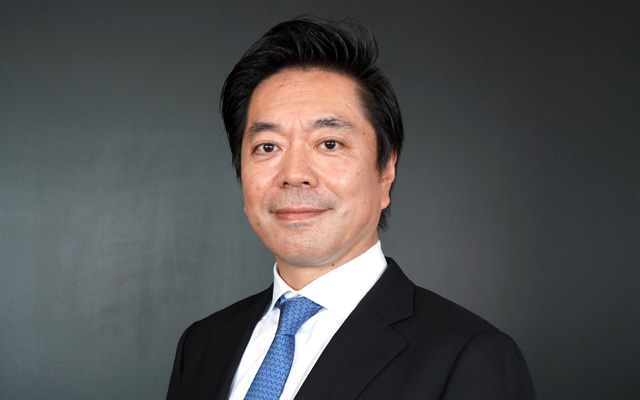
CBRE Hotels Japan has appointed Tomotsugu Ichikawa as senior director to head the investment side of the business, strengthening the company’s brokerage services for hotel-related assets.
Ichikawa brings a wealth of knowledge and expertise that are complementary to that of CBRE’s existing team, said a statement from the company.
Prior to this appointment, Ichikawa led the hotel brokerage team at Savills Japan Co.
The recently published 2022 ACI Report on Salary & Employment Trends highlighted an improving hiring confidence with 45 per cent of HR and hiring managers expecting new headcount this year. However, that positivity is met by the worrying reality of talent shortages across roles and resulting higher salary expectations, states Andrew Chan, founder and CEO of ACI HR Solutions.
In this episode of TTG Conversations: Five Questions, Chan dives deep into recruitment and retention challenges for travel, tourism and hospitality organisations in the coming years.
Tour operators in Malaysia are getting ready for the possible reopening of the country’s international borders, with efforts being ploughed into staff training, itinerary revisions and reconnection with business networks.
This follows the National Recovery Council’s (NRC) recommendation last week to the Malaysian government to reopen borders as early as March 1, 2022 to spur economic recovery. However, the final decision remains with the Cabinet, and on February 11, prime minister Ismail Sabri Yaakob said the Cabinet had yet to discuss the NRC’s recommendation. The Health Ministry too had yet to provide its feedback on the recommendation to the Cabinet for evaluation.
Malaysian tour operators are ramping up operations to be ready for a possible reopening soon; Cameron Highlands pictured
While policymakers decide on their stand, Asian Overland Services Tours & Travel is preparing to renew permits for its coaches and vans, which have been out of service for the past two years. Managing director Yap Sook Ling said there are also plans to increase operations manpower as well as begin staff training.
Ping Anchorage Travel & Tours is revising its itineraries to feature more open-air dining venues, accommodation in small island resorts, as well as off-the-beaten-track destinations in Pahang, Kelantan and Terengganu. CEO Alex Lee believes that travellers will favour less crowded destinations when they return.
Expecting the FIT segment to expand, Lee intends to lease more vans to supplement his own fleet of five when demand picks up.
Over at Universal Holidays Travel and Tourism, founder and CEO Zahira Tahir has been reconnecting with agents and partners overseas, and is now contracting with hotels and suppliers in Malaysia.
She told TTG Asia that agents in India and Pakistan wish to bring incentive groups to Malaysia in 1H2022, but materialisation would depend on the government’s decision on when borders will reopen as well as standard operating procedures (SOPs) for travellers.
Zahira opined that the government should give at least a month’s advance notice on the reopening date as well as instructions on what is needed from travellers in terms of Covid-19 tests.
Yap added that it was important for arrival SOPs to not be too restrictive, as that would turn potential travellers away. Citing an example, she said daily Covid testing requirements was a hassle to travellers.
Tour operators also view the coordinated return of scheduled flights with the reopening will determine the success for Malaysia’s tourism recovery.
Meanwhile, Malaysian Association of Tour and Travel Agents president KL Tan has called for the government to develop a recovery roadmap for the industry as well as implement travel bubbles with more countries.
Following a successful trial in December in the Philippines, Indonesia, Vietnam and Cambodia, PATA will now launch the Tourism Destination Resilience Programme to help industry stakeholders at both the national and sub-national level build their destination resiliency against the Covid pandemic and other future challenges.
The online and in-market training programme offers 10 modules, available on PATA’s Crisis Resource Center website. The modules are open-sourced and available for any tourism professional that wishes to boost their business or destination’s Covid recovery, increase competitiveness and become more resilient and sustainable.
PATA’s latest training programme aims to help tourism professionals and destinations recover from Covid-19 business disruptions and prepare for future crises
Users can expect a comprehensive guide to post-crisis planning, which involves responding to the crisis, rethinking tourism models and, finally, strategising for recovery.
Tourism Destination Resilience is implemented by PATA with support of the Deutsche Gesellschaft für Internationale Zusammenarbeit (GIZ) on behalf of the German Federal Ministry for Economic Cooperation and Development (BMZ).
Vietnam will remove pandemic restrictions on international passenger flights from all markets starting February 15, with the intention to restore flight frequency to pre-pandemic levels.
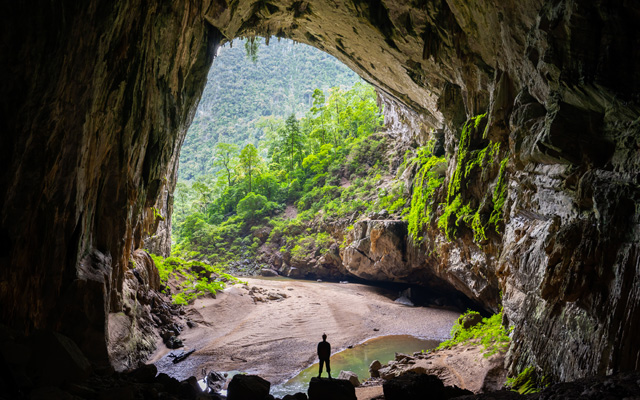
Vietnam will lift all Covid-19 restrictions on international flights to aid the country’s tourism recovery; Hang En cave pictured
According to state-run Tuoi Tre newspaper, Dinh Viet Son, deputy director of the Civil Aviation Administration of Vietnam, said Vietnam has informed her partners about the new policy and only China has yet to agree on commercial flight resumption with Vietnam.
Vietnam has begun her travel and tourism restart, with gradual international flight resumption with 15 markets from the start of 2022 as well as an intended full border reopening to international tourists by April 30.
Emirates and Maldivian have signed a Memorandum of Understanding (MoU) to explore codeshare, interline, and joint holiday package opportunities.
Emirates and Maldivian will explore opportunities to develop their routes and enhance travellers’ connectivity
The two carriers are reviewing a codeshare agreement that will enable Emirates’ customers to conveniently book and connect from Male to more than 15 domestic destinations and all international destinations served by Maldivian, the flag carrier for the Maldives.
They will also explore opportunities to cooperate on their respective tour operating arms, to offer customers tailor-made packages including hotel stays and exclusive tours.
Adnan Kazim, Emirates’ chief commercial officer, said: “Maldives is one of the most popular leisure destinations in Emirates’ network and we are very pleased to be exploring a partnership with the nation’s local carrier. A codeshare and interline agreement will immensely benefit both carriers. For Emirates customers, it is enhanced connectivity to and from the Maldivian archipelago; for Maldivian travellers, it’ll ease access to our extensive network of more than 120 destinations, via Dubai.”
Ibrahim Ameer, minister of finance of the Republic of Maldives, acknowledged the Emirates’ significant impact on the Maldives’ tourism industry – the airline is a top producer of international passenger traffic for the destination.
“The possible partnership between the two airlines will benefit the Maldivian economy and strengthen economic ties between the Maldives and the United Arab Emirates,” Ibrahim added.
Despite progress in Bali’s reopening, which saw direct flights being announced by two airlines and the 10-day quarantine period being cut by half with a new travel bubble system last week, Indonesian inbound players are losing faith in the policy.
Their source of woe is the Bubble Quarantine Policy’s continued requirement of quarantine for arriving travellers.
Indonesian inbound players say Bali’s new Bubble Quarantine Policy is too restrictive to aid recovery
Sugeng Suprianto, managing director of Top Indonesia Holidays, told TTG Asia that travellers today are gravitating towards destinations that are easy to access, particularly those without mandatory quarantine.
“Europeans are not interested (in Bali). I’ve lost many clients who have turned to the Philippines, the Maldives and other countries that have dropped their quarantine requirement,” he added.
Ricky Setiawanto, Panorama Destination’s director of business development, hopes the government will have the confidence to remove the quarantine requirement, as many destinations have. He said the quarantine requirement inflates the cost of travel, making the destination less competitive than those without compulsory on-arrival isolation.
“Tourists have to spend at least US$700 on the Warm-Up Vacation package (a 5D/4N arrangement with select hotels that is part of the Bubble Quarantine Policy). This burdens tourists, which pushes them to choose other destinations,” said Ricky.
Under the new rules, tourist visas will also no longer be available on arrival. Instead, travellers will need to obtain an e-visa from sponsoring travel companies before they fly. This worries Adjie Wahjono, operations manager of Aneka Kartika Tours, as the procedure adds to the cost and complexity of planning a trip to Bali.
“We hope that visa-on-arrival can be reinstated, at least for residents of ASEAN member countries,” Adjie said.
With the Philippines easing international border restrictions, including the removal of returning quarantine, outbound players in the country believe that Philippine residents are ready to explore the world once again.
However, Filipinos still lack the confidence to travel abroad, said Matt Poonin, general manager of Cebu-based Travelite Travel and Tours in Cebu.
Thailand’s destination branding and supportive traveller schemes have led to outbound interest from groups in the Philippines; Phuket pictured
To help stoke outbound travel demand, Travelite has partnered with Divaishnavi Travel and Tours as well as iTravel, iExplore Tours & Services to organise the 7th Edition of the International Travel Fair (ITF). The largest B2C travel show – back after a two-year hiatus – in the Visayas and Mindanao will take place from February 18 to 20 at the Ayala Mall Cebu.
During the tradeshow, the companies will promote both domestic and overseas destinations, shared Poonin.
Among the ITF exhibitors will be Turkish Airlines, which currently flies direct from Turkey to Manila, and has recently added a connecting flight to Cebu on January 4, 2022.
But without destination promotion support from the Turkey tourism board, Eric Papa, president and CEO of Kasel Travel Solutions, said the route “is not appealing for both leisure and incentive travel at the moment”.
“The prospect and potential of (Filipinos choosing) an outbound destination depend on the marketing activities of its NTO during this pandemic. It is noteworthy that Japan – despite closed borders – has been conducting continuous promotions in the Philippines, as well as webinars that started last November,” Papa elaborated.
A successful marketing strategy is also required. He cited Thailand as an example, where the Test & Go Thailand Pass and Sandbox programmes in holiday locations like Phuket have both enabled him to receive an outbound enquiry from a small incentive group for May.
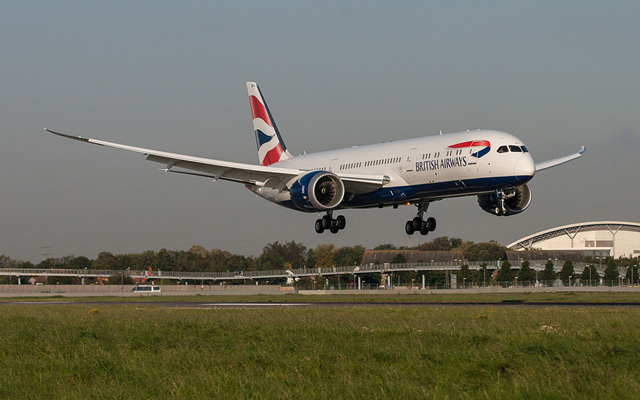
British Airways’ first passenger flight between Sydney and London since April 2020 will take to the skies on March 29, 2022, following news of Australia’s reopening to fully-vaccinated international travellers.
Flight BA15 is scheduled to touch down in Sydney on March 29 at 06.10, while returning flight BA16 is to depart at 15.50.
British Airways has also introduced a number of measures at the airport and onboard to look after the safety and well-being of its customers and colleagues.
Prior to travel, travellers will receive details of how they can prepare for their journey, including information on discounted test providers. They are also encouraged to download the VeriFLY app – which allows travellers to combine their travel verification documents and Covid-19 test
results in one place – before departing for London.
The airline offers a flexible booking policy, where customers can exchange their bookings for a voucher or move their dates without incurring a change fee.
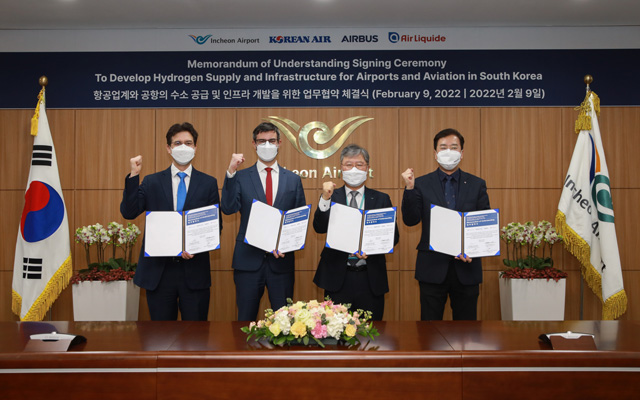
From left: Air Liquide Korea's Guillaume Cottet; Airbus Korea's Fabrice Espinosa; Incheon International Airport Corp's Jeon Hyoung-wook; and Korean Air's Lee Soo-keun at the MoU signing
Airbus, Air Liquide Korea, Korean Air and Incheon International Airport Corporation have signed a Memorandum of Understanding (MoU) to explore the use of hydrogen in the decarbonisation of the aviation sector in South Korea.
The collaboration will also study the development of South Korean domestic airport infrastructure to support the deployment of hydrogen-powered commercial aircraft. This partnership reflects a shared ambition to drive the emergence of an aviation sector dedicated to supporting the South Korean government’s goal of carbon neutrality by 2050.
From left: Air Liquide Korea’s Guillaume Cottet; Airbus Korea’s Fabrice Espinosa; Incheon International Airport Corp’s Jeon Hyoung-wook; and Korean Air’s Lee Soo-keun at the MoU signing
Anand Stanley, Airbus president Asia-Pacific, elaborated in a press release: “Under the MoU, Airbus will provide characteristics of hydrogen-powered aircraft ground operations, as well as aircraft characteristics and fleet energy usage. Together, we will prepare a roadmap to first develop hydrogen usages at and around Incheon Airport and then build scenarios to support the deployment of hydrogen ecosystems connected to other (South) Korean airports.”
The partnership will also focus on carrying out studies aimed at defining and developing the required liquid infrastructure at Incheon Airport to prepare for the arrival of the first hydrogen-powered aircraft.
Each partner will leverage their expertise to define the potential opportunities that hydrogen offers. Air Liquide will bring its expertise in mastering the entire hydrogen value chain (production, liquefaction, storage and distribution), in particular, liquid hydrogen supply, while Korean Air will provide expertise on ground aircraft operations and aviation management and operations.
Lastly, Incheon International Airport Corporation will provide an airport development plan outlook, along with air traffic characteristics and distribution among terminals.


















Tour operators in Malaysia are getting ready for the possible reopening of the country’s international borders, with efforts being ploughed into staff training, itinerary revisions and reconnection with business networks.
This follows the National Recovery Council’s (NRC) recommendation last week to the Malaysian government to reopen borders as early as March 1, 2022 to spur economic recovery. However, the final decision remains with the Cabinet, and on February 11, prime minister Ismail Sabri Yaakob said the Cabinet had yet to discuss the NRC’s recommendation. The Health Ministry too had yet to provide its feedback on the recommendation to the Cabinet for evaluation.
While policymakers decide on their stand, Asian Overland Services Tours & Travel is preparing to renew permits for its coaches and vans, which have been out of service for the past two years. Managing director Yap Sook Ling said there are also plans to increase operations manpower as well as begin staff training.
Ping Anchorage Travel & Tours is revising its itineraries to feature more open-air dining venues, accommodation in small island resorts, as well as off-the-beaten-track destinations in Pahang, Kelantan and Terengganu. CEO Alex Lee believes that travellers will favour less crowded destinations when they return.
Expecting the FIT segment to expand, Lee intends to lease more vans to supplement his own fleet of five when demand picks up.
Over at Universal Holidays Travel and Tourism, founder and CEO Zahira Tahir has been reconnecting with agents and partners overseas, and is now contracting with hotels and suppliers in Malaysia.
She told TTG Asia that agents in India and Pakistan wish to bring incentive groups to Malaysia in 1H2022, but materialisation would depend on the government’s decision on when borders will reopen as well as standard operating procedures (SOPs) for travellers.
Zahira opined that the government should give at least a month’s advance notice on the reopening date as well as instructions on what is needed from travellers in terms of Covid-19 tests.
Yap added that it was important for arrival SOPs to not be too restrictive, as that would turn potential travellers away. Citing an example, she said daily Covid testing requirements was a hassle to travellers.
Tour operators also view the coordinated return of scheduled flights with the reopening will determine the success for Malaysia’s tourism recovery.
Meanwhile, Malaysian Association of Tour and Travel Agents president KL Tan has called for the government to develop a recovery roadmap for the industry as well as implement travel bubbles with more countries.