Explora Journeys, part of the MSC Group, will offer Ocean Wellness Retreats, a series of one-day programmes available on Grand Journeys aboard Explora I and Explora II. The programmes draw on Eastern and Western practices and include yoga, breathwork, sound-based sessions and guided reflection.
Sessions feature Surya Shakti Yoga, pranayama, sound healing, gong baths held at night and structured reflection. Each programme is designed to support rest and self-awareness, and guests may take part in more than one retreat during a voyage.
Guests can participate in one-day wellness programmes on Explora Journeys’ Grand Voyages, combining yoga, breathwork and sound therapy
The retreats will take place on Explora I from October 18 to November 12, 2025, sailing from Fusina (Venice) to Miami via Mediterranean ports and Caribbean stops, and on Explora II from November 11 to 22, 2025, sailing from Barcelona to Bridgetown, Barbados, with calls at Tangier, Gran Canaria and other ports.
The National Economic and Social Development Council (NESDC), Thailand’s central economic planning agency, released its 2Q2025 Economic Report on August 18.
The report shows Thailand’s tourism sector is slowing, although earnings continue to rise, mainly from higher-spending longhaul travellers. International arrivals in 2025 are projected at 33 million, down from 35.5 million in 2024 and below earlier forecasts.
Thailand is evolving with increasing draws for premium travellers that cater to high-spending tourists; photo by Anne Somanas
Data from January to July 2025 shows the country received 19.3 million international tourists, a 6.4 per cent decline from the same period last year, with shorthaul markets such as China, Malaysia, Hong Kong, and South Korea seeing the largest falls. In May, the NESDC had projected 37 million arrivals, revised down from an earlier estimate of 38 million.
Despite fewer visitors, international receipts are expected to rise to 1.57 trillion baht (US$43.6 billion) in 2025, up from 1.5 trillion in 2024, but below the earlier forecast of 1.71 trillion baht. Average per-capita spending is projected at 47,686 baht per trip, up from 42,301 baht in 2024, reflecting a higher proportion of longhaul tourists.
The slowdown is affecting core service industries. Accommodation and food services grew 2.1 per cent in 2Q2025, down from 7.2 per cent in 1Q2025. International visitor numbers fell 12.2 per cent to 7.14 million, equivalent to 87.24 per cent of pre-Covid levels, while hotel occupancy dropped to 69.8 per cent from 74.9 per cent. 2Q2025 tourism receipts reached 647 billion baht, a 12.1 per cent increase year-on-year, slower than 1Q2025’s 13.7 per cent growth.
Analysts warn that weaker near-term demand will affect transport, retail, and food services, leading the NESDC to cut Thailand’s 2025 GDP midpoint growth forecast to 2.0 per cent, citing both softer exports and cooling tourism.
To counter the slowdown, the NESDC recommends improving safety and readiness in tourism infrastructure, launching targeted campaigns to attract high-spending travellers, and advancing sustainable tourism to strengthen long-term industry resilience and competitiveness.
GDS-Movement, which publishes the well-known annual GDS-Index that assesses DMOs, CVBs, NTOs, regional tourism organisations and tourism boards on their sustainability efforts, will soon launch a simplified programme for tourism destinations that are just starting out on their regenerative tourism journey.
Named GDS-Index Lite and set to launch in September, the programme adopts a 28-point assessment criterion – a much smaller set than the regular GDS-Index that comes with 77 questions and 300 sub-questions.
Launching in September, the GDS-Index Lite will help tourism destinations new to sustainability efforts to get started on making positive progress
Guy Bigwood, CEO and chief changemaker at GDS-Movement, told TTG Asia that the 28 checkpoints were identified through data analysis with the University of Exeter and proven to bring about the biggest positive change to the city.
The 28-point assessment criteria comprise “basic stuff”, such as the existence of a strategy, training programme, stakeholder communication, and certification.
“We will also ask if the destination had communicated the strategy to the mayor, and require proof of that by way of a letter to the mayor and a photo. We are fanatical about evidence – everything assessed for the GDS-Index and GDS-Index Lite have to be backed up by evidence,” said Bigwood.
Explaining the need for a lightweight version of the GDS-Index, Bigwood said: “We realised that there are a lot of cities around the world that are not able to handle that sort of immense change (required by the regular assessment programme), and we don’t want to leave them behind.”
The GDS-Index Lite benchmark will not be made public – results will only be communicated to participating destinations.
A tourism destination could make progress on the regular GDS-Index over three to five years, subject to committed resources, ambition and alignment with the city’s goals. With the GDS-Index Lite programme, tourism destinations could see progress in two years.
He added that the GDS-Index Lite programme could be regarded as the startup phase. Once tourism destinations have achieved the basic requirements in regenerative tourism efforts, they could then move on to the full GDS-Index programme where “every department in the team must now be involved through proper training, guided by a proper strategy with a director who gets a budget to run it”.
The third stage in a tourism destination’s regenerative tourism journey would then be certification.
GDS-Movement, through its GDS-Academy and GDS-Consulting units, can help tourism destinations close gaps in their sustainability efforts.
When asked what common obstacles are in the journey towards regenerative tourism, he pointed to resources and stakeholder engagement.
“Someone has to commit to it, to do the work and invest the time – and this person needs sufficient management support. So, you need the CEO – ideally – or the vice president of something to support that one person,” he said.
“The second step is stakeholder engagement – getting enough people together. You need the tourism people, convention bureau people, marketing people, and data people together – that’s just in the DMO. You also need the hotel association, the restaurant association, and so on for you to ultimately build a green team.
“Once the tourism destination is able to build that team, then synchronicity starts to happen, and the magic starts to happen.”
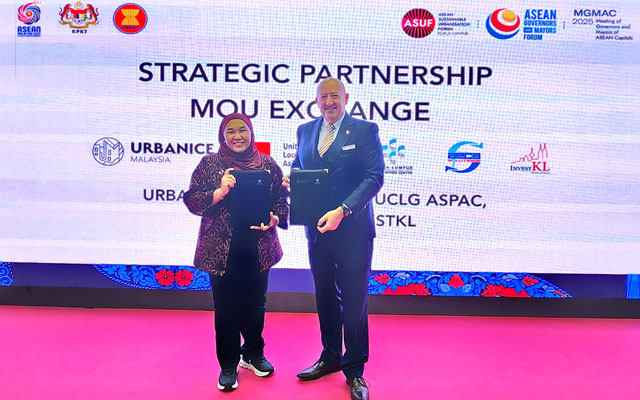
Kuala Lumpur Convention Centre Business Events Alliance (KLCCBEA) and Urbanice Malaysia have signed a memorandum of understanding to strengthen Kuala Lumpur’s position as a sustainable tourism destination.
The agreement was formalised during the ASEAN Sustainable Urbanisation Forum (ASUF) 2025 at the Kuala Lumpur Convention Centre.
The partnership aims to advance sustainable tourism in Kuala Lumpur
The partnership brings together KLCCBEA’s destination marketing expertise and Urbanice’s sustainable urban development strategies to support tourism growth that benefits local communities, protects cultural heritage, and aligns with the United Nations Sustainable Development Goals.
The two organisations also co-organised the inaugural Stakeholders Business Assembly during ASUF 2025. Themed Mobilising Partnerships to Drive Inclusive Economic Growth through Tourism, the assembly gathered more than 70 representatives from ASEAN member’s local authorities, tourism bodies, industry leaders, and cultural practitioners. Discussions focused on practical partnership models that can generate measurable economic and social benefits.
Participants highlighted five key factors for successful collaboration in sustainable tourism: creating mutual benefits, recognising the value of small initiatives, prioritising local products and resources, sharing ideas to generate value, and engaging champions to drive momentum. Two such champions were recognised – the Malaysian Association of Tour and Travel Agents for promoting tourism in rural northern regions, and KLCCBEA for coordinating initiatives such as Sustainable September.
Sustainable September, now in its third year, brings together KLCC precinct partners under a shared sustainability vision. Through events, community programmes, and educational campaigns, the initiative has grown to become a flagship example of collective impact and sustainable urban tourism in Kuala Lumpur.
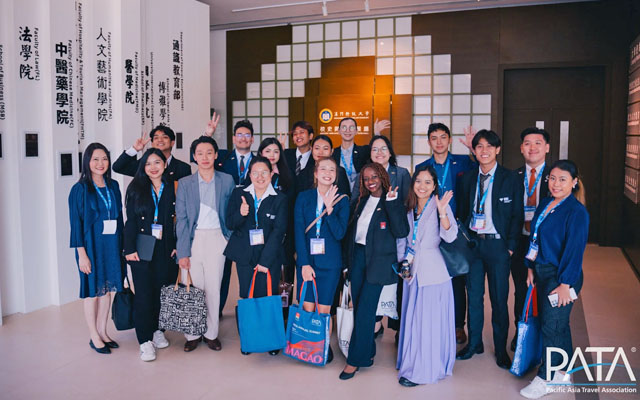
PATA will hold the PATA Youth Symposium 2025 at Srinakharinwirot University in Bangkok, Thailand, on Monday, August 25, ahead of the PATA Travel Mart 2025. The event is hosted by the International College for Sustainability Studies at Srinakharinwirot University (SWUIC), in collaboration with Bangkok University International.
The symposium will include panel discussions, student-led dialogues and opportunities to meet leaders from across the Asia-Pacific tourism sector. It is designed to provide young professionals with practical knowledge and skills to prepare for careers in the industry.
The symposium in Bangkok aims to prepare young professionals for careers in the evolving tourism industry; photo by PATA
The event will begin with keynote speeches from Sophia Montgomery, a Physics student at Harvard University and Paris 2024 Olympian in Women’s Dinghy Sailing, and Jonathan Low, CEO of Global Success Learning Academy. This will be followed by a panel with graduates who have successfully entered the tourism workforce, giving students a chance to engage with experienced professionals.
Two additional panels will focus on career guidance. Uncovering the Unseen: Discovering Hidden Careers in Tourism will feature experts from the Thailand Incentive and Convention Association, Intrepid Travel and iSanook Hotels & Resorts, highlighting lesser-known career paths. Career-Ready: How to Impress Recruiters will include human resources professionals from Dusit International and other companies, offering advice on preparing for the job market.
The day will conclude with a Student Chapter workshop, co-organised by the PATA Thailand SWUIC Student Chapter and the PATA Thailand Bangkok University Student Chapter.
The symposium aims to connect students with industry insights, develop career skills and encourage engagement with the Asia Pacific tourism sector.
SWUIC will welcome participants to its campus. The college aims to develop students with an understanding of sustainability and diversity while providing skills for the modern workplace. The campus will be the venue for discussions on career paths and trends in travel and tourism.
PATA CEO Noor Ahmad Hamid stated: “Empowering youth is not just an investment in their future, it is an investment in the future of the tourism industry. Together, as an industry, we must build the bridges that lead them from aspiration to achievement.
“PATA is, of course, grateful to our host, the International College for Sustainability Studies, Srinakharinwirot University, and all participating organisations for joining us in supporting the rising stars of our industry. Without them, this event would not be possible.”
Thanakorn Thongprayoon, dean of the International College for Sustainability Studies, Srinakharinwirot University, commented: “The PATA Youth Symposium 2025 aligns closely with our mission to foster globally minded graduates who are not only career-ready, but also committed to creating a sustainable and inclusive future for the tourism industry. We believe in the power of youth, and by connecting them with industry leaders, we can ignite new ideas and drive meaningful change in our shared future.”
Chedi Hospitality is entering the Japanese market with The Chedi Niseko, a boutique hotel in the heart of Hirafu, Niseko. The development is scheduled for completion in June 2029 and marks the brand’s return to Asia.
Located within one of Japan’s prominent ski and nature regions, The Chedi Niseko will provide access to slopes, local dining, and year-round outdoor activities. The project addresses growing international demand for experience-led stays in Japan and reflects Chedi Hospitality’s approach to design-led, culturally attuned destinations.
The Chedi Niseko will offer slopeside access and year-round outdoor activities when it opens in June 2029
Ahead of its opening, Chedi Hospitality will introduce seasonal culinary events over the next three winters. These experiences will offer early insight into the brand’s gastronomic approach, combining global cuisine with Japanese hospitality traditions.
Building on its alpine presence in Andermatt and its planned development in Trojena, The Chedi Niseko reinforces the brand’s position in curated mountain destinations. The project reflects the group’s focus on careful expansion, prioritising substance over scale and providing long-term value in significant locations.
“Niseko presents a rare convergence of natural beauty, international appeal, and all-season relevance,” said Stephan Schupbach, CEO of Chedi Hospitality. “Our expansion into Japan speaks to our long-term commitment to cultivating meaningful hospitality experiences in destinations that share our values of authenticity, sophistication, and global connectivity.”
Shania Zhang, president at Ryowha Group, added: “The Chedi Niseko is a long-term investment in excellence, one that will resonate with discerning travellers and investors alike.”
Korean Air introduces Premium Class on retrofitted Boeing 777-300ER
Korean Air has unveiled Premium Class on its newly retrofitted Boeing 777-300ER, with the first flights on short- and mid-haul routes from mid-September. The airline has invested around 300 billion won (US$230.77) to upgrade 11 aircraft with redesigned cabins and new onboard technology.
Premium Class, positioned between Prestige (business) and Economy, features 40 seats in a 2-4-2 layout with 50 per cent more space than Economy, a seat pitch of 39 to 41 inches, 19.5-inch-wide seats, up to 130-degree recline, leg and footrests, ergonomic headrests, and winged sides for privacy. In-flight entertainment includes 15.6-inch 4K screens.
Meals on international routes comprise a main course, appetiser, and dessert from the Prestige menu, with beverages including wine, coffee, and tea. Premium Class passengers also enjoy priority ground services, Morning Calm check-in counters, priority baggage handling, and Sky Priority boarding.
The launch coincides with a full interior overhaul of the Boeing 777-300ER fleet, featuring Prestige Suites 2.0 in 1-2-1 configuration, New Economy in 3-4-3 layout, upgraded Wi-Fi, and improved in-flight entertainment across all cabins.
Qantas
Qantas to offer daily Sydney-New York flights via Auckland
Qantas will increase its Sydney-New York flights via Auckland from five per week to daily from June to October 2026. This will be the first daily Sydney-Auckland-New York service since the route launched in June 2023 and Qantas’ first daily flights to New York since pre-Covid Sydney-Los Angeles-New York services.
The airline’s A380 has returned to Sydney-Dallas on August 11, and the Boeing 787 Dreamliner resumed Brisbane-Los Angeles services on August 13, part of an international network update announced in October 2024.
Scoot
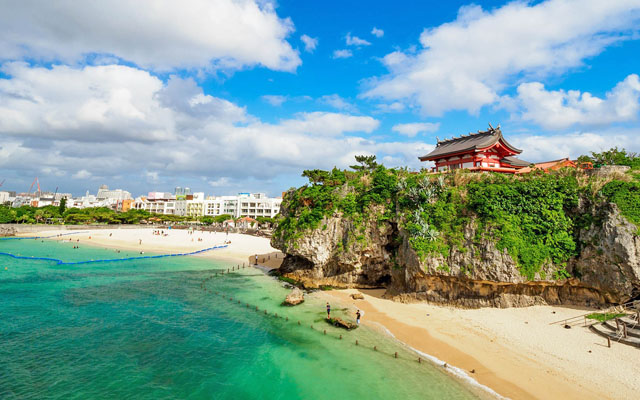
Scoot adds flights to Chiang Rai, Okinawa and Tokyo
Scoot will launch new flights to Chiang Rai in Thailand, and Okinawa and Tokyo (Haneda) in Japan between December 2025 and March 2026. Flights to Chiang Rai will operate five times weekly from January 1, 2026, on the Embraer E190-E2. Services to Okinawa will start three times weekly from December 15, 2025, on the Airbus A320 family, while daily flights to Tokyo (Haneda) begin March 1, 2026, on Boeing 787 Dreamliners.
With these additions, Scoot will operate 111 weekly flights to Thailand and 45 to Japan, serving 76 destinations across 18 countries and territories in Asia-Pacific, the Middle East, and Europe.
The airline will also increase frequencies on existing routes. In South-east Asia, Bangkok flights rise from 35 to 39 weekly from August 2025, Ipoh from 17 to 21 weekly from November 2025, and Chiang Mai progressively to 14 weekly by December 2025. In North Asia, Tokyo (Narita via Taipei) increases to 14 weekly from October 2025, Sapporo (Hokkaido via Taipei) from four to seven weekly from December 2025, and Singapore-Taipei from 23 to 25 weekly in October and 25 to 28 from December 2025. Flights to Jeju will increase from five to seven weekly from January 2026. In Europe, Vienna services rise from three to four weekly from March 2026.
AirAsia X
AirAsia X launches Kuala Lumpur-Istanbul route
AirAsia X (AAX) will introduce a new route between Kuala Lumpur and Istanbul, Türkiye, from November 14, 2025, with four weekly flights.
The service operates from Istanbul Sabiha Gökçen International Airport, which connects to more than 117 international and 40 domestic destinations. The route expands AAX’s network to Europe, linking South-east Asia to one of the world’s most historically and geographically unique cities.
The launch also enables an affordable Umrah Plus Istanbul package through Your Companion, the Islamic lifestyle arm of Capital A, allowing travellers to combine a spiritual journey with a visit to Istanbul. Fly-Thru services via Kuala Lumpur provide one-stop connections for passengers without baggage recheck, while giving travellers from Türkiye access to AirAsia’s 130 destinations in South-east Asia.
The St Regis Singapore will host Marriott International’s Luxury Dining Series 2025 from August 29 to 31.
The series is a regional dining event across Asia-Pacific, taking place from July to September 2025 at luxury hotels including The St Regis Osaka, JW Marriott Jeju Resort & Spa, JW Marriott Bengaluru Prestige Golfshire Resort & Spa, The Ritz-Carlton, Perth, The St Regis Jakarta, and The Ritz-Carlton, Bangkok. Each hotel will offer curated dining experiences led by Marriott International’s chefs and mixologists, highlighting traditional flavours and techniques.
Experience signature dining, cocktails and afternoon tea at The St Regis Singapore from August 29 to 31
At The St Regis Singapore, the event will be held across four venues: Yan Ting, The Astor Grill, The Tea Room, and the soon-to-be-launched St Regis Bar Singapore. Executive Chinese chef Chan Chung Shing of Yan Ting will collaborate with Chef Daniel Wong of the One MICHELIN-starred Jin Xuan at The Ritz-Carlton Shanghai, Pudong, for a four-hands lunch and dinner on August 29 and 30. The six-course dinner menu starts from S$228++ (US$169++) per person or S$298++ with wine pairing, while the Dim Sum Brunch is priced from S$168++ per person.
At The Tea Room, chef Angela Lai and executive pastry chef Ng Chee Leong will present a locally-inspired Afternoon Tea from August 29 to 31, priced from S$65++ with sparkling tea or S$95++ with champagne. The St Regis Bar Singapore will feature a takeover by Paulo Naranjo of The St Regis Jakarta and Marco Dognini of Bar Sathorn at W Bangkok from August 29 to 31, with cocktails starting at S$26++.
At The Astor Grill, chefs Vladimir Veiga, Fabio Granata, and Angelo Sergio will present a six-hands tasting dinner from S$198++ per person or S$298++ with wine pairing. The weekend concludes with a brunch on August 31 from S$138++ per person or S$198++ with free-flow champagne.
Marriott Bonvoy members may use loyalty points for a package that includes a one-night stay in a Caroline Astor Suite and a private cocktail masterclass, with bids starting from 60,000 points.
Event timings and pricing vary by venue and date, with multiple seating for lunch, dinner, brunch, and afternoon tea.
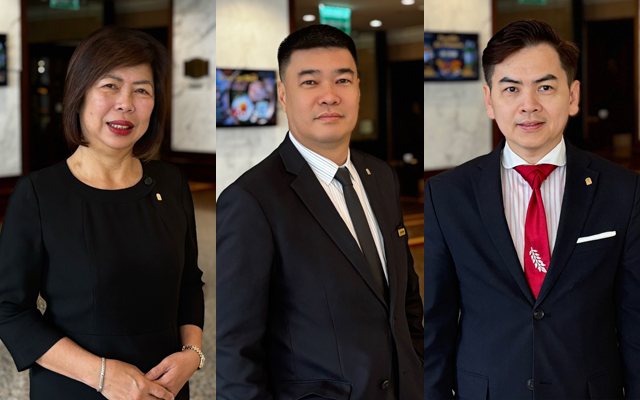
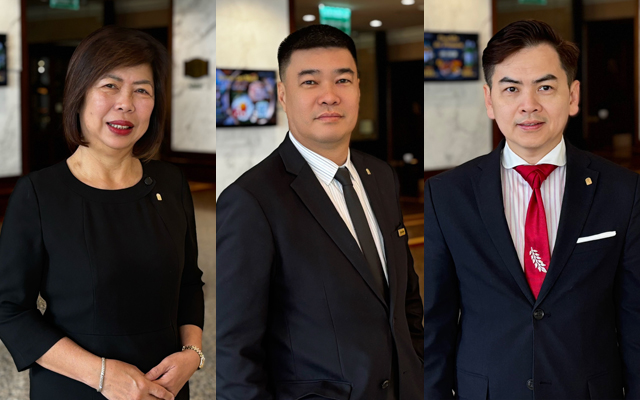
Gurney Bay Hotel, a Parkroyal Partner Hotel, has appointed five seasoned hospitality professionals to its executive team ahead of its upcoming brand transformation.
Winnie Low, formerly director of F&B and operations leader across Pan Pacific, Millennium, InterContinental, Shangri-La, and Ritz-Carlton, joins as director of operations.
From left: Winnie Low, Ng Soo Chuan, and Tom Toh
Ng Soo Chuan, most recently overseeing financial operations at Lexis Suites Penang and Iconic Hotel, is appointed director of finance.
Tom Toh, previously cluster director of human resources at Forest City, Johor Bahru, takes on the role of director of people and culture.
Lee Ai Leng, formerly senior sales and marketing leader at Lexis Suites Penang, joins as director of sales and marketing.
Clarissa Lim, most recently cluster revenue manager for three Shangri-La properties in Penang, is named revenue manager, while Rochesder Hillary, previously involved in Parkroyal Langkawi Resort’s pre-opening, becomes marketing and communications manager.
The Thai Hotels Association (THA) will petition the Administrative Court to review the Wage Committee’s 14th announcement on minimum wage rates, which sets a nationwide minimum of 400 baht (US$12.30) per day for hotels of types 2, 3 and 4, effective July 1, 2025. Type 1 hotels, which provide guestrooms only and no additional facilities, are excluded.
The new rate is part of the government’s plan to raise the daily minimum wage to 650 baht nationwide. While supporting fair pay, THA argues the uniform rate does not take into account economic differences between provinces.
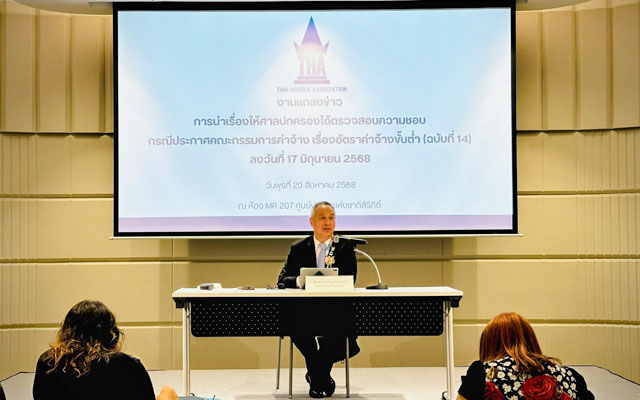
Thienprasit Chaiyapatranun, president of the Thai Hotels Association, addresses the press at a media briefing on August 20; photo by Anne Somanas
“We are not opposed to higher wages – we know they improve workers’ lives and strengthen the economy. But applying the same rate to every hotel, in every province, ignores the huge differences in economic conditions and tourist demand,” said THA president Thienprasit Chaiyapatranun at a media briefing.
Thienprasit warned that the flat rate could destabilise operators in secondary destinations with low or inconsistent tourism demand.
“In some provinces, the minimum was 345 or 350 baht. To push that suddenly to 400 baht is a 17 per cent jump overnight,” he explained.
Labour already makes up 25 to 30 per cent of hotel operating costs, with energy being “the biggest burden after staff”.
Together, these make up more than half of overall expenses, leaving operators with limited room to manoeuvre.
“If you are a hotel in a remote province, you will be in real trouble. Hotels in Bangkok or Phuket may absorb the increase, but in places like Nan or Phrae, the markets simply cannot bear it. Yet we are all forced to pay the same rate,” he added.
Fairness issues also arise between licensed and unlicensed operators.
“Hotels with permits must pay 400 baht. But unlicensed hotels don’t follow the rules and that creates unfair competition. In effect, the new policy punishes the operators who comply with the law,” he stressed, suggesting the new conditions may discourage compliance and incentivise some operators to avoid hotel licensing altogether.
THA fears smaller enterprises, already struggling since the policy took effect on July 1, will be forced to cut permanent staff and rely on casual or part-time workers.
“If the policy remains in place, many operators will eventually have no choice but to reduce their workforce. They will move to on-call hiring – housekeepers or cleaners who come in only when there are guests. That is the reality we face,” Thienprasit stated, warning of employment consequences.
He emphasised the court challenge is not against higher wages but against the way they are being applied.
“If the Wage Committee imposes a flat rate without considering local realities, it is unfair and unlawful (according to Thai labour laws). We want the court to review whether this was a proper use of discretion,” he said.
According to projections released August 18 by Thailand’s National Economic and Social Development Council, tourism arrivals are forecast at 33 million this year, down from 35.5 million in 2024, with hotel revenue expected to contract by around seven per cent. While Phuket and other southern provinces remain resilient, many secondary cities continue to struggle.
“Hotels with strong demand and high-spending guests will always pay more, because they need skilled staff with language ability. That is a healthy economic mechanism. But forcing small hotels in weak economies to match the big players – at the same rate, even for inexperienced staff – is what we are fighting against,” he concluded.
He confirmed THA has also instructed its legal team to seek temporary suspension of the 400 baht requirement for hotel operators until the Administrative Court delivers its ruling.