Lodging specialist Ascott has launched its refreshed hospitality brand, Somerset, as part of Ascott’s Brand360 strategy, a groupwide exercise to strengthen its expanded brand portfolio through sharpened brand stories and introduce signature experiences and programmes unique to each brand.
“The Somerset brand was refreshed to meet travellers’ growing expectations for sustainability, while at the same time ensuring they can immerse themselves in a truly inclusive, harmonious experience,” said Tan Bee Leng, managing director for brand & marketing, Ascott.
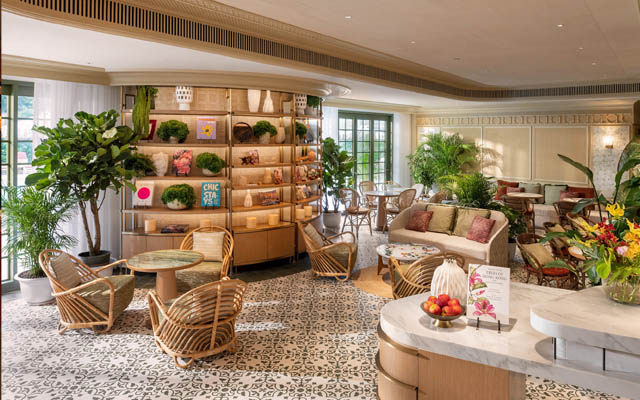
Somerset Baitang Suzhou in China has its lobby wall adorned with high wooden bookshelves that serve as trellises for plants to be displayed
“Somerset has been most popular among our guests travelling with families, because of its flexibility to cater to different travel purposes – from long-stay relocations to short-stay vacations. We hope to curate a stay where all families across generations can share happy moments, build lasting memories and create positive impact.”
Highlights of Somerset Brand Signatures include the Somerset signature scent, signature lobby wall feature, and Somerset associates, known as “the Guardians”, who are custodians of the brand’s commitment to being inclusive and sustainable, and ready to extend help to guests.
There is a range of Signature Themed Suites that are curated with family and eco-friendly themes in mind, such as Jungle, Forest, Arcade and Tatami depending on the property.
The Eco Play Area caters to young guests with biophilic elements and play features powered by solar and kinetic energy, and the Eco Gym includes energy-saving or power-generating gym equipment and technology.
In addition, the Somerset Sustainability Passport Programme encourages guests to be part of the green travel movement by rewarding them with discounts and perks when they make sustainable choices.
This announcement follows Ascott’s recently-announced Ascott CARES having been conferred Recognised Standard status by the Global Sustainable Tourism Council.
In 2023, Ascott, Oakwood, and The Crest Collection brands will also be rolling out new brand signatures and programmes.
The G20 Summit contributed to Bali’s economic growth in the third quarter of 2022 and provided a multiplier effect on the tourism industry at all levels.
At a media briefing, Sandiaga Uno, minister of the Ministry of Tourism and Creative Economy, stated that Bali’s economy in 3Q2022 experienced significant growth of up to eight per cent year-on-year as compared to three per cent the previous quarter.
Income from the tourism and creative economic sector is expected to reach the target of US$1.7 billion
He added that holding the G20 Summit in Bali delivered a strong impetus to the recovery of Indonesia’s tourism sector – the number of domestic and international travellers at the summit activities and meetings reached 20,559 people, and arrivals to Bali has now hit an average of 24,009 daily.
Direct spending stood at US$575 million, which he attributed to F&B, attractions, ground transport, telecommunications, shopping, accommodation and flights. Other organiser expenditures included PCOs, venues, vendors and government, as well as reception and marketing.
Indonesian Hotel and Restaurant Association (IHRA) reported that occupancy last year was only around 20 per cent – it has now reached nearly 70 per cent. About 80 per cent of staff shortage due to the pandemic lay-offs has also been filled.
Sandiaga said: “We project that the hotel occupancy rate in Bali will remain high, especially during the Christmas and New Year holidays.”
The minister is optimistic that the income from the tourism and creative economic sector can reach the target of US$1.7 billion this year, not only from the contribution of the G20 Summit, but also various other international events in Indonesia this year.
According to G20’s website, the G20 Summit is projected to contribute up to 7.4 trillion rupiah (US$533 million) in GDP (gross domestic product), including an increase in domestic consumption of up to 1.7 trillion rupiah.
Sandiaga commented that the event was a promotion to “meet the target of 3.6 million international tourist arrivals with a total foreign exchange earning of US$1.7 billion”.
“G20 has had the maximum and direct impact on society, such as increasing foreign tourists from 1.8 million to 3.6 million and also (creating) 600,000 to 700,700 new jobs supported by good performance in the culinary, fashion and craft sectors,” noted Nyoman Shuida, expert staff for Utilization of Maritime Resources at the Coordinating Ministry for Human Development and Culture.
The summit was attended by 17 heads of state, three foreign ministers, nine invited countries and 10 international organisations. Data from G20’s website showed the summit events absorbed a budget of 674 billion rupiah and reaped a return on investment of up to 552,000 billion rupiah for the country.
With the recovery of inbound tourism well underway, Japan’s tourism sector is providing English training for staff, many of whom have seldom been able to use the language in their workplace since 2020.
Inbound tourism dropped 99 per cent in May 2020 from a year earlier as the government introduced strict border controls that were finally fully lifted in October this year.
Japan’s tourism sector is stepping up English training for staff so they can converse with international visitors
Since then, JR East has been helping staff at its Omiya branch in Saitama Prefecture, near Tokyo, to brush up on their English via training at Omiya Bonsai Art Museum.
As bonsai is the main tourism draw of Omiya – a city home to Omiya Bonsai Village, Bonsai Restaurant Omiya and Fuyoen – staff are learning how to converse with international visitors on the basics of bonsai, in addition to reviewing how they give directions and explain train ticket purchases in English.
At Hilton Tokyo, where staff have been taking part in video call lessons and using other online learning tools since the start of the pandemic, in-person lessons are being reintroduced.
Before Covid, staff enjoyed regular classroom teaching in English, with private lessons available for key members to cover English use on the telephone, in emails and so on, Shannon Fujimaki from learning and development at Hilton Tokyo told TTG Asia.
The Tokyo Metropolitan Government is also equipping their National Licensed Guide Interpreters with new information on the elements of Japan that are expected to be most popular among travellers post-lockdown.
“With an eye on the post-Covid era, we are implementing a programme to train interpreter guides who can meet the diversifying needs of foreign visitors,” said a government spokesperson.
“Repeat visitors and individual travellers have strong demands for an understanding of Tokyo’s arts, culture, traditional performing arts and industries, as well as for unique regional experiences.”
The new guides will be trained using in-person lectures and simulated tours over 12 days between November 2022 and February 2023.
ForwardKeys’ China market expert shares some insights on the opportunities with emerging markets in South-east Asia as China’s continued absence from the international travel market leaves many destinations facing a huge shortfall in tourist arrivals.
Despite international travel to and from China having been restricted since the emergence of Covid-19, domestic travel has been permitted for some time. However, continuous lockdowns on major population centres, like Shanghai and Chengdu, following new coronavirus outbreaks, have created a volatile domestic travel landscape. Recovery is fast when restrictions are lifted, but changes are frequent and sudden, and each lockdown has a significant effect on demand.
China’s continued absence from the international travel market leaves many destinations facing a huge shortfall in tourist arrivals
Given the problems facing China’s domestic travel market, and the government’s recent affirmation that it would maintain its cautious approach to Covid-19, the chances of the country reopening to international tourism in the short-term appear slim. Nevertheless, similar policies, including travel bans, were widespread throughout South-east Asia until recently.
If local markets can keep Covid-19 rates under control now that much of the region has reopened, it may encourage China to reopen, gradually, in 2023. Ultimately, it will become increasingly difficult for the country to keep its borders closed when the rest of the region has returned to normality.
Yet even if China were to reopen next year, the economic challenges currently facing the country – including a property market crisis and issues relating to the pandemic – would result in a slow travel recovery, particularly in the longhaul segment.
Top outbound South-east Asia markets to consider
Until China’s outbound travel market fully reactivates, regional destinations that had developed a dependency on Chinese tourists in the years preceding the pandemic will need to shift their attention to other important markets.
Among the top-five outbound markets in South-east Asia before the global health crisis, India shows particular promise. Although India’s size as an international outbound market is largely attributed to its significant global diaspora, its middle-class population is growing, and the number of outbound leisure travellers from the country is increasing as a result.
Moreover, while India’s intra-regional outbound travel market is relatively small, it had experienced more growth (+10.4%) than any of the other major South-east Asia outbound markets – both international and intra-regional – over the five years before the pandemic. Now that the country has fully reopened, ForwardKeys expects its development as an inter-regional outbound market to accelerate.
The economic situation is also improving in Thailand, allowing more of its residents to travel abroad and thereby making the country an increasingly valuable source market for regional destinations.
Meanwhile, Japan and South Korea, the two top-performing outbound markets in South-east Asia (excluding China) before Covid-19, have recently reopened to travel and are expected to re-establish themselves as important source markets.
With China’s reopening seemingly still some time off, regional destinations need to adapt to the new environment, identifying markets and travel audiences to fill the gap left by China and contribute towards a long-term, sustainable tourism model.
Banyan Tree Group continues to expand one of its latest brand concepts, Homm, with two new properties – Homm Sukhumvit34 Bangkok in Thailand, and Homm Huzhou Xisai Shan in China.
Both properties opened their doors in October this year, following the brand’s debut hotel Homm Bliss Southbeach Patong in Phuket, Thailand.
More Homm properties are set to open in 2023; Homm Huzhou Xisai Shan pictured
More Homm properties are set to open next year in Bali, Indonesia and Luang Prabang, Laos.
Homm is one of five new brands within Banyan Tree Group’s growing ecosystem of concepts, and provides a sensible lifestyle and a globally diverse experience with a homely feel.
Homm’s essentials go beyond answering to basic needs, with H2O stations, Grab & Go meal options and friendly associates known as Hommates who possess detailed knowledge about the hotel and destination.
Under the Group’s signature Stay for Good programme, each Homm property advocates for a different endangered species, centrally displayed in lobby areas via origami art. At Homm Sukhumvit34 Bangkok, the mascot is the Asian Elephant – a national symbol of Thailand, while Homm Huzhou Xisai Shan’s is the crane.
The 148-room Homm Sukhumvit34 Bangkok is located in a private residential area in Sukhumvit Road, in the heart of the Thai capital. Facilities comprise an outdoor pool, fitness centre and private onsen.
Homm Huzhou Xisai Shan sits at the foot of Xisai mountain in the Wuxing district of Huzhou, the transportation hub of Shanghai, Hangzhou and Nanjing. The hotel boasts 116 guest rooms, 26 suites, 30 family rooms, four villas, and two barrier-free rooms.
“Bringing the concept of Homm-away-from-home to these exciting locations is a testament to our commitment to offering guests immersive, destination-specific travel experiences by placing them in the heart of the local community where they can truly savour the flavours, sounds and aromas of the locale,” said Philip Lim, senior vice president, head of regional operations and group specialist services, Banyan Tree Group.
Hmlet has teamed up with TCRE Partners and JMD Group to launch Owen House by Hmlet. This will be the first hotel for Hmlet, and is scheduled to debut in 1Q2023.
The 106-key hotel is located in the Little India neighbourhood, and can accommodate both long- and short-term stays, with room sizes ranging up to 52m². It will also have a communal lobby and island bar on site.
Owen House by Hmlet is scheduled to open in 1Q2023
“The launch of Owen House by Hmlet comes at an opportune time to ride the upswing in momentum for the residential leasing market and tourism recovery as Singapore’s borders reopen,” said Joshua Li, chief real estate officer, Hmlet.
TCRE Partners and JMD Group are confident that Owen House provides the ideal accommodation for the inspired traveller, and will “inject fresh energy to the bustling and eclectic Farrer Park neighbourhood”.
Earlier in April, Hmlet had announced its merger with Habyt – Owen House will join the newly combined Habyt group’s portfolio across the world, with over 8,000 rooms under management and a presence in 10 countries and 20 cities.
Owen House will also be part of the Hmlet Boutique Collection, following the successful launch of its serviced apartment Hmlet Cantonment in August 2019.
Dusit Hotels and Resorts in Thailand are offering international travellers a chance to escape the cold with a new long-stay package applicable for stays at one property or a choice of up to six properties nationwide.
With two options available – 50,000 baht (US$1,383) or 135,000 baht – the Always Warm with Dusit package is valid for bookings and stays made through March 31, 2023 and comprises 30 nights’ accommodation with daily breakfast, dining and spa discounts, laundry services and more.
Guests can escape the cold and bask in the warmth of Dusit Hotels and Resorts in Thailand with the new long-stay package; Dusit Thani Hua Hin pictured
They can choose to spend the entire time at one property or purchase a pack of six vouchers valid for five nights each at the participating hotels of their choice.
Participating properties include Dusit Thani Laguna Phuket, Dusit Thani Hua Hin, Dusit Thani Pattaya, Dusit Thani Krabi Beach Resort, Dusit Suites Hotel Ratchadamri Bangkok, dusitD2 Chiang Mai, dusitD2 Hua Hin, Dusit Princess Srinakarin Bangkok, and ASAI Bangkok Chinatown.
Always Warm with Dusit is available for booking now until March 31, 2023. Guests will need to sign up for Dusit’s guest recognition programme, Dusit Gold, to qualify for these special rates and privileges.
Martin Rinck has been appointed to the executive board by Small Luxury Hotels of the World (SLH).
In this role, he will support SLH’s strategic vision and growth plan for SLH, along with their continued expansion of independently owned and operated properties.
As a seasoned hospitality executive with over 35 years of global experience in strategy, operations, business development, P&L and brand management, he has held leadership positions at some of the world’s largest hospitality companies and brings with him extensive business, talent, and stakeholder management expertise.
Most recently, he was the executive vice president and chief brand officer at Hilton, where he led a portfolio of 18 brands across 6,500 hotels globally, developing and executing the enterprise portfolio strategy, and leading multiple ESG initiatives for the company.
Preparations are underway in Yogyakarta to welcome delegates of the ASEAN Tourism Forum (ATF) 2023, with improvements being made to various tourist attractions, venues and facilities.
For instance, Jogja Expo Center, the official venue for ATF, is currently under renovation and targeted for completion in December 2022.
The welcome dinner for ATF 2023 will be held on the grounds of Prambanan Temple
Other infrastructure improvements include the Malioboro shopping stretch which will introduce a number of electric becak rickshaws, and the Sultan’s Palace museum which is undergoing an upgrade to include 4D technology.
Gusti Kanjeng Ratu Bendara, head of the Yogyakarta Tourism Promotion Board (BPPD) and chairman of the ATF 2023 Committee, shared that the city is keen to showcase its cultural experience to delegates.
That is why the welcome dinner will be held on the grounds of Prambanan Temple, while the closing event will be at the Sultan’s Kraton Palace where a special royal dinner will be served.
In all, ATF 2023 is expected to attract 1,000 delegates, both from Indonesia and overseas.
However, direct air links to Yogyakarta have not been reinstated to pre-pandemic levels. Currently, direct flights to the new Yogyakarta International Airport (YIA) include flights from Singapore (Scoot), and Malaysia (AirAsia and Malaysia Airlines).
Responding to concerns over accessibility, Singgih Raharjo, head of Yogyakarta Tourism Office, shared there will be more direct regional flights starting next month. For instance, Thai Smile will commence operations from Bangkok, while AirAsia plans to mount a Singapore-Yogyakarta service in December.
Singgih added that the government is also working with Indonesian airlines to add more flights from Jakarta and Bali to Yogyakarta. He added that Yogyakarta is also easily accessible from Jakarta and Surabaya by land transport, as well as via trains.
Other preparations include the arrangement of shuttle services for delegates during the summit, as well as transportation from the airport into the city, shared Wayan Suweta Darma, director of Karma Events, the official organiser for ATF 2023.
A total of 10 official hotels and 14 partner hotels will provide accommodation for the ATF 2023 delegates.
Philippine Tour Operators Association have declared Mindanao as a safe destination to promote
Department of Tourism to spur connectivity by improving accessibility and infrastructure
Tourism Promotions Board to work with property development companies for accommodation standards
The Philippine government is paving the way for tourism in Mindanao, a pristine and undeveloped part of the southern Philippines that has had a troubled image.
After several travel caravans to various parts of Mindanao, Philippine Tour Operators Association (Philtoa) president Fe Abling-Yu, concluded that it is safe, and has listed it as one of the new destinations to promote.
Mindanao booths at Philtoa’s 33rd Philippine Travel Mart in Manila
In late September, all five of Mindanao’s regions were present at Philtoa’s 33rd Philippine Travel Mart in Manila, stealing the limelight with their colourful booths and costumes, quality artisanal wares, and tour packages even in areas previously off to tourism.
“Imagine the impact on local communities and their livelihood, on small and medium enterprises, on the local economy, on investments, if Mindanao is given the chance to wield its full tourism potential,” Abling-Yu commented.
The need to change perceptions
While areas of armed conflict still exist, tourism stakeholders need to help change misconceptions and create awareness that Mindanao also has safe tourist spots such as Siargao, Davao, Cagayan de Oro, Camiguin, Bukidnon, GenSan, and Zamboanga.
Recently added to this growing list is the island province of Basilan, which used to have an exaggerated image of violence. Today, demand is growing for tour packages twinning Basilan’s capital, Isabela de Basilan, with its gateway port, Zamboanga City, noted Charles Anthony C Rotoni, senior tourism operations officer, Department of Tourism (DOT) Region 9 (Zamboanga Peninsula).
“When you see Basilan, it is different from how it is perceived. We have tourism circuits that include Basilan for farm tourism, Yakan indigenous culture, gastronomy and its clean, pristine beaches,” said Errold Lim Bayona, tour director of Itravel Tourist Lane and manager of All For South Consultancy.
Bayona said that although his companies are in Zamboanga Peninsula, they are also expanding to the neighbouring island provinces of Basilan, Sulu and Tawi-Tawi because tourism products are already available there.
Zamboanga too, used to have a spotty image many years ago, but successfully transitioned into a safe, popular destination, with varied offerings of nature, secluded pink beach, seafood delights, and cultural heritage from Christianity and Muslim backgrounds, among others.
Rotoni said that apart from Basilan, DOT Region 9 is also starting to promote the cities of Dapitan and Dipolog, both in Zamboanga del Norte. These safe havens have oft been overlooked due to limited access and infrastructure.
“We’re trying to spur connectivity under DOT’s thrust on (improving) accessibility and (building) infrastructure,” shared Rotoni.
For instance, national carrier Philippine Airlines currently flies to various points in Mindanao, and is helping to encourage domestic tourism by adding more flights to and from Tawi-Tawi, Cotabato and Jolo.
Nograles: to make sure that when we say Mindanao is safe, it is safe
Government assistance
For Mindanao to gain a larger foothold on the tourism map, DOT’s Rotoni said they will be pushing for a Northern Luzon Travel Exchange next year for its main domestic source market.
“We see the potential of this market so we nurture and grow it. Tourists who visited are the best bet in telling the story on the ground and world-of-mouth advertising instead of relying on photos and videos,” Rotoni explained.
Tourism Promotions Board (TPB)’s new chief operating officer, Margarita Nograles, added: “We have to make sure that when we say Mindanao is safe, it is safe.”
“A quick solution for us to show to the world that Mindanao is safe is to bring more fam tours and let international tourists enjoy meaningful experiences in our region…. especially now that we’re rooting for sustainable, community-based tourism,” Nograles pointed out.
Stakeholders also understand that Mindanao has miles to go in achieving lasting peace and building tourism hardware.
Hence, apart from destinations that are already known to foreigners like Siargao, its target market is mainly domestic and viable markets in certain Asian countries for halal tourism, and those not sensitive to travel advisories.
This comes as Western countries have red-flagged parts of Mindanao in their travel advisories and travel insurance for their citizens excludes portions of Mindanao.
Regardless, TPB is pushing forward with a Colors of Mindanao campaign to highlight indigenous people, and reiterate that Mindanao is a safe destination for visitors.
Charles Aames Bautista, TPB’s deputy chief operating officer, added that Mindanao is also being explored as a “MICE destination”, which is why the “next MICECON will be held in Davao next year”.
“If it’s any indication, even the private sector is echoing our sentiments. We just had a meeting with a few online platforms and (are) working with property development companies to set the standards for accommodations.
“A lot of travel agents are creating Mindanao tours and circuits but if you don’t have a place to stay, it’s no use. That is why accommodation and food availability are always in conjunction with tourism circuits,” Bautista explained.