


sky100 rolls out tourist discount, photo contest

From now until December 31, 2023, overseas visitors to sky100 Hong Kong Observation Deck can enjoy 25 per cent off standard admission tickets when they book online through the attraction’s official website.
 sky100 Hong Kong Observation Deck is also inviting photography enthusiasts and tourists to join its photo competition, which will run until September 6 this year as part of its Sky-high Chillest Photography Summer Campaign.
The attraction opens daily, from 10.00 to 20.30.
For tickets, visit https://sky100.com.hk/en/offers/
Discover Paradise: Unveiling Amari Raaya Maldives with Exclusive Pre-Opening Offer

 Brought to you by Amari Raaya Maldives
Situated on a lush private island just 45 minutes from the airport, Amari Raaya Maldives is the newest luxury destination resort that celebrates life’s best moments. Offering warm and friendly service, well-appointed rooms, an indulgent spa, and a variety of delectable dining options, it’s the perfect backdrop for an island getaway.
 Scheduled to open its doors on August 1st, 2023, the resort is delighted to unveil an exclusive pre-opening offer tailored for discerning travelers. Guests who book their stay during the pre-opening period will enjoy an incredible 40% discount on accommodations, along with a 20% discount on rejuvenating spa treatments. Additionally, as a special bonus, guests will have the opportunity to experience a complimentary photoshoot experience.

The island boasts 187 villas, nestled amidst pristine reefs and lush tropical palms, offering unique and unforgettable experiences. With direct beach access, guests can choose from an array of options, including the Beach Villa, Beach Pool Villa, or interconnecting Family Beach Villas with a shared private outdoor space for quality bonding time. For those seeking a closer connection to the mesmerizing marine life, the Ocean Villas and Ocean Pool Villas, set above the turquoise waters, provide a captivating experience. Moreover, for those yearning to witness the breathtaking sunset hues from the comfort of their villas, the Sunset Ocean Villas and Sunset Ocean Pool Villas offer the perfect choice.
 Offering an unrivalled range of dining options, the resort boasts a new culinary adventure for each day of the week with eight restaurants. Guests will feel a burst of flavour at any one of the food and beverage outlets – each one finding the perfect balance between Thai, Asian, Maldivian, and International flavours, ingredients, techniques, and experiences. The perfect meal can be paired with a cocktail or creative drink concoction, whilst welcoming sundown from atop a canopy of palms or spent with a loved one on a private corner of the beach, with a romantic dinner for two, whilst feeling sand between your toes.
 Interwoven into the resort experience is the story of Seb, a shipwrecked artist who made the island his home. This castaway story frames the resort’s experience, showcasing the remnants of Seb’s life including his art studio, ship and watch towers converted to private dining and star-gazing venues.
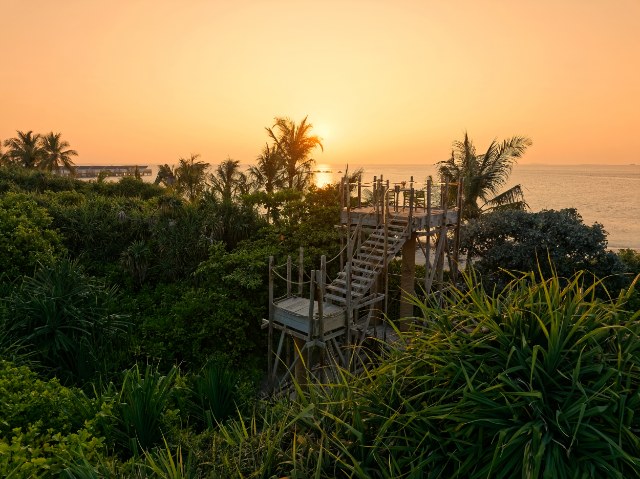 In the evening, guests can enjoy live entertainment, traditional Bodu Beru, and regular cultural events.
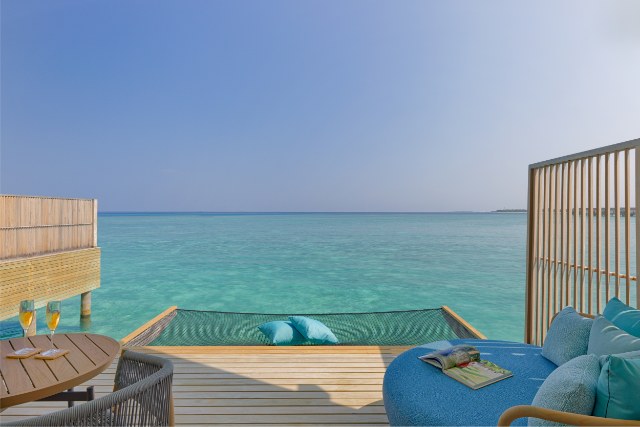 Activities like diving, water sports, and excursions take the fun out onto the open ocean, while the island offers a vast range of amazing food, relaxing spa treatments at Maai Spa, and a myriad of outdoor adventures including archery, kids’ play areas, mini golf, paddle tennis and more. The island is also home to natural mangroves with walking path ideal for exploring.
The resort is located on Raa Atoll and is accessible from Velana International Airport directly by a 45-minute seaplane to the resort or a fixed-wing domestic flight and speed boat via Ifuru Domestic Airport.
 Don’t miss out on our exclusive pre-opening offer, valid for stays between August 1 and December 23, 2023. Secure your preferred dates and accommodations by booking early. With the grand opening of our resort approaching, this limited-time opportunity is perfect for travelers in search of an enchanting paradise experience.
 Amari Raaya Maldives is the newest luxury destination resort found on a lush private island in Raa Atoll, inspired by surrounding natural fauna and flora, open ocean and a sense of castaway adventure. Book now and enjoy a 40% discount on stays and special benefits. More information on the Pre-Opening can be found at https://www.amari.com/raaya-maldives/special-offers or contact the resort directly at reservations.raaya@amari.com
More travellers turn to ChatGPT to plan their travels: Euromonitor International

Travellers using artificial intelligence (AI) tools such as ChatGPT to plan their travel itineraries is set to boom, according to market research company Euromonitor International.
The massive increase can be narrowed down to convenience and 24/7 accessibility, as travellers can access AI tools from various devices, including smartphones and computers, at any time and from anywhere with an internet connection.

A resounding 97.8% of travel executives in the Euromonitor International’s Voice of the Industry: Travel Survey stated that AI would have an impact over the next five years.
AI could disrupt travel bookings industry
Caroline Bremner, head of travel and tourism research, Euromonitor International, said: “ChatGPT is taking travel and the world by storm. With travel highly digitalised where 66% of all bookings are conducted online in 2023 and mobile accounts for 35% of all online sales, disruption from generative AI is already rife.”
The travel industry is already adapting. Expedia announced in April 2023 its collaboration with OpenAI, offering in-app trip planning powered by ChatGPT for iOS, as well as offering a plug-in to ChatGPT Plus users. The Expedia ChatGPT experience provides personalised recommendations, acting like a virtual travel assistant, delivering relevant results for hotels and what to do in the destination.
Booking Holding’s Kayak and OpenTable also announced ChatGPT plug-ins, with other travel brands like TripAdvisor, GetYourGuide and Klook soon following suit.
Trip.com integrated ChatGPT into TripGen, its newly-released AI chatbot that provides real-time assistance, itinerary planning and booking tips in the pre-trip stage. Hotels and airlines meanwhile are turning to generative AI for customer service, while automating menial tasks.
More integration will inevitably follow so that ultimately the trip planning to booking stages will blend seamlessly, dependent on access to real-time booking functionality. Generative AI is only at the beginning of its journey, giving consumers what Airbnb called “the ultimate concierge”.
AI access to ‘real time data’ can be a game-changer
“The path of AI adoption will not run entirely smoothly as there are major concerns over consumer privacy with countries like Italy temporarily banning ChatGPT. There are also concerns over large language models being reliant on out-of-date internet knowledge, with a lag of two years in the case of ChatGPT with no access to current events or real-time information. However, access to real time data has been enabled thanks to a new plug-in with Microsoft Bing,” said Bremner.
“The risks of amplifying misinformation, bias and inequality are all too real. Safety and security of consumers must be of paramount importance. Tech leaders like Elon Musk recently demanded a pause on AI development to avoid risks to humanity including possible extinction from superintelligence, stating that the AI race was out of control and time was needed to enable government policy to play catch up.”
She continued: “Travel agents faced mass disruption due to the rise of online travel three decades ago, that led to mass store closures and job losses. Now, the sector is ripe for more disruption as generative AI accelerates automation of tasks across every stage of the customer journey, before, during and after the trip. With Microsoft planning to integrate generative AI into its Microsoft 365 Copilot software, it will become ever more prevalent in consumers’ daily lives and work whether we like it or not.
“As before, travel brands will take the rough with the smooth to navigate this new phase of digital transformation with a test-and-learn approach. However, only those that ultimately celebrate the human touch of travel and hospitality will thrive.”
Capital Alliance, TFE Hotels gets green light for dual hotel project

Melbourne property developer, Capital Alliance, has secured approval for the planning permit for an A$340 million (US$234 million) dual hotel project in the Australian city, and construction is now set to commence in 1H2024.
The project, run in partnership with Australia’s International Hotel Group, TFE Hotels, is a mixed-use lifestyle development in Melbourne’s Docklands precinct. It will house a conference centre for up to 1,000 people, a 200-room hotel carrying the Collection by TFE Hotels brand, a 105-room A by Adina hotel, and Australia’s largest rooftop infinity pool.
Mohan Du, founder and chief executive, Capital Alliance, said: “Pearl River is our last blank canvas for Docklands and as such represents a significant milestone, so we wanted to create something truly remarkable and, in collaboration with TFE Hotels, a precinct that fosters a work, rest, play lifestyle.
“Importantly, this project also prioritises sustainability, world-class lifestyle amenities and provides a premium setting for large scale Melbourne events.”
Melbourne lord mayor, Sally Capp, shared that “the precinct’s popularity continues to grow” and that the Docklands has much to offer with its modern commercial and residential developments, shopping and dining options, and accessibility to the city.
In addition, the project will showcase the longest escalator in Australia, transporting visitors on an immersive ride using the latest in visual projection technology.
“Just like the Pompidou Centre in Paris, this enormous escalator runs up the side of the building and leads to a fabulous bar and function centre – and just like at the Pompidou, I am sure this new escalator will be renowned as one of the best rides in Melbourne,” said deputy lord mayor Nicholas Reece.
Desaru’s Anantara deepens sustainability reach

Anantara Desaru Coast Resort & Villas in Malaysia has expanded its CSR programme with new initiatives to protect the land and water ecosystems on Desaru Coast.
The resort rolled out the brand-wide CSR programme Dollar for Deeds in June, which matches guests’ donations ringgit for ringgit, with money raised going to ReWild Desaru, a not-for-profit organisation focused on resident wildlife protection.
This effort joins the resort’s on-site water bottling initiative, achieved through its own bottling plant established in 2022, as well as its food sustainability commitment that sees it sourcing from its own hydroponic farm, run by a local vendor. The resort also partners with Rainforest Alliance, a certified fair-trade supplier, which supplies coffee beans for the restaurants. Coffee pods used in guestroom coffee machines are sent back to the manufacturer to be recycled, while food waste is turned into fertiliser for crops.
Christian Gerart, general manager at Anantara Desaru Coast, said team members were mindful of conservation, and would regularly recycle aluminium cans and paper products as well as switch off the lights when leaving the room.
The resort also promotes a love for nature among guests with activities such as birdwatching and daily nature walks.
Radisson Hotel Group signs second Radisson Blu hotel in Fiji
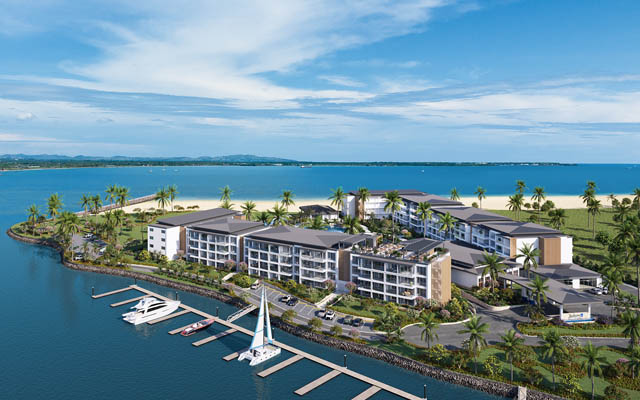
Radisson Hotel Group is expanding in Fiji with the signing of the new Radisson Blu Mirage Resort, Fiji Naisoso Island, slated to open 1Q2026.
The 250-key resort is set against the backdrop of Naisoso Island, and will offer guests direct beachfront access from apartments that overlook the South Pacific Ocean.
Accommodation comprises guestrooms along with one- to three-bedroom apartments and expansive villas that will be equipped with modern kitchen amenities.
Facilities will include three beachfront swimming pools, a gym, and a kids’ club, as well as F&B options and event spaces.
Located just five minutes from Nadi International Airport, Radisson Blu Mirage Resort, Fiji Naisoso Island provides easy access to various attractions, such as the popular Port Denarau which is 15-minutes away via a water taxi ride.
Agoda serves up insights on breakfast preference among travellers
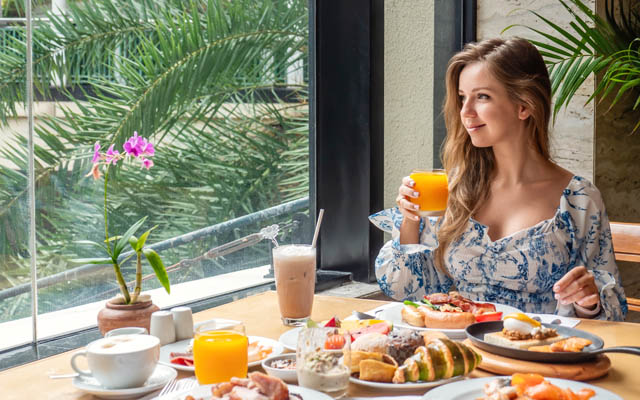
A study focused on travellers’ preference for hotel breakfast has led Agoda to discover that those from Taiwan were most in favour of a hearty way to start the day.
The two-month-long study draws on hotel booking data taken between May and June of travellers from Taiwan, Vietnam, India, the Philippines, Singapore, Thailand, Indonesia, South Korea, Japan, and Malaysia.

Forty-six per cent of travellers from Taiwan opted for inclusive breakfast, followed closely by those from Vietnam (43 per cent), and Indian (42 per cent).
On the other end, South Korea (29 per cent), Japan (27 per cent) and Malaysia (23 per cent) markets ranked eighth, ninth and 10th respectively on the breakfast requirement popularity table.
When comparing domestic with overseas travel, Agoda noticed that travellers taking an international trip were more likely to opt for comfort and peace of mind – 37 per cent of international travellers would select the ‘breakfast included’ option on Agoda, compared to 31 per cent of those who stay within country borders.
Agoda data also identified destinations where customers were most likely to opt in for breakfast – Vietnam took pole position, followed by Taiwan and the Philippines. Appetite for inclusive breakfast buffets was smaller in Japan, Malaysia, and Singapore, with South Korea at the bottom end of the ranking.
“There are lots of factors at play to determine the popularity of including breakfast when booking accommodation,” said Enric Casals, regional vice-president South-east Asia and Oceania at Agoda.
“It’s often the flexibility to decide last-minute depending on your plans during the trip, but it’s well worth noting that if you do plan to start the day with a meal, it’s often most economical to include it during the booking.”
He added that customers holding VIP Platinum status automatically qualifies for complimentary breakfast at many accommodation suppliers.
Singapore Night Festival returns this August

The Singapore Night Festival 2023 will light up the Bras Basah.Bugis (BBB) precinct again from August 18 to 26.
This year’s theme, Singapore, the Great Port City, will connect the city-state’s rich history of trade and exchange with contemporary experiences, and showcase Singapore’s evolution and growth beyond its early role as a port city into a dynamic modern metropolis where worlds meet.
Festival-goers can look forward to exploring the museums and heritage buildings around BBB with a line-up of multicultural festival offerings featuring works by local artists – from dynamic projection mappings and Night Lights installations, to unique, experiential programmes and food and retail experiences.
The Singapore Night Festival 2023 website will go live on July 18.
For more information, visit Singapore Night Festival 2023.
Get a taste of Hong Kong at The Standard, Bangkok Mahanakhon

The Standard, Bangkok Mahanakhon is offering a new Make Room for Mott 32 package that includes an overnight stay, breakfast and lunch at Mott 32 Bangkok, one of Hong Kong’s most celebrated Cantonese restaurants.
The set menu will feature Mott 32’s hallmark Cantonese dishes prepared with a modern flair along with nods to other regional cuisines of China.
Dishes include starters such as pan-fried turnip cake with conpoy, and King prawn Ha Gow; soup of the day; mains like sweet and sour pork with dragon fruit and aged black vinegar, and tossed Shanghainese noodles with dried shrimp and scallion oil; and sweetened guava soup with sago and pomelo as dessert to round off the meal.
The Make Room for Mott 32 package can be booked for stays until the end of December 2023, with rates starting from 8,700 baht (US$249) per room per night which includes breakfast, and lunch set at Mott 32 Bangkok for two persons.
For more information, visit The Standard, Bangkok Mahanakhon.







After a long pandemic-induced hiatus, The Eastern & Oriental Express, A Belmond Train, Southeast Asia will return to service, with two new seasonal journeys departing from Singapore starting February 2024.
Passengers will traverse Malaysia’s landscapes in these journeys – Essence of Malaysia, operating November to February; and Wild Malaysia, operating March to October. Both are priced from US$3,410 per person in a Pullman cabin, and include all meals, a selection of alcoholic and non-alcoholic drinks, on board entertainment, onboard and offboard activities as per the itinerary.
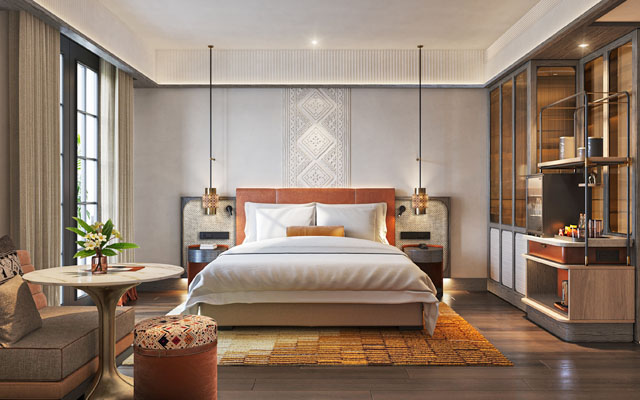
The train will feature restyled interiors and elevated on board experiences.
Of the 15 carriages, eight will be sleeping cars, two restaurant cars, one Piano Bar Car, and the iconic open-air Observation Car. From ornate marquetry, to Malaysian embroidery and oriental silks, the grand train will convey the character of South-east Asia through curated design details and colour schemes. Watch out for the eye-catching green carpet with a Tiger Orchid blooming across the entire length of the Piano Bar Car; carpets infilled with traditional Malay batik in the Malay restaurant; and interiors paired with natural wicker details, colourful cushions and hand-painted pots in the Observation Car.
Guests can pick from three accommodation categories – Pullman, State and Presidential.