 Where did your passion for accessibility issues in tourism begin, and how did you end up becoming a champion for its causes?
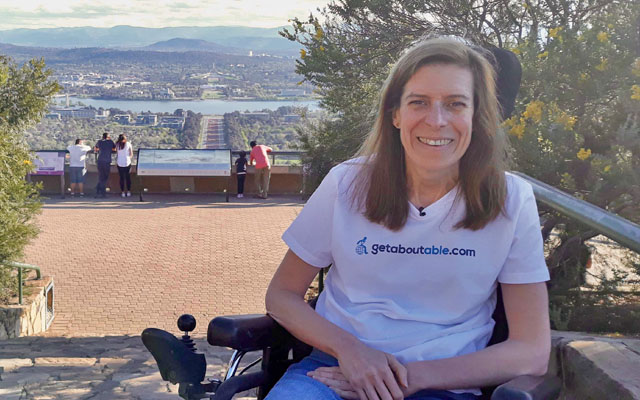
I’ve been a lifelong traveller doing longhaul flights since I was six months old, until Covid hit. It became increasingly frustrating with the lack of accessibility in tourism as my disability progressed. I’d been doing workarounds to keep travelling for myself, and thought surely there are other people like me who are finding it just as frustrating and there’s so little information out there. So, I wanted to find solutions not just for myself but for others facing the same challenges.
Can you tell us about your disability?
I was diagnosed with multiple sclerosis in 1996 but I had symptoms from 1985. It’s an autoimmune disease of the central nervous system where basically my major nerves and my brain will short circuit, which can cause all sorts of ‘fun’ problems.
In my case at the moment, it’s not being able to walk and having very weak arms, but it started with a few twitches here and there, a few pins and needles and that’s why it took over 10 years to be diagnosed. I now get around in a power wheelchair.
How easy is it to travel with your wheelchair?
It’s not easy but what I found more limiting was the stage where I was still walking, but slowly with a cane. I would tire very easily but wasn’t yet requiring so much assistance that it (could be) labelled assistance.
It would’ve been very helpful to have more benches or different rest spots where I could still enjoy myself. That’s what we talk about at GetAboutAble – how to cater to everyone regardless of what their physical needs are, which can include invisible, psychosocial, intellectual disabilities, or other areas of neurodiversity.
How big is the community of people who love to travel and have disabilities? I’m sure this community bands together and shares notes.
One in five or six people has some form of disability, and that doesn’t even count the older population or others who might never classify themselves as having a disability. The Australian Bureau of Statistics estimates that’s one in three households.
So, when we talk about travellers with access needs, we say, don’t look at us as a specific niche. Look at us as one in five travellers across the entire spectrum. We’re solo travellers, families, luxury and business travellers.
For most businesses it’s 20 per cent of their market but they’re completely missing it because they don’t even think about it, much less work to cater to it. It’s not that hard – it’s all about knowing your customers and how to make their visit more enjoyable.
By the way, most people who think about accessible tourism think about ramps and wide doorways and measurements, but that’s just the compliance piece for building standards. What we need for inclusive travel is just asking the same question you ask other customers: what can I do to make your visit better?
Is there monetary value that you’ve been able to place on the disability travel market?
Absolutely. We just heard from Tourism Australia when they came to speak at our annual conference that they had it valued at A$13.5 billion (US$8.9 billion) annually in 2021, compared to just over A$10 billion before the pandemic.
In the year it was measured, it was (worth) more than the Chinese tourism market. Think of how travel and tourism operators catered to the Chinese market and compare it to this market that’s at least that big and growing without any (extra) effort. We estimate it’s going to be two or three times as big once people start looking at it.
When borders were closed, we were waving our hands going “Hey, we’ve got a market for you” and that’s when people started listening. With Queensland declaring 2023 as the Year of Accessible Tourism and the Olympics and Paralympics coming in 2032, there’s just such a groundswell of momentum.
I’ve been saying this for a long time – people with access needs are high-value travellers, spending almost three times as much as the average traveller even if they’re staying in budget accommodation. The reason is because they travel with more companions, they stay for longer and they are more loyal. I feel like it’s just a big secret that’s going to get out.
What do you think the Accessible and Inclusive Tourism Conference in the Asia-Pacific held in Queensland this year achieved?
It’s our third year but our first with an in-person event.
Progress, not perfection, was a really big theme for this conference. Start wherever you are on that journey, figure out what you already have in your business and build on that.
Also, looking at accessible and inclusive tourism as a customer service issue rather than a compliance issue – so many businesses are used to having to tick the box that says that they’re accessible as part of legal requirements.
We’re not talking about those at all. We’re talking about how do you make a good experience for your customers. Start with a statement of welcoming people of all abilities and telling us what your access requirements are. You might have to say, I’m sorry, we can’t help you or maybe let’s work on this or that.
The other thing is working on access and inclusion as business as usual, not as an afterthought. It’s much more expensive to retrofit or deal with a complaint later. If inclusion is part of your business as usual, and if your intention is good, a lot will be forgiven because you are on the journey together.
It sounds like you are still up against much resistance in the tourism and hospitality industry. What do you think is the biggest misconception about accessible travel that you are encountering?
First of all, I wouldn’t call it resistance – I think it’s fear. The biggest hurdle is the preconception that it’s too expensive or too difficult. If you work in an old heritage building, to get it compliant-accessible could be very expensive but to get it customer service-inclusive is quite a different conversation.
In your opinion, which is the most disability friendly country in the world, and what did you love about it?
In our region, Singapore is incredibly accessible and inclusive every step of the way. The culture is such that people will help people with disabilities. If you are talking cities, Barcelona is also incredibly inclusive.
What are some of the most imaginative ways you’ve seen tourism operators incorporate services for the accessible and inclusive market Ideas?
Oh goodness, there are so many! There is an art deco style hotel in the UK that has a ceiling hoist track, which you can think of as an upside-down monorail that goes across the ceiling – they had done the moulding in such a way that the ceiling hoist track goes into a closet and gets stored there so it isn’t in your face as soon as you walk in the hotel room.
That’s the thing – for most people when they think of accessibility, they’re thinking of the ugly hospital-like looking, plastic or metal up the wall but I’ve seen so many examples of it being done really well.
That’s when it doesn’t feel like accessibility – it feels like a holiday.






 Before joining Sofitel Melbourne On Collins, she was general manager at Sofitel Adelaide.