TTG Asia
Asia/Singapore Thursday, 25th December 2025
Page 394

Lion Travel develops unique products to raise Taiwan’s profile

0

Lion Travel, a prominent Taiwan-based tour operator, has made a strategic move to attract more outbound travellers to Taiwan by investing in a five-year charter of two trains and a cruise liner.

“When you think of Bali, you think of massage. When you think of Bangkok, you think of food. We were advised (by the Taiwan Tourism Bureau) to find a unique selling point so that we can market Taiwan better,” Lion Travel’s international business development project manager, Nobita Jong, told TTG Asia.

Jong: we were advised to find a unique selling point so that we can market Taiwan better

This was how the two train products, The Future and Breezy Blue, were created, which Jong said would provide tourists with a unique, eco-friendly experience.

The Future takes 120 guests on both a luxurious culinary and scenic journey, and a range of one- to seven-day itineraries are available. For instance, the one-day tour takes guests from Nangang Station to Taroko Gorge and back, while the three-day tour goes from Nangang to Chishang, a hot spring town, includes a stay at the five-star Hotel Royal Chihpen, before returning to Nangang by bus.

The Future welcomes corporate bookings, but advanced reservations are needed. The activity is currently fully booked till February 2024.

Meanwhile, Breezy Blue offers seven-day tours that are wallet-friendly, taking tourists to must-see sights such as Beinan Site Park, Ten-drum Cultural Village, and Jiufen. Guests will travel mainly by bus, with the railway experience running between Taitung and Fangliao.

Lion Travel has also signed a long-term charter agreement with Norwegian Cruise Line, which will see the deployment of Norwegian Spirit to Asia from June to September 2024. The ship will sail from both Keelung and Kaohsiung with 26 voyages to Hong Kong, Japan and South Korea.

“In general, I feel that Taiwan is not very well known (as a tourist destination among) Indian travellers,” stated Jong, likely because Lion Travel only started looking at India more keenly this year.

He acknowledges India as a “big market with a lot of potential”. As such, Lion Travel is looking for a rep for the India market.

Meanwhile, regional expansion is on the cards for the Taiwanese operator, with a Vietnam office soon to open.

Based in New Zealand, Jong manages Lion Travel’s operations in Australia and New Zealand, and has recently taken on the task of handling the Indian market.

China’s Golden Week sees record outbound demand, travellers spending more

0

During China’s National Day holiday from September 29 to October 6 this year, Trip.com Group recorded a significant surge in outbound travel by over eight times compared to the same period in 2022.

The appetite for international travel was particularly evident among younger travellers. Looking at flight booking data, the post-90s remain the dominant group, accounting for nearly 30 per cent of outbound tourists, while the younger post-millennium generation, including Gen Z, exhibited the fastest growth rate, with a 22 per cent share, equal to that of the post-80s generation.

China’s Golden Week this year not only showed an increase in outbound travel but also Chinese travellers spending more via mobile payments

Destinations of choice for Chinese tourists during the Golden Week period continued to include Thailand, Singapore, Malaysia, and South Korea. Notably, longhaul international destinations such as Switzerland, Spain, Turkey, the UK, and France experienced the fastest growth in tourist numbers compared to the Labour Day holiday in May.

An increasing number of overseas tourism businesses are gearing up to welcome Chinese tourists, with hotels in more than 15 popular destinations, including Dubai, Paris, and Kuala Lumpur, offering tailored services such as Chinese language support and payment options exclusively for Chinese travellers.

Cruise tourism is also emerging as a promising growth sector in 2024. The recent debut of the first domestically-produced large-scale cruise ship, Aida Modu, marked a milestone as being certified all ready to take to the open seas from its Shanghai dock. Domestically, daily ticket sales for its 2024 voyages surpassed 100. The ship’s cruising routes will include ports in South-east Asia.

Meanwhile, Alipay reported that the average spending of outbound Chinese travellers during the first five days of China’s National Day holiday has surpassed the level in 2019.

The number of daily transactions by inbound visitors to China using the 10 Alipay+ partner e-wallets (AlipayHK, mPay, Hipay, OCBC, Changi Pay, Touch ‘n Go eWallet, TrueMoney, Kakao Pay, Naver Pay and Toss Pay) increased by as much as 200 per cent.

The highest expenditure via Alipay during this period was on purchasing goods, including skincare products and duty-free goods, while F&B and accommodation ranked as the second and third largest spending categories, respectively.

In addition, Chinese tourists have increasingly turned to the various digital travel services on Alipay to elevate their travel experience, such as currency exchange, Coupon Hub, tax refund, and transportation, where the number of transportation-related transactions rose 16 times compared with the same period in 2019.

A recent survey on Chinese outbound tourism also found that Chinese travellers of all ages embrace digital technology in travel planning. It showed that they prefer mobile payments for their transparent and favourable exchange rates discounts and other value-added services offered, expense tracking facilitation, and safety and convenience over cash.

The most popular destinations based on total spending via Alipay include Hong Kong SAR, Singapore and Malaysia, as well as European countries like France and Italy. However, there was a notable increase in Chinese tourist spending via Alipay in less-explored destinations like Estonia and Qatar compared to the same period in 2019, indicating a shift in travel preferences.

Norwegian Cruise Line to expand solo accommodations across its fleet

0

Norwegian Cruise Line (NCL) is set to introduce nearly 1,000 dedicated solo staterooms across its diverse 19-ship fleet for future sailings starting January 2, 2024.

For the first time, NCL will open for sale three new solo stateroom categories, including Solo Inside, Solo Oceanview and Solo Balcony. With pricing and availability dependent on the destination and demand, solo travellers can expect to pay less than a traditional double occupancy room.

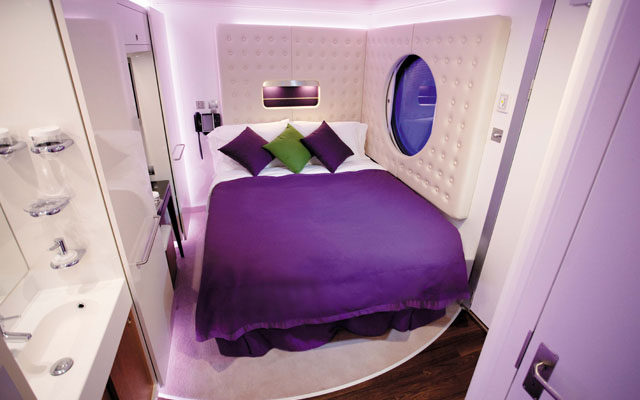
Norwegian Epic was the first ship to introduce solo staterooms, like the Studio, pictured

This announcement comes in response to a recent surge in the popularity of solo travel within the tourism industry, NCL had also seen an increase in guests booking accommodations as a single occupant in non-studio staterooms.

“We strive to provide our guests with diverse offerings to create their dream vacation,” said David J. Herrera, president of NCL. “Since we first launched our solo staterooms in 2010 with Norwegian Epic, they have been quite popular with single travellers. After realising the growing demand of individuals looking to travel on their own, we have now expanded single occupancy staterooms across our fleet.”

Guests who stay in the new solo stateroom categories will also have access to the key card entry-only Studio Lounge, available on select ships, which features a dedicated space to relax, a bar equipped with beer and wine, and a variety of snacks served daily. In addition to their own lounge, solo cruisers can enjoy activities scheduled for single travellers to mix and mingle. With the capacity of solo stateroom categories expanding from nine ships to the full 19-ship fleet, single cruisers have more opportunities to visit destinations such as Asia, Africa, Australia and New Zealand on vessels which historically have not offered this.

IHG brings Vignette Collection to Indonesia

0

IHG Hotels & Resorts has partnered with MMS Land to debut the first Vignette Collection hotel in Indonesia.

Rumah Luwih Bali’s 74 rooms and suites will join the IHG system later this year, before full converting to a Vignette Collection property in 2024 following an extensive refurbishment.

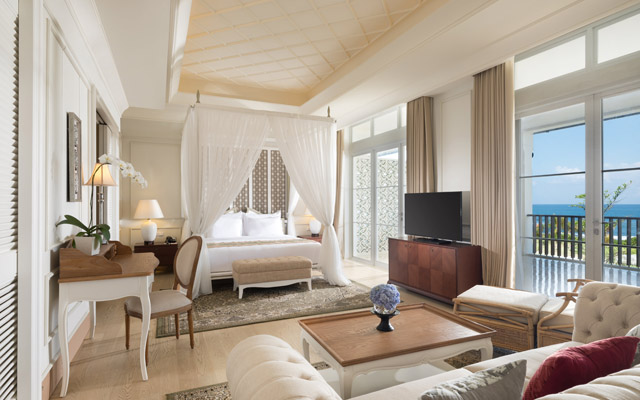
Rumah Luwih Bali will be refurbished and converted to a Vignette Collection property in 2024

Nestled amid lush greenery with views of Mount Agung and the ocean, Rumah Luwih Bali is a classically colonial-style Indonesian mansion located within an hour’s drive of the I Gusti Ngurah Rai International Airport. Facilities include an all-day dining restaurant, swimming pool, meeting rooms, fitness centre and spa.

Nearby leisure options comprise diving, snorkelling, sunrise walks, as well as eco-tourism activities like white water rafting, waterfalls and surfing. The Tirta Gangga, Besakih and the Water Palace temples are also accessible from the property.

“IHG Hotels & Resorts is expanding quickly across Indonesia with 24 open hotels and 15 hotels in the pipeline. As we grow across wonderful destinations in Indonesia, Bali continues to be an important market and tourism hub for international and domestic travellers,” said Chris Anklin, senior director, development, South-east Asia and Korea, IHG Hotels & Resorts.

“We already have a strong luxury and lifestyle footprint in Bali… we are introducing more brands, and together with MMS Land, we will debut the Vignette Collection brand along Bali’s East Coast.”

MMS Land’s CEO Andre Chandra Biantoro added: “Rumah Luwih is a heritage hotel acquired by MMS Land in April 2023, and now brings its distinct character and identity to Vignette Collection.”

Expedia Group strengthens its B2B portfolio across Asia-Pacific

0

Expedia Group announced signings with new travel partners during its inaugural Explore 23: Connect Asia conference, further bolstering its expansive B2B portfolio across the Asia-Pacific region.

It will help these new partners’ businesses grow using its technology solutions – White Label Template, Rapid API, and Optimized Distribution. These technologies are driving extensive traveller demand into the region by enabling partners to tap into a global travel market, while retaining full control of their operations.

Expedia Group is focused on helping partners find new demand and control their wholesale distribution across Asia-Pacific

The White Label Template, Rapid API, and Optimized Distribution solutions are designed for businesses to leverage Expedia Group’s investment in industry-leading technology and remain at the forefront of travel.

“We are intensifying our focus on helping partners find new demand and controlling their wholesale distribution across Asia-Pacific and beyond. Our industry-leading technology will have a positive impact by delivering valuable demand to our partners and creating amazing travel memories to people that visit this incredible region. Our technology solutions power major local airlines and hotels, and manage wholesale distribution for our hotel partners,” said Greg Schulze, senior vice president, strategic partners, Expedia Group.

“Through these partnerships, we foster a sense of collaboration rooted in a shared goal of enriching the travel experience.”

Expedia Group’s White Label Template is a turnkey solution that allows partners to integrate Expedia Group’s extensive selection of hotels and other travel products into their own websites or apps, creating a one-stop shop for their customers. The solution provides a multi-product travel website, seamless loyalty integration and enhanced marketing capabilities to drive deeper customer engagement and grow revenue. Newest partners include Jetstar Airways, Philippine Airlines, and Mastercard.

The group’s Rapid API technology enables travel companies of any size to build superior end-to-end booking experiences by giving companies access to industry-leading support and Expedia Group’s comprehensive lodging supply, including competitive rates and availability from more than 700,000 properties with 35 different property types in over 25,000 destinations worldwide. The API solution also offers a great selection of last-minute availability and package rates. Gmarket (South Korea), and Joy Travel (Guangzhou, China) have signed on as new partners for Rapid API.

Developed in collaboration with hotels, Expedia Group’s Optimized Distribution technology offers hotels a single gateway solution that provides a consistent and reliable shopping experience for travellers, helping ensure an accurate display of hotel descriptions, room rates, and fees through known and trusted third-party travel providers. Having tripled the number of participating hotel chains, the most recent partners include Dusit Hotels & Resorts, and COMO Hotels and Resorts.

In addition, Vietnam Airlines recently expanded its relationship with Expedia Group at a global scale to enhance traveller experiences and increase visibility for Vietnam’s national carrier.

Majestic falls and more

0

Paddling on a wooden canoe upstream against the swiftly flowing river. Steering clear of sections with too many boulders and rocks. Lifting the boat where water is too shallow. Manoeuvring the small, narrow boat through 14 river rapids downstream, also known as shooting the rapids.

The unmatched thrill and euphoria from at least two hours of canoeing over a 5km stretch of water in reaching Pagsanjan Falls and the downstream return trip from it is what makes Pagsanjan Falls unlike any other.

Pagsanjan Falls, Philippines

The waterfalls cascade 91m in three tiers from the mountains, which can be seen in between lush landscape and towering cliffs accessible only by dugout canoe – it was the stellar attraction of the province of Laguna before Covid-19 hit.

The Department of Tourism (DoT) has committed to bring the lustre back to Pagsanjan Falls , including the protection of the Pagsanjan Gorge National Park (PGNP) where the Pagsanjan waterfalls can be found, straddling the town of Pagsanjan, Cavinti and Lumban.

Tourism secretary Christina Garcia Frasco said that through the DoT’s infrastructure and tourism arm, Tourism Infrastructure and Enterprise Zone Authority, the old Pagsanjan Resort will be revived, more boats will be donated to boatmen, and a tourist rest area will be built in the neighbouring town of Bay.

The mayors of Pagsanjan, Cavinti and Lumban chimed in with a tripartite agreement in June to unite public and private sector stakeholders to reinvigorate tourism in PGNP, a protected area covering about 152 hectares around a series of gorges on the Pagsanjan River leading to the waterfalls.

Likewise, PATA Philippines Chapter initiated a fund-raising for boat ride tours and boatmen that masterfully and skillfully paddle the canoe towards the falls and for the schooling of the boatmen’s children.

Festival celebrated in San Pablo City, Laguna

Indeed, without these 2,000 plus, there would be no shooting the rapids, no tourism. “This is an opportunity for us to work together to support the life not just of the boatmen and their families, but make it a green and sustainable community,” said Maria Paz Alberto, PATA Philippines chair.

With its proximity to metro Manila, Pagsanjan can become a tourist magnet again particularly for South Koreans, but international marketing exposure is needed.

“Pangsanjan is definitely a must visit not only for foreign tourists but Filipinos as well. The younger generation does not even know about this beautiful tourist area. Many foreigners from India, South Korea and Japan do visit, but hopefully we can promote this destination in international shows (more),” she said.

Alberto also noted that Pagsanjan “is now evolving, not only for adventures but also getting to be a culinary destination plus a great place for buying Filipino fabrics and even ready-made Filipino outfits”.

Marlene Insigne, general manager of Southeast Travel Corp is optimistic about Pagsanjan’s revival. She said: “Being one of the Philippines’ pioneer tourist destination, Pagsanjan has always been attractive to foreign tourists regardless of nationality. Pagsanjan is a must in their itineraries… (and) the kind of adventure experience the tourists are looking for.”

She added that the destination is on the right track with the three town mayors working closely with the DoT and tour operators to include Pagsanjan in their Philippine tour programmes. With a greater demand, it will lead to the development of new accommodation, tourism activities and infrastructure which the destination desperately needs.

While they may be on the right track, stakeholders should not overlook the basic ingredients of marketing and promotions by making destination information and images readily available for media and agency use.

The big customer shuffle

0

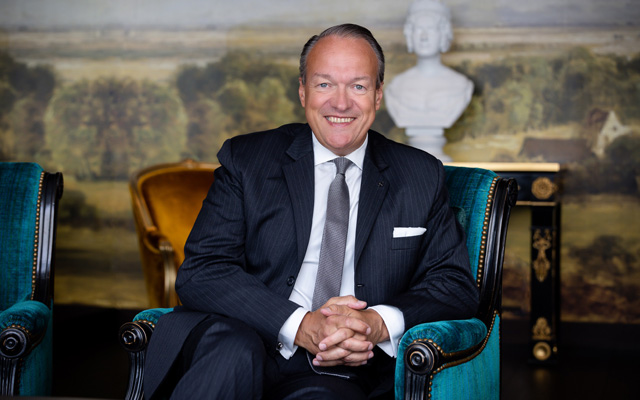
Kempinski’s Asia-Pacific presence has so far been most prominent in China (21 in operation), but in a short time you have opened one in Bali and just signed on two more – one in Ubud and another in Lombok – both opening in 2027. What led to the Indonesia spurt, and where else in South-east Asia do you have eyes on?
We have to look at profitable growth first and foremost, then ideally, with one partner who will give us a family with many ‘children’ (properties). We are a small company with 81 hotels, with something like 31 in the pipeline – that is the fastest growth in the company’s history. We signed over 20 deals in the last 2.5 years.

We have to be very selective.

Our Indonesian properties are with one partner: the Katuari family (which runs real estate firm Panorama Indah Dewata). They are a fantastic owner who built us a beautiful hotel in Nusa Dua – The Apurva Kempinski Bali. This property was where the G20 was hosted last year, and it earned us extensive publicity.

The same owner then looked at Lombok, where a large integrated resort with several hotels has been planned; Kempinski will manage one or two of them and be the anchor project. Following that, a discussion came up about Ubud, which has vast opportunities for hotel development.

There are only a handful of hotel operators in Bali that have a property on the beach and also in Ubud. I think hotel operators today have to give guests a necklace of different destinations.

Now, to your other question, where we want to be in South-east Asia: we have a project (8 Conlay Kempinski Hotel) in Kuala Lumpur (Malaysia), which is part of a mixed-used development just opposite of Pavilion; and we signed one in Khao Yai (Thailand), which is part of a massive integrated resort that will also have a Kimpton, a golf course, and an airstrip.

We are looking at what else can be put on in Thailand. We want to be on the beach side, joining our two absolute flagship hotels in Bangkok which are doing very well. Siam Kempinski, which has a strong retail component, is doing very well with the Middle Eastern and business markets. The Middle Easterners buy suites, which has a big impact on average rates. Our other hotel, Sindhorn Kempinski, is very different. It has over 4,000m² of wellness space and offers a lot of tranquillity.

I would like us to also go into Vietnam, where we could do one in Ho Chi Minh City or Hanoi plus another one along the coast; Manila is important for us too.

We had a project in Yangon, but that was stopped because of the crisis.

(Also), Hong Kong and Macau are good too and would be our logical next steps – but they are difficult to enter.

How has Kempinski’s top outbound market mix changed?
China was traditionally our strongest outbound market, and I’m always super positive about China. There are 150 million outbound travellers pre-Covid, and only 10 per cent of the population hold a passport, so there is room to grow. This pond is big and will remain big. We should not worry about short-term issues, like insufficient flights and visa problems.

What surprised me was the strength of the US outbound market. We have no hotels in the US, but we are doing a lot of activities in the US with our partners like AMEX FHR (American Express Fine Hotels+Resorts). Today, the US is our strongest market. It is also a market that buys suites, which is different from the European market which traditionally upgrades to a club floor or harbour view.

India’s outbound market is also doing extremely well.

The future will be about these markets, but we must not forget South-east Asia and South Korea. The travel spend in both regions is really high. There are Singaporeans taking up beautiful hotels in the Alps for destination weddings. We need to do better in these markets.

We did a news piece for TTGmice recently on where Asian corporate events are heading to, and found that Asian destinations are favoured now due to high travel costs and careful budgets. Are your MICE-friendly properties in Asia benefitting from more Asian bookings?
This depends on the destination. Here in Singapore, for example, the glass is always full. The way the Singapore Tourism Board is handling MICE development is too good to be true, but this is not the case in some other Asian destinations.

In China, we have a lot of hotels with large event spaces – lavish ballrooms, multiple breakout rooms, and so on. Many of them were used for large government functions, and this segment has gone down.

MICE is the most profitable segment for hotels because we get business on the books one or two years in advance; we can secure a deposit ahead of time, and the customer acquisition cost is relatively low, with one person booking multiple room nights, coffee breaks, three meals, spa, airport transfers, etc.

We love the MICE segment. However, in an environment with geopolitical risks, recession risks, and interest rate hikes, MICE is something that is moving very slowly as business leaders are just nervous about spending. So, we have to be more active and creative, and do more of other things (events), like pop-up restaurants, to use our real estate (spaces in the hotel) in a different way.

Looking at how expensive travel has become, how do you expect business to be in the coming months and next year?
The rate hikes in the world this summer are enormous, and they are all driven by leisure travel. It begs this question: is this sustainable?

Repeat business is the most profitable business in the world. You look at the great European resorts as an example – they are not so strong on yielding, but they have sometimes up to 70 per cent repeat business. When you have so much repeat business, you won’t need to spend a lot on customer acquisition.

The risk of yielding too aggressively – like squeezing blood out of stone – is losing the customer in the long term. So, we, the hotel sector, have to be careful and not overdo it.

That said, I am quite optimistic about the way forward. I think that corporate, leisure and big events will come back by 2024, and it is just a question of when.

There is one interesting thing that is happening with leisure travel today. We see customers go into the Adlon (Hotel Adlon Kempinski Berlin), but they fly with a budget airline. People are wanting to splurge on their hotel stay. We also see tech entrepreneurs from Silicon Valley, who fly only first class around the world, check into Motel One because they just need a good breakfast and Wi-Fi.

When I am in Berlin, I sometimes fly EasyJet to Geneva because the airline has a good hub there. This is different from the old days when businessmen only flew Lufthansa.

So, I think all the drawers where the travel industry put people in the past are shuffled. The world is changing and hotels need to do better in understanding consumers.

You brought up an interesting point about shuffled customer types. Does it make it harder for hotel companies to track and build loyalty if people are booking differently ­– booking out of character, preferring the most practical option, or making the rare splurge?
I think loyalty is still a valuable asset for hotels, and there are many ways for hotels to run loyalty programmes.

A small boutique hotel operator may not need a loyalty programme, since people who love it will just keep coming back. Loyalty, in this case, is driven a lot by emotions.

In the case of the earlier example I gave – long-standing European hotels with a high repeat customer base – loyalty is driven by tradition. Families over generations continue to stay there, and book for the following year upon check-out.

You also have the really big players, the Marriotts of the world, with a massive loyalty programme. Marriott does a great job with Marriott Bonvoy, which has 30-plus brands with some very loyal customers.

Then, you have the mid-sized players like us, that are part of the Global Hotel Alliance (GHA). Kempinski holds the largest share of the GHA, and have great partners like Pan Pacific Hotels Group and Minor Hotels. GHA has over 40 brands and roughly 20 million members.

And as the largest shareholder of GHA, Kempinski is always looking for ways to add value to the programme. From just being GHA Discovery, the programme was rebranded (in December 2021) to reflect the hotel brand. So, for some customers it could be Kempinski Discovery, and for others Pan Pacific Discovery. The second thing we did was to transform the experience-based programme into a currency-based one, by offering guests a chance to earn Discovery $ when they stay with a GHA property.

A loyalty programme that facilitates cross-brand access gives people opportunities to stay with different brands and hotel types – and this resonates with the trend of shuffled customer types.

The shuffled customer segments must make marketing and communications difficult. Is Kempinski using Artificial Intelligence (AI) to identify customer segments faster and create more precise messages and products?
I think that will come. We have not started on AI yet, but a few years ago we bought a small tech company called Consiglio that does work with GHA. We are talking to them about the use of AI, perhaps in internal communications for a start.

With technology adoption, (however), we have to tailor our approach with the destinations we operate in. Asia is so far ahead with technology use.

I also think hotels have to drive digitalisation on their own and at their level. Each hotel is different, and has different chunks of customer segments. Products, therefore, have to be localised.


Big Indian destination wedding bells toll strongly

0

The Indian destination wedding market is growing exponentially, spreading joy to both domestic destinations as well as overseas ones.

Speaking at the PATA Travel Mart 2023 Forum, Rajeev Jain, founder and managing director, Rashi Entertainment India, noted that the market is growing at a rate of 30 per cent and had generated approximately US$40 billion in the period between October and December 2022, based on a report released by ICICI Bank.

Hotels in Asia are hoping to draw Indian couples by offering attractive wedding packages

“This highlights the immense scale and significance of the sector,” said Jain.

Other research conducted by Ernst & Young and Deloitte pegged the global wedding industry at US$400 billion, with India alone accounting for a significant US$50 billion share.

Jain said: “Indian weddings are not just about single-room bookings; they represent a colossal affair, often involving bookings for 500 rooms per night. Despite soaring prices for hotels, artists, and other essentials, Indians are continuing to invest in their dream weddings – 25 per cent of budgets are directed to venues, hotels, catering, and logistics.”

In India, Jaipur, Udaipur, Jodhpur, Agra, Delhi, Goa, Mussoorie, and Mahabalipuram are a hit with couples looking to celebrate their union in a big way. However, escalating hotel rates, especially in popular wedding destinations, are forcing Indian couples to explore international alternatives for their nuptials.

“Countries like Bahrain and Oman are emerging as competitive alternatives due to their relatively lower costs for hosting high-end Indian weddings. The UAE, Turkey, and Bali are also (attracting attention),” said Jain.

Thailand, however, appears to be losing steam among Indian lovebirds, observed Jain, who shared that the destination is now hosting just 375 to 400 weddings compared to 1,000 weddings annually before.

Malaysia, no stranger to lavish Indian destination weddings, is looking to take a bigger slice of the pie.

Musa Yusof, deputy director general, promotion, Tourism Malaysia, told TTG Asia: “Indian weddings is one of the niche markets we are focused on. Our priority has been on making Malaysian wedding products ready for the Indians. We participate in wedding shows in India and work closely with Indian wedding planners.”

Musa emphasised that Malaysia is an increasingly exciting option for Indian couples, considering the expanded range of hotels ready for such celebrations.

“There are many hotels in Malaysia that are keen to tap the potential vested in the Indian destination wedding market,” he added.

Some of the destinations Tourism Malaysia is eager to highlight for Indian destination weddings include Kuala Lumpur, Port Dickson, Sabah, Langkawi and Selangor.

Japan expands on wellness offerings

0

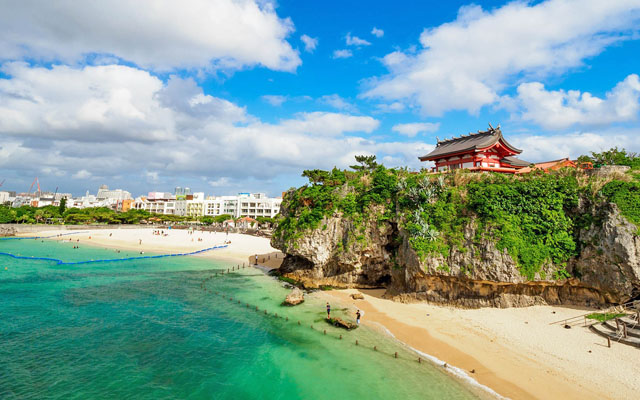
Japan is strengthening its position as a wellness destination thanks to rapid growth in products and services based on the country’s hot springs, nutrient-rich cuisine, diverse nature and healthy living.

Agents, tour operators and other industry professionals are now expecting a significant increase in arrivals attracted by these offerings, particularly from the Asia-Pacific region, as travellers seek destinations that will support their physical and mental health.

Japan is poised to take advantage of the growth in well-being tourism by strengthening its position as a wellness destination

“Wellness has joined shopping and sightseeing as a priority activity” among travellers from the Asia-Pacific, noted an analysis of the Global and Asia Wellness Tourism Sector. It continued with a “pent-up demand for wellness tourism could soar as Chinese and other Asians seek destinations that can help strengthen their well-being” post-lockdown.

Japan is poised to take advantage of the growth in well-being tourism. Valued at US$303.6 billion, Japan’s wellness economy is the second-largest in the Asia-Pacific region and the third-largest in the world as of August 2023, according to non-profit organisation Global Wellness Institute.

“Well-being has long been part of Japan’s spiritual culture, from its forest bathing experiences immersed in nature to its centuries of enjoying onsen hot springs for both therapeutic and relaxation purposes,” said the Japan National Tourism Organization (JNTO), adding that new offerings continue to be launched.

Zen retreat Zenbo Seinei, which opened in April 2022, offers a dedicated space for meditation and yoga on Awaji Island located in the Seto Inland Sea. Day-trippers and overnight guests can also enjoy vegan cuisine using seasonal, local produce from the island, as well as experiences in the tea ceremony, traditional calligraphy and other contemplative activities.

In Toyama Prefecture, River Retreat Garaku provides Art Walk, a new activity that leads guests through lush mountain and river scenery along the Jinzu Gorge using a series of Japanese contemporary art works.

Japan is also attracting international brands focusing on wellness.

This April saw the opening of Bulgari Hotel Tokyo, only the eighth hotel of the luxury brand. In addition to a 1,000m² spa and a 25m indoor pool, guests are offered fine dining-inspired Japanese traditional healthy eating, including superfoods such as miso.

Vietnam’s free visa extension a boon for inbound recovery

0

Tourism players welcome Vietnam’s move to extend its free visa-on-arrival from 15 to 45 days for select countries, while extending e-visas from 30 to 90 days and allowing multiple entries.

The new rules took effect on August 15, with the increase in visa-free travel being an attempt to lure more visitors from 13 countries, including Japan, South Korea, the UK and Germany.

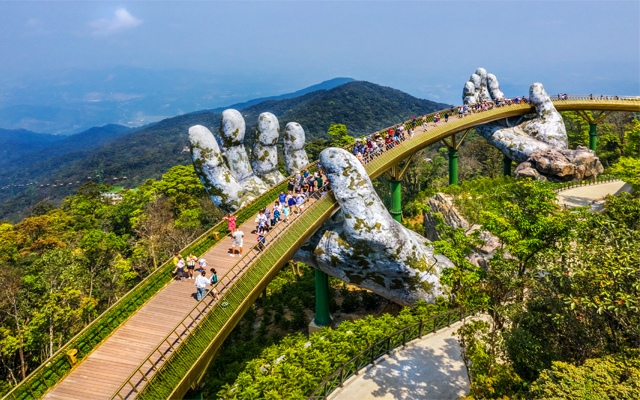
Vietnam hopes to attract more foreign visitors by extending its free visa-on-arrival from 15 to 45 days; Golden Bridge in Vietnam, pictured

Linh Le, principal and co-founder of Luxperia, noted an uptick in travellers extending the duration of their visit to an average of three-week itineraries. “For trips in September and beyond, I expect this trend will increase to higher average stays for Vietnam,” he added.

Pham Ha, CEO and founder of LuxGroup, which focuses mainly on middle- and high-end customers in Europe, including retirees with long-term travel needs, expects to see revenue increase by at least 30 per cent from September.

“Normally, our customers stay in Vietnam from 10 days to two weeks,” he said, adding they can now spend more time experiencing in-depth Vietnamese culture and exploring the landscapes.

He believes the visa extension will open the door for a wide range of tourists, especially digital nomads and long-term visitors.

“Since Covid-19, we can see the rapid development and importance of remote working. Extended visa periods offer more flexibility for those who want to stay long-term,” he said. “In addition, Vietnam offers thriving co-working spaces, affordable living costs and vibrant cities, which makes it an attractive destination for digital nomad tourists.”

Guilhem Cavaille, general manager at Diethelm Travel Vietnam, said the best aspect of the visa changes is that visitors can now exit the country and immediately return. Previously, they had to wait one month between two visas being issued.

“Multi-country travel is a rising trend and this facilitates things a lot,” he said. “When clients combine Vietnam and Cambodia or Vietnam and Laos, their international arrival and departure are often from Vietnam, therefore, they frequently need two entries into the country.”