TTG Asia
Asia/Singapore Wednesday, 24th December 2025
Page 383

Bamboo Airways suspends international services

0

Troubled Vietnamese carrier, Bamboo Airways, announced on October 28 its decision to suspend services on 10 international routes as it undergoes restructuring.

The move affects connections between Hanoi and Incheon, Tokyo Narita, Taipei, Bangkok and Frankfurt; and Ho Chi Minh City and Frankfurt, Singapore, Sydney and Melbourne. Suspensions will come into effect starting from October 29.

Bamboo Airways trims down international operations as it undergoes restructuring

This follows Bamboo Airways’ earlier service suspension of Hanoi-London Gatwick flights on October 18.

In a Facebook post, the airline said domestic services will remain for major hubs, such as Hanoi, Ho Chi Minh City, Danang.

The same post informed affected passengers that customer service manpower has been “strengthened” to “support requests and provide assistance as soon as possible”, and forms of assistance include flight rescheduling or full fare refunds.

Bamboo Airways has seen major leadership changes since chairman Trinh Van Quyet was arrested in March 2022 for stock market manipulation and fraud. Former leader of Pacific Airlines and Air Mekong Luong Hoai Nam was appointed new CEO last week.

Fast-paced recovery

0

Thailand welcomed 11.4 million foreign arrivals in the first half of 2023 making Thailand the most popular tourism destination in South-east Asia this year. This must be cause for celebration in the TAT team. What led to this strong recovery even in the absence of the massive Chinese market?
Thailand’s tourism has been seeing a strong recovery since the pandemic subsided and travel resumed. This year, the figure proves to be even more promising. From January 1 to September 3, Thailand welcomed 17,808,866 international visitors, who generated over 735 billion baht (US$20.2 billion) for the country.

The top five international visitors were from Malaysia, China, South Korea, India, and Russia, in descending order.

This positive turnout comes from various factors, such as the return of potential markets like Russia, the Middle East, East Asia, and South-east Asia, and the rise in cross-border travel. Other factors include the increased number of flights and seating capacity to Thailand, as well as the recovery of the domestic market.

Would this powerful recovery serve as a good reminder to Thai tourism players to diversify their source markets, or would marketing focus return to China now that Chinese group outbound travel is allowed once more?
We have to acknowledge that before the pandemic, Chinese travellers amounted for one-fourth of the total number of arrivals, with over 11 million Chinese travellers generating over 500 billion baht in tourism revenue.

However, the pandemic has taught us not to rely on a single source market. Thus, we are diversifying our target markets by also focusing on other main markets, like South-east Asia, India and Europe, while tapping into emerging markets like the Middle East, which visits for medical tourism, and Saudi Arabia, which is new for Thailand.

We are also focusing on segments that have a higher spending power and longer length of stay, as well as niches like health and wellness, sports, luxury, and responsible tourism.

We have another two more months to go before the year comes to an end. Will Thailand achieve its arrivals target?
We have already crossed the 17-million mark in early September. TAT is forecasting continuous growth, especially with rising demand from the Chinese and Middle Eastern markets. With the high season approaching, we are hopeful that we will meet our target of 25 to 30 million international arrivals.

TAT has been active in engaging the young travel demographic through fun activations like the Write Your Own Amazing New Chapters event involving trendsetting influencers, the use of the online battle game Home Sweet Home to inspire interest in Thailand, and Amazing Thailand NFTs. Why the focus on the young travel demographic? How valuable is this demographic for Thailand?
After the pandemic, the younger generation, especially the millennials, was one of the first groups to travel aboard. According to our survey, these are usually FIT travellers and many are first-timers with the potential of becoming repeat visitors to Thailand.

In addition, the younger generation records a higher spending per trip of around 48,000 to 50,000 baht – higher than average tourists.

They seek personal travel experiences that are refreshing and uniquely their own. They are also open to trying new experiences and being immersed in local culture. They are considered to be tech-savvy and tend to share their experiences on social media with their family and friends.

Part of the Visit Thailand Year 2023 campaign is the emphasis on sustainable and responsible tourism with efforts involving local communities as much as possible. What achievements has TAT made in this aspect?
For many years, we have been conducting our campaigns and events under the 7 Greens concept. This has been initiated with the determination and eagerness of TAT as the main agency overseeing the tourism industry to take responsibility and to persuade all parties to join hands in creating a new environmentally-friendly tourism chapter in the future.

The 7 Greens concept comprises Green Heart, Green Activity, Green Community, Green Logistics, Green Attraction, Green Service, and Green Plus.

In line with the Royal Thai Government, TAT emphasises on the distribution of tourism income to the local people and the extension of tourism benefits to more communities. Thus, the BCG model (Bio-Circular-Green Economy Model, an economic model for inclusive and sustainable growth) will be implemented in various tourism segments.

We will focus on developing Gastronomy first, followed by Integrated Digital Tourism and Responsible Tourism to drive sustainability through organic tourism. For the latter, we have collaborated with the Thai Organic Consumer Association to create a farmer’s network and connect farmers with consumers, thus reducing carbon footprint and expanding the benefits of a circular economy. We have piloted this project in several destinations in Thailand now.

In Phuket, for example, we work with restaurants and hotels that use local ingredients and support local farmers. Such responsible establishments include Torry’s Ice Cream, Grand Mercure Phuket Patong, and Trisara.

To rebuild the tourism industry, shaping supply is just as important as driving demand. TAT knows that sustainability plays a crucial role in tourism performance, and is positioning Thailand as a high-value and sustainable destination that offers meaningful experiences to tourists.

We have started developing the Sustainable Tourism Goals (STGs) concept from the 17 goals of the United Nations Development Programme’s Sustainable Development Goals (SDGs). TAT will actively implement the STGs in line with the SDGs. This is a national drive that encompasses the entire Thai tourism industry.

A Sustainable Tourism Acceleration Rating (STAR) system will also certify tourist businesses in the area of tourism sustainability. Businesses that are able to comply with several goals will attain a corresponding number of stars.

Finally, what is next after the Visit Thailand Year 2023 campaign?
The Visit Thailand Year 2023: Amazing New Chapters focuses on offering meaningful experiences for travellers to engage with local people, culture, and nature. This dynamic concept is in the right direction for protecting our country’s vast natural and scenic beauty, and instigating a range of environmental initiatives.

Next year, the focus is on Meaningful Relationship. We want international travellers to engage in meaningful local connections. When travellers form a relationship with the people and the place they visit, they will stay longer, spend more, and return again and again. We want to invite tourists to have a good experience – taste, create, play, absorb, and relax – while forming a meaningful relationship with Thailand. We hope they will discover lifelong friends, form cherished memories, and enjoy their time.

There are many ways to present meaningful experience-based tourism.

In terms of taste, travellers can sample authentic local flavours and celebrate the journey of each ingredient, from farm to feast.

In terms of create, they can take home a beautiful handmade craft and leave local creators filled with pride as well as profit.

In terms of play, they can experience an adrenaline rush through an adventure activity and contribute to conservation at the same time.

In terms of absorb, they can soak up Thailand’s beautiful nature and rich culture, and leave only their footprint behind.

To relax, they can disconnect from the busy world and rediscover themselves, the community and planet Earth.


Japan’s tourism expo kicks off in Osaka

0

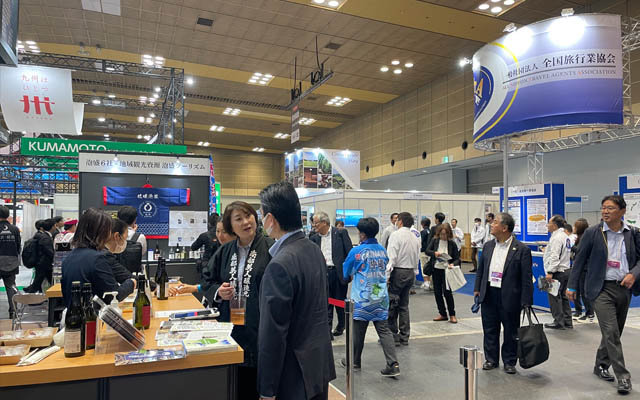
Tourism Expo Japan 2023, Japan’s showcase for domestic and international travel, commenced in Osaka yesterday (October 26) with a series of high-level speeches and seminars discussing the future of travel.

Delegations from some 20 countries and representatives from leading global tourism organisations joined Japanese ministers to consider how to “rethink tourism” to make it more socially and environmentally sustainable in the post-lockdown era, ahead of the opening of the event to the public over October 28 to 29.

Tourism Expo Japan 2023 is expected to attract 150,000 visitors during the four-day event (Photo: Kathryn Wortley)

Organised by the Japan National Tourism Organization (JNTO), Japan Travel and Tourism Association and the Japan Association of Travel Agents, with special cooperation from All Nippon Travel Agents Association, the event will focus on “travel aspects that support a bright future”, according to the secretariat. These include adventure tourism, the digitalisation of travel, workations, the UN’s Sustainable Development Goals and engagement with Gen Z.

Welcoming everyone, JNTO president Atsumi Gamo said the event would offer attendees an experience “filled with discovery” and “present the future of travel”, which Japan hopes will contribute to sustainable regional development.

With Osaka as host, for the first time in four years, the event is also designed to put a spotlight on developments related to Expo 2025, which will be held in a nearby venue from April 13 to October 15, 2025. Seminars and performances at Tourism Expo Japan will showcase Expo 2025 while a special zone manned by 11 companies and organisations, which will be dedicated to travel in Osaka and the surrounding Kansai region.

Hirofumi Yoshimura, governor of Osaka Prefecture, said the event will “generate excitement” for not just those attending Expo 2025 but also for visiting nearby areas, either beforehand or afterwards.

Tourism Expo Japan is expected to attract 150,000 visitors over the four days, with attendance by 1,275 companies and organisations as well as representatives from 70 countries and regions.

Weakened rupiah dampens Indonesian players’ yield

0

Bookings for the coming Christmas and New Year travel season may be strong for Indonesian outbound travel specialists, but the devaluation of the rupiah against the US dollar may topple hopes of a good yield.

The rupiah stood at 15,992 to one US dollar on October 26, compared against 15,856 rupiah per US dollar a week ago.

Jeffry: we have reserves but it is not enough to cover the currency difference

Pauline Suharno, president of the Association of the Indonesian Travel Agents (ASTINDO) and managing director of Elok Tour, told TTG Asia that tour packages presented and sold at the recent ASTINDO travel fair in August were priced in rupiah.

“Depending on how tour companies manage their finances, this currency drop could have a significant impact,” said Pauline, explaining that some agencies might have chosen to collect payment from customers first and pay their overseas ground handlers only at deadline.

Larger companies that are used to dealing with big groups may be able to escape unscathed from the currency woe, according to Pauline, as bookings are usually made far in advance and contracts tend to contain a clause relating to rate adjustments. Companies specialising in both inbound and outbound may also be able to dampen impact since they could “balance revenue”.

Jeffry Darjanto, director of Aviatour, said the currency devaluation was worrying since outbound travel performance has yet to return to pre-Covid levels even though travel interest is high.

For travellers who had paid only a deposit for their tours during the recent travel fairs, Aviatour could adjust final tour fees in response to currency changes and higher airline fuel surcharges. However, fare changes are not possible with customers who have paid in full for trips ahead.

“We have reserves (in anticipation of rate fluctuation) but it is not enough to cover the currency difference,” Jeffry said, adding that his team needs to be “strategic” about fees management so as not to “lose too much (money) and clients do not cancel their trips”.

“If the (adjusted) price is too high, clients may cancel their booking. If this happens, not only will we lose the business but clients will also lose the trip they have been waiting for,” he said.

As the rupiah has also devalued against the Japanese yen, worries are creasing the brows of Rudy Techrisna, managing director of Multi Holiday Travel in Indonesia.

“When I created my tour product (to Japan) about four months ago, the exchange rate was 102 rupiah to one yen – now it is almost 107. We will bear the losses because it is not appropriate to increase the price for clients who have confirmed their bookings,” said Rudy.

He added that his company would usually hedge prices with the bank, but this process required invoices from clients. Unfortunately, invoices for those affected bookings were only issued recently even though confirmation was made a few months ago.

Maldives takes South-east Asian marketing focus

0

Opportunities to grow visitation from South-east Asian markets are richer now that the Maldives has better air connectivity and a wider range of products, say Maldives Marketing and PR Corporation/Visit Maldives.

The destination marketer recently led a road show to Singapore, Malaysia and Thailand to engage with online travel companies and agents.

Thoyyib: more people know that we are also a family destination

Thoyyib Mohamed, CEO of the organisation, said these three markets are top contributors among the South-east Asian countries for the Maldives’ tourist arrivals, with accessibility made possible by Singapore Airlines, AirAsia and Cathay Pacific.

Traffic from Malaysia is set to grow on the back of new daily flights between Kuala Lumpur and Male operated by Batik Air.

Thoyyib shared that arrivals from South-east Asia in the first eight months of 2023 reached 39,304, up 40 per cent from 2022. Thailand contributed the most arrivals during this period, with 12,000 arrivals. This is followed by Malaysia at 8,900 and Singapore at 7,300.

Speaking on the destination’s expanding points of appeal, Thoyyib said the Maldives is no longer just for honeymooners.

“Lately, through advertising and with (increasing) visibility, more people know that we are also a family destination. Almost all our resorts are family friendly. There’s so much for families to do, even on the local islands.”

The introduction of liveaboard boats and guest houses has also helped to attract different traveller segments.

He explained: “Liveaboard boats give a very different experience, where you can have the whole (vessel) for your group, travelling from one interesting place to another without having to change mode of transportation. Guest houses, on the other hand, are more affordable, priced between US$100 and US$340 per night.”

Guest houses have good amenities, similar to a two- to four-star hotel, according to Thoyyib. As they are located on local islands, travellers can learn about the local way of life.

“They can go fishing and island-hop with the locals,” he added.

Bhutan lowers tourist levy to draw more international visitors

0

The Himalayan kingdom of Bhutan is actively working to increase international tourist arrivals, aiming to boost the tourism sector while maintaining a strong commitment to environmental conservation.

Bhutan’s director general of Department of Tourism (DoT), Dorji Dhradhul, shared with TTG Asia that Bhutan had, since August, halved its Sustainable Development Fee (SDF) to US$100 per person, per night, and that this new, lower levy will be in effect until September 2027.

Dhradhul: a fantastic opportunity for more people to experience the beauty of our kingdom in the future

Dhradhul stated: “The change was made in recognition of the vital role of the tourism sector in job creation, economic growth, and foreign exchange earnings. The lower SDF presents a fantastic opportunity for more people to experience the beauty of our kingdom in the future, benefitting our citizens and supporting various projects funded by the SDF.”

It is important to note that a portion of the revenue generated from the SDF is allocated to various sustainability initiatives including the conservation of the pristine natural environment, upskilling workers in the tourism industry, reducing the country’s reliance on fossil fuels and electrifying Bhutan’s transportation sector, among other projects.

Abhishek Bajgai, a sales manager at Bhutan Peaceful Tours & Treks, expressed support for the government’s decision to lower the SDF fee from the US$200 imposed when Bhutan reopened its doors to tourists on September 23 last year. He noted that before the Covid-19 pandemic, the SDF was US$65 per person, per night, making the current SDF slightly higher in comparison.

In addition to the SDF reduction, the Bhutanese government has implemented various initiatives to attract more international visitors and achieve the goal of having tourism make a greater contribution to the country’s economy. The DoT is collaborating with travel partners in Bhutan to create diverse itineraries to attract a more varied group of tourists.

Since reopening in September 2022, Bhutan has also made it easier for tourists to access the country by allowing them to independently book all aspects of their journey. In the past, all visitors were required to book their travel to and within Bhutan through an accredited tour operator.

Furthermore, significant investments have been made at the national level to enhance the skills of workers in the tourism and hospitality sectors, re-certify guides and accommodation providers, improve tourism infrastructure, and create new and unique tourism experiences. These efforts collectively aim to enhance Bhutan’s appeal as a tourist destination while preserving its natural beauty and cultural heritage.

Cebu Pacific operates first SAF-powered flight from Japan

0

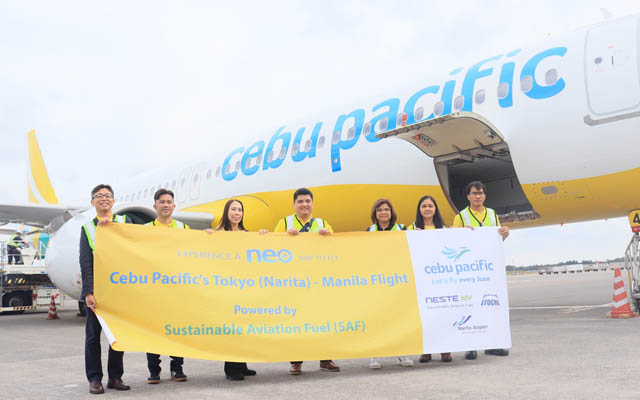
Cebu Pacific (CEB) has become the first Philippine carrier to use sustainable aviation fuel (SAF) for a commercial flight from Japan with its inaugural Narita-Manila SAF flight.

The Philippine carrier’s SAF flight was operated with an Airbus 321neo, using 40 per cent blended SAF produced by Neste Corporation and supplied by Itochu Corporation – a combination resulting in a 44 per cent reduction in carbon emissions per passenger.

Cebu Pacific is the first Philippine carrier to use sustainable aviation fuel to power a commercial flight from Japan

“As we await sufficient SAF supply to meet the demand of the entire aviation industry, this inaugural Narita to Manila SAF flight represents Cebu Pacific’s ongoing efforts toward making air travel more sustainable. Other decarbonisation programs that we have put in place include investing in fuel-efficient NEOs, optimisation of flight plans, and adoption of fuel efficiency best practices to minimise fuel consumption,” said Alexander Lao, president and chief commercial officer, CEB.

“All these are concrete sustainability initiatives that bolster our commitment and support for the aviation industry’s goal of flying net-zero by 2050.”

Itochu’s energy division’s senior officer, Atsushi Onishi, added: “Our collaboration underscores the growing demand for SAF in the Asia-Pacific region and we are ready to meet that need.”

The initiative was also warmly welcomed by Narita International Airport.

Prior to the commercial flight, CEB signed a strategic partnership with Neste to work towards establishing a long-term supply of SAF across the Asia-Pacific. This initiative aligns with the airline’s sustainability goal to gradually integrate SAF into its operations, thereby reducing its carbon emissions footprint and promoting environmental consciousness.

CEB operated its first passenger flight powered by SAF in September 2022 from Singapore to Manila, making it the first low-cost carrier in South-east Asia to incorporate SAF in its commercial operation. The airline aims to integrate blended SAF for its entire commercial network by 2030.

New kids zone at Singapore Zoo

0

The new KidzWorld, also the Home of the Ranger Buddies, has been launched at the Singapore Zoo.

The one-hectare kids zone augments Singapore Zoo’s 50-year heritage of providing children and their families with a living classroom to experience animal encounters and plenty of opportunities for playtime. It builds on the strengths of the park’s previous Rainforest KidzWorld (2009) and Children’s World (1991).

Kids interact with animals at Animal Land at the newly-opened KidzWorld (Photo: Mandai Wildlife Group)

The experiences have been designed to spark and grow love for animals, wildlife and nature, ranging from interactive play, to meeting animals, to a new water maze.

KidzWorld is also Home of the Ranger Buddies, an edutainment programme for children. There is an interactive quest where children can go on physical missions to visit outposts while equipped with smart binoculars and a companion app. There are also three outposts in KidzWorld where children can discover more about animal health, animal care and animal nutrition. Quest missions and outposts will be gradually added in the coming months and will take the Ranger Buddies on adventures in Singapore Zoo and River Wonders.

From now to December 30, Singaporeans can plan their visit with a two-park bundle to Singapore Zoo and River Wonders at S$54 (US$39) for adults and S$38 for children for visits between November 1 and December 30.

Tickets for all visitors will be released at a later date.

For more information, visit KidzWorld.

The Claridges New Delhi appoints new GM

0

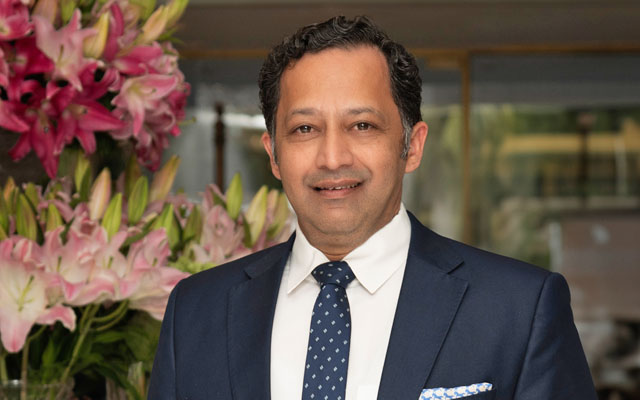
The Claridges New Delhi welcomed Hemendra Singh Kushalgarh as the newly-appointed general manager.

Kushalgarh brings over two decades’ experience and expertise to this role. He also plays a senior role at Claridges Collection, designated as the vice president – operations for the entity.

He was hotel manager at Amanbagh prior to joining The Claridges New Delhi.

Adrian Rudin helms as MD of Dusit’s two Thai properties

0

Dusit International has appointed Adrian Rudin as managing director of its flagship Dusit Thani Bangkok hotel, and Dusit Residences, which will launch in mid-2024 and early 2026, respectively.

The Swiss national brings with him over three decades of experience in leading luxury hotels. He served as general manager of Sindhorn Bangkok Kempinski and vice president of Operations for China and Southeast Asia at Kempinski Hotels before joining Dusit.

In his new role, he will be in charge of shaping the success of both upcoming properties, including securing future MICE business ahead of the hotel’s grand opening next year.