

Accor receives recognition as choice employer for two years running

Accor has once again been named as one of the best companies to work for in Australia having been recognised as a 2024 5-Star Employer of Choice (500+ employees) by HRD Australia for the second consecutive year.
This coveted accolade was achieved through a rigorous two–part selection process, consisting of a detailed submission on Accor’s team offerings and practices, followed by an anonymous employee survey to gauge employee satisfaction across multiple metrics.

Accor operates more than 400 hotels, resorts and apartments across the Pacific region, employing more than 21,500 people.
Commenting on the recognition, Accor Pacific COO PM&E, Adrian Williams, said: “It reinforces that we have a committed and caring team, who are passionate about supporting and developing people, and creating career pathways. Our teams bring diversity, experiences and stories to our culture, which makes Accor a community for all to excel. Our people are integral to our success and growth and I could not be prouder of them.”
Accor has implemented a number of initiatives to attract, retain and develop talent. Example programmes include Accor’s revolutionary Work Your Way initiative, which offers increased flexibility and a range of personalised benefits, to create a fulfilling and inclusive team member experience.
Accor also has a nation-leading Indigenous Careers Program, which has placed more than 2,500 Aboriginal and/or Torres Strait Islander team members into positions since its inception in 2015. Plus, with a growing desire among its Indigenous team members for leadership roles, Accor has facilitated numerous scholarships for tertiary education, leadership programmes, and the appointment of Indigenous hotel general managers.
Furthermore, Accor is steadfast about setting team members on the path to sustainable transformation and recently launched its ‘School For Change’ training programme, which aims to improve individuals’ understanding of the causes of climate change and its impact on biodiversity and communities.
“It’s an exciting time to work in hospitality as the travel industry continues to evolve and expand. What I love most about our industry is that it gives you the chance to learn and grow, which opens doors to the world,” added Williams.
La Vie Hotels & Resorts launches new tower at ADGE Hotels & Residences
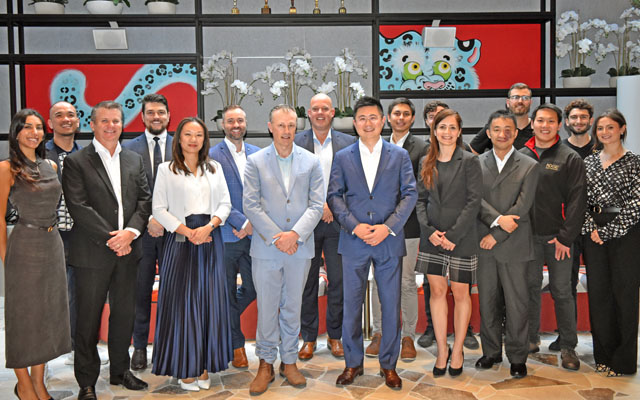
ADGE Hotel & Residences in New South Wales, Australia – managed by La Vie Hotels & Resorts – is launching a second designer hotel tower on the former site of the Cambridge Hotel, adding an additional 149 guestrooms to the property, making 254 rooms in total.
This decision was due to ADGE Hotel & Residences having exceeded occupancy targets since opening last August, regularly selling out during key events.
ADGE Hotel & Residences general manager, Paul Cundy, said: “Adding 149 extra rooms to our inventory means we can better cater to demand surges over busy event periods, which will only add to the colour and life that keeps this hotel buzzing.”
“We understand that today’s travellers want more than just a place to rest and ADGE has been a great example of how we’ve been able to deliver a fun, vibrant and sociable place for locals, interstate and international travellers to stay,” said Jerry Xu, CEO, La Vie Hotels & Resorts.
“Travellers are looking for hotels with personality, flair and a unique point of difference that creates a truly one-of-a-kind stay close to city hubs, and we’re thrilled with what we’ve been able to achieve with ADGE, with the support of our trusted owners.”
Maldives promotes destination at ADEX Ocean Mission 2024
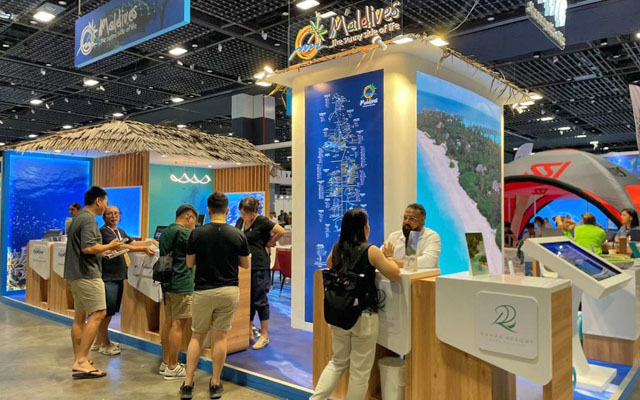
Maldives Marketing & Public Relations Corporation (MMPRC/Visit Maldives) participated at the ADEX Ocean Mission 2024 held in Singapore from April 12 to 14 at the Suntec Singapore Exhibition and Convention Centre.
Along with six industry partners, MMPRC utilised this event to showcase the diving and underwater experiences available in the Maldives at the largest dive fair in the South-east Asia market, as well as to provide the latest destination information to interested visitors and create awareness for the Maldives as a preferred dive destination.
A total of 58,947 visitors dropped by the Visit Maldives booth at the fair – some of the activities included a consumer survey, distribution of informative flash cards about Maldivian marine life, and artworks displaying the different dive locations in the Maldives.
In addition, MMPRC has planned several activities targeting the South-east Asian market, to increase travellers and maintain destination presence. These activities include joint-marketing campaigns with major stakeholders, outdoor advertising campaigns, participation in fairs, hosting webinars, E-Learning programmes and other events.
With a history spanning 26 years, ADEX is the biggest and longest-running dive expo in Asia, bringing together VIPs and speakers from across the globe and provides a platform for various exhibitors such as dive operators, equipment manufacturers, and national tourism boards of countries.
Leading Hotels’ Sustainability Leaders collection sees healthy growth
The Leading Hotels of the World (LHW) has revealed that the Sustainability Leaders collection that launched in October 2023 has since grown by more than 50 per cent.
LHW has more than 400 independent luxury hotels in over 80 countries, and created the Sustainability Leaders collection to recognise Leading Hotels that are committed to preserving the environment and the cherished values and cultural heritage of their destinations.
A Leading Hotel with the Sustainability Leader recognition has been rigorously evaluated and has received at least one, or more, GSTC-accredited certification or certification to a GSTC-recognised standard.
In addition, LHW has partnered with Vireo Srl (GSTC-Accredited Certification Body) as well as Green Globe, Green Key Global, and Travelife (all use a GSTC-recognised standard) to offer its hotels resources and tools to advance their sustainability strategies.
Over the last year, the collection has completed approximately 10K community service hours, and in 2024 alone, Leading Hotels have committed to nearly US$10M investments in renewable energy and waste reduction around the world.
Lauren Alba, vice president, global marketing & communications, LHW commented: “Travellers are placing far more emphasis on companies that value and demonstrate sustainable practices. LHW recognises its role in reshaping the world through responsible travel as we work to seamlessly integrate our three pillars of the Sustainability Leaders program into every stay: Community Champions, Culture Guardians and Environmental Protectors.”
One of the Community Champions is The Datai Langkawi in Malaysia which has projects offering educational classes for locals, reforesting the surrounding woodland and an extensive coral restoration programme. For Environmental Protectors, Constance Halaveli Resort Maldives has invested in Manta Ray awareness for all team members and guests to protect these highly threatened marine creatures; while an example of Cultural Guardians is Royal Palm Beachcomber Luxury in Mauritius, which has an initiative that helps local hand-craft creatives by giving them the opportunity to develop their skills and sell their products to the tourist market.
“LHW’s Sustainability Leaders are committed to being environmental stewards and good global citizens that are dedicated to creating a better world for generations to come,” said Alba.
Developing people power
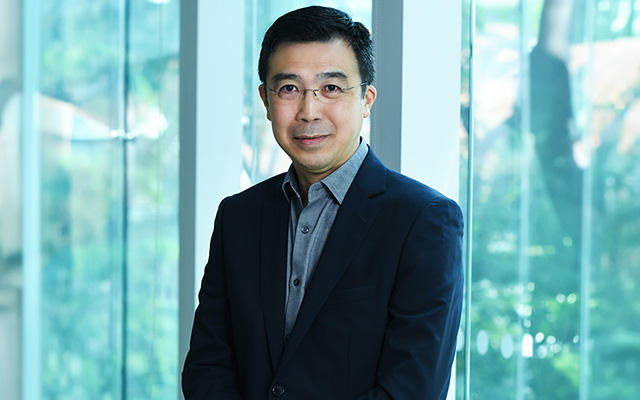
 Most people in Singapore are familiar with NTUC LearningHub. For the benefit of our Asia-Pacific-wide audience, how would you describe the organisation’s raison d’être?
NTUC LearningHub is one of the largest continuing education and training centres in Singapore. It is set up to help adult learners upskill and re-skill, particularly for emerging or in-demand job roles and functions.
Our team at NTUC LearningHub creates the courses and helps adult learners to get the necessary skills or certifications that enable them to do their job better and advance in their career.
Over the years, we have moved in line with the government’s direction for training outcomes. We have starting to move into job placement, as well as to assist with job redesign and provide business transformation advisory.
In order to know what to train, we need to understand how businesses need to transform and how job roles need to be redesigned. Once we figure out what the skill gaps are, we can embark on necessary training.
From job-seekers’ point of view, understanding what jobs are in demand and their own skill gaps will enable them to decide on the certificates they should obtain.
We get support from our sister organisation, NTUC (National Trades Union Congress), and we plug ourselves into NTUC’s e2i (Employment and Employability Institute) ecosystem to facilitate job search and employment.
One of the common things I hear from department leaders is that companies must match productivity-driven job restructure with better wages. How do you approach such conversations about job redesign with equitable wage changes?
Businesses are all about revenue and cost. When a company develops the capability of its people, it is with the intention for employees to grow revenue.
The purpose of optimisation, digitisation and automation is easy to communicate to business leaders, but this may not be easy to execute because the process comes with many other considerations, like investment and people management.
I will say that the new conversation about job restructure is built upon the shortage of talent. Businesses are starting to understand and appreciate the fact that to attract talent, they must position themselves as a progressive organisation.
We have customers who, after going through basic training, come back to ask us about drawing a career journey for their people. Business leaders know that people seek employers who will invest in them.
Obviously, larger enterprises have more resources and are better able to answer to this call. It is generally tougher for SMEs (to adjust wages upwards with job restructure), but there are some very progressive SMEs setting great examples in multi-skilling and growing their talents.
There is also more talk about helping companies with implementation-led training, where talent development efforts are not limited to training the individual, but expanded to include mentors who will help staff implement new projects. This is very much like capstone projects in school, with the professor mentoring and guiding students.
How does NTUC LearningHub’s work fit into Singapore’s travel and tourism workforce?
The travel and tourism sector was hit hard by the Covid pandemic. Companies working to recover also had to cope with changing traveller demands and requirements. They had to recruit people all over again while updating their training programme and learning how to adapt to a new world of travel and tourism.
NTUC LearningHub works with the Singapore Tourism Board (STB) and the travel and tourism sector to identify emerging skills and jobs. NTUC LearningHub offers the most number of courses in the city centre across many disciplines. Our technology team, hospitality team, and tourism team allow us to bring together all the necessary skills and knowledge across the spectrum and curate courses based on needs of the travel and tourism sector.
As jobs change post-lockdown, is the human resource (HR) function changing as well?
HR is seen to play a more critical function now. HR officers not only need to meet the emerging demands of their company and the workforce, they also have to address the norms of remote work – such as managing staff who work from home, ensuring their mental wellness, etc.
If you think about it, the HR function is a big anchor in business transformation.
So, two things are happening on the national level. One, we are working with the Institute of Human Resource Professionals to get HR practitioners to upskill themselves.
Another initiative is related to career health, where we not only work with individuals but also through the HR function to help individuals take charge of their own career development. We’re providing toolkits to facilitate conversations with individual staff, so that they know where to look for information, what their options are, and how they can upskill themselves towards a better career.
You said companies are a lot more aware of the importance of training. But where difficulties still exist in convincing business leaders of the need to invest in talent development, what are the common causes of concern?
The challenge of SMEs is that they are resource-tight, so the issue is not about convincing them of the need to upskill their people. They face constraints in meeting everyone’s needs in time – the customers’ need to be attended to and employees’ need to be trained. SMEs will have to decide which business need is more important. If a customer says the company must have a certain certification to do business with them, then the company has no choice but to set aside time for staff training and certification.
Obviously, money is also an issue and that’s where NTUC LearningHub can help. We should be able to find some ways to get training programmes funded. Most of our programmes, if not all, are funded in one way or another. We have the NTUC Education and Training Fund for NTUC members to defray part of their expenses, as well as other programmes on the national level. For example, there are schemes that subsidise salaries of employees who are sent for training.
Does training resistance exist among employees?
It is not so much resistance towards training, but the lack of understanding and awareness.
If we were able to have a conversation with individuals for them to understand how changes were impacting the business and their role, most would have no issues with embarking on training.
However, training follows the 70-20-10 model, where 10 per cent of one’s learning comes from classroom-based training; 20 per cent of retention is through group sharing and experiential learning; and 70 per cent is from on-the-job training, subject to the culture and leadership of the line manager.
Hence, the real retention and positive habit-forming can only take place in the office and at work. The culture of the company and peer support is important.
Let’s talk more about the hiring landscape in Singapore. What roles and skill sets are most in demand among local travel and tourism businesses, and do we have enough locals wanting and able to meet that demand?
Based on our recent Tourism Industry Insights report, digitalisation and sustainability are the two big skill sets needed today and going forward. About four out of five employers say they need or are looking for people with digital skills. About 50 per cent of employers say they are looking for people with sustainability knowledge and skills.
As the society gets more productive, you can see that there is greater interest in how to do things better with technology and to do things more sustainably.
You also asked if Singaporeans have these needed skill sets. There are huge offerings in the training landscape (to teach emerging skill sets), so there are certainly many opportunities to upskill oneself. The challenge with training is that the business environment will keep evolving, so people must not only learn new skills but also how to keep expanding their sources of information, build their network, and cope with changes that come their way.
How successful has NTUC LearningHub been with its continuing education push and job placement efforts?
NTUC LearningHub has always been supporting the travel and tourism sector, however we started focusing on in-demand and emerging skills specifically for this industry last year. Between then and now, the number of supported organisations has grown by several folds. These organisations include SMEs.
NTUC LearningHub is able to get many organisations on the training bandwagon because the team works closely with the unions, associations, and industry partners. Moreover, being part of the labour movement, we are able to reach out to companies to raise awareness on training and available schemes to help business owners.
At the same time, we also work closely with funding agencies to provide optimal funding to such in-demand and relevant training programmes.
While travel and tourism companies used to just send their people for mandatory courses, more are recognising the need to upskill their team on emerging skills to respond to the changing demand of the customers. We therefore see increasing frequency of training and wider variety of courses subscribed by their staff.
I spoke earlier about implementation-led training. In our work with travel and tourism customers, we also introduce implementation-led training programmes that include developing implementation plans that address a practical problem statement with actions plus a follow-up three months on so that we can review progress. This approach has its merits, as organisations often worry that training investment is lost once trained employees leave the company. However, corporate implementation plans will not be lost with staff attrition.
Looking through the newly published Tourism Industry Insights, I cannot help but notice that more than half of surveyed tourism leaders (52 per cent) consider customer service to be only average or below. What are the issues and can training alone resolve this?
Covid created a gap of three to four years when many people had to stay at home, thus reducing interaction between human beings and impacting the art of serving people.
Furthermore, as the Singapore society gets more affluent, it has also become harder to understand how to serve others.
Customer service concerns also stem from the whole host of new visitors that are coming into Singapore post-lockdown. There is a shift in major tourist markets, moving from China to India and Vietnam. Hence, there is a need for travel and tourism organisations to understand the different cultures of our visitorship and how these new visitor segments wish to be served.
Hospitality is complex. Organisations have to consider how the world is changing, customers’ expectations around digitalisation and sustainability, and the many emerging needs of customers and the workforce.
Can training improve customer service standards? Well, my answer goes back to the 70-20-10 training model. Training can solve 30 per cent of the problem, but the real test is in the environment the staff has outside of the classroom. Is there a supportive work culture of continuous learning and mentorship? Is there a feedback mechanism? Organisations must not only teach skills but facilitate mindset and habit changes.
Travel and tourism businesses beyond Singapore often turn to academic institutions here for educational support. Does NTUC LearningHub provide any learning support for foreign firms?
NTUC LearningHub’s courses are offered in partnership with local and overseas professional associations, so the approach is global in nature. However, these courses are conducted in Singapore, and attendees need to be here to undergo them.
Both local and overseas travel and tourism organisations are welcome. We have had travel and tourism professionals from Hong Kong, the Philippines and Malaysia attending our courses.
So, the short answer to your question is yes, NTUC LearningHub does support foreigners and foreign firms that want to partake in our training programmes.
There are also occasions where NTUC LearningHub brought certain programmes overseas for specific organisations, but such arrangements are not something that we actively pursue.
Vietjet rolls out ticket deals to Vietnam and beyond

Vietjet has launched its Real Deal to New Me event featuring a million Eco tickets and up to 50 per cent discount on Business tickets for all domestic and international routes.
From now till April 21, travellers can secure millions of Eco tickets starting from S$80 (US$58)/one-way for the following services: Singapore-Ho Chi Minh City, Singapore-Hanoi, and Singapore-Danang, as well as other Vietnam domestic and international routes. Travel dates are from September 1 to October 31 (excluding holidays and peak periods).
Book Business tickets and receive half off by using the BU50 code for direct flights between Vietnam, India, and Australia from now to April 30. For other direct and connecting flights covering Vietnam and international destinations, apply the BU30 code to enjoy a 30 per cent discount. Travel for this promotion is valid from May 1 to June 30.
For more information, visit Vietjet.
Singapore unveils pavilion design for Expo 2025 Osaka, Kansai, Japan

Singapore has revealed its theme and design for the Singapore Pavilion at the upcoming Expo 2025 Osaka, Kansai, Japan from April 13 to October 13, 2025.
With Where Dreams take Shape as the tagline, the Singapore Pavilion, or The Dream Sphere, aims to delight visitors with interactive multimedia and art installations featuring Singapore artists, as well as showcase the country’s food, culture and arts to further pique visitors’ interest in Singapore.
Kingsmen Exhibits has been appointed to design and produce the showcase for the Singapore Pavilion, while DP Architects will spearhead the architectural design.
Inspired by the ‘Little Red Dot’ – a term of endearment for Singapore – the genesis of the design is a physical manifestation of this into a larger-than-life experiential sphere, nestled in a dream-like cloudscape.
Led by the Singapore Tourism Board (STB), Singapore’s participation at Expo 2025 on Yumeshima Island, situated near Osaka, presents a valuable opportunity to share the nation’s story.
Carrie Kwik, executive director, World Expo and special project, STB, said: “Singapore’s participation at Expo 2025 in Osaka serves as an important platform for Singapore enterprises and talents to be profiled on a global stage, and a chance for companies to enhance their brand visibility and engage potential business partners. We are proud to bring Singapore to Osaka and aim to have Singapore business missions visiting Japan to network and promote collaboration between Singapore companies and Japanese guests at our Singapore Pavilion.”
“Singapore and Japan enjoy robust and multifaceted ties,” shared Ong Eng Chuan, Singapore’s ambassador to Japan and commissioner general of the Singapore Pavilion.
“The strength of these ties is evident in Singapore’s strong support for the Expo 2025 Osaka, including being the first country to begin construction on our pavilion. As we approach the 60th Anniversary of diplomatic relations between Japan and Singapore in 2026, Singapore’s presence at the Expo 2025 Osaka will reinforce our strong bilateral ties and benefit both our countries.”
Expo 2025 Osaka is expected to attract more than 28 million visitors over 184 days. Themed Designing Future Society for Our Lives, Expo 2025 Osaka will be Japan’s third Expo, having hosted the Osaka Expo in 1970 and Aichi Expo in 2005.
Meliá adds two new hotels in Thailand
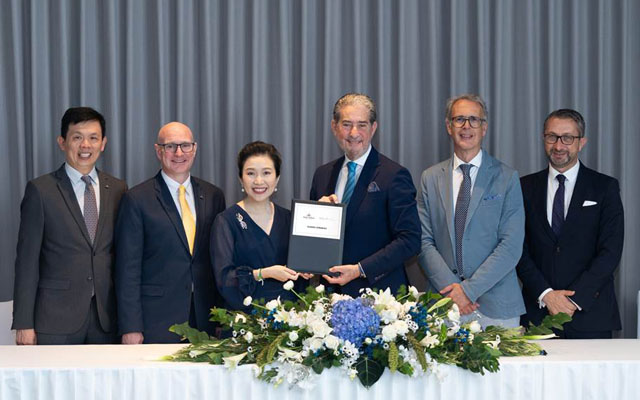
Meliá Hotels International is expanding its partnership with Thailand’s Asset World Corporation (AWC) to launch two new properties – Meliá Pattaya City, and the first Paradisus by Meliá-branded property in the region, Paradisus Jomtien Resort.
Both hotels will further enhance Meliá’s presence in partnership with AWC, bringing the total number of hotels under their umbrella to six in the country.
Situated in the beachside resort town of Pattaya, Meliá Pattaya City will start welcoming guests in December 2024 following a full renovation of the three-star, 234-room Grand Sole Pattaya. The new property will embrace its coastal location by expanding F&B seafood offerings with an all-day dining restaurant inspired by a local fisherman’s village. Facilities will include new bars, event spaces, kids’ club, fitness centre, and a theatre.
Paradisus Jomtien Resort will debut in 2028 in a 43-floor tower boasting 698 keys. The new hotel will sport a more dynamic and sustainable facade, incorporating vertical tropical greenery into the exterior. Forty-four rooms will also feature outdoor plunge pools, and the hotel will comprise multiple restaurants, a gym and spa, convention centre and meeting rooms.
“The addition of these two hotels to our portfolio marks a major milestone in our long-term relationship with AWC,” said Gabriel Escarrer, CEO and chairman of Meliá Hotels International. “We will build on the success of Meliá Koh Samui, Meliá Chiang Mai, and most recently INNSiDE by Meliá Bangkok Sukhumvit in Thailand with AWC.”
Wallapa Traisorat, president and CEO of AWC, shared: “This collaboration will create significant value for the surrounding community and contribute to the Thai economy.”
21 Carpenter
Location
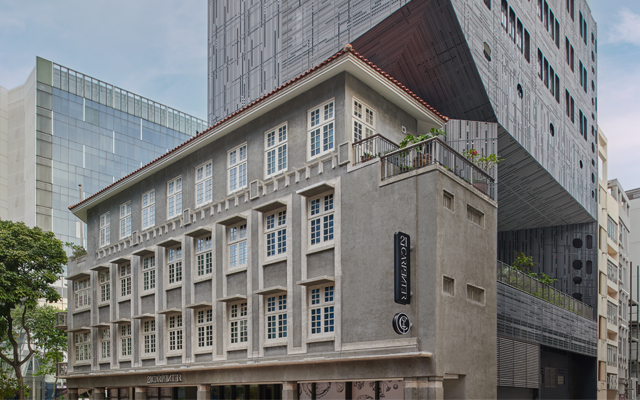
The 48-room 21 Carpenter is Singapore’s latest Design Hotels member, affiliated with Marriott Bonvoy. The boutique property stands just across from The Central shopping mall, which is directly linked to the Clarke Quay MRT Station.
Calligraphic writing of Chinese cities to where remittances were made, as well as a CHS crest on an iron-wrought balcony remain on the hotel’s front, a nod to the property’s storied past. The 1930s shophouses once served as the Chye Hua Seng Wee Kee remittance office of Lee Wee Nam, who went on to become one of the founders of Overseas Chinese Banking Corporation.
Accommodation
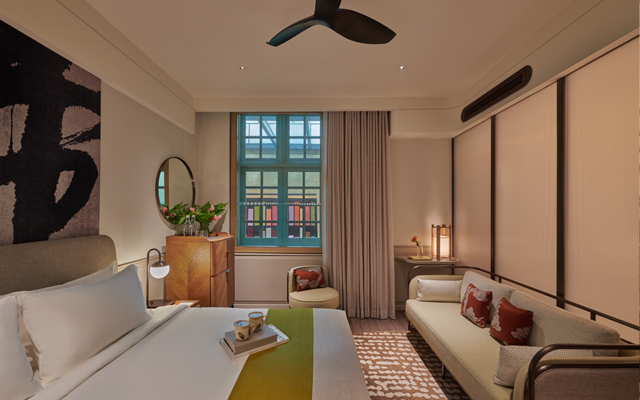
Reimagined by WOHA Architects – known for their green masterpieces like Parkroyal Collection Pickering and Pan Pacific Orchard – the hotel comprises two wings: the conserved Heritage Wing features 26 rooms, while the five-storey extension has an additional 22 rooms. Room sizes range from 30m² to 56m².
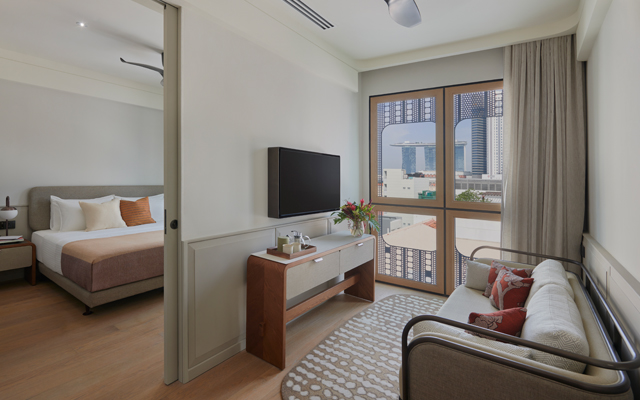
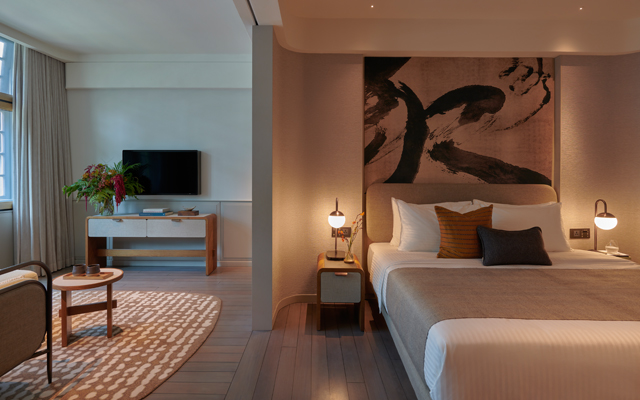
I was put up in a gorgeous Heritage Suite, comprising a living/work space with a flat-screen TV, which led to a separate bedroom with a king-size bed. Walking down the walkway into the living room immediately put me at ease with its homely feel.
Meanwhile, the pink-tiled bathroom came complete with a bathtub, rain shower, Dyson hairdryer, and Smith and Co amenities. Although there was a vanity cabinet, I thought it was not necessary and would have preferred more hooks for clothes or towel racks.
I was told that sturdy Chengal timber boards from the 1930s were restored and used as the flooring. I have no complaints about the bed or pillows, and even though my room faced a brightly-lit entertainment centre, the blackout curtains and quiet space helped ease me into a deep slumber.
Also in the living space was a “wardrobe” that was actually a mini bar and sink, snacks, beverages from Bacha Coffee, TWG, and Oatbedient, and two carafes of water. I particularly enjoyed the sea salt gula melaka cookies, customised specially for 21 Carpenter by the local Fat Kid Bakery.
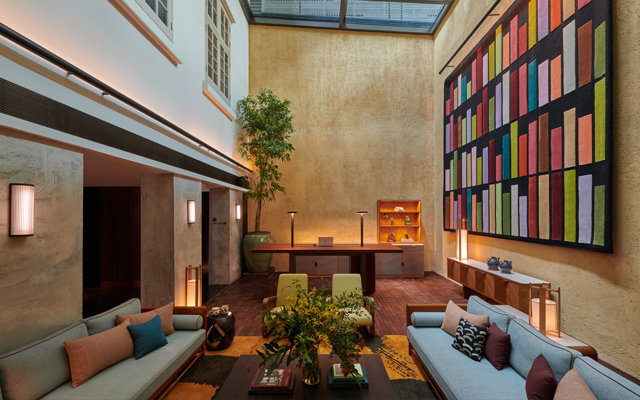
Aside from local F&B partnerships , local artists such as Heman Chong, and Dawn Ang of Aeropalmics, were also commissioned for art pieces adorning the lobby and rooftop lounge respectively. Other local brands that enrich 21 Carpenter’s interior tapestry were bathrobes by In Good Company, bed throws by artist Liu Liling, and tea cups by Un Studio.
Sustainability is expected of every hotel these days, where refillable water bottles, and large pump shower bottles are now the norm. What stood out for me in 21 Carpenter’s sustainability ethos were the 22 photovoltaic panels on the roof, the installation of ceiling fans in every room (both my bedroom and living room had one), and perforated aluminium on the facade. The ceiling fans, employed in lieu of air conditioning when the room is sufficiently cool, aid in reducing electricity consumption, while the aluminium front effectively shields against the sun and disperses the tropical heat.
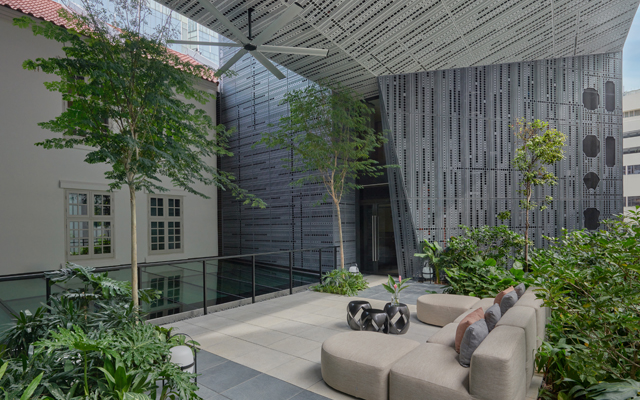

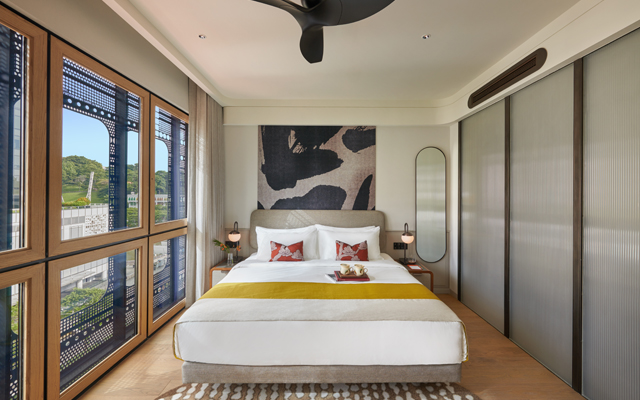
Etched in the aluminium architecture are poetic phrases, horizontally in English and vertically in Mandarin, extracted from letters in the remittance documents early immigrants sent home. My favourite phrase? “Day and night, when will we reunite”, which I thought was a poignant reflection of an immigrant’s love for one’s family, and longing of a home faraway.
Apparently, there are 22 of these phrases, look carefully and you might just spot all of them; I only managed five.
F&B
Kee’s is the boutique property’s only F&B venue. The breakfast menu features made-to-order dishes such as a spinach & mushroom quiche, and avocado toast, as well as a small buffet area with cold cuts, cheeses, salad, and bread.
Open to public, the 71-seater bistro on the first floor also serves a lunch and dinner menu. Conceptualised by Michelin-star Irish chef Andrew Walsh, diners can expect European classics with Asian influences such as Pepper-Crusted Ribeye Steak Frites, and Mediterranean Sea Bream served with a green curry sauce and coconut-infused rice.
The tipple list is way longer than the menu, and offers cocktails infused with heritage spices, craft beers, and an extensive range of spirits and wines.
Facilities
There is an open-air garden terrace on the third floor. Though you would never find me there in Singapore’s humid weather, guests should try and spot poignant phrases inscribed onto the aluminium facade.
On the rooftop (level nine), there is a second, air-conditioned lounge – my type of relaxing space – that looks out over a stainless-steel lap pool infinity pool with a view of Marina Bay Sands and the CBD.
Service
Check in and check out was swift and efficient, and service staff at Kee’s were polite.
Verdict
Standing proudly in an unbeatable central location, this beautifully-restored urban sanctuary provided a delightful and restful weekend getaway. It is a fantastic place to stay, ideal for both business travellers and leisure guests.
Contact details
Website: https://www.21carpenter.com.sg/

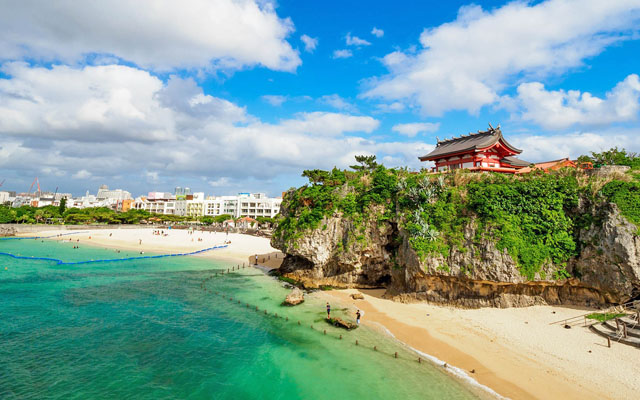






Travelport and Tourism Malaysia have expanded their strategic destination marketing collaboration following the successful campaign and data analysis work that has accelerated the campaign conversion growth for the Malaysian DMO during the past year.
Travelport will continue to provide Tourism Malaysia with meaningful data and market intelligence used to drive destination marketing campaign decisions. The DMO will use insights from Travelport to educate and engage travel retailers about Malaysia, focusing on continuous growth in visitor arrivals, longer stays and higher spending from tourism.
“Travelport provides the meaningful data analysis that we need to effectively educate tourism players about our unique and diversified experiences for travellers so they can promote Malaysia as a top destination for their customers,” said Manoharan Periasamy, director general of the Malaysia Tourism Promotion Board. “Through this collaboration, we have achieved a 50 per cent uplift in campaign conversions compared to 2019.”
Travelport global head of destination marketing Anna Au-Yeung shared: “As we expand our strategic collaboration, Travelport’s data insights will continue to empower Tourism Malaysia with setting the right strategic focus, resource allocation and market priorities as traveller preferences and market conditions continue to evolve.”
This year’s tourism scene in Malaysia is packed with State Visit Year from four states: Melaka, Kelantan, Perak, and Perlis. The country will also host the ASEAN Tourism Forum (ATF) 2025 and the upcoming Visit Malaysia Year that will take place in 2026.
Periasamy said: “We expect that this collaboration will continue to maximise our promotional efforts which will focus on placing Malaysia as the top-of-mind ecotourism destination of the world, through the country’s diverse ecosystems and natural wonders.”