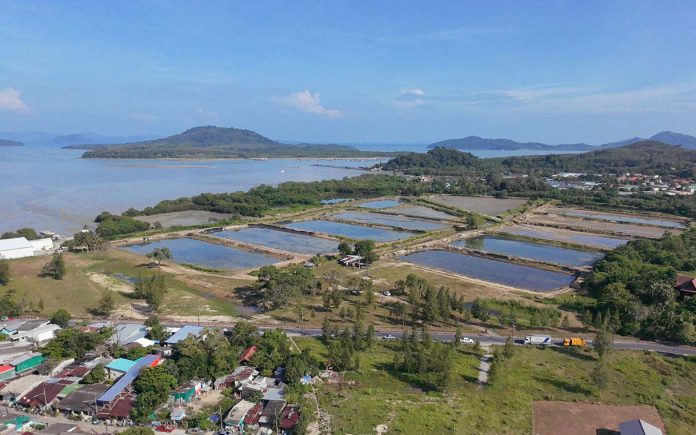
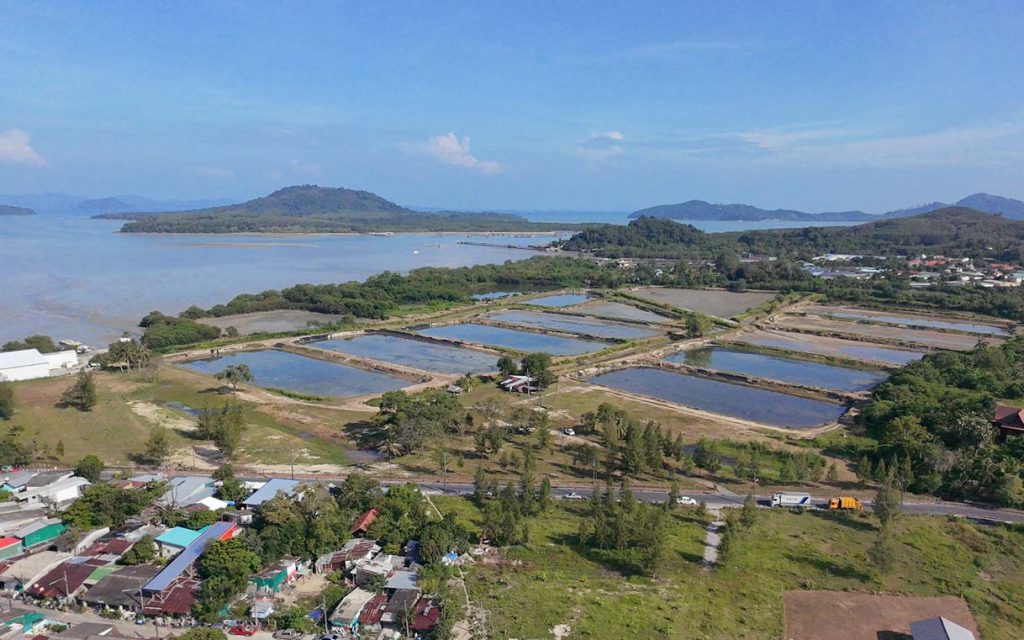
Thailand’s Na-Ranong family, owners of The Slate Phuket, is looking for investors to develop a world-class marina development project on the east coast of Phuket at Sapam Bay, complete with adjacent land for housing, shopping, and leisure facilities.
The land comes with a pre-approved Environmental Impact Assessment and construction permits, which can take up to five years to complete, meaning the property is ready for immediate operation, allowing investors to focus on scaling the business and getting returns faster.
Investors to develop a world-class marina project on the east coast of Phuket wanted
The land, which also has a Marine Operating License in place, is offered at a time when the Thai government is prioritising marina and cruise liner port projects to enhance the country’s role as a regional marine tourism hub.
“Phuket’s nautical tourism has grown rapidly in the past decade, and we are proud to offer this site for development in the burgeoning marine tourism sector, providing a new launchpad to explore the islands and attractions around Phuket,’ said Krystal Prakaikaew Na-Ranong. “This is a rare opportunity to develop a world-class marina project that will contribute to the continued growth of Phuket as a world-class tourism hub.”
Krystal Prakaikaew Na-Ranong said the family is flexible in terms of either offering the site as a long-term lease project or for sale to the right buyer.
Phuket governor, Sophon Suwannarat, commented: “Phuket is fast becoming the boating capital of Asia, and we welcome the development of this marina site, which will not only attract more high-spending international tourists, but will considerably enhance Phuket’s economic growth.”
Ahead of its March opening, Raffles Sentosa Singapore is now taking enquiries for bookings, including stays, weddings and events, and spa and dining experiences.
The 62-villa property, said to be Singapore’s first all-villa property, is nestled within 100,000m2 of tropical greenery on Sentosa island.
Raffles Sentosa Singapore will open in March 2025
“Raffles Sentosa Singapore will be an enchanting sanctuary, where nature, heritage, and wellness come together with the legendary traditions and world-class hospitality of the Raffles brand to create truly unforgettable experiences,” said Cavaliere Giovanni Viterale, cluster general manager of Raffles Sentosa Singapore and Sofitel Singapore Sentosa Resort & Spa.
“The resort will also offer the perfect setting for private retreats, family gatherings, and celebrating significant milestones.”
Villa sizes range from 210m2 for a one-bedroom pool villa to 650m2 for the four-bedroom Royal Villa. Each comes with a private pool and outdoor terrace.
The resort aims to be a destination for weddings and events, with two state-of-the-art ballrooms, the largest of which can accommodate up to 400 guests.
The Philippines has plenty to offer, besides the sun and sea; UNESCO World Heritage Site Ifugao Rice Terraces, pictured
Even though economic and geopolitical headwinds have slowed Philippine tourism, tailwinds of opportunities abound within the destination in the coming times.
Last year’s tourist arrivals of 5.95 million – of which 8.58 per cent are balikbayans or Filipinos permanently residing overseas – is 9.15 per cent more than 2023. It is, however, 23 per cent shy of the 7.7 million targeted in 2024 and 28 per cent short of the pre-pandemic (2019) 8.26 million arrivals.
Shortage of tourists from China, aggravated by tourism budgetary constraints and visa liberalisation delays, have caused the fall.
The Philippines has plenty to offer, besides the sun and sea; UNESCO World Heritage Site Ifugao Rice Terraces, pictured
Analysts foresee full tourism recovery in 2026.
In this light, Philippine Travel Agencies Association (PTAA) executive vice president, Jaison Yang, has suggested a revisit of tourism policies and strategies.
“We need to review current policies, re-strategise and work together (both government and private sectors) to make our targets and prospects objective, realistic and achievable,” Yang explained.
What the country lacks in tourist numbers is made up for by other “more important” indicators spelt out by tourism secretary Christina Garcia Frasco: longer tourist stays at 11 nights, up from nine nights in 2019; high per capita tourist spend of US$2,073; repeat visitors at nearly 70 per cent of total arrivals; and 41 per cent surge in tourism receipts of 760 billion pesos (US$13.1 billion) last year from 539.4 billion pesos pre-pandemic.
While “arrivals is just one of the metrics,” Rajah Travel chair and president Aileen Clemente posited that the more important aspect is “how we can maximise the tourist receipts we can derive from the arrivals”.
Fortunately, more investments are pouring into infrastructure projects, making the Philippines more accessible with new commercial flights from abroad to regional provinces, Clemente said.
In Colliers’ 2025 Philippine Property Market Outlook Report, research director Joey Bondoc highlighted the impact of at least six new and modernisation airport projects in attracting tourism investors.
“Now is an opportune time” and “developers should identify growth opportunities,” Bondoc said, which is already happening with an investment surge in accommodation, business events facilities, and tourist attractions especially in emerging tourist destinations.
Another tailwind is the broadening of tourism products outside of the usual sand and sea offerings to include halal, farm, gastronomy, health and wellness and eco-tourism, among others.
This diversification is creating new source markets and adding to the country’s destination appeal, said Jennifer Sanvictores, global head of sales and marketing, The Farm at San Benito.
Sanvictores cited the Department of Tourism’s recent positioning of the Philippines as a leading international destination for wellness as the sector evolves beyond spa relaxation into mainstream offering scientific and evidence-based and holistic wellness.
Marketing these new offerings and new destinations can also harness tailwinds of opportunities. As Clemente said: “We need to push our promotions, both traditional and new, to be more aggressive in certain countries on a consistent and sustained basis. More importantly, we need to have effective curation of our tourism sites (and offerings).”
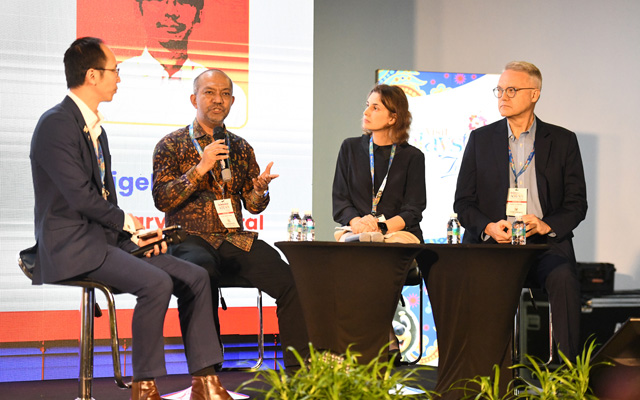
From left: Eco-STEPS’ Kingston Khoo; The Habitat Foundation’s Justine Vaz; Bornean Sun Bear Conservation Centre’s Wong Siew Te and Batu Batu’s Cher Chua-Lassalvy discuss innovative approaches to sustainable tourism development; photo by Rachel AJ Lee
Leading figures in Malaysia’s sustainable tourism sector have sounded an urgent call for collective action to address environmental and social challenges while promoting responsible travel.
From left: Eco-STEPS’ Kingston Khoo; The Habitat Foundation’s Justine Vaz; Bornean Sun Bear Conservation Centre’s Wong Siew Te and Batu Batu’s Cher Chua-Lassalvy discuss innovative approaches to sustainable tourism development; photo by Rachel AJ Lee
Speaking on the Sustainability Pioneers: Malaysian SMEs Driving Change panel at the ASEAN Tourism Conference on January 15, session moderator and founder and president of Eco-STEPS (Sustainable Tourism & Environmental Protection Society) Malaysia, Kingston Khoo, highlighted the slow global progress in achieving the UN Sustainable Development Goals (SDGs).
To help Malaysia on its sustainability journey, Justine Vaz, executive director of The Habitat Foundation, and Cher Chua-Lassalvy, co-founder and managing director of Batu Batu, jointly established the Sustainable Tourism Malaysia network.
The Habitat Foundation is a charitable trust based in Penang. It influences biodiversity conservation at a national level and focuses on empowering local communities, enhancing their livelihoods, and promoting under-appreciated destinations. Its sister organisation under The Habitat Group is The Habitat Penang Hill, a rainforest park.
“The network that we formed comprises NGOs, government organisations, and tourism businesses. We help our network members communicate what they do, where they do it, and (strengthen) their visibility. We also do consumer education and help people to make better (environmental) choices,” said Vaz.
Vaz shared that the foundation is undertaking several projects in preparation for Visit Malaysia 2026, including the development of new trails and an exhibition showcasing the region’s rich tin mining history in Perlis.
Meanwhile, Chua-Lassalvy shared her experience in transitioning Batu Batu – an eco-island located two hours from Johor Bahru – from traditional tourism to a regenerative model, aiming to create positive impacts on the environment and local communities while offering restorative and thought-provoking retreats. It was challenging, she shared, having to deal with problems such as overflowing sewage issues, oil spills that the waves carried in, and trash pollution.
She also encouraged the audience to create destination coordination groups, where stakeholders can discuss, share, negotiate, and find a sustainable way forward.
“This is one thing that the Sustainable Tourism Network does. The plan is to get everyone who is working in sustainable tourism to get together, share their knowledge and databases, so that the industry can progress,” she explained.
Wong Siew Te, CEO and founder, Bornean Sun Bear Conservation Centre, shared how wildlife conservation and nature-based tourism can be mutually beneficial. The centre generates revenue through responsible tourism, which in turn supports conservation efforts and improves the livelihoods of local communities.
“We need to nurture future generations to help protect our environment as much as possible,” he stressed.
Chua-Lassalvy advised the industry to listen to and learn from local communities, rather than impose external ideas. By respecting their knowledge and integrating their cultural heritage, truly authentic and sustainable tourism experiences can be developed.
Vaz said: “I’m currently working on establishing a new protected area in Malaysia, twice the size of Singapore. While the potential for eco-tourism that can benefit the seven villages living (deep in the forest) is significant, we must ensure that their livelihoods and cultural integrity are not compromised by rapid tourism development.”
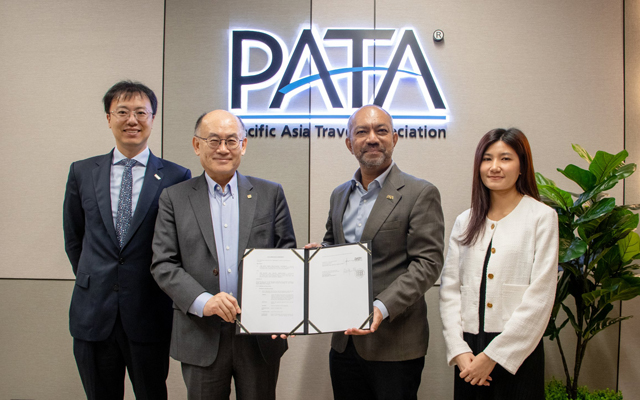
From left: The Hong Kong Polytechnic University’s Anyu Liu and Haiyan Song; PATA’s Noor Ahmad Hamid and Panadda Suk-in
The Pacific Asia Travel Association (PATA) has extended its partnership with The Hong Kong Polytechnic University (PolyU) for an additional three years to continue the publication of the Asia Pacific Visitor Forecasts reports.
This renewed agreement, spanning from 2024 to 2027, will see the continued production of reports that provide insights into the evolving tourism landscape of the Asia Pacific region.
From left: The Hong Kong Polytechnic University’s Anyu Liu and Haiyan Song; PATA’s Noor Ahmad Hamid and Panadda Suk-in
PATA CEO Noor Ahmad Hamid said that this partnership “will ensure that PATA members receive the most updated insights on the region’s tourism demands”.
The agreement to collaborate on the project Further Development of the Tourism Demand Forecasting for Asia Pacific Region (Phase 4), reinforces the ongoing cooperation between PATA and PolyU to leverage advanced statistical forecasting techniques, scenario analyses, artificial intelligence (AI) algorithms and stakeholder insights to produce the Asia Pacific Visitor Forecasts reports, which covers inbound visitors, tourism receipts, and departures.
From left: IDC’s Giuseppe Garofalo, Romolo V Nati, and Jose D. Leviste III; Dusit International’s Gilles Cretallaz, Dusit Thani Philippines’ Evelyn Singson, and Dusit International’s Prateek Kumar
Dusit International has signed hotel management agreements with IDC Prime to manage two new hotels in Northern Mindanao under Dusit’s upper-midscale Dusit Princess brand. Both are set to open in late 2029.
From left: IDC’s Giuseppe Garofalo, Romolo V Nati, and Jose D. Leviste III; Dusit International’s Gilles Cretallaz, Dusit Thani Philippines’ Evelyn Singson, and Dusit International’s Prateek Kumar
Dusit Princess Moena will sit within Moena Mountain Estate, a sustainability-focused mixed-use development located in the mountains of Manolo Fortich, Bukidnon, on the outskirts of the Mount Kitanglad Range Natural Park. The 184-key hotel will cater to both business and leisure travellers and offer a wide range of premium facilities.
Further north, Dusit Princess Firenze will be part of IDC’s Firenze Green Tower project in the Limketkai area of Cagayan de Oro, near the city’s commercial and business districts. Dusit will manage 180 rooms on the tower’s upper floors, providing guests with exceptional views and Dusit’s signature high standards of service.
The Firenze Green Tower and Moena Mountain Estate projects are pre-existing real estate joint ventures between IDC, as the property developer, and the Go family, the original site owners. Adding hotel components to these developments is set to elevate their appeal, positioning Dusit Princess Moena and Dusit Princess Firenze as destinations in their own right.
Scoot launches direct flights to Vienna and Iloilo City From June 3, 2025, Scoot will fly three times a week to the Austrian capital of Vienna on Tuesdays, Thursdays, and Saturdays.
Flights run on the Boeing 787-8 Dreamliner, which has a capacity of 329.
Flights to Iloilo City begin on April 14, 2025, on Mondays and Wednesdays. From June, the frequency increases to four times a week, on Fridays and Sundays.
The service operates on the 112-seater Embraer E190-E2 aircraft.
Vietjet
Vietjet opens four new routes between Vietnam and China Come March 30, 2025, Vietjet will fly four new direct round-trip flights from Ho Chi Minh and Hanoi to Beijing and Guangzhou.
The Hanoi to Beijing flight operates on Tuesdays, Thursdays and Saturdays with return on Wednesdays, Fridays and Sundays.
Daily flights will also commence from Ho Chi Minh City to Beijing; Ho Chi Minh City to Guangzhou, and Hanoi to Guangzhou.
These additions bring the airline’s total number of weekly flights to 48. Vietjet is also the first Vietnamese airline to fly to Beijing’s Daxing International Airport.
Lucky Air
Lucky Air’s inaugural flight connects Dali, Yunnan province, and Kuala Lumpur Lucky Air has commenced flights from Dali, in China’s Yunnan province, to Kuala Lumpur. The bi-weekly service, which leaves on Mondays and Fridays, operates on a Boeing 737 with 189 seats.
Bhutan Airlines
Bhutan Airlines now flies directly to Hong Kong Hong Kong will now be the third destination in Bhutan Airlines’ fixed departures programme, with flights commencing January 27, 2025. There will be 16 fixed departure flights.
Travelport has appointed Andrew Jordan as chief product & technology officer.
Jordan brings to Travelport more than 25 years of experience in digital transformation and large-scale technology platform leadership. He most recently served as chief technology officer at Element Materials Technology, responsible for driving the company’s technology, innovation, and cyber strategies.
Previously, Jordan was chief product and technology officer at Carlson Wagonlit Travel, where he successfully transformed the US$27 billion travel management company into a modern, digital-first platform business.
Jordan’s career includes senior technology leadership roles at NEP Group, NBCUniversal, and Thomson Reuters. In addition, he was a co-founder and chief technology officer of Beyond Analysis, a software solutions and data science business; and chief information officer of dunnhumby, the former data science division of Tesco.
Noor Ahmad Hamid, CEO of PATA (second from left) spoke about travellers' evolving preferences, with AI helping tourists plan their travels
The rise of sustainable tourism, the growing influence of technology, and the need to shift focus from simply attracting tourist numbers to fostering longer stays and deeper cultural immersion were key themes that emerged during the panel discussion, Charting Tourism for ASEAN: Trends Defining the Next Decade, at the ASEAN Tourism Conference on January 15.
Speaker Noor Ahmad Hamid, CEO of PATA, believes there will be “phenomenal change”, especially in the way tourists travel.
He said: “Consumer behaviour is changing, and AI is helping tourists to plan and travel (through) user-generated content.”
From left: MATTA’S Nigel Wong, PATA’s Noor Ahmad Hamid, Agoda’s Giuliana Riitano, and GSTC’s Randy Durban discuss defining trends in travel and tourism
Fellow session speaker, Giuliana Riitano, vice president for Asia-Pacific, Agoda, agreed.
“There is a shift in consumer behaviour, where 75 per cent of travellers (according to a Statista study in 2023) rely on social media to discover new destinations and unique experiences. This is going to continue to grow,” she said.
Riitano also touched on the significant impact major events have on tourism, citing the surge in Agoda searches and sustained bookings following events like the week-long Taylor Swift concerts in Singapore and the MotoGP races in Thailand. She said such events not only generate immediate demand but also leave a lasting impact on tourism.
Randy Durban, CEO, Global Sustainable Tourism Council, further advocated the dispersal of tourists to reduce pressure on popular spots. He referenced LCCs’ role in this effort while making travel in the South-east Asian region more affordable.
When Nigel Wong, president, Malaysian Association of Tour & Travel Agents and session moderator, posed a question on whether NTOs would cease having high arrival numbers as targets shift to focus on quality tourists, Noor opined that it was “up to us” to change how the industry measures tourism performance.
“There should not be just one parameter. We need to be mindful of the type of (meaningful tourism metric) we want to put in place,” he said.
Durban opined that “numbers will not go away”, and that it cannot be the beginning and the end of how to meaningfully measure tourism metrics.
He elaborated: “If I were a DMO, I would measure length of stay as a key indicator of quality tourism. Whether it’s a budget traveller or luxury traveller, if all of them were spending more time, they were going to have a longer list of things to do in the destination, and would therefore spend more time connecting with the (local) community.”
Improved waterways will bring travellers to destinations less covered;
Wat Sampov Pram in Kampot city, Cambodia pictured
Cambodian tourism players have welcomed plans for a boat link between Thailand’s Trat and Cambodia’s Kep and Kampot as well as Vietnam’s Phu Quoc, claiming it will boost regional tourism and help lure more visitors to the Kingdom’s coastal areas.
Sinan Thourn, chairman of PATA Cambodia, said the PATA Cambodia chapter has been collaborating with counterparts in Thailand and Vietnam through the Cambodia-Vietnam-Thailand Economic Corridor (CVTEC) platform for many years to promote waterway travel.
“We’re optimistic about the project’s official launch soon,” he said, adding that during the inaugural Cambodia Travel Match held in Kampot in December 2024, PATA initiated a new route from Thailand, bringing Thai and Indian DMCs through the Koh Kong port to the new Kampot International Tourism Port, which held its soft opening in the same month.
“This initiative will provide a firsthand experience of the waterway and showcase the Cambodia tourism map,” he said, noting that efforts are also underway to streamline visa processes to facilitate travel across the three regions.
Improved waterways will bring travellers to destinations less covered; Wat Sampov Pram in Kampot city, Cambodia pictured
Steve Lidgey, general manager of Travel Asia a la Carte, welcomed the cooperation, calling for a “simple and seamless” process for crossing the borders.
He added that the route may also appeal to repeat travellers who have already visited Siem Reap and Phnom Penh and are seeking new experiences.
“With a new route, it might be possible to avoid Phnom Penh and Siem Reap, for example,” said Lidgey, adding that domestic travellers in the three countries can explore places closer to home.
Sivlin Chhay, president of Cambodia Travel Association (CATA), said the proposed boat link has the potential to enhance regional tourism by creating a “vibrant regional tourism circuit” while improving accessibility between the three destinations”.
“The opening of the new Kampot port will significantly enhance accessibility to the Kep/Kampot region, attracting more domestic and international tourists, and generate economic growth for local communities by creating jobs in the tourism sector,” said Chhay.
“However, careful planning and consideration of environmental and social impacts are crucial for the successful implementation of this project,” she added.