TTG Asia
Asia/Singapore Friday, 2nd January 2026
Page 2688

Travel industry top brass to converge on Marina Bay Sands

0

THE SANDS Expo and Convention Centre will see a coming together of Asia-Pacific’s leading travel industry stakeholders when it plays host to Low Cost Airlines (LCA) World Asia Pacific 2012 and Travel Distribution World Asia from February 8-10.

Travel Distribution World Asia will feature speakers such as Agoda.com’s COO Bryan Lewis, AirAsia Expedia’s CEO Dan Lynn, Golden Tulip’s managing director (South-east Asia) Mark van Ogtrop, Jin Jiang International Hotel Management’s CEO Bernold Schroeder, and Swiss-Belhotel International’s GM Askar Kamis among others.

LCA World Asia Pacific will be no slouch either, with chief executives from various budget carriers such as AirAsia X, Thai AirAsia, AirAsia Philippines, Scoot, Cebu Pacific, Spring Airlines, Peach Aviation, Nok Air, SpiceJet and GoAir, set to provide insights into growth opportunities within the market.

Sustainable tourism pioneers lead the way in Bhutan

0

HOTEL Zhiwaling and Yangphel Adventure Travel, both part of the Yongphel group of companies, became the inaugural private enterprises in Bhutan to adopt the national philosophy of Gross National Happiness (GNH), when they launched in 2011 a three-year programme to integrate sustainable business practices into their operations.

Karma Lotey, the CEO of the Yangphel group of companies said: “The firm has been adhering to the principles of GNH for some time, but we thought it was finally time to formalise our processes.”

During the first phase of implementation, Hotel Zhiwaling and Yangphel set out to raise understanding among employees of the nine key components of GNH, and how its values could be integrated into the business. Workshops on waste management and environmental monitoring were conducted for staff members.

Isabel Sebastian, a sustainable tourism consultant drafted in to develop Yangphel’s GNH-based practices and business structure, said: “This exercise enabled both players to engineer benchmarks and indicators for the Bhutanese tourism sector. Now, there is a basis and reference point for companies in Bhutan to integrate the concept of GNH to achieve lower electricity consumption and carbon emissions while reducing waste.”

“What’s amazing was that the success of the first year, including a reduction in carbon emissions, was attained solely through behavioural changes (of employees),” Sebastian added.

A statement by Hotel Zhiwaling revealed that emissions per guest per night declined by 13 per cent in 2011 over the year before, after a waste segregation and recycling system was introduced as part of its GNH efforts.

Also commiting to its GNH philosophy, Yangphel launched a competition for its trekking crew, awarding a prize to those who collected the largest amount of waste along trekking routes for recycling. Responsible trekking and minimum impact guidelines were established and introduced in July 2011.

Subject to further funding from the Bhutanese government, the second phase of implemenation will take place in 2012, with the focus on educating owners and shareholders about the concept of sufficiency.

Sebastian explained: “Essentially, we want owners and shareholders to agree and declare a satisfactory profit level, and develop steps that will enable the organisation to transfer benefits to as many people as possible.”

Bhutan seeks meaures to retain exclusivity

0

DESPITE concrete moves to expand its tourism product offerings and seasonality (TTG Asia e-Daily, February 6, 2012), Bhutan is contemplating raising its minimum daily tariff to US$300 or more within the next four to five years, to restrict the profile of targeted source markets to a select few.

Levied on non-Indian foreign visitors, high season (March-May, September-November) tariffs were raised from US$200 to US$250 per person per night beginning this year. Low season tariffs remain at US$200 per person per night.

Speaking to TTG Asia e-Daily on the sidelines of the PATA Adventure Travel & Responsible Tourism Conference and Mart 2012, Kesang Wangdi, director general Tourism Council of Bhutan, said: “It is imperative for Bhutan to be a high-end destination. We want to concentrate on creating sustainable value and benefits for Bhutan in the long term, rather than pander to mass tourism in the short term.”

“We want to attract visitors for whom price is not the main criteria when selecting a holiday. Bhutan is an exclusive destination for a certain type of tourist with a particular mindset,” he added.

Anthony Wong, group managing director of Malaysia’s Asian Overland Services Tours & Travel, said: “Bhutan is right to consider increasing its tariff as it will protect local businesses, stemming the flow of revenue exiting the country. Bhutan is a gem and an exclusive destination, and people should understand that coming here is a privilege.”

Wong emphasised that Bhutan should explain clearly that the tariff encompasses a royalty fee used to fund the country’s health and education sectors. “If this were highlighted to consumers, a fee hike would have less of a detrimental impact on demand,” he said.

Buyers such as Hannah Methven, product manager for UK-based Explore Worldwide, and Jenny Campbell from South Africa’s Travel Experts said the lower end of the market would probably think twice about heading to Bhutan if tariffs were raised.

“Some clients might choose to go to Nepal or Tibet, which are not as expensive. Only fairly affluent FITs or the well-travelled will continue to choose Bhutan,’ said Campbell.

Tshewang Om, operations manager of Thimpu-based Om Travenza, said: “If the tariff was increased, from a business standpoint, this would make Bhutan harder to sell. However, it would be good for the environment and overall wellbeing.”

Sonam Wangmo, founder of Bhutan’s Yu Druk Tours and Treks, said: “It is more critical to ensure that we put measures in place to manage numbers and capacity, rather than just think of the bottom line.”

Singapore sets another year of tourism records

0

SINGAPORE earned an estimated S$22.2 billion (US$17.8 billion) in tourism receipts for 2011, while 13.2 million overseas visitors were recorded for the year—both new records, according to the latest figures from the Singapore Tourism Board.

The figure for tourism receipts met the forecasted range of S$22-24 billion. All major components saw year-on-year growth, with Sightseeing & Entertainment recording the highest growth (+37 per cent).

tourism-receipts-by-major-components-january-december-2011
Source: STB

The 13.2 million International Visitor Arrivals (IVA) registered in 2011 exceeded the forecasted range of 12-13 million.

international-visitor-arrivals-january-december-2011
Source: STB

Indonesia (2,592,000), China (1,577,000), Malaysia (1,141,000), Australia (956,000) and India (869,000) were Singapore’s top five international visitor-generating markets.

Seventy-six per cent of total IVA came from Asia (including South-east Asia, North Asia, South Asia and West Asia, excluding Oceania). IVA from Europe saw a two per cent increase despite a four per cent drop in IVA from the UK.

international-visitor-arrivals-top-15-markets-january-december2011
Source: STB

Gazetted hotel room revenue for 2011 came in at an estimated S$2.6 billion, representing a 27.8 per cent year-on-year hike.

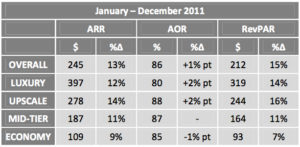
ARR was S$245 in 2011, a year-on-year increase of 13 per cent. Room rates for all hotel tiers increased, with the upscale tier posting the highest growth rate of 14 per cent.

AOR reached 86 per cent in 2011.

Robust performance in ARR and AOR resulted in a 15 per cent growth in RevPAR, which stood at S$212 in 2011. The upscale tier was the top performer in terms of RevPAR growth.

arr-aor-and-revpar-2011
Source: STB

Pierret joins Travelport’s Asia-Pacific team

0

TRAVELPORT has appointed Nicolas Pierret to the role of senior director of corporate development for Asia-Pacific.

Pierret’s previous experience includes senior leadership roles with Carlson Wagonlit Travel in Singapore and New Delhi, where he was involved in strategic planning, global accounts and overseeing the company’s India subsidiary.

Pierret has also worked as a management consultant at McKinsey & Company in France and Boston; and at Banque Paribas (now BNP Paribas) in New York as a mergers and acquisitions analyst.

Pierret will be based in Sydney initially, before relocating later in the year to Travelport’s office in Singapore.

InterContinental Samui opens

0

INTERCONTINENTAL Samui Baan Taling Ngam has opened, a new flag after several different managements including Le Meridien Hotels & Resorts.

Located in the enclave of Taling Ngam Bay, on the west coast of Koh Samui, the 81-key resort offers guestrooms, suites and beachfront villas that come fitted with state-of-the-art amenities including LCD flat-screen TVs, DVD players, iPod docking stations. Private plunge pools are featured in all villas, and complimentary Internet access is provided across all room types.

Dining and entertainment establishments include Air Bar, Amber and Flames.

Highlights of the resort include seven designer pools, a private beach with a 150m licensed private jetty and a 200m pier that provides guests easy access to the rest of Koh Samui’s well-known destinations.

Royal Brunei to beef up Melbourne operations

0

ROYAL Brunei Airlines will be increasing its services between Melbourne and Bandar Seri Begawan from four-weekly to daily starting March 25.

The enhanced services will improve connections and travel options for passengers travelling between Melbourne and London, Dubai, Manila, Bangkok, Sabah or Sarawak, the flag carrier said in a statement.

Victorian Minister for Tourism and Major Events, Louise Asher, said: “South-east Asia is one of Victoria’s fastest growing markets, and these additional services will enable greater tourism and trade linkages and opportunities across this valuable growth market.”

Melbourne Airport CEO, Chris Woodruff, said: “In addition to a link to Brunei, Royal Brunei’s extensive Asian and European networks support Melbourne’s two most significant longhaul markets, China and the UK.”

Meanwhile, Melbourne Airport handled 6.6 million international passengers in 2011, an 11 per cent rise over the year before.

The airport’s key international growth markets were from Asia, with passengers from China up by 23.2 per cent, the Philippines up 17.3 per cent, Singapore up 10.5 per cent, Indonesia up 10.4 per cent and Taiwan up 10.0 per cent.

Traditional markets also experienced growth, with nationals from New Zealand up 11.1 per cent, the US up 5.2 per cent and the UK up 2.1 per cent.

Thailand maps out yearlong MICE drive

0

THE THAILAND Convention & Exhibition Bureau (TCEB) is planning to declare 2013 as the Year of MICE, as part of an aggressive strategy to win more major events for the country.

According to TCEB president Akapol Sorasuchat, the Year of MICE initiative, derived from a private-public sector discussion held in January, had already been tabled to the Thai cabinet for approval.

“The plan comes as Thailand is scheduled to host 17 major events this year. It is also in line with our long-term strategy to prepare the country’s MICE industry for regional economic integration under the ASEAN Economic Community agreement in 2015,” he said.

Thailand is targeting 750,000 overseas MICE visitors this year, up from 720,000 in 2011. The number is expected to grow to 958,320 visitors in 2015, and hit one million in 2016.

Meanwhile, Thailand has won the rights to host an 18,000-pax Amway China incentive event in Phuket this year, as well as a 1,700-pax incentive group from Unilever Hindustan.

The two MICE wins are on top of other major events already confirmed for the year, such as the 2012 Rotary International Convention for 38,000 pax at IMPACT Arena Exhibition & Convention Centre, the Million Dollar Round Table for 5,000 delegates, and the International Congress on Infectious Diseases for 3,000 delegates.

Reporting by Sirima Eamtako

Bhutan eyes tourism quantum leap

0

BHUTAN, where the annual tourism season runs for only five and a half months each year, is looking to transform itself into a year-round destination through a series of product, marketing and infrastructural developments.

According to Kesang Wangdi, director general Tourism Council of Bhutan, hotel occupancy rates range from 10-30 per cent throughout the year, while tourism-related activities mostly take place in the capital Thimpu or nearby Paro, making it difficult for businesses dependent on tourism to survive.

Hence, the government is making moves to expand the country’s tourism product portfolio, both geographically and categorically, with the aim of “distributing the benefits obtained from… tourism, throughout the calendar year and to tourism deficient areas… particularly in the rural south and east of Bhutan”, said Wangdi.

A host of niche products covering cultural, festival, wellness, spiritual and MICE tourism is under development in various regions, while a route that links with Buddhist sites in neighbouring nations, as well as a joint destination marketing campaign together with Thailand are in the works.

To meet the projected increase in arrivals, the government is also incentivising developers to build infrastructure outside the main cities of Thimpu and Paro.

“To encourage hotel development, we permit 100 per cent foreign ownership if developers construct hotels of a five-star calibre. Moreover, all foreign firms will be treated as Bhutanese entities – they are equal before the law,” said Wangdi.

However, before any private sector plans are implemented, they are subject to evaluation against the country’s gross national happiness (GNH) masterplan benchmarks, he cautioned. “In order for plans to be approved, developers will have to ensure that their projects adhere to the nine pillars set out in Bhutan’s GNH philosophy.”

Meanwhile, with an expected increase in arrivals from 30,000 presently to 100,000 per year by 2013, the Tourism Council of Bhutan is thinking of raising the daily tourist tariff, currently upwards of US$200, to over US$300, in a bid to boost tourism coffers and improve yields for Bhutanese operators and hoteliers.

The government royalty component of US$65 per day, used to fund health and education efforts, could also increase in the medium term if numbers entering Bhutan grow too quickly, said Wangdi.


Garuda keen on building Hong Kong, Macau trade relations

0

GARUDA Indonesia is looking to boost its business from Hong Kong and Macau through the development of trade partnerships across all sectors in the region.

“This year, we are targeting five more trade partners such as Ocean Park and hotels in (Macau’s) City of Dreams,” said the airline’s general manager Hong Kong & Macau, Riza Perdana Kusuma. “All Garuda offices will follow an open channel management, and act as a business solutions partner to offer one-stop solutions for travel to Indonesia.”

“Apart from growing our own business, we aim to help our trade partners grow their businesses. For instance, we helped Hong Kong Disneyland bring in an Indonesian media group last year,” he added.

Kusuma is hoping to double the number of Garuda’s corporate partners in the region from 65 to 150, as well as ramp up promotional efforts targeting Hong Kong outbound, such as launching a local website and adding more social media elements to the exisiting portal.

“We hope to expand our international network beyond just Jakarta and Bali. Our 32 domestic routes within Indonesia and 25 international destinations translate to good alternatives,” he said.

Last December, Garuda inaugurated a new office in Causeway Bay, complete with lounge and meeting facilities for visiting trade partners.