TTG Asia
Asia/Singapore Wednesday, 14th January 2026
Page 2674

View from the Top: Martin J Craigs

0

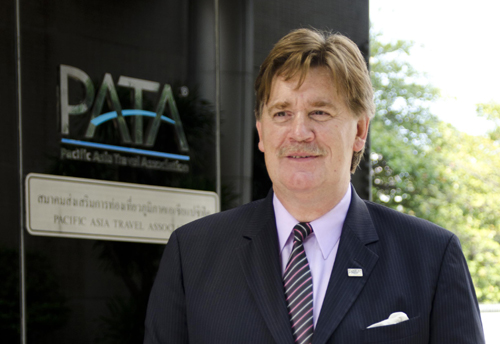
You can hear Craigs from a mile away. He’s big, he’s loud and he wants a new ‘Next Gen’ PATA to be heard. As someone who’s not afraid of conflicts – or the Internet – he might just get his way. Raini Hamdi chats with the new PATA CEO in Bangkok
09mar12_martin_craigs
Martin J Craigs, CEO, PATA

So why did you want the job as PATA CEO?
(Laughs) I was approached and advised on this job during the Paris Air Show in June last year. Like many people, I was invited to put my name in. Initially, I was not sure it was a job I was entirely equipped or suited to do because I’m not a tourism specialist. But I was assured that PATA’s main role going forward would be advocacy, would be creating new value for members, and would relate to how we deliver and communicate our services. And those, I’m interested in.

Now about four months into the job, it has become clear to me that I had accidentally been in training for the job in the last three years, through a taste of the travel business in civil aerospace (Craigs held senior positions at aviation firms such as BAE Systems and Saab-Scania). And, if nothing else, through being a high frequency traveller myself.

When did you first hear of PATA?
The first time must be around 1986, my first year in Hong Kong (where he was previously based for the past 25 years). I had the pleasure to meet the CEO of Cathay Pacific at the time, Peter Sutch, and in the course of conversation, he told me he was going to the PATA conference the following week – it was the best fun event of the year, he said. I had filed that away, thinking this PATA must be a good organisation.

After a long search, and even the debacle of a candidate getting cold feet, do you think your job is a hot seat?
PATA’s had its fair share of ups and downs in recent years. I just look at it as the inevitable result of change – any long-standing association has to change with time and technology.

In many ways, the Internet has somewhat been an enemy of PATA – and thousands others, as people have been disintermediated – but that does not mean there is no value in having an organisation that links people together face-to-face and online – it’s not as if you can only do one and not the other. No, no, the whole point about life generally is finding a balance. And it’s a non-stop process.

It is fair to say it is a hot seat, but in a good way. The PATA CEO is given great respect and hospitality whenever he goes to an event. It’s not me personally; it is the 60 years of work PATA has done to build a reputation for itself. It is a responsibility that has to be respected and built on.

You came in when the direction had been set by an interim CEO in the form of the PATA Future Strategic Focus. Would you have preferred that you got to set the direction yourself as the new CEO?
No. It’s logical – serendipity, in fact – that someone of Bill (Calderwood)’s experience and mindset did the interim CEO job thoroughly. He restructured internally, made the organisation leaner, streamlined a lot of the activities, but he consciously did not embark on a new voyage in terms of the messaging for the Next Gen. I didn’t regret that a lot of the organisation had been shaped by Bill. I felt, to use an analogy, that I had a fairly waterproof ship that had been repaired in the harbour and was now ready to go out on the open seas.

Now, I’m on it and of course we want to catch the wind at the back, getting the support of members, media, etc, by acting in smart and insightful ways. You’ve got to win hearts and minds to a new way of thinking; it’s not just about cold, hard spreadsheet numbers.

“I come from Northern Ireland and conflict resolution, as someone once said to me, must have been built into my DNA…”

How will you fatten PATA’s coffers again?
Innovation, by not depending solely on membership fees but finding new revenue streams and retaining members so you are doing less selling and more auto-renewals. Fundamentally, it is showing the PATA Next Gen activities and then money should flow in the right direction.

Tell me more about this new tagline which you’ve adopted.
It’s a mixture of enhancing our ability to deliver events, research and membership value by making the Internet an ally and, in concrete terms, delivering new-style events.

Examples: webinars on topical subjects, live-streaming highlights from our forums or even our AGMs. Or giving bites of information members might not have picked up through a monthly regional directors’ digest, potentially podcasting these as well. Or delivering meaningful insights from our vast amount of aggregated data through mobile platforms (from April 2).

Let’s talk more about creating new value for members. Have you figured out how?
I want to be truly marketing, not selling. I want to be shaping the product – the value proposition of PATA – according to what the majority want. That to me is real marketing and showing empathy.

What I try to do in the first few months is walk the talk. Do it. That’s why I started the PATA Hub City Forum very quickly (the first was in Bangkok on January 30 with the PATA Thailand Chapter) and people thought I was crazy to do it at a month’s notice and expect the head of Thai Airways International and Tourism Authority of Thailand to turn up, but they did, and so did a good number of people.

Basically, we have to engage people face-to-face and we can’t just depend on our two iconic big events (PATA conference and mart) and the adventure travel mart. We will continue to deliver those in a professional and vigorous way, but we also need to go out and reach the markets.

So instead of expecting everyone to come to us once or twice a year, we go to them and we will try to inject new perspectives on issues critical to those hubs. The next one we plan to do is the Singapore PATA Hub City Forum on May 22.

Another philosophy of mine is clustering. I hear from the senior people I meet that they get so many invitations and they want to make their trips as productive as possible. If they can get two or three events out of one trip, that’s more value for them.

So if we can overlap events, we will. For example, the Airports Council International (Asia-Pacific Regional Assembly, Conference and Exhibition in Singapore, May 22-25), which is immediately after our events. Now this body has (577 members operating 1,689 airports in 179 countries) and airports are part of the travel and tourism cycle. Yet, they are often seen as the weakest link in the chain because they don’t always offer the convenience and comfort.

It is also PATA’s job to point out where the weak links are – hopefully politely and subtly – because when an end-user rates his travel experience, it’s not just the hotel bed or the restaurant food, but  a whole chain of events. If they are kept waiting 45 minutes to an hour at the airport, that’s not a good memory.

Is that an airports or an immigration issue?
Immigration, but the point is, customers think it is an airports issue. An example: Hong Kong generally does a good job of processing people. But in recent years, it has been noticed that there have been sporadic backlogs of people waiting well over an hour. I met the commissioner of tourism and he told me that 96 per cent of people were processed within 15 minutes. Sounds good. However, that’s still a couple of million people who were kept waiting – four per cent of 50 million.

I read a letter in a UK publication from a lady who was really mad she was kept waiting an hour-and-a-half to get into Hong Kong. She got madder when she read in the papers that Hong Kong needed to invest US$17 billion  on a third runway and asked why it couldn’t invest US$17 in an extra hour of an officer’s time, which I thought was a reasonable observation. So my job is to politely raise that up to the system through the people I meet.

What inspired you in the last four months as PATA CEO?
Meeting the very experienced and the youngest members of the industry – Khun Kusa (Panyarachun, managing director, World Travel Service Thailand) who, at 93 years of age, spoke eloquently from the floor during our Bangkok PATA Hub City Forum. Then, I was asked to give a lecture at a university in Beijing. A 19-year-old was tasked to make a welcome speech and she spoke about the dream of travel so emotively, that you realise how travel and tourism touches people’s lives over and above the usual experience of business. And therefore, to be part of it is genuinely a privilege.

How do you unite PATA given the diversity – just look at that age gap, for instance.
Of course there will be problems within PATA; how could you not expect different opinions when you represent roughly 50 different countries and, on top of the national culture,  is the functional culture – this person a GM, the other accountant, government minister, media member. So it is completely expected for there to be 101 different opinions on what PATA should prioritise or do. The pleasure is how to harmonise that to a reasonable consensus.

It is a pleasure?
I come from Northern Ireland and conflict resolution, as someone once said to me, must have been built into my DNA because I’m used to seeing conflict all around me in its most serious forms. And after 700 years we’ve solved that little problem in Northern Ireland. Terrorists are now ministers. So, after seeing that at close range, you can’t say that the kind of conflict that goes on inside of PATA is to be feared or to be avoided.

To do this job, you have to take the views, but someone has to decide to do something or or not to do something. In a multinational, multfunctional organisation, when someone decides to do something or not to do something, it will divide to a certain extent. But if you don’t decide at all – that’s the worst. Then you will drift.

My approach is to decide and take responsibility for that decision. It does not mean I won’t learn some lessons along the way. You’ve got to accept that this (PATA) is a learning organisation in a middle of an incredibly fast-moving industry, in the world’s greatest growth market. There couldn’t be a better time to start talking and delivering PATA Next Gen.

Who influenced you recently?
You can’t not pay attention to the Facebook phenomenon, an idea in one guy’s mind lying on his bed at Harvard and now a business whose market capitalisation is estimated to be worth more than Boeing.

One quote (Mark) Zuckerberg made in his IPO which I read two weeks ago was, ‘you need to move fast and break things’. Speed is the competitive weapon and you don’t need to worry along the way something will drop off the table. As I understand it, it’s the graffiti at Facebook that ‘done is better than perfect’.

Since coming onboard, I’ve had to move fast; hopefully I haven’t broken anything substantially.

I had the luxury of reading a bit more about PATA before assuming the role end-October, and I found that there had been an enormous amount of analysis, introspection almost, on PATA, a lot of it very worthy and eloquent thoughts, like Prof Chuck Gee’s comments in the PATA 50th book. They were mulling over challenges going forward 10-20-30 years ago and it has been an evolution challenge since the start of the Internet, since PATA and every other association became disintermediated.

To do this job, you do have to move fast, you will break things and you won’t please all of the people all of the time.

But ‘done is better than perfect’.

This article was first published in TTG Asia, March 9 issue, on page 8. To read more, please view our digital edition or click here to subscribe.

Suffering Maldives launches tacticals

0

THE POLITICAL shake-up in the Maldives has affected Chinese arrivals – now its biggest source – and triggered concerns in its traditional Europe and Japan markets, but rates appear to be holding.

Let’s Go Maldives managing director, Mohamed Riyaz, said his company had seen 12 per cent of its Chinese bookings wiped out. “The Maldives gets between three and five charter flights from China every day, so if we lose one or two flights that means we lose quite a large volume.”

Maldives Marketing & PR Corp deputy director, Ibrahim Asim, said the China market was “quite sensitive about political issues”. “Buyers (from other markets) at the show have also shown concern, but we have not seen a significant impact from the other markets so far,” he said. “Having said that, we are putting together plans to minimise the impact, and we expect to launch these by the end of this month.”

Asim added that the NTO had also started inviting tour operators and media, especially from China, for fam trips.

According to Riyaz, these seem to have worked, as charter flights from China were scheduled to return to normal by April.

He pointed out that while resorts in the Maldives were holding their rates, they had introduced tacticals such as stay-four, pay-three-night packages, although this was not unusual in the low season which runs from March to May.

Thulhagiri Island Resort & Spa sales and reservations manager, Ismail Areef, was confident that the European market would do well during the peak season, based on feedback gathered from buyers at ITB Berlin.

China is a new but very fast-growing market for the destination, totalling 198,655 arrivals last year. This represents 21.3 per cent of overall arrivals.

Read the full report in TTG Asia, March 9, 2012

Read the full report in ITB Berlin

UNWTO, WTTC on the case to ease visas

0

THE UN World Tourism Organization (UNWTO) and World Travel & Tourism Council (WTTC) are joining hands to convince world leaders of the need to improve visa application and processing formalities.

The two global bodies have commissioned a study exploring potential economic models if visa policies in each of the G-20 group of major global economies were relaxed, either through making it easier to obtain visas, the use of e-visas, or even opening borders altogether.

“Complicated, lengthy and overpriced entry formalities are making it extremely difficult for tourists to travel, especially (those from) emerging economies which are leading growth in terms of outbound markets,” said Taleb Rifai, secretary-general, UNWTO.

“Travel facilitation is closely interlinked with tourism development and can be key in boosting demand,” said Rifai. “This area is of particular relevance in a moment in which governments are looking to stimulate economic growth but cannot make use of fiscal incentives or public investment.”

The results of the study are due to be presented to the G-20 heads of state at a meeting in Mexico on May 16. The G-20 counts the US, China, Japan, South Korea, India, Indonesia, France, Germany, the UK and Australia among its members.

Read the full report in TTG Asia, March 9, 2012

Read the full report in ITB Berlin

Beleaguered Egypt rolls out brand campaign

0

A NEW brand campaign, We’re Egypt, has been rolled out to portray the country as a safe and welcoming destination for international tourists, and to restore confidence in traditional source markets following the revolution in February last year.

The campaign depicts locals enjoying themselves in their own country, thereby sending a message to inspire travellers to spend their holidays in Egypt.

Mounir Fakhry Abdel Nour, Egyptian Minister of Tourism, said: “The main issue for Egyptian tourism today is the perception of security in the country.”

Participating at ITB Berlin in the capacity of official partner country, Egypt is aiming to double international arrivals to 30 million by 2017, compared to 14.8 million last year and 20 million in 2010, according to Abdel Nour.

He said: “Europe will continue to be our top source market, but growth will come from China, India and South Korea, among others. We will also diversify our products by promoting religious and cultural attractions and ecotourism.”

To meet arrival targets, the Egyptian Tourist Authority will intensify its partnerships with tour operators and airlines through organising fam trips, co-funded marketing activities and above-the-line advertising campaigns.

An online training course for travel consultants selling Egypt is being planned, as well as more activities through travel expert networks and associations.

EgyptAir is also attempting to restore direct air connections from Japan, China and India to Cairo.

Meanwhile, the tourism ministry is in talks with Messe Berlin to host a Middle East & Africa variant of the ITB travel trade fair in 2013/2014.

Read the full report in TTG Asia, March 9, 2012

Read the full report in ITB Berlin

Integrated resort to open in Lombok in 2015

0

THE TRANQUIL island of Lombok will see its southern area buzzing with a large integrated resort development as early as 2015.

The Mandalika Resorts Lombok, which will cover an area of 1,175 hectares, is part of a special economic territory programme established to develop West Nusa Tenggara as a tourism hotspot.

The site is geared to become an event-based destination and will be located 15 minutes away from Lombok’s new international airport.

Bali Tourism Development Corp (BTDC), the state-owned company that manages Bali Nusa Dua area, has been appointed developer and manager of the site.

BTDC director of development, Edwin Darmasetiawan, said: “We want the resort to complement Bali instead of competing with it. Therefore, the product will be very different from Nusa Dua in terms of its type of attractions.”

Facilities earmarked for the integrated resort include an F1 race track, an integrated theme park, an underwater marine museum, an eco park, meeting spaces and a concert hall. The developer also plans to invite Disney to “be a part of ” the theme park.

Seventeen major Indonesian companies including Lippo Group, MNC Group, Gobel International and Rajawali Group have signed MoUs with BTDC for various developments.

The BTDC is now finalising the environmental impact analysis, which is expected to be ready by June. The project’s first phase, including road construction, hotel developments and an 18-hole Jack Nicklaus golf course, will be completed within three to five years. More hotels and attractions will follow in the second stage.

Panorama Destination managing director, Rocky Praputranto, said: “The development will change Lombok, which is known as a tranquil, laid-back island. Do the people in Lombok, who are more conservative (than the Balinese), want this? Are they ready for the change?

However, Bidy Tour Lombok managing director, Yandianto Hamidy, welcomes the change and believes the destination will draw a wider range of markets in the future.

Read the full report in TTG Asia, March 9, 2012

Read the full report in ITB Berlin

Imminent changes at MAS

0

BARELY 16 months after introducing its current branding, Malaysia Airlines will announce a new corporate structure in the third week of March 2012, which is also expected to bring clarity to the airline’s branding and that of its various subsidiaries.

The airline is planning a sub-branding of its premium regional services – a move that first began under the “Sapphire” project title and then tentatively re-named “MAS” (which means “gold” in Bahasa Malaysia).

To be unveiled in April, the premium carrier will operate exclusively with Boeing 737-800 aircraft and will be operational by June 2012. It is not clear if this is or will be part of the joint venture currently being discussed with Qantas Airways.

Changes to the logo are also in progress. Its current logo will be retained but rendered fully in blue while the logo of its premium yet-to-be-named carrier will be rendered in red.

Meanwhile, Malaysia Airlines is considering selling off MASKargo and other subsidiaries including Firefly Airlines (based at Subang Airport in Kuala Lumpur and Penang) and MASwings (based in East Malaysia) to reduce losses made over the last few quarters.

Pontiac to unveil luxury brand Patina

0

PATINA Hotels & resorts, a brand new luxury-lifestyle hotel chain conceptualised by the Pontiac Land Group, will be unveiled at the upcoming Hotel Investment Conference Asia Pacific (HICAP) in Singapore on March 13 and 14, as outlined by the chain’s recently appointed CEO, Marc Dardenne.

TTG Asia e-Daily believes that the flagship 200-room property will be at the Capitol, an upmarket mixed-use development built by Capitol Investment Holdings in Singapore’s civic and cultural district.

Residents of the 10-storey ultra-luxurious residential tower on the same site will have exclusive access to a selection of the services and amenities provided by the yet-to-be-named Patina property, including in-residence dining, airport pick-up, concierge, housekeeping and access to facilities.

In a press release, a spokesperson for the Pontiac Land Group said: “In blending the rich architectural heritage with a contemporary setting in the Capitol building and Stamford House, we have a unique opportunity to create one of the finest hotels in Singapore.”

The development will also encompass a four-storey shopping mall housing luxury brands, and the Capitol theatre, which is envisioned to become a hub for concerts, live theatre and special events.

Meanwhile, a consolidation of shareholdings for the Capitol was completed on March 7, with Top Property Investment exiting from the venture. Its shares were transferred to the remaining partners, with Chesham Properties, a member of Pontiac Land Group, taking up half of all shares, Perennial Real Estate upping its stake to 24 per cent, and the stake of Ron Sim, chairman and CEO of OSIM International, rising to 26 per cent.

GHM gives free nights to mark 20th bash

0

LUXURY hotel group, General Hotel Management (GHM), is doling out a free roomnight and a suite of special rates to travel consultants at any of its seven properties until the end of this year.

It marks its 20th anniversary this year.

The hotels include The Nam Hai Hoi An in Vietnam; The Setai South Beach in Miami, USA; The Legian Bali in Indonesia; The Chedi Club Tanah Gajah Ubud on Bali; The Chedi Chiang Mai in Thailand; The Chedi Muscat in Oman; and The Strand Yangon in Myanmar.

The group has also lined up bimonthly prizes and a grand prize of 20 free nights.

Travel consultants can contact any of GHM’s worldwide sales office to obtain a promotional code to facilitate with online bookings at GHMhotels.com or with direct bookings to the hotel.

WFS wins bid to operate Hong Kong cruise terminal

0

A CONSORTIUM led by Worldwide Flight Services (WFS) has won the bid to manage and operate the new HK$8.16 billion (US$1.04 billion) cruise terminal at Kai Tak.

The contract, awarded by Hong Kong’s Tourism Commission, is for 10 years. The minority partners in the consortium are Royal Caribbean Cruises and a subsidiary of Shun Tak Holdings.

Due in mid-2013, the terminal is located on the historic runway of the former Kai Tak airport and is designed to accommodate the new class of mega passenger cruiseships, including the largest in operation today, Royal Caribbean’s Oasis.

COO of WFS, Barry D. Nassberg, said: “We are delighted to be given this opportunity to help grow the tourism trade in Hong Kong and look forward to market the terminal to cruise lines around the world. We will work towards creating a passenger experience that sets new standards, in keeping with Hong Kong’s reputation for service excellence.”

Jeff Bent, director for cruise projects at WFS, added: “Hong Kong’s wide variety of cultural, gastronomic, urban, and countryside attractions make it an ideal destination for longhaul and shorthaul travellers alike, and our vast source market in mainland China for cruise passengers is an enduring attraction for cruise lines.”

More multi-city Asian tours

0

CONVINCED that it should collaborate rather than compete with its South-east Asian neighbours, the Department of Tourism (DoT) Philippines has set about establishing partnerships with the region’s NTOs, with Malaysia being the latest, as air links between the two neighbours rise significantly.

DoT secretary Ramon R Jimenez Jr said at the core of its cooperation with Malaysia was the development of the Muslim market. “The Philippines is a predominantly Christian country, so we have much to learn in terms of attracting and taking care of Muslim tourists,” he said.

Jimenez hopes the country can also leverage on Malaysia’s strength in the Europe market, while Malaysia will benefit from the Philippines’ US connection.

He also revealed that similar discussions had been held with his Singapore counterpart, with the goal of creating packages combining both destinations. “We are determined to form a team who will create high-end packages: Europeans can fly into Singapore for a city tour, go to Boracay to get their tan and tattoo, then fly to Singapore again.”

From March 25, Malaysia Airlines is increasing its flights to the Philippines to thrice daily, while SEAir will launch a thrice-weekly Clark-KK service on May 1. Cebu Air has reportedly filed paperwork for flights to Kuching, while Zest Air is looking to mount flights to KL mid-year.

Tourism Malaysia’s acting director-general Azizan Nordin added that the NTO was also widening the number of airlines it worked with. To attract more tourists from the US and Russia, for instance, it will work with the Philippines and South Korea.

The trade, however, has its eye focused closer home, on the Malaysian and the Philippine markets themselves. “As Manila and Clark are just an hour-an-a-half flight away from KK, it will be easy to persuade Sabahans to visit the Philippines,” said Borneo Trails Tours & Travel general manager, Tan Kok Liang.

Infrastructure will also be a focus

ASIDE from growing demand, the Philippines is embarking on capacity building, said Department of Tourism secretary Ramon R Jimenez Jr.

With a new law being implemented this year, 21 areas have been declared tourism enterprise zones, where investors will be offered incentives such as a moratorium on income tax for a property’s first year of operation and no limit to the hiring of expatriate executives, said Jimenez. This is in addition to international airports that are being built and the expansion of cruise terminals across the country, the former meant to boost international arrivals, and the latter, South-east Asian arrivals.

Jimenez also revealed that a Singapore group had already expressed interest in turning the former post office in Manila into The Fullerton Hotel, similar to the one in Singapore.

Read the full report in TTG Asia, March 9, 2012

Read the full report in ITB Berlin

Additional reporting by N. Nithiyananthan and Marianne Carandang