


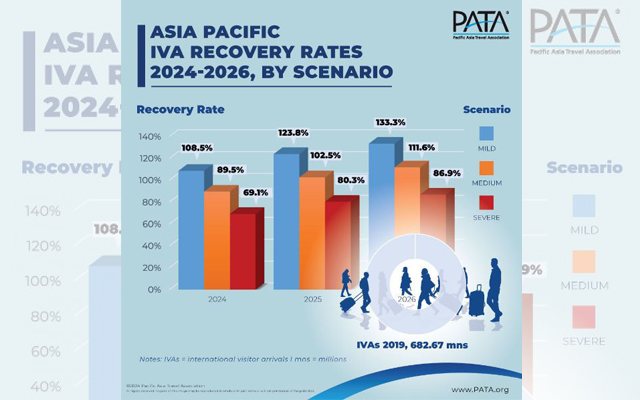
PATA’s upcoming mid-year report for its Asia Pacific Visitor Forecast 2024-2026 has revealed strong gains in the region’s international visitor arrivals (IVA) for 2024, reinforcing its original forecast figures released earlier this year.
This update, to be released in early July, underpins the prior report’s prediction of strong annual growth in IVAs into and across Asia-Pacific, exceeding pre-pandemic 2019 levels for the first time in 2024 under the mild scenario, and by 2025 under the medium scenario. However, challenges persist as the severe scenario predicts arrivals in 2024 to remain 31% below 2019 levels, and 13% below the benchmark by 2026.
PATA has also published its 39 individual reports of the Asia Pacific Destination Forecasts 2024-2026 series, sponsored by Visa and featuring the latest insights and data from Euromonitor International and Visa.
While uneven recovery rates between each region and sub-region within Asia-Pacific exist, IVA numbers of Asia, the Americas, and the Pacific have all been predicted to exceed 2019 levels in 2024, under the mild scenario. The momentum is said to continue into 2025 and 2026, with IVA numbers across all three destination regions forecasted to surpass those of 2019.
As expected, the severe scenario forecasts are much weaker and while IVA numbers are still predicted to continue trending upwards to the 2019 level by the end of 2026, they do so at very much slower rates.
At the destination sub-region level, some very strong IVA annual growth rates are forecast for 2024 under the medium scenario, with eight of the 11 sub-regions foreseen to have annual growth rates above 10%, led by Micronesia, South America, and South-east Asia. For annual increases in absolute numbers of IVAs, the destination sub-regions of North-east Asia, South-east Asia, and North America lead the field.
The drivers of much of this expansion in IVA numbers between 2023 and 2024 are very much the North-east Asia source markets with China. Over the 2023 to 2026 period, North-east Asia still dominates, with the top five source markets by additional IVAs generated all coming from that sub-region. Specifically, seven source markets are forecast to add more than 111 million IVAs each to the Asia-Pacific count with the US being the sole source market outside North-east Asia in that ranked list.
Another way to recognise the power of North-east Asia as a generator of IVAs across Asia Pacific between 2023 and 2026 is to understand that of the 258.3 million additional IVAs predicted for Asia-Pacific over that period, 60% are forecast to be from North-east Asia source markets.
“The severe scenario forecasts remind us that while things are positive right now, with growth projections generally bullish, dangers still loom,” remarked PATA CEO Noor Ahmad Hamid. “Geopolitical tensions, the effects of climate change and economic uncertainty prove to be sources of obstacles to Asia-Pacific tourism growth, highlighting the critical need for continuous efforts to create innovative solutions that could effectively combat such challenges.”
He stressed: “We must not, however, revert to prioritising arrival numbers alone when it comes to the recovery and growth of our industry. It is crucial that tourism industry stakeholders turn their focus on promoting responsible and sustainable methods of managing volume growth as a way to foster these positive trends, focusing on quality tourism experiences, environmental conservation, and community engagement.”
The 39 individual reports in the PATA Asia Pacific Destination Forecasts 2024-2026 series can be viewed here.























Travellers from Australia and New Zealand will now be able to enter China for business, tourism, and transit without a visa for up to 15 days, thanks to the country implementing a unilateral visa-free policy.
Australia and China also jointly declared to provide multiple-entry visas mutually with a validity period of three to five years.
According to the National Immigration Administration of China (NIA), the number of Australian visitors to China is continuously increasing.
In October 2023, the NIA released a list of 53 eligible countries for a 72/144-hour visa-free transit, including the UK, France and Australia. Then on May 15 this year, the NIA permitted the entry of foreign tourists by cruise ship without a visa, facilitating inbound visits by Australian residents.
Australia has a large community of Chinese residents; thus the introduction of the unilateral visa-free policy not only facilitates their visits to relatives and friends but also a chance to see the changes in China over the years.
New Zealand will also be included in the unilateral visa-free list, as flights between China and New Zealand have recovered quickly. Since last December, direct flights between China and New Zealand have recovered to that of pre-pandemic period. Six airlines including Air New Zealand, China Southern Airlines, China Eastern Airlines, Air China, Hainan Airlines, and Cathay Pacific are offering direct flights from eight stops in China to New Zealand.
China has been continuously expanding the unilateral visa-free countries since 2023 – to date, China has implemented unilateral visa-free for countries including France, Germany, Italy, the Netherlands, Spain, Switzerland, Ireland, Hungary, Austria, Belgium, Luxembourg, and more. Additionally, Thailand, Singapore, Malaysia, and Georgia are mutually visa-free countries with China.