TTG Asia
Asia/Singapore Sunday, 18th January 2026
Page 2609

Asian port encounters

0

While there are no lack of appealing Asian destinations, port infrastructure is stopping cruise lines from featuring a wider range of itineraries. 

jun29_story2-1
From top left: Inle Lake, Myanmar; Fukuoka, Japan; Jeju, South Korea;
Redang, Malaysia; Yangon, Myanmar; New Delhi, India

Royal Caribbean International
Kelvin Tan, regional director, 
Asia-Pacific, Royal Caribbean Cruises

jun29_story2-royal-caribbean
Voyager of the Seas

Which is the most desirable port of call in Asia?
There are many desirable and attractive ports in Asia. Just to name a few, based on our guest ratings, popular destinations in North Asia include Jeju, Kagoshima, Kobe and Okinawa, while in South-east Asia, Halong Bay, Danang, Phuket, Bali and Penang.

Most of these destinations offer great port and tourism infrastructure, as well as impressive cultural, historical and scenic attractions and shopping and gastronomic experiences.

Which is the most challenging port of call in Asia?
Some cities have great tourism appeal but their lack of port infrastructure, such as a cruise terminal located in or near these destinations, have prevented our ships from calling. Seoul, Bangkok and Hanoi are examples.

If you had your way, where is your next port of call in Asia?
Boracay, Palawan, Yangon and Sandakan are interesting, exotic destinations with a rich variety of historical, cultural and scenic attractions for our guests. We have yet to feature them due to their lack of port infrastructure.

What are you looking for in a potential port of call?
Correct and adequate infrastructure that can support over 3,000 guests and 1,200 crew at the same time. Other important factors to consider are visa policies and immigration procedures.


Silversea
Melvyn Yap, regional director, Asia, Silversea

jun29_story2-silversea
Silver Whisper

Which is the most desirable port of call in Asia?
For turnaround ports, i.e. Singapore, Hong Kong, Tokyo, Bangkok and Shanghai, we desire good air connectivity to the rest of the world.

For ports of call, there should be decent infrastructure to support the berthing of a cruise vessel and enough attractions nearby. There should also be a convenient transportation network.

Taking into consideration of the above factors, berthing in Singapore and Hong Kong are equally desirable.

Which is the most challenging port of call in Asia?
Ports in India are the most difficult as the immigration, customs, port operators, the tourism board, etc, do not seem to communicate with each other.

If you had your way, where is your next port of call in Asia?
We made port calls in Myanmar in the past, but had to stop due to political reasons. We hope to return to Myanmar, as it is a beautiful country.

There are also many wonderful islands in Japan, but it is a case of too many destinations and too little time. As much as we would want to squeeze everything into an itinerary, our Asian clients have short vacation durations.

What are you looking for in a potential port of call?
As Silversea operates smaller cruise vessels, there are not as many prerequisites as a big ship would need. Having said that, it is important to have good port infrastructure, so that our guests are allowed to go through usually restricted port areas without hassle.

Our guests also appreciate if we can run our own complimentary shuttle buses to town, such as in Phuket and Jakarta, where these were not permitted. Our guests had to take local taxis that charged high prices.


Costa Cruises
Buhdy Bok, vice president, Pacific Asia and China, Costa Cruises

jun29_story2-costa
Costa Victoria

Which is the most desirable port of call in Asia?
Asia is such a diverse region that there are many ports that we can define as most desirable.

For nice beaches, there are Kagoshima, Wakayama, Langkawi, Kuantan, Penang, Malacca and Sanya. For cultural experiences, Penang and Fukuoka are prime choices. Costa Victoria offers itineraries from four to seven nights to these destinations.

Which is the most challenging port of call in Asia?
There isn’t a port of call in Asia that we consider challenging. However, we value ports that allow our ships to berth without too much navigational difficulty, and have a terminal that is functionally efficient and with a good land transportation network.

Costa’s presence in Asia is growing bigger each year, and we face infrastructure restrictions that prevent us from calling at some ports that can handle only smaller ships. We encourage expansion among terminals to accommodate bigger and better ships.

If you had your way, where is your next port of call in Asia?
We are always exploring new ports as well as seasonal destinations. For example, Yeosu, which is currently hosting the 2012 World Expo; the tropical paradise of Hososhima/Miyazaki; Osaka; Wakayama; and the Kanto region.

We would also love to explore more destinations, such as Bali and the Komodo Island in the near future.

The only limitation to Costa’s expansion is port infrastructure, and we will continue to extend our itineraries as and when ports address size and capacity issues.

What are you looking for in a potential port of call?
Our concerns are infrastructure, accessibility, proximity and popularity of destinations.


Star Cruises
Michael Goh, senior vice president, sales, Star Cruises

jun29_story2-star
SuperStar Virgo

Which is the most desirable port of call in Asia?
Popular Asian hotspots include Redang, Penang, Langkawi, Malacca, Kuala Lumpur, Phuket, Koh Samui, Bangkok and Krabi. These exotic destinations have a fascinating blend of culture, history and adventure.

Redang is an all-time favourite, made famous by the Hong Kong movie Summer Holiday. It has pristine beaches for diving and a colourful underwater life for snorkelling.

Which is the most challenging port of call in Asia?
Although Redang is popular among both local and overseas passengers, SuperStar Virgo can only call at this port in the summer from April to September each year due to the north-east monsoon season.

If you had your way, where is your next port of call in Asia?
No answer given.

What are you looking for in a potential port of call?
Factors are key tourist attractions, good infrastructure, extensive air, sea and land connectivity, and great convenience based on visa exemption for international guests. For example, Malaysian ports practise 72-hour visa-free policy for some nationalities.

This article was first published in TTG Asia, June 29, 2012 issue, on page 8. To read more, please view our digital edition or click here to subscribe.

Additional reporting from Jayne Tay.

View from the top: Jan Smits

0

He continues to rise at IHG, with Middle East/Africa under his wings aside from Asia/Australasia since last July. Smits does it through being competitive but, more importantly, with humility and by being intuitive of people and diverse cultures. Raini Hamdi gives insights into the CEO

jan-smits_1
Jan Smits
CEO, Asia, Middle East, Africa
InterContinental Hotels Group (IHG)


What’s it like having a bigger role covering AMEA smack in an Arab Spring?
The region has its volatility. Political or natural catastrophes happen. Last year, we had two earthquakes, in New Zealand and Japan, the Arab Spring, floods in Thailand…but that’s business. Things will happen but it’s how you react to these things that is important.

You hold a Dutch passport, grew up in Zimbabwe, Borneo, Singapore, lived all over the world – how does this diverse background shape you as a leader?
Living all over the world gives you cultural sensitivity, so you’re very ‘aware’ how individuals behave, what’s acceptable to them, even if you don’t know sometimes that you are aware.

It makes you respectful of people and different cultures, so you don’t, for example, ask for a conference call with the team on Friday/Saturday (weekend in the Middle East) or Saturday/Sunday (weekend in Asia) – there are enough days to meet between Monday and Thursday instead.

Then there’s that whole piece about coaching and mentoring people. In my early days, I watched how elders in the village take the time to teach the kids, how one generation passes on the mantle to the next generation. Intuitively as a leader you know that that is a responsibility. You’re only as good as the people you have and driving the right people in the right jobs with a clear strategy is how you get an outcome.

Leaders need to articulate and communicate the outcome they want, which will be clear if they take the time to think about it. This is why I actually have ‘think days’ in my calendar. Then, once you’ve articulated the objective, step back and help people achieve the outcome but don’t tell them how to do it. It’s not about making the decisions for them, but helping them find the answers for themselves – so the old theory on teaching them to fish rather than giving them fish.

As the region gets bigger, it has become more important that we ensure everyone has the space to grow and run the business.

Tell me about your ‘think days’.
I lock out a day in a month at least, where I don’t take appointments and spend time looking at where are we are and what’s happening. For that full day, no one comes near me and I don’t even turn on the email. The problem with email is you turn it on at 8am and your blood pressure goes up (chuckles), so I turn it on at 4pm on my ‘think day’.

What do you think about?
I don’t have an agenda, but I jot down a couple of points to think through. I think not only about the business, but how I’m going myself, areas I want to improve on. As a leader, you need to grow and develop, so that you can help the business and others, but we spend too much time thinking about how to improve the business. It should go hand in hand.

I like mind maps, so I draw and think.

Thinking is hard, and leaders don’t spend enough time thinking. Sure you can do it on the plane or while jogging, but on planes, especially through different time zones and jet lag, your clarity is not there.

Give me an example of a great idea from one of your ‘think days’ recently.
Sometimes you just get great clarity from it. I know some of my leaders say they have been at the receiving end of Jan’s ‘think day’ (chuckles) when I start going ‘What about this?, What about that?’. I’ve to be mindful as that can be negative, so I write things down and at the right time pull them out.

What’s the biggest issue in AMEA that keeps you thinking?
How you attract, retain and develop your talent is going to be critical. At the end of the day, your hotels in India need to be run by Indians – you need a diversity of talent, so you need to develop them. India’s a great example, it’s got 150,000 rooms, 200,000 rooms or something under construction – just think the multiples and where you are going to get the talent, with the call centres, etc, also trying to attract the same pool.

This is why I’m getting my head around to leveraging on the people we have in AMEA, how we can capture Indians, Indonesians, Filipinos, etc, working in InterContinental or Crowne Plaza hotels in the Middle East, if they want to leave, to work with us in Asia or vice versa.

This is why putting Middle East/Africa as part of Asia rather than UK or Europe makes sense. Geographically, it is a wide spread, covering 50 countries (40 of which IHG operates in), but the two businesses are similar. Eighty per cent is managed (the rest franchise). The hotels are more upscale – close of half of InterContinental hotels in the world are in the region. There is heavy F&B content. The owner profile is similar – more high net worth individuals, fewer institutional investors and the labour markets are cross-regional, unlike UK hotels, which are run mainly by people from UK, or Australia, run mainly by Australians.

There’s also a lot of Middle East investment going into Asia, even Australia. So, when you look at the owners, customers, business models, people (labour), Middle East/Africa have more similarities to Asia/Australasia than to Europe.

Are Middle East owners similar to Asian owners and are they getting younger like them too?
Culturally they are different but needs are the same – it’s all about relationships. Institutional owners are different compared with these high net worth families where one-on-one relationship with the management company counts.

And yes, I used to be the youngest guy on the table (Smits started his career with IHG in 2002), now I’m the oldest (laughs). But it’s exciting to see the next generation come through. They are astute business people who have been mentored by their family. They are ready to grow the empire and they come with a fresh pair of eyes. It’s fantastic. And our customers too are getting younger.

What is your biggest achievement since taking on the AMEA role?
Setting up the framework on how to work the region and doing it differently. I have a diverse management team – leaders all over the place and they are not in one office – and we’re using technology to effectively manage the business. We only get together four times a year; there are different technologies now to meet, but it takes discipline and focus, for example, when you’ve set aside time for a conference call, you have to be really present. It’s the same principle as giving quality time and not quantity time with your family.

What drives you in this role?
I love the diversity of the region. Cultures always excite me.

The region is also exciting. Yes, it’s had its challenges but look at the development – I was in Saudi Arabia for the first time, look at the infrastructure that is going in!

I’m a competitive person, and the other thing that drives me is people – seeing people and owners who work with us grow.

This article was first published in TTG Asia, June 29, 2012 issue, on page 7. To read more, please view our digital edition or click here to subscribe.

Luxury Travel rolls out Central Vietnam golf package

0

HANOI-based Luxury Travel has launched a Central Golf Coast Tour of Vietnam tour package to leverage on Central Vietnam’s growing golf appeal, due to the improved air access and new products in the area.

The six-day package allows golf enthusiasts to play on Vietnam’s world-class golf courses such as Montgomerie Links and Danang Golf Club. Accommodation options include beachfront resorts in Danang or Hoi An, and sightseeing trips to Hue, Hoi An or along the coastline will be planned. Non-golfers are also targeted.

Pham Ha, founder and CEO of Luxury Travel, said: “We will launch new exciting golf packages to promote Central Vietnam as a high-end golf destination in South-east Asia as we are seeing interest from golfers from the Middle East, Singapore, Malaysia, Australia and New Zealand.” Danang’s new international airport now links travellers from Hanoi, Ho Chih Minh City, Singapore, Bangkok and Kuala Lumpur.

Vietnam currently has 29 golf courses, and Ha added that two new golf courses, including the Laguna Lang Co Golf Club and Ba Na Hills Golf Club, will open in Central Vietnam in late 2012.

The last two years have also seen the arrival of hotels along the coastline such as Hyatt Regency, InterContinental and Fusion Maia, offering more choices for golf travellers, said Ha.

Earlier this month, Luxury Travel opened its new office in Danang to tap the tourism boom (TTG Asia e-Daily, May 24, 2012).

Nordic travellers say standards are slipping in Land of Smiles

0

SATISFACTION surveys among Nordic travellers to Thailand suggest standards in the kingdom are falling, and must be addressed if the destination is to maintain the loyalty of high-value, repeat visitors.

Surveys of travellers from Denmark, Finland, Norway and Sweden showed that satisfaction ratings in Phuket decreased over the last three years from 4.34 in winter 2010 to 4.17 in winter 2012. While ratings are dropping across the country – from 4.35 in 2010 to 4.25 in 2012 – the trend is most pronounced in Phuket. TUI Nordic has a 29 per cent share of the inbound market from the four countries, which collectively generated 762,088 arrivals to Thailand in 2011.

Tomy Serban, product and purchase manager for TUI Nordic, said: “Seeing (that the ratings dropped) from a very strong to normal satisfaction level, we are seeing a negative trend that we have to tackle before it’s too late.” He attributes the decrease to reasons such as congestion at Phuket International Airport, changes in market mix and increased tourist numbers in Kata, Karon and Patong.

Niels Steeman, group product director of Destination Asia, pointed out that the Russian market had started to move over from Pattaya to Phuket. “It means that it is too busy, and the peace and quiet that the destination has always been known for is suddenly beginning to change,” he explained.

TUI Nordic has raised these issues with the Tourism Authority of Thailand. “We have to keep quality at the back of our minds and work on it to keep Thailand as the destination we like. Thailand is extremely popular in the Nordic countries, and we want them to come back year on year,” said Serban.

Despite this, the company expects to receive more than 100,000 arrivals this year from the four markets. About 30-40 per cent of TUI’s business to Thailand are repeat travellers who stay for up to 15 days.

– Read more in TTG Asia July 13, 2012

Reporting by Timothy France

United upgrades to B747-400 on Hong Kong-Singapore route

0

UNITED Airlines will deploy Boeing 747-400 aircraft on its daily, non-stop Hong Kong-Singapore service, effective October 27, 2012. The route is currently operated with a B737-800.

The aircraft will offer 12 United Global First, 52 United BusinessFirst, 70 Economy Plus and 240 United Economy seats. Global First and BusinessFirst passengers will also be able to enjoy flat-bed seats and a range of premium services and amenities.

United said it is the first US airline to introduce the 180-degree fully-flat beds in premium cabins and that it has such seats on 144 aircraft, more than any US carrier.

Four Seasons property rebranded as Hotel Chinzanso Tokyo

0

TOKYO-based hospitality company Fujita Kanko will take over the management of the Four Seasons Hotel Tokyo at Chinzan-so, debuting the rebranded Hotel Chinzanso Tokyo on January 1, 2013.

Hotel Chinzanso Tokyo will offer 259 guestrooms and 36 meeting rooms, including one that accommodates banquets for up to 2,000 guests. Fujita Kanko also plans to invest US$90 million over the next three years on hotel renovations and upgrades.

Chinzanso is a 6.6-hectare Japanese garden in the heart of the capital, and Fujita Kanko already operates two buildings on the property that house 22 well-equipped banquet/meeting rooms and six restaurants.

Hotel Chinzanso Tokyo will begin taking in reservations from July 2 online and through phone.

Shangri-La strengthens foothold in Australia with Traders Hotel, Brisbane

0

SHANGRI-LA Hotels and Resorts will acquire and manage Traders Hotel, Brisbane from August 7, the first Traders to be operated by the chain in Australia.

Following the group’s recent acquisition of the 563-room landmark Shangri-La Hotel, Sydney and its current majority stake in Shangri-La Hotel, The Marina in Cairns, Traders Hotel, Brisbane will mark its third venture in Australia.

The 191-room property will offer a rooftop fitness centre, an all-day dining restaurant serving modern Australian cuisine and a bar.

It will also have 700m2 of meeting space, including seven rooms that can be converted into a ballroom for up to 500 guests, and a fully equipped business centre. Meeting planners are also available.

Located above the Brisbane Transit Centre and next to Roma Street Parklands, the hotel is a 10-minute walk from the centre of Brisbane’s entertainment and dining district of Southbank.

Firefly breathes fire again with new flights

0

FIREFLY will launch four weekly services between Kota Bharu and Singapore and re-introduce three weekly flights between Penang and Koh Samui which were suspended in 2009.

The flights will start from August 10. Three weekly services between Subang and Hat Yai will also be launched on August 17.

Firefly will be the only airline to provide air links between these destinations.

PYO Travel, senior manager, sales, distribution & global support, John Chan, said: “It opens up opportunities to tourism players in these destinations and allows them to tap the Gen X and Gen Y segments with money to travel and are looking for short breaks to distract them from work and daily pressures.”

The new services and increased frequencies on certain high traffic routes are designed to maximise its 12 ATR72-500 aircraft utilisation.

Effective August 10, Firefly will add one service on Sunday between Subang and Pekanbaru in Indonesia, bringing the weekly number of services to four. Services between Singapore and Kuantan will be increased to daily, from four weekly services.

To make way for the new services between Kota Bharu and Singapore and the increase in frequencies between Singapore and Kuantan, Firefly will reduce its weekly services between Subang and Singapore from 49 to 42 weekly services as it does not have additional traffic rights.

Jump in Asia-Pacific online hotel bookings

0

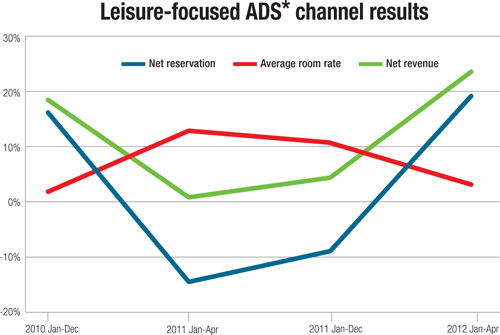
PEGASUS Solutions reports a big increase in leisure-focused ADS hotel bookings in Asia-Pacific for January to April (19%). This, however, may be a correction as it follows a 15% fall in the same period last year.

Average room rate still lags bookings growth (3%), which may indicate resistance in the market to rate increases. But it also follows a sizeable growth last year during the same period (13%).

Overall revenue  looks comfortable, growing near 24%. That compares with just 1% during the same period last year.

jun29_story4-1

jun29_story4-2

*Alternative distribution system (ADS) channel, which is used mostly for leisure travel. This consists of purely Internet bookings, including non-GDS online third-party channels or OTAs primarily used by consumers. Notes: Includes Africa. Source: Pegasus Solutions

This article was first published in TTG Asia, June 29, 2012 issue, on page 10. To read more, please view our digital edition or click here to subscribe.

Reporting by Murray Bailey

Idenburg heads off to Abu Dhabi

0

PIETER Idenburg, who has resigned as CEO of Suntec Singapore International Convention & Exhibition Centre, has revealed his next move – CEO of Abu Dhabi National Exhibitions Company (or ADNEC Group), which owns and operates the Abu Dhabi National Exhibition Centre, the largest exhibition venue in the Middle East, and is also into convention centre management business.

The appointment is effective August 1.

“I am delighted to play a part in ADNEC’s future in Abu Dhabi, the region and in the exhibition and convention industry as a whole. I am sure that my lifelong passion for service excellence will support ADNEC to grow the business in line with its vision and values,” Idenburg said.

Idenburg served as CEO of Suntec since 2005, helming events such as The IMF/Worldbank Conference, APEC meetings and the first-ever Youth Olympic Games. He was also CEO of Suntec International.

His resignation from Suntec came as a surprise, as he was gung-ho about expanding Suntec’s convention centre management business, while the convention centre in Singapore itself is undergoing a S$180 million (US$142 million) modernisation programme and a S$230 million upgrading for Suntec City Mall.

Idenburg would not comment on pull and push factors when asked by TTG Asia e-Daily.

Arun Madhok is acting CEO of Suntec Singapore (TTG Asia e-Daily, June 19, 2012).