TTG Asia
Asia/Singapore Friday, 26th December 2025
Page 2319

Caravelle Hotel debuts Sensational Saigon getaway for women

0

CARAVELLE Hotel has put together a weekend getaway package for women travellers for stays until January 31, 2014.

The Sensational Saigon package includes a stay in the Caravelle’s Signature Suite, full club benefits such as private check-in and check-out, free evening cocktails and canapés, daily breakfast buffet and all-day refreshments in the Signature Lounge.

Welcome chocolates, free Wi-Fi, daily fresh fruit and newspapers are also part of the deal.

Guests can also look forward to being pampered at Kara Salon & Spa, the hotel’s seventh floor wellness facility, once a day. Sessions include indulgent body scrubs, as well as shampoo and blow dry from the salon’s hairstylists.

Prices begin at 8.8 million Vietnamese dong (US$417) per room per night, based on double occupancy. The package is open to couples and women travelling alone or in pairs on weekends from now until January 31, 2014.

This excludes the Christmas and New Year weekends.

A whiff of the wellness market

0

Despite Asian spas becoming more holistic, outbound travel agencies say the regional wellness market remains miniscule for them. Direct bookings are a reason. There is also plenty of choice at home. TTG Asia looks at several Asian spa markets and their preferences

banyan-tree-spa_reception_photo-credit-marina-bay-sandsbig

SINGAPORE
Wellness travel is evolving among Singaporeans who travel consultants said are demanding a more “life-changing experience” than a body massage could give.

Rufus Tan, director at Quotient Travel Planner, said: “When people (Singapore travellers) refer to a wellness travel package today, they are more likely to be referring to a holistic programme, as opposed to a day spa, where the client deviates from his/her usual lifestyle and embarks on a scheduled programme designed to cleanse either body, mind or soul, or all three.”

For such holistic packages, the emphasis is on personalisation, where a programme is tailored to achieve a desired outcome after consulting an in-house doctor or specialist.

“Depending on the individual, the programme could cover a diet, physical exercise, meditation and massages, all designed to foster a sense of well-being,” Tan said.

CTC Travel’s senior vice president marketing and public relations, Alicia Seah, called these individuals “hard core” spa-goers, adding they are still a niche audience. The majority are singles in their early 30s, typically the busy working female professional.

Seah added that growing affluence and knowledge has created a greater interest for such packages, with CTC registering a five per cent year-on-year demand. Thailand, Bali and South Korea are popular, she said.

Likewise for Simon Cameron, managing director of Lightfoot Travel, wellness packages are popular among predominantly females. He said: “These travellers are those who work in professional fields, with long hours, or are mothers who juggle family and job.”

He agreed with Seah that wellness packages are largely popular in Thailand and Bali.

However, Cameron said: “We do not see a huge demand for wellness holidays specifically. Most still like to have a (general) beach, trekking or cultural exploration holiday with a few great spas and massages thrown in throughout the trip.”

As these packages are more personal, travel consultants said such travellers prefer direct bookings instead of going through them.

Seah said: “Asians being naturally shy will not approach an outsider with regards to their health conditions and issues. Also, the abundance of knowledge acquired from the Internet on this makes tour operators redundant.”

Quotient’s Tan added that wellness programmes are usually resort-based hence there is “not much value add” for the clients.

He suggested: “Perhaps agencies can start considering dedicated departments to do wellness programmes, where consultants are well versed in the various types of wellness programmes and are able to recommend programmes accordingly.

“They should have a basic knowledge of the differences between dietary, meditation, yoga and massage programmes. In this way, they can play more of an informed consultative role to prospective customers,” he said. – Lee Pei Qi

THE PHILIPPINES
The Philippine wellness market is primarily domestic and inbound, with outbound lagging behind.

Simon Ang, managing director-operations, Celebrate Life, Travel & Leisure, said wellness travel among Filipinos has not taken off owing to the availability of local services like massages and spa therapies that are almost identical in quality and techniques with their Asian counterparts.

Ang, who tried pioneering wellness travel several years ago by booking members of the erstwhile Spa Association of the Philippines (now Philippine Health and Wellness Society) on an educational tour of spas in Thailand, admitted the local market is not yet ready for it.

Agreeing, Josefina Baena, general manager of New Era Travel and Tours, said there is “no outbound, only booming domestic and inbound wellness travel” due to a growing prevalence of reasonably priced yet quality wellness and medical facilities in the country.

From the narrow concept of massage and spa, wellness in the Philippines has evolved into a holistic concept balancing body, mind and spirit, as seen from the opening of centres including The Farm at San Benito in Batangas, both Nurture Spa and Sonya’s Garden in Tagaytay, and the vast grounds of Chi Spa at Shangri-La’s Mactan Resort and Spa, among others.

The wellness menu has also expanded with the introduction of bespoke services for detox, weight loss, destressing, beauty enhancement, healing and the like.

And catching up with trends abroad, wellness has also become broader to encompass health and aesthetics and, frequently, medical tourism. Hence the smorgasbord of offerings from medical spas and plastic and reconstructive surgery to dental surgery, eye care and cancer care and treatment.

As a result, Ine Faustino, general manager of CCT 168 Travel and Tours, said Filipinos do not have to travel abroad purely for wellness. There are, however, special medical tourism cases, like stem cell therapy in Europe, fertility clinics in Singapore and Taiwan, and advanced medical procedures in the US that are not available locally.

Thailand has carved a name for sex change, plastic surgery, skin whitening and slimming medicines, said Dorothy Aytona, president and general manager, Skynet Travel Corp.

Among Asian NTOs, Aytona said Korea Tourism Organization Manila is one of the most aggressive in promoting medical tourism, having just completed promoting the province of Gyeonggi-do, a mecca for medical tourism.

Taiwan Tourism Bureau is also active in promoting medical tourism, including its therapeutic hotsprings, to Filipinos.

While Japan’s National Tourism Organization does not highlight wellness offerings, some travel agencies including Universal Holidays have included onsens or hotsprings in their tour packages.

Some clients like it but others hesitate skinny dipping in onsens, according to Michelle Victoria, president and general manager, Golden Eagle Travel and Tours. – Rosa Ocampo

maya-ubud-resort-and-spa-059-a-couple-at-spa_cmyk

INDONESIA
Home to famous traditional treatments such as the Javanese lulur and respected for its skilled masseuses, it is no wonder Indonesian spa enthusiasts make a beeline for their own country, with Bali as the number one destination.

WITA Tour director of sales and marketing Rudiana said: “Indonesians can find a wide variety of spa facilities in the country at affordable prices; there is no incentive to look elsewhere.”

While shopping is a must in a tour programme for Indonesian outbound travellers and demand for culinary experiences  is increasing, wellness has yet to catch on, observed Panorama Tours vice president retail business development, Fenny Maria.

“Some clients would request to include a spa treatment when travelling to Thailand, but they will not ask for one when travelling to Singapore or Hong Kong. Even then, they will not choose an elaborate spa programme, usually only an hour of spa treatment or so.

“Rare are those who want the more special treatments such as a hot stone massage, mud or chocolate scrub, or a signature programme. Price is the main consideration. The more exotic the programme, the more expensive it is. They will then compare it with what they could get back home and find it more affordable at home,” she said.

Indonesians who travel to resort destinations in the country, especially Bali, usually go for a spa. Even MICE events now include spa teaser programmes like a mini shoulder and foot massage.

There are also niche segments such as yoga groups that would spend a two-day/one-night programme in Bali taking a yoga class, practising by the river, doing meditation, and having a spa treatment and a healthy-cooking class. Such a package costs around Rp4 million (US$353) per person, while a similar package in Thailand could cost twice as much, Multi Holidays managing director, Rudy Techrisna, said.

Techrisna added: “In Bali, you can have a massage for Rp75,000 in a small day spa, or a sophisticated five-star yoga and wellness package. Indonesians don’t have to travel to Thailand or India to have them.”

Spas in neighbouring countries wanting to tap Indonesians could look to the luxury market or honeymooners. Smailing Tour vice president leisure division, Kurniawan Halim, said: “When a member of the high society or a honeymooning couple have had a good spa experience overseas, they would tell their friends and go again in a group.

“These travellers may book a flight and hotel with travel companies but arrange their own programme in the destination.” – Mimi Hudoyo

MALAYSIA
The Malaysian outbound spa market is small and growing slowly, according to tour operators.
Some of them, like Grandlotus Travel Agencies, tap Indian travellers in Malaysia to destinations such as Kerala, which is well known for Ayurveda.

Grandlotus managing director, K Thangavelu, said: “They have heard that Kerala is well known for Ayurveda and they wish to experience it out of curiosity. For this segment we have seen a year-on-year growth of five per cent.

“There are also those with ailments such as high blood pressure, rheumatism and diabetes who go for Ayurveda treatments to improve their health. Stays can range from two weeks to six months.

“Some ask us to recommend a centre and arrange everything for them, including flights, accommodation with full meals at the centre and consultation, while others will communicate directly with the centre and we do the transfers.

“This segment of travellers is still very small and we have business on an ad hoc basis. As we don’t advertise, they hear that we can make arrangements for them through word of mouth.”

Hidden Asia Travel & Tours tried to tap the Indian wellness market a year ago by including a one-day Ayurvedic treatment into its South India programme covering Kerala, Trichy and Rameswaram. But growth was minimal. However, managing director, Nanda Kumar, is not giving up.

With the depreciation of the Indian rupee against the ringgit, Nanda recently started promoting Ayurveda treatments in India to the Malay and Chinese communities in Malaysia at consumer travel fairs and through advertising in the local Malay and Chinese papers. The main challenge he faces is convincing Malay clients that there are halal restaurants in Kerala.

New Asia Holiday Tours & Travel general manager, Raaj Navaratnaa, also saw minimal growth of three to five per cent since venturing into wellness programmes two years ago. Popular destinations are Kerala and Bali. He sells a nine-day or 14-day total detox programme in Kerala, which includes vegetarian meals and consultation with an Ayurvedic practioner. His five-day/four-night detox programme in Bali includes organic meals and massages.

He said clients who ask for these programmes want to feel good at the end of the programme.
He added: “There is potential growth especially for travellers who have already been to India and Bali many times. Wellness offerings will give them new reasons to revisit the destination.”

Raaj said the main challenge of promoting wellness tourism is the lack of awareness among the Malaysian public on the benefits of wellness. He said: “Most people, especially the elderly, think they know what is best for them. It is difficult to convince them to take a few days off and go for a wellness programme.”

Panorama Tours Malaysia was at press time developing a wellness package to Nepal which involves meditation and yoga practices for total mind and body relaxation. This is scheduled to be launched in November.

Its managing director, Richard Vuilleumier, said the target markets are business owners and senior managers. “We will have scheduled departures, perhaps twice or thrice a year, depending on how the market reacts to the product. I expect it to appeal only to special interest clients.” – S Puvaneswary

HONG KONG
While the Hong Kong outbound market is a mature Asian market overall, its wellness segment is still a baby, said tour operators.

Kuoni Travel (China) general manager – sales, marketing and distribution, Raymond Ng, said: “Currently the awareness and acceptance of wellness travel is still low, so raising awareness obviously is the first step to take.”

Sunflower Travel Service senior manager, Wendy Li, said: “It’s still in the infant stage, accounting for less than 10 per cent of our business. I take care of FITs by tailoring the programme for them, but they are only concerned about entertainment, fun and dining. They are not ready to spend on a trip for the sole purpose of wellness. Some clients may ask for spa services at a specific destination, but this is only a small element of wellness travel. To me, it’s an experience at wellness resorts such as Chiva Som in Thailand. Unfortunately, I have not received many requests from clients to stay there.”

Li expects the market to take off slowly in the next five to 10 years as more consumers shift from group travel to FIT, and as air access opens up new wellness destinations such as Vietnam.

“So far, Thailand has successfully positioned itself as a spa destination. It is deeply rooted in Hong Kong travellers’ mind for spas. South Korea may be an option for (services such as cosmetic plastic surgery) but we would not include these treatments as they involve a lot of complicated procedures.”

Meanwhile, Miramar Travel is pushing spa packages to the younger generation. General manager, Alex Lee, said: “The whole market is still not ready for the wellness concept but we observe more groups of young ladies now and they are craving for it. We include spa/massage treatments and choose hotels that are located in downtown shopping areas.” – Prudence Lui


This article was first published in TTG Asia, November 1 – 14, 2013 issue, on page 10. To read more, please view our digital edition or click here to subscribe.

Additional reporting from Rosa Ocampo, Mimi Hudoyo, S Puvaneswary, Prudence Lui

What Thailand needs is niche

0

Andrew Wood, president, Skal International Thailand, shares his thoughts on marketing

andrew-wood-oct2013

The Tourism Authority of Thailand (TAT) has excellent products at its disposal but not surprisingly promotes all of them to all markets to maximise ROI. It has good campaigns and the record-breaking number of tourist arrivals is testament to Thailand’s intrinsic strengths and TAT’s marketing.

Is it a good policy to be all things to all men or should Thailand specialise as well?

Markets are changing and our marketing efforts also need to change. We should be cognisant not to just focus on destination but to also emphasise unique, new experiences that cannot be found elsewhere.

Thailand is a leader in the field of medical tourism and was a pioneer in Asia in this very lucrative niche. Medical tourist arrivals to Thailand had 40 per cent of Asia’s medical tourist arrivals in 2011. Its medical tourism market was around US$2 billion in 2011 and is expected to be more than double by 2015. Thailand has been one of the favourite medical tourism destinations due to its cultural heritage, state-of-the-art medical facilities, personalised hospitality and reasonable medical costs. The country takes pride in having the first hospital to receive the first JCI accreditation in Asia and has the highest number of JCI-accredited hospitals in Asia.

We can learn lessons from this successful marketing campaign. Thailand identified a demand in the market, and with our unique ability to offer high levels of service at relatively low cost and with companies such as Bangkok Bank investing in a total integrated five-star hospital experience in Bumrungrad, Thailand was able to provide world-class products to a market that was hungry for easily accessible and affordable quality medical care.

It is a specialised market requiring specialised promotion and specialised attendance at very specific tradeshows and conventions. Thailand’s record shows what can be done with a very careful rifle-shot approach to marketing (narrow and very targeted) as opposed to a shot-gun approach.

According to the UNWTO in 2007, over half a million Americans travelled abroad to receive medical treatment and since 2003, 1.3 million Britons aged 16 to 64 had dental treatment outside the UK because it was more economical.

By 2015, the health of the so-called Baby Boomer generation will have started to decline. With more than 220 million Baby Boomers in the US, Canada, Europe, Australia and New Zealand, this represents a significant market for Thailand.

I recently met up with a potential client who was in Bangkok to attend IT&CMA. The company deals exclusively in school sports tourism. This is another HUGE niche market, and we hope to tap into international schools travelling abroad with pupils, educators and parents. By their very nature, private independent schools are economically a different animal to what we might traditionally imagine. They have funds and opportunities for travel that are little understood.

You don’t need to be an expert to realise the Chinese are definitely coming to Thailand. Their presence and their numbers are clearly visible. During my visit to Shanghai earlier this year I was briefed by the TAT office on the expected number of arrivals to Thailand over the next few years: 4.2 million Chinese arrivals from an expected total of 24.5 million from all markets, i.e. one in seven tourists visiting Thailand in 2013 will be Chinese, rising to one in five next year. This is definitely not a niche market.

Will there be a backlash to such a weighted mix? Yes I believe so, not just because of Thailand’s response to tourist’s cultural/behavioural traits, but also the risk of too many eggs in one basket not being good for business.

Spreading the risk is important and niche markets can help. I believe that we need to offer, like medical tourism, complete integrated packages with a one-stop-shop approach that includes unique world-class experiences, be it golf, spas, beaches/resorts, cooking or culture. Luxury will also have a place and is usually recession-proof. Stretch the imagination – potential arrivals will pay for unique once-in-a-lifetime experiences and travel great distances to find them. Bespoke tourism tailor-made to your whims, likes and dislikes also doesn’t get more unique.

Thailand needs platinum-quality travel professionals to sell dreams not just holidays. If we can incentivise these visitors with tax breaks, such as tax deductibles or VAT refunds, and funnel marketing funds to the private sector too, all the better.

This article was first published in TTG Asia, November 1 – 14, 2013 issue, on page 3. To read more, please view our digital edition or click here to subscribe.

By Andrew Wood, president, Skal International Thailand

Connecting Europe and Asia

0

The poor shape of European economies in recent years has depressed outbound demand, but travellers from Asia-Pacific have taken up the slack, driving route expansion

Air routes linking Europe and Asia were dominated by European carriers from the 1930s until the 1980s, when Asian carriers burst onto the scene and made great strides. In spite of this, the number of European carriers operating to the Asia-Pacific region continued to spike in the 1990s. With the entry of Gulf carriers, the dynamics on these routes changed dramatically and many European carriers shaved capacity before eventually pulling out.

The dominant European carriers serving the Asia-Pacific region today include Air France, British Airways, Lufthansa and Finnair – all of these except Finnair have gained critical mass and strength through some form of merger, acquisition or consolidation. Finnair, however, has been able to ride on its proximity to Asia (via the Polar Route) and its growing cooperation with Air Berlin. Also included in this report is Qatar Airways, which is a strong operator along the Europe-Asia Pacific air corridor and the first Gulf carrier to join an alliance.

As economies in Europe and the Asia-Pacific begin their upward swing from recent lows, air travel between both continents will once again grow in prominence. The airlines featured will surely be joined by more of their Asian counterparts. Along with these, a new threat in the form of longhaul low-cost carriers will probably begin to gnaw at the incumbents’ load factor and yield.

b777-200dxvo-p044820havet_claire_lise_01-cmyk

AIR FRANCE
Network/capacity growth in 2013
Air France added Kuala Lumpur to its route map in April. The thrice-weekly flights from Paris-Charles de Gaulle are operated by a Boeing 777-200.
In terms of capacity to Asia, an average of five per cent growth has been maintained. During the airline’s 2013 summer season, frequencies increased from five weekly to daily for Guangzhou and three to four weekly for Bangkok. Service to Ho Chi Minh City was also adjusted, with four flights weekly operated by a B777-200 instead of three.

Network/capacity growth in 2014
Jakarta will join Air France’s network from March 30, 2014. A continuation of the Singapore service, daily flights will be operated by a B777-300.
Senior vice president, Asia-Pacific, Patrick Roux, said: “Apart from (adding new routes to) Indonesia and Malaysia, we also have our eye on developing Philippines and are growing frequencies for Vietnam.”

Product upgrades
Starting from June 2014, 44 longhaul aircraft will be retrofitted with new premium economy and economy cabins featuring seats with more legroom and wider touchscreens, among other changes. However, it is still unknown which routes in Asia these will be deployed on. The airline also plans to unveil its new business-class offerings and La Première (first class) in January and April 2014 respectively.

Performance
For the first eight months of 2013, load factor hit 86 per cent for Asia-Pacific, a 0.2 per cent year-on-year decrease.
According to Roux, the Greater China market is dynamic. “While there is still a lot of group travel, FIT is growing fast,” he said.
Regional manager for Hong Kong and Macau, Wenchi Wang, added that fly-cruise travel is also on the rise, with the airline launching such packages this summer.

Trade partnership
Air France stirred up protests among agencies in 2010 when it pioneered the zero-commission policy in Hong Kong. However, Wang said: “They are still our key partners and we cooperate closely on different destination packages and a variety of products.”
A series of seminars, fam trips and roadshows are coming up next year for the airline to introduce its new cabin products.

USPs
Air France is the only carrier to serve champagne on longhaul international flights to economy-class passengers. – Prudence Lui

ba-777-300er-330-dpi

BRITISH AIRWAYS
Network/capacity growth in 2013
British Airways launched thrice-weekly services from London to Colombo and Chengdu in April and September respectively. Both services are operated with B777-200s and come on the heels of six-weekly flights to Seoul-Incheon in December 2012. Frequencies on London-Hyderabad and London-Chennai were boosted by one flight per week in October, the same month one of two daily flights to Hong Kong was upsized to an A380.

Network/capacity growth in 2014
In summer 2014, Seoul-Incheon will receive a seventh frequency per week while the newly launched London-Chengdu route will see a doubling of frequency to six per week.

Product upgrades
In 2013, following the termination of a commercial partnership with Qantas Airways, British Airways’ services to Singapore, Australia and Thailand have migrated to Terminal 5 at Heathrow Airport. This move has vastly improved connection to other cities in the UK and across Europe.
British Airways newest cabin products are also offered on the B777-300ERs that ply London-Singapore-Sydney and on the B747-400 for London-Singapore.

Performance
British Airways’ area general manager, Asia and the Pacific, Jamie Cassidy, declined to disclose the airline’s performance but noted that “more and more business customers are returning to the skies and there is a steady demand for travel to the UK by holidaymakers and students”.

Trade partnership
While the airline sees a steady increase in bookings on its website, many of its customers in China and South Korea continue to rely on support from travel consultants. Cassidy said: “Travel agencies and consultants remain a very valuable channel for us and we continue to invest in our relationships with them. We also regularly work with them to raise the profile of the UK as a tourism destination.”
British Airways’ longstanding Speedbird Club also ensures that its travel consultants in the region have round-the-clock access to its policies, fares and service information.

USPs
British Airways is the first airline to introduce both the A380s and B787 Dreamliners into its fleet, part of a five-billion-pound (US$8 billion) investment in new aircraft, an upgraded cabin and inflight menu, and more intuitive service delivery. The state-of-the-art Terminal 5 at Heathrow is also used exclusively by British Airways and Iberia. – Sim Kok Chwee

110902_747_8_intercontinental_9280-cmyk

LUFTHANSA
Network/capacity growth in 2013
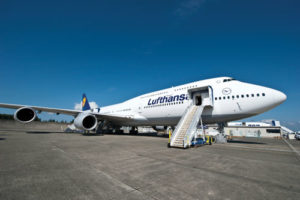
Earlier in 2013, Lufthansa deployed its B747-8 Intercontinental to Hong Kong. In September, the A380 was also operated five times weekly on Frankfurt-Shanghai. It continues to boost capacity through the deployment of larger-capacity aircraft and currently, the A380 is operated to Tokyo, Beijing, Shanghai and Singapore, while the B747-8I, Hong Kong, New Delhi and Bengaluru.

Network/capacity growth in 2014
Starting October 27 and into the summer of 2014, the existing A380 service into Tokyo-Narita will be replaced by the B747-400. In summer 2014, the A380 will replace the B747-8I on the Beijing route, while the B747-400 replaces the A340-600s to Seoul-Incheon and on the second seasonal service to Shanghai. The current Munich-Seoul service operated by an A340-300 will also see a capacity boost through the deployment of an A340-600 six times per week.

Product upgrades
Starting mid-2014, Lufthansa will retrofit its entire fleet of longhaul aircraft with its new  business-class, fully lie-flat seats at a cost of one billion euros (US$1.4 billion). The airline is also introducing its onboard wireless internet service – FlyNet – on its longhaul fleet.

Performance
In the first half of 2013, Lufthansa’s services to the Asia-Pacific have outperformed other routes in its network, with load factors exceeding 80 per cent.
Steffen Harbarth, Lufthansa’s vice president Asia and Pacific, said: “China and South-east Asia in general and Singapore in particular have been strong performers in the region. However, the currency development in many other parts in Asia, especially Japan and India, are challenging.”

Trade partnership
“We have several schemes in place that vary from market to market. In general we are keen to open our own sales tools to our loyal sales partners in order to give them best access to available routes and prices,” Harbarth said, adding that the airline had attracted many new potential partners in emerging markets like Indonesia.

USPs
Precision, punctuality and professionalism. With a whole brood of airlines under its wings, the Lufthansa Group is also able to offer multiple hubs in Frankfurt, Munich, Zurich, Vienna and Brussels as well as its own dense network of intra-European point-to-point connection through or even bypassing busy hubs. – Sim Kok Chwee

fina340-unikko

FINNAIR
Network/capacity growth in 2013
In June, Finnair launched thrice-weekly services to Hanoi and Xi’an with A330s.

Network/capacity growth in 2014
Finnair’s country manager in Singapore, Nick Naung Naung, would only say that new routes will be announced in due course. He added: “We are always evaluating possibilities to add new routes or frequencies, and we have targeted to double revenues from Asian traffic between 2010 and 2020. This will most definitely entail a vigorous pursuit of new route opportunities.”

Product upgrades
As part of its ‘Design for You’ motto, Finnair’s collaboration with Marimekko Studio involves its tableware, textiles and even a special livery adorning its A340-300s. Besides being more aesthetically pleasing, the new tableware in business class boasts weight savings of up to 20 per cent.
Finnair has also recently relaunched its Signature Menus, taking advantage of Finnish natural ingredients, seasonal vegetables and wild game and fish. These include specialties such as reindeer fillet, and are prepared by well-known Michelin-star chefs who are prominent in Finland’s culinary scene.

Performance

Although load factors have improved on most Asian routes in the first half of 2013, yield remains a challenge for Finnair. In the second quarter of 2013, demand in Asia for its services to Helsinki and Europe actually contracted 2.1 per cent.

Trade partnership
To help travel consultants better sell the airline’s services, Finnair sees the importance of communicating the benefits of its products. Commenting on the airline’s relationship with agencies, Nick Naung Naung said: “These really vary quite a lot by local market and route, but we have regular product updates and product presentations. We also have fam trips (via Helsinki) for selected travel (consultants) to help orientate them around the Helsinki airport and our Finnair products.”

USPs
Finnair’s hub at Helsinki is geographically well placed to connect traffic from Asia to the rest of Europe and North America via the Polar route. Helsinki’s Vantaa Airport is probably one of the most efficient for connections, something which can be consistently accomplished within minutes. The Lapland, billed as home to Santa Claus, will also continue to fascinate families seeking a winter destination with a strong dose of Christmas cheer. – Sim Kok Chwee

pic-40-qatar-airways-boeing-777-300er-cmyk

QATAR AIRWAYS
Network/capacity growth in 2013
In 2013, Qatar Airways launched services to 11 new destinations. Among them are daily flights between Doha and Phnom Penh in February and Chengdu in September as well as thrice-weekly services to Clark in October. Meanwhile, Yangon’s thrice-weekly service was increased to daily on October 27, while Jakarta welcomed 14 flights a week from September 1, up from 11.

Network/capacity growth in 2014
Qatar Airways’ CCO, Marwan Koleilat, would only say: “Our strategy is to expand our footprint in Asia-Pacific as well as increase frequency on existing routes to offer passengers greater choice.” The region is one of the most significant for the airline.

Product upgrades
Qatar Airways’ most significant product enhancement will be realised when the new Hamad International Airport (HIA) is opened in stages starting end-2013. HIA will initially be able to handle 28 million passengers per annum (mppa) but will grow its capacity to 50 mppa. With unrestricted operation for all aircraft types – including the A380 – HIA will further smoothen the airline’s intercontinental connections throughout the day.

Performance
While it did not disclose performance of its services, Qatar Airways noted that most of its customers from this region travel beyond Doha to final destinations in the Middle East, Africa, Europe, North and South America.

Trade partnership
Koleilat said: “We value the role of travel consultants. They are the experts on the ground with access to the customer, providing valuable advice in a timely fashion. As technology evolves, we will continue to find ways to work closely with our trade partners to deliver value-added services to our customers.
“Travel consultants can play a more active role in helping airlines collect passenger contact information at the point of sale. It is to our mutual benefit for both parties to work together to fulfill the various mandatory government security requirements.”

USPs
Its multi-national cabin crew – many of whom are from Asia – are well placed to cater to the needs of its customers in Asia-Pacific. Its in-flight menus too strongly feature Asian meal options. Most importantly, Qatar Airways’ strength lies in its ability to connect passengers from one plane to another, even when these are parked in remote stands at the existing Doha International Airport.
– Sim Kok Chwee

This article was first published in TTG Asia, November 1 – 14, 2013 issue, on page 6. To read more, please view our digital edition or click here to subscribe.

Additional reporting from Prudence Lui

Jetstar ramps up Yangon frequency with three additional services

0

JETSTAR Asia is adding three more weekly services to its Singapore-Yangon route in order to meet strong demand from passengers.

The introduction of the new flights on November 20 will bring the LCC’s number of weekly services on the route from seven to 10, offering 15,600 seats each month.

Running on Tuesdays, Wednesdays and Fridays, flights out of Singapore depart at 17.20 and land in Yangon at 18.50. Return lights leave Yangon at 19.30 and arrive in Singapore at 00.10 the next day.

Jetstar Asia’s CEO, Bara Pasupathi, said: “In the last few years as Myanmar has opened up and more tourists have started to explore this country, the demand for our low-fare services has grown significantly.

“Offering a morning and an afternoon flight will not only suit the growing number of business and holidaymakers going to Yangon, but will provide more options for people to connect through to other cities opening up in Myanmar.”

Jakarta banks on bloggers for Singapore promotions

0

JAKARTA’S tourism authority is harnessing the power of social media in its latest bid to court tech-savvy Singaporean travellers.

In town yesterday to meet a group of Singapore-based bloggers, Cucu Ahmad Kurnia, promotion director of the Jakarta City Government Tourism, said: “We know Singapore is a very ‘techie’ country and social media will be the best way to increase awareness and grab their attention.”

Jakarta City Government Tourism will be hosting all 15 bloggers in Jakarta this month and give them a “taste of Indonesia through shopping and culinary adventures over 12 days”.

“Singapore is generally very similar to Jakarta in terms of habits and lifestyle so (Singaporeans) can relate well to us,” Cucu said.

He said this is the first time the tourism body is utilising blogging as a tool for destination promotion, Singapore was its pilot project. He added that his organisation would assess the results of this campaign before extending it to other countries.

He said: “There is still the perception that Jakarta is an unsafe destination and we want to overturn this mindset. (Promotion) becomes more intimate when bloggers share their first-hand experiences with their readers, and this can help us increase interest from Singapore.”

Apart from utilising blogs, Cucu said Jakarta will be rolling out its newly revamped website by end of this year, which contains interactive features for more “two-way communication”.

Indonesian flag carrier Garuda Indonesia in August increased capacity on the Singapore-Jakarta route by deploying larger aircraft to meet strong demand (TTG Asia e-Daily, August 30, 2013).

Huma Island resort soft launches in Palawan

0

HUMA Island resort forged ahead with the launch of soft operations in northern Palawan today, having “amicably” terminated its management agreement with Movenpick Hotels & Resorts (TTG Asia e-Daily, March 16, 2012).

News of the split was confirmed by Huma Island’s director of sales & marketing, Jean Taouk, who declined further comment.

Instead, he shared that the resort already has confirmed bookings from Chinese and Russian guests. “We also have a minimum of 15 villas booked for a Singapore group for two nights, and another booking for 22 villas,” Taouk added, who said the whole island is also bookable.

He expects a surge in bookings in the February-March period from MICE and leisure clients, as well as honeymooners.

The resort is accessible by a 15-minute seaplane ride from Manila Bay to Huma; or a 30-minute drive from Busuanga to Coron, followed by a 50-minute speedboat trip or seaplane ride to Huma Island.

Available during the resort’s soft opening are 24 over-water villas and 15 beachfront villas, three F&B outlets, a spa, diving centre, kids’ play centre and library.

When complete, Huma Island will have a total of 64 over-water villas, 15 beachfront villas and a pair of two-bedroom villas. The resort is looking at a grand opening in March 2014.

All bookings made from now until December 22 will feature discounts of 50 per cent for published rates and 20 per cent for F&B and laundry.

Malaysia removes VoA for Iranian tourists

0

THE Malaysian government’s decision to scrap visa on arrival (VoA) for Iran will hurt Iranian arrivals during the Visit Malaysia Year campaign, according to Malaysian travel consultants TTG Asia e-Daily spoke to.

Malaysia stopped issuing VoA for Iranians after a request from the Australian government, on fears that Iranians were using Malaysia as a transit point to enter Australia illegally, reported Malaysian daily The Star.

Aspen Holidays’ operations manager, Loo Pei Yuet, said: “Iranians are last-minute travellers, so having to apply for a visa and wait for approval will definitely affect arrivals.”

Combined with the weak Iranian rial relative to the US dollar, she predicted a 40 per cent drop in business from Iran during the Iranian new year Nourooz in March, also the peak Iranian travel season.

Meanwhile Andy Muniandy, director of sales and business development at Asian Overland Services Tours & Travel, said the impact on arrivals is subject to how easy it is for Iranians to obtain a visa from their country of residence.

He added that his business would not be very affected as Iran is not the company’s main market. “We get mainly ad-hoc, FIT travellers and our main destinations are Kuala Lumpur, Penang and Langkawi.”

Last year, Malaysia saw 127,404 Iranian tourists representing an 8.7 per cent decline from 2011, when the country registered 139,617 Iranian visitors.

Ritz-Carlton debuts in India

0

THE Ritz-Carlton Hotel Company has launched its first hotel in India, the Ritz-Carlton, Bangalore.

The property located in the centre of downtown Bengaluru offers 277 rooms, seven dining venues to be run by a Michelin-starred chef, a Ritz-Carlton Club Lounge, a spa, salon, and the city’s largest no-pillar ballroom.

The Lantern is a stunning three-level restaurant offering authentic Chinese dim sum and cuisine; The Market offers all-day dining with a unique wine room and private dining spaces for guests; and the fine-dining restaurant Riwaz serves up authentic Indian dishes.

The rooftop bar and sky lounge Bang offers panoramic views of Bengaluru over cocktails and Jaali-inspired dishes; the Lobby Lounge serves afternoon tea and cocktails; and The Ritz-Carlton Bar lures with a wide selection of cocktails and fine wines.

Apart from the spa facilities, level five of the property also features an expansive fitness facility with a fully equipped Technogym, and an outdoor swimming pool with a poolside lounge and bar surrounded by lush foliage.

Business facilities include a range of meeting rooms featuring the stunning 600m2 Ritz-Carlton Ballroom, one permanent boardroom and three function rooms with natural light.

Thai Lion Air buckles up for competition in budget sector

0

NEW LCC entrant Thai Lion Air will go head-to-head with budget carriers in Thailand when it commences operations this year-end, differentiating itself through consistently low fares and value-adds.

The airline will start twice-daily flights to Chiang Mai and Jakarta respectively, and one daily flight to Kuala Lumpur from its Don Mueang base on December 30 on its two brand-new B737-900ERs, said Thai Lion Air CEO, Darsito Hendroseputro, during a media briefing today.

When questioned on the adoption of the LCC strategy for Thai Lion Air as opposed to the hybrid model adopted by sister airline Malindo Air in Malaysia, Darsito said: “Thai Lion Air will operate like our parent company, Lion Air, in Indonesia, on a total LCC model. People coming to Thailand look for value, so the potential of the Thai market is more towards the low-cost segment.”

“We are aiming for a six to eight per cent market share in Thailand…The LCC market in Thailand is fairly challenging, but the number of people using LCCs is increasing every year. In five years’ time, we envisage Thai Lion Air to be one of the strongest LCCs in Thailand,” he remarked.

“In 2014, we are bringing an additional eight aircraft into Thailand, with a total of 50 aircraft in another five years,” said Darsito, who added the airline would also begin flying to Phuket and Hat Yai in Thailand, Singapore, India and China (likely Guangzhou and Hong Kong) next year.

The LCC today unveiled its new Boeing 737-900ER aircraft, which will be deployed on the carrier’s first routes, at Bangkok’s Don Mueang International Airport.

“Thai Lion Air will be the first airline in Thailand to operate the B737-900ERs, the biggest narrow-body in the world,” said Leithen Francis, head of public relations, Lion Group. The higher 215-seat capacity on its new aircraft – versus the typical 180 seats on Airbus A320s – would enable Thai Lion Air to operate its routes more economically, he added.

Darsito remarked that the airline “will offer consistent low fares”, as opposed to its competitors’ strategies of offering low fares for a limited period.

Further setting the carrier apart from the competition is Thai Lion Air’s free 15kg baggage allowance, said Francis.