TTG Asia
Asia/Singapore Friday, 10th April 2026
Page 2310

We built the City

0

The ‘City’ he built turned 50 last year – richer, greener and peppered with hotels. At 72, the Singapore tycoon has more indefatigable energy than ever
21feb_kwek-leng-beng-dscf8850_72dpi
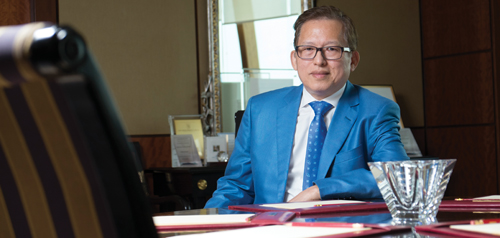
Kwek Leng Beng, Executive chairman, City Developments Limited

You’ve just hired the first CEO for City Developments Limited (CDL), Grant Kelley. What would you like him to do?
He is a private equity man who knows how to invest in real estate, from Japan, China, Australia to the UK and the US. He also has experience with hotels, which will help, as CDL has a big subsidiary hotel group. We have not yet extracted the full potential (of Millennium & Copthorne [M&C]) in terms of earnings, assets and value creation. Private equity people are good in controlling costs and improving the value of a property.

How would you like to see M&C grow and strengthen?
We have been growing. We’ve just acquired the Wyndham (Grand London) Chelsea Harbour (and at press time, the Novotel New York Times Square).

But there aren’t many assets coming into the market. In any case, hotel capital values worldwide, Singapore including, have gone up a lot, but earnings have not caught up. In Singapore, a three-star hotel was recently sold at S$900,000 (US$710,000) per key, which was unheard of before. Grand Park Orchard fetched S$1.4 to S$1.5 million per key, even though the rooms are small. Construction and land costs have gone up.

The New York Palace was sold in 2010 for only US$400,000 per key. Today, anything less than US$2 million (per key) will not buy you a five-star deluxe hotel in New York.

What about emerging markets or buying another chain, like the Copthorne Hotels that you bought?
We are looking at emerging markets, but there’s always a priority. We also looked at buying another chain over a year ago, but there were few opportunities in that chain that we could work upon and the financials didn’t work. Today one also competes with many private equity firms, all flushed with funds. So the whole dynamics have changed. I tried to repeat what I did in the early days when I first started to buy hotels – it’s too late now, unless you’re willing to pay blindly.

Don’t you wish you had bought more?
Of course, but don’t forget, at the time, that kind of money was big, also I didn’t want to put all my eggs in one basket. I had a policy to diversify, into global markets and into different sectors, so if one sector goes bad, it will be balanced by another. Look at SARS, when occupancies dropped to zero in Singapore and East Asia hotels. But in Europe and America, business was strong.

So what to do, if there isn’t a lot to buy?
You continue to have the vision to buy, search. Meanwhile, you add value to your existing hotels. With the right concept and proper renovation, you might be able to increase your rates by 30-50 per cent. That’s as good as buying or building another hotel, where you have a gestation period of two to three years (for hotel construction) in which there is no income. Then, when the cycle is up, you can sell it if you like.

Do you see yourself as a hotelier or a real estate player?
You can say both, and add being a financial man too. Hoteliers might not be real estate people; they are also generally not financial people. They don’t necessarily see things the way I do. I have come across GMs or even more senior management staff who say, ‘We must give good service.’ But what’s the use of giving six-star service and charging four-star rates?

Hoteliers can be dreamers. They are polite and articulate. Even if their hotel occupancy is low, they will give a long speech on how good the occupancy is.

This is why if things don’t work out (with people), I have a policy that we must be brave enough to change them. People try to advise me, ‘Don’t change or else no one would dare to join you.’ When I interview senior people, some of them have asked me, ‘I hear you have a revolving door practice?’ I reply, ‘If you are suffering from cancer, should you not seek treatment?’

You are in the hotel industry, you should know how good they are. In fact though, at M&C, we have had only one CEO who was with us for six months only. (The others served an average of five years, the longest serving being Richard Hartman). In the US today, if you’re no good, you get chucked out pretty quickly.

So it’s not that you’re tough, but they are weak?
Exactly. Business is business. If you are frightened, don’t join me. If you’re a (weakling), I will find out.

It is hard to find a good CEO and it’s getting harder, isn’t it?
Yes, the world is seeing a lot of hotels being built. The greatest problem facing the industry is talent. You have a lot of people who are willing to work, but they are not up to the mark. And the good ones get poached frequently.

International chains earn big money through management/franchise fees. Why is this a small part of your business?
To a large extent, it’s because of a shortage of talent. It is true one’s brand will be enhanced with more management contracts/franchises, so it is something we should do more. But it’s not a priority.

I’m big in management contracts/franchises in the Middle East (including 25 contracts), with 40 more in the pipeline. We have a good partner there who’s aggressive and hands-on. But overall, we prefer not to be too involved (in this area). I use the rule of thumb that, in terms of income, one hotel you own equals 20 management contracts. The fee is based on percentage of turnover and GOP, but do you realise how many people and how much infrastructure you must have? If you have 10 good hotels, why would you want to manage other people’s hotels and earn so little? So, our priority is our own hotels.

So why do the other chains want to be asset light?
They get better returns because they have critical mass. But they don’t appreciate there’s a lot of capital value to be harnessed (from owned hotels). My Orchid Inn (Singapore) used to make less than S$10 million a year. At the right time, I pulled down the aged building, had planning approval to build a condo and sold the units I developed. I announced a profit that would take me 30-40 years to make if it were a management contract.

How much of your success is luck?
Luck plays a part, especially these days, when the world is so uncertain. But some calculated risk and foresight are necessary. My strengths are, I can analyse and I have some foresight. I always go with one fundamental pro and con and not with the whole host of pros and cons that can make me unable to make a good decision in the end. I always believe, if you can solve that one fundamental issue, the rest will in turn be solved.

This is why I have bought hotels within 24 hours of being offered. I made quick decisions because I was confident they were good buys.

While hotel operations contribute nearly half of City’s revenues, at the end of it, the profit contribution is not even 20 per cent.
Hotels don’t make as much as property development. Also if one does not control costs one will not make much money. But we are making strong progress. We now have training programmes and are raising the standards of certain services and giving new amenities. Over time, these costs will be absorbed.

But yes, even my son once commented to me, that with hotels, one faces management issues every day in every department. But in property, there are only three chapters, so to speak: you buy land, get planning approvals then sell. Yet even he feels that the property business is not challenging enough and prefers to be in biotech. In biotech he can make a lot of money if he identifies the right biotech. He said, ’I don’t want to work so hard like you!’

If you ask me, if I were to be reborn would I go into hotels? I would say no. Too much work for too little profit and by the time you make a profit, you need to channel it back to keep up with the trends.

But you have fun with it.
Yes, but up to a certain point. You travel so much that you suffer from jet lag. Everywhere I go, I don’t see the country’s sights, but I try to see the latest trends at places I travel to. I check what are people doing there that is so good? Can we think of something better or modify what they’ve done?

Are you a connoisseur of luxury hotels?
I once asked my late father, ‘Why don’t we position ourselves as a deluxe developer?’ He said, ‘Why be so silly? You should do whatever that can make money – deluxe, middle, lower end – cast your net wider.’

This is the right strategy. Some people focus on luxury only because they want to create a statement for themselves. But the trick is, a three-star makes more money than a four-star, a four-star more than a five-star. Pick your choice. I choose to cast my net wider so I have better profits and spread my risk.

So you’re not keen to build your own luxury brand, even with your South Beach project in Singapore?
What’s the objective? To make money or to create a statement? I don’t need to create a statement. I think I’m already known in the hotel world, maybe better known in the hotel world than in the real estate world. When I bought The Plaza New York, people said, ‘Who’s this Singaporean in New York buying The Plaza?’

Why did you tender for South Beach about five years ago?
Initially, I was not interested. One day, I went to the DTZ office at Shaw Towers along Beach Road, from where I could see the new developments in the city’s financial district. I had unobstructed views. Location and the priceless views were the deciding factors. South Beach is just across the road from the convention centre, Suntec Singapore. That’s why several international chains have knocked on our doors to manage South Beach. But we haven’t made a decision on who will manage South Beach.

Are you inclined to outsource or self-manage?
Sometimes, after calculating management fees, I feel you can be better off managing the hotel yourself. One can’t assume that international management will perform better. They may get you a higher rate (because of the brand), but if the hotel management group has five hotels in Singapore and each day they have 500 rooms to fill, how much is your share of the business?

What is the one thing international management companies have not learnt through all these years?
Some are living on past glory or the perception that their brands can drive a lot of business. It was true perhaps in the early days.

After the (former) Westin (Plaza & Stamford), which had 1,500 rooms, left Singapore, we brought in The St Regis brand for our hotel. How many Westin customers shifted to St Regis? Not many. (Both brands are owned by Starwood Hotels & Resorts.)

Also, even though chains love to talk about consistency, and try their best to achieve it, their products are not always consistent. I can assure you that many a four-star hotel in London is only as good as a three-star here.

What’s your vision for South Beach? And why Philippe Starck?
I want to create a hotel that is not a cookie cutter. Something that is both lifestyle and luxurious, that will make you go ‘waaah’ when you see the lobby and, by the time you reach your room, your mind is no longer so jumpy; you just want to relax.

So we thought of Philippe Starck. His design is more down-to-earth now. Previously, his concepts at times were edgy, like Alice in Wonderland (jokes).

People don’t like cookie-cutter products. When I built my Studio M, the first loft hotel in Singapore, people loved it. Singaporeans do staycations at the hotel. It attracts the hip crowd, who party there over the weekends. The occupancy and rates have been high from day one.

I understand you’re creating another M – M Social.
I’m trying to create another lifestyle category, this time for young people who want to socialise and interact with one another, use technology, want to see and be seen.

Is there any other gap left?
One day I would like to build a two-star hotel, but one that will have a strong talking point.

Growing up, did you tell yourself, ‘I’m going to be the second richest man in Singapore?’
(Laughs) First, I want to make a correction. Nobody actually knows how rich a person is. One can only speculate. Do you think Forbes is accurate? Forbes gives you a rough idea of the wealth of a person in its publications. Most times, they take into account the market capitalisation in the person’s equities portfolio, which may not be the true or full figure.

A lot of Asians are private people. Why should they want to reveal their assets? It’s not like we want to be subjected to probity checks.

Do you like such rankings?
It’s fun to read.

What does ‘rich’ mean to you?
I’ve always said, someone worth $100 million may have a higher standard of living than a person worth $1 billion.

I do not spend money carelessly. I used to enjoy super cars. I like to stay in nice hotels, not necessary six-star but ones that make me feel good, comfortable and, most importantly, happy.

What motivates you now?
It has always been, and still is, about being passionate about what I do. If you’re not, at best you will be a mediocre performer. And what a waste, if you have the knowledge and experience, not to contribute or pass that on to others. I learnt years ago that by working, you keep your mind active. It’s like driving a car – you don’t want to apply the brakes, which make the car falter, you keep going till it’s over.

So retirement is not on the cards?
I don’t think about it. I feel young at heart. I feel I can contribute to the business and society. I’ve seen friends retire at 35 and are bored after two years of going round the world.

When your late father handed the reins to you and your brother, he said: “I hope the young will emulate the older generation in their indefatigable energy for hard work, spirit and tenacity.” What would you say when it’s time to hand over?
That philosophy is correct. But it’s up to the individual – some accede to that philosophy, for others, it matters not.

I would say, at end of the day, you must ask, have I done anything useful to my business? How much more can I contribute to my business? Am I happy to do so?

Don’t you wish to see your legacy continue?
Every father wishes that. But one can only try.

21feb-view2

This article was first published in TTG Asia, February 21, 2014 on page 6. To read more, please view our digital edition or click here to subscribe.
Room rates slide in Asia: HRG

0

ROOM rates in Asia registered a year-on-year decrease in Asia although “supercities” such as Singapore and Shanghai exhibited gains in average room rates (ARR) in the face of negative foreign exchange rate growth.

Hong Kong still tops the charts in Asia with the priciest rooms at 193.20 pounds (US$322), a 0.6 per cent year-on-year increase, according to the latest survey from Hogg Robinson Group (HRG).

Likewise, Singapore bucked the overall trend of declining room rates in Asia with a 2.5 per cent increase in ARR to 175.10 pounds.Shanghai and Beijing posted a 0.8 per cent and 8.2 per cent growth to 130.90 pounds and 141.34 pounds respectively, while Seoul saw a 9.0 per cent rise in ARR to 170 pounds.

On the other hand, Tokyo, New Delhi, Mumbai, Bengaluru and Hyderabad were all found to have decreases in ARR in line with regional performance.

Margaret Bowler, director global hotel relations, HRG, commented: “Some of the fastest growing economic regions in the world are in this group and we expect to see some stopping and starting in forthcoming years as they reach maturity ­– currently, the stop-start nature of supply and demand, with one catching up with the other, means it will take a little time for these destinations to even out.”

The HRG study found that supercities – destinations popular both for leisure and business travel – such as Singapore, Barcelona or Beijing are now leading the rise and fall in room rates rather than external trends as was previously the case.

Said Bowler: “Despite the declines across given regions, we see clear evidence of the ‘supercities’ forging their own path, contradicting their national trend. Nairobi, Beijing and others each have their own story to tell which differs from other destinations in those regions.”

Germany upbeat about growth from India

0

GERMANY welcomed more Indian arrivals in 2013 despite the severe devaluation of the Indian rupee and economic downturn, with arrivals growing five per cent year-on-year to 628,544.

Speaking at the German National Tourist Board’s (GNTB) India Pool roadshow last week, Romit Theophilus, director-marketing & sales, German National Tourist Office in India, said: “We are optimistic for 2014, and expect the growth rate to be back in double digits (since 2011) and to have 1.5 million Indian visitor overnights by 2020.”

To do that, GNTB will promote Germany’s UNESCO World Heritage sites and the Berlin Wall, as 2014 marks the 25th anniversary of the Fall of the Wall, said Theophilus.

Wolfgang Gärtner, head of international marketing, Tourism Marketing Company of Saxony, said his company had customised three itineraries for the Indian market. “We have the only Dresden-based Indian tour guide who’s certified. The automobile-making tradition of our region is an added bonus for Indian car aficionados.”

Sanjay Maniar, managing director, Travelaid, said: “Germany is usually a two- to three-night destination for Indians but interest is rising with GNTB’s promotions. Indians are looking beyond Black Forest and Oktoberfest, and Berlin is very high on the must-do list.”

ExecuJet fires up presence in Asia

0

EXECUJET Aviation Group is expanding its footprint in Asia to meet the growing appetite for travel on business jets in the region.

Zurich-headquartered ExecutJet currently has bases in Indonesia, China, Malaysia, Australia and New Zealand, offering fixed-based operations, aircraft maintenance and charter operations.

It made its maiden showing at the Singapore Airshow last week, where it announced that it will open a Singapore office.

Graeme Duckworth, managing director of ExecuJet Asia, said: “The Chinese are still looking for natural resources and doing business around the world. In Malaysia, we are seeing demand for travel to Russia, South America and Africa.

“ExecuJet currently manages aircraft that are based in Singapore and Malaysia, but in order to grow the business we are intending to invest in resources on the ground by establishing a Singapore office and hiring an aircraft management director.”

ExecuJet Australasia is also boosting the company’s charter fleet of eight aircraft with the addition of its first Gulfstream G650 to be based in Wellington. The G650 can fly non-stop from Auckland to cities including Los Angeles, Beijing and Hong Kong.

The rest of ExecuJet’s fleet are based in Sydney, Melbourne, Perth, Wellington and Kuala Lumpur, and charters cost about US$9,000 an hour for a business jet that seats between eight and 19 passengers.

Meanwhile, ExecuJet Indonesia is preparing in the next two months to move from the temporary general aviation terminal at Bali airport to a new facility, which is designed to handle all general aviation and business aircraft up to narrow-body aircraft, and provide VIP lounge access, ground handling services and aircraft management.

Hilton says no to shark fin in Asia-Pacific

0

HILTON Worldwide will no longer serve shark fin or take orders for shark fin dishes at all 96 of its Asia-Pacific properties from April 1.

The company announced today that it was on track to ban shark fin in all its restaurants and F&B facilties around the world.

“We made a decisive commitment to influence consumer demand and ensure operational compliance across our portfolio of hotels by taking a measured country-by-country approach,” said Martin Rinck, president, Asia-Pacific, Hilton Worldwide.

“In placing a global ban on shark fin, we take action in suport of environmental conservation efforts worldwide, and progress our efforts in responsible business operations.”

Hilton took shark fin off the menus at its properties within China and South-east Asia in December 2012, serving it only on request. It subsequently rolled out a complete ban in South-east Asia in September last year, in Greater China on February 1 this year and will completely halt the serving of shark fin from April 1, when the ban takes effect in Japan.

Elaine Tan, CEO of World Wide Fund for Nature-Singapore, lauded the move, saying: “The demand for shark fin in Asia-Pacific has been identified as a major cause of decline in global shark populations. Hilton Worldwide’s ban on shark fin will go a long way in this region towards protecting valuable shark species, which are in turn crucial for maintaining the health of our marine ecosystems.”

Several Asia-Pacific airlines including Korean Air and Asiana Airlines last year stopped the transport of shark products in order to support shark conservation efforts.

Hospitality International Inc to open 3 properties this year

0

HOTEL management company Hospitality International Inc Philippines (HII) is scaling up across the country, having opened two boutique properties recently with a third on the way.

According to Peter Stevens, executive director of HII: “Guests want to feel at home and they want to be recognised. A small boutique hotel can really provide that.”

In January, HII launched the 38-room The Henry in Cebu, offering short-, medium- and long-term stay options. Hanky Lee, chairman of the The Henry, said: “There are personal touches in the branding (of The Henry) – the sign, the font, the toiletries. They look small and simple but they’re really thought out.”

This was quickly followed by the opening of the 169-room Y2 Residence Hotel on Makati Avenue as part of the Makati’s room boom (TTG Asia e-Daily, February 20, 2014).

The property boasts an Asian-inspired black-and-white design, large rooms and flexible long-stay options for business and leisure travellers, said Philippe Bartholomi, the general manager of Y2 Residence Hotel.

The Henry’s sister property, the 33-room The Henry Manila, will come up in the FB Harrison Area near Mall of Asia by December 2014. Lee said: “The charm of it is that it’s a compound of post-war houses.”

HII’s portfolio, including the latest The Henry Manila, encompasses five boutique hotels and five residence hotels, all under different brands.

Asialink harnesses technology, goes upmarket after OAD shutdown

0

BANGKOK-based Asialink Holidays has substantially recovered from the collapse of one of its key clients, OAD Reizen, a leading Netherlands travel company which shocked the travel trade when it filed for bankruptcy in September last year (TTG Asia e-Daily, September 27, 2013).

Arjen de Haan, CEO of Asialink, which was the regional groundhandler for the 90-year old family-owned operator, said Asialink has managed to claw back much of the business lost from the overnight collapse. “OAD was a major client for us, but we have recovered a substantial amount of our business.”

The DMC, which specialises in South-east Asia, used OAD’s closure as an opportunity to deploy new technology to drive business.

Asialink has invested about US$1 million over the past year in a custom-designed dynamic packaging system that enables its travel consultants to instantly budget and book round-trip tours for clients, including key elements such as hotels and local transport.

“We’ve had a very positive response (from consultants),” de Haan said. “Of course,  (the take-up rate) depends very much on the company in question and how they work but we are working with innovative partners who are willing to learn how to use the system.”

The DMC has also adjusted its business strategy and moved upmarket by focusing on group adventure tour and FIT markets.

“OAD was a mid-market brand which dealt with group and mass round-trip travel,” said de Haan. “It’s very hard to replace that sort of business. That type of operator doesn’t really exist anymore.”

Bagan Lodge rolls out experiential family package

0

BAGAN Lodge has launched its Family Escape deal for two adults and two children, which comes complete with a cultural experience delving into the Burmese tradition of thanakaface paint.

The package offers two nights’ board in a 55m2 Deluxe Room with a 17m2 private veranda, as well as breakfast, airport transfers and a roll-away bed.

Families will also learn about Burmese culture through an hour-long programme onthanaka face paint to learn when the paste was first used, how it is derived and how to apply it.

The Family Escape package starts at US$300 including taxes and service charge, and is valid for stays from March 15 to October 14.

For more information, visit www.bagan-lodge.com.

Don’t remind me of your crisis

0

blog-web-21feb
Every other day since November, I have been receiving ‘Bangkok Demonstrations’ update from Bangkok-based DMC Destination Asia and regular ‘Situation Update: Thailand Political Developments’ from Tourism Authority of Thailand (TAT) Newsroom in my mailbox.

The gist of the updates is, the anti-government protests are largely peaceful and contained in certain areas, aren’t harmful for tourists/clients and aren’t affecting day-to-day operations and transfer services.

On January 17, Destination Asia wrote: “Without sounding too repetitive with our daily updates, it seems we may have to grin and bear these demonstrations as they look set to be part of daily life here in Bangkok as Thailand works out its path to democracy. The protest sites remain peaceful and calm and continue to have a carnival atmosphere, it’s fiesta time with smiles and whistles and red, white and blue on the streets. And this being Thailand you are never too far away from street vendors selling T-shirts, food, ice cold drinks, and foot massages! Oh and don’t forget the live bands! On a serious note though late last evening and in the early hours of this morning there were reports once again of a few minor sporadic incidents near to the protest areas so we again emphasise that all visitors should stay clear of blocked intersections and areas of demonstrations, especially during the night hours.”

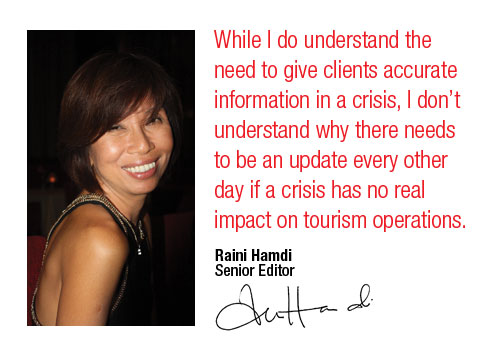
While I do understand the need to give clients accurate information in a crisis, and applaud such an effort, I don’t understand why there needs to be an update every other day if a crisis has no real impact on tourism operations. Isn’t it time to go into a tactical mode to bring back the tourists? The peak Chinese New Year season is lost, so are MICE bookings; what a big loss – isn’t it time to stimulate a rebound?

Situational updates have become the standard practice since they were advocated by crisis management experts when Asia proved not immune to terror, health, political, nature, and man-made upheavals. The problem with standard practices, however, is you stop thinking about them. On an auto mode, they become inane statements that, worse, only serve to remind people that a destination has a problem. Every other day, I have to grin and bear these emails, though I noted a few DMCs, like Diethelm Travel, stopped theirs around mid-January.

Branding and advertising gurus shudder at what they believe are political statements at best that clients can see through quickly (see Analysis, How to rebuild a destination, page 5). They just want to jump out of the window at what they believe are opportunities lost – the opportunity to turn a negative into a positive; the opportunity to evolve a destination’s brand that is weak to begin with or whose catchphrase is rendered ridiculous or, worse, takes on a completely new meaning in the face of a crisis – Amazing! Incredible! Fun?; the opportunity to re-ignite pent-up demand for a popular destination through tacticals and other positive campaigns rather than reinforce a crisis through sending out all’s-really-fine updates. If all’s really fine, what are you waiting for?

These experts have a point of course. Incredible India, for example, is conspicuously present by its absence after a series of rape cases that have many clients – lots of them females – recoiling at the thought of visiting India. Beyond reaching out to protestors to prop up low occupancies, there is nothing that suggests Thailand is concerted in launching a campaign to woo back tourists – in fact, whispers are, how much more can Thailand push its luck?

I’d say, it’s time to think of crisis management as more than just effective communications, which is but a branch of an entire discipline.

Bangkok’s QSNCC sees the light

0

DESPITE a challenging start to the year due to Bangkok’s ongoing political turmoil, Queen Sirikit National Convention Center (QSNCC) is seeing business returning to usual, according to Sakchai Pattarapreechakul, president of NCC Management & Development, which operates the venue.

“The MICE impacts were not much initially, but the Bangkok shutdown (on January 13) and the state of emergency (invoked on January 21) worsened the situation for us. The emergency decree resulted in a lot of cancellations and postponements – some organisers postponed their shows till the third or fourth quarters this year or even skip this year’s edition,” said Sakchai.

As show organisers were worried about transport and access to the convention centre due to its proximity to the Asoke intersection, where one of the main protest rallies is located, the QSNCC team quickly worked to convey the message to clients alongside photo updates that venue access was not obstructed; visitors can enter QSNCC directly from MRT subway station or via road access from Rama IV Road and the expressway.

“We worked very hard to persuade the first client to come back,” said Sakchai. “Once the first show, 17th Thailand Baby & Kids Best Buy (February 6-9), proceeded, other organisers were encouraged to continue their shows. Thailand Mobile Expo and 6th Shopping Paradise Fair (both February 13-16) took place just last week and this week we are seeing the 14th Thai International Travel Fair (February 20-23).

“Our events (bookings) from February onwards are already back to normal,” Sakchai added, although he admitted that there are “some problems with minor cancellations” as some 5-10 per cent of exhibitors dropped out of the shows.

At the same time, QSNCC also saw some spillover meetings and small exhibitions traffic diverted from other downtown venues such as Bangkok Convention Centre at CentralWorld, he said.

Overseas confidence is visibly more shaken as organisers of potential new international shows are mostly doing site inspections now while the bidding front is “still quiet”, Sakchai admitted. But in spite of a shaky start to 2014, the number of international shows at QSNCC this year is expected to increase 30 per cent from 2013, he shared.

To restore organisers’ confidence, QSNCC has rolled out various “value-add packages” including such perks as complimentary advertisements with the centre on local publications and social media sites, discounted subway fares, F&B discounts at the venue and special rates for overseas visitors at partner hotels, Sakchai said.

International shows such as Asian Paper (April 23-25), 10th International Mycological Congress (September 24-26), Cosmobeaute Thailand (September 24-26) and EcoLightTech Asia (November 12-14) are scheduled to take place as usual.