The trend to watch the waste line is rising. In the MICE sector, meeting impact reports are being generated. The same can be done for leisure travel, as Raini Hamdi discusses in this Roundtable
More effort is being taken to ensure both MICE and leisure travel generate as little waste as possible, participants of this Roundtable tell Raini Hamdi.
When did you start doing meeting impact reports? Briefly, how is it done?
TENG Marina Bay Sands (MBS) started offering the Eco360 Meetings Impact Statement in 2012. These reports are prepared only upon request by our clients and are for individual events. Each report collects data on social, environmental and economic impact of the meeting. Data on energy and water usage, and waste produced, are collected based on the total floor space (measured in m2) during the rental period. The total energy consumption per event is calculated based on the readings of the individual energy meters installed within our MICE facilities. Other specifics such as the number of delegate attendees, event duration and amount of food consumed are also taken into account. Global Reporting Initiative indicators are subsequently used to determine key reporting metrics that are material to our clients.
MARATOS Our Meeting Impact Report (MIR) is one of 25 initiatives under (the chain’s) Sustainable Meeting Practices, applicable across all our nine brands, launched in May 2010. Data is entered into an online Sustainability Resource Centre and the key indicators tracked include: energy and water consumption; waste management, including reduction of waste sent to landfills through recycling (glass, paper, plastic and metal) and environmental savings; composting; material selection and reuse; sustainable food choices; and volunteer programmes offered. The report is then converted to a PDF and sent to the customer via email.
SIMONS MCI made a solid commitment in 2007 by signing the UN Global Compact. Since then we have been providing our clients with detailed sustainability strategies and reports.
WONG We have been doing this since nine years ago, without extra cost to clients. It is part of our CSR initiative and our team members spend extra hours on it, on top of their usual tasks. Being green is my personal philosophy. With the client’s agreement, we compile data through electronic or physical survey forms, sometimes with video interview sessions with participants.
It has become a ‘must-have’ from a ‘good-to-have’.
RICAUTE Greenview has been working with event organisers to report the holistic impact of their events since 2011. Holistic because the report is a culmination of strategy and programme implementation. The process begins first with identifying the factors related to an event that are the most impactful, most relevant to its specific community or pose reputation risks. For example, if it’s a food tradeshow, the key event issues are food donation, composting, food sourcing, etc. How to create a programme to improve performance in those areas?
Reporting the performance and sustainability story is the last component. Greenview works with clients to go through this process, learning, growing and improving with each event.
We help planners understand all the players and their impact, then facilitate the collection of data to calculate an event’s carbon footprint and create KPIs that allow planners and their partners to see how they are performing and progressing. We have also been working to make impact reporting easier, helping to standardise calculations and key items to report. An example is the Hotel Carbon Measurement Initiative with the hotel industry, which standardises the carbon footprint of a room night and meeting space rental.
What follow-ups are made after these reports have been issued?
TENG All data collected for the impact statement can be included in the overall sustainability report prepared internally by the individual event planner/organisation. These sustainability reports state the key objectives and the performance for the event. We also use the data collected for the impact statements to assist organisers to develop goals and targets for their future events through identifying key areas of improvements.
RICAUTE The reporting process increases awareness and brings attention to important topics that can be changed for a particular event, but most likely can be changed permanently for more efficient and effective event execution.
When a planner works with a vendor partner on a sustainability programme they create a case study for that vendor to use to market its abilities and value. Many times programmes continue and grow after an event.
One important component that can be incorporated into the report is a perception analysis of attendees or exhibitors, asking them how they perceive the sustainability or socially responsible degree of the event. The results each year can be an indicator of the programme’s success.
What is driving the need for these reports?
RICAUTE Companies have always recognised the power of the brand and more are quickly realising the role CSR plays for the brand. Events are a unique touchpoint with attendees and powerful opportunity to reflect an organisation’s values. Planners themselves want to minimise repetitional risk and maximise positive associations with their organisation and brand by hosting sustainable meetings. This then trickles down the supply chain. Hotels, caterers, venues, AV providers, staffing organisations, etc are responding to consumers as well as investors. Also, reporting helps organisers manage their programme each year as they essentially have a memorialised plan of action and programme, and results that they can carry forth and improve upon each year.
TENG I agree. As more companies start to introduce climate protection goals as part of their overall corporate strategy, they are increasingly placing more focus on measuring and reporting the environmental impact of their events. Demand for event impact statements are driven by corporate clients and these reports are often being used to create the baseline data for future event goal setting.
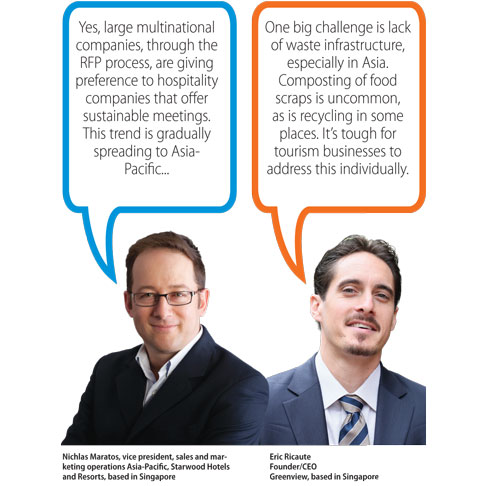
MARATOS Yes, large multinational companies, through the RFP process, are giving preference to hospitality companies that offer sustainable meetings. This trend is gradually spreading to Asia-Pacific. To capitalise on it, we are looking at how the programme can be made more relevant to our customers in Asia-Pacific. We hope to roll it out more broadly early next year.
SIMONS Sustainability reports are common in other industries. There’s strong political pressure and increased investor focus on how sustainable businesses are. I agree that in Asia we’ll see a lot of change in the coming years. The Singapore Exchange is already introducing sustainability mandatory reporting guidelines for publicly-traded corporations, while the Securities and Exchange Board of India is mandating Environmental, Social and Corporate Governance (ESG) disclosure for India’s top 100 listed companies and most recently a ruling that companies should donate to social causes. The Hong Kong Stock Exchange is moving to a ‘comply or explain’ approach for ESG reporting by 2015. Events are very much a part of a company’s ecosystem and increasingly their impact will become part of higher-level reports.
Investors are also now seeing that companies with a strong sustainability strategy and report are actually financially outperforming those that don’t, so investors now look to sustainable business as equally as consumers in many markets are.
Lastly mega events are very much driving the trend specifically in the events industry. It (sustainability) is a major requirement of an Olympic bid or a FIFA World Cup, and this mentality is slowly filtering down to business events and large exhibitions.
What are the biggest areas of waste with events?
TENG At tradeshows, unused pamphlets/brochures and food waste.
MARATOS Paper.
SIMONS It depends on the type of event. Exhibitions can create a lot of solid waste through carpeting and temporary stand constructions, while the largest source of waste from conferences is often food and paper. But the biggest sustainability impact from international events is always carbon emissions from flights.
RICAUTE Totally agree – exhibit hall move-in and move-out generates incredible amounts of waste. Cardboard and plastic films are expected, but carpet, furniture and unused collateral fill dumpsters with quick turnarounds between events and limited dock space.
Any edible food that can be donated and is not is an unacceptable waste of resources.
Meetings are moving towards digital solutions and apps, but the amount of printing that gets disposed of onsite is still very high.
So many registration materials and giveaways end up being left in hotel rooms. Companies need to find ways to add value to attendees through experiences and creative solutions rather than more stuff and more signs with logos on them.
WONG Energy, water and food, especially at the venue. This is why good architecture design with green in mind is vital during the planning stage to save as much energy as possible. The country we live in is near the equator – air-conditioning is necessary but it also drains large amount of energy. Why cool the whole centre at 16 degree Celsius? For water, we normally replace glasses with free bottled water and a water station. This not only saves water but a huge amount of plastic. As for food, as we all know, there is always a large quantity of food wasted after tea breaks and lunches. Instead of throwing food away, why not work with the venue to send the food to charity houses?
Why meet at all if it generates waste?
WONG Nothing can substitute face-to-face meetings.
Can leisure travel impact be measured?
SIMONS With technology, it is definitely possible. At Westin Hotel Singapore, we have 56 guestrooms on the hotel’s 38th and 39th floors that have been equipped to monitor and track energy consumption via a meter on the in-room IPTV system.
WONG Yes, the basic green principles are almost the same. Same elements apply – energy, water and food, especially in the hotel.
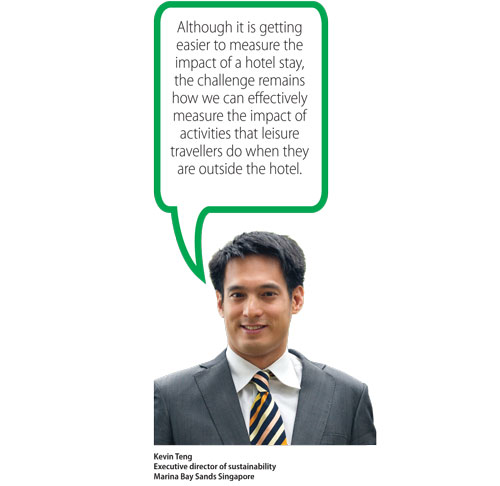
TENG Although it is getting easier to measure the impact of a hotel stay, the challenge remains how we can effectively measure the impact of activities that leisure travellers do when they are outside the hotel.
RICAUTE I disagree. It’s actually easier for leisure travel, which is already being done on certain levels for transport and hotels. It’s more a matter of purpose – companies will report for certain reasons, while individual travellers want to know how they can make a difference.
What are you doing to help make leisure travel stays greener?
TENG Since MBS started operations in 2010, we have been looking for ways to further reduce our environmental impact through leveraging technology and streamlining our operational processes. As we continue to ramp up our sustainability drive through Sands Eco 360, we are also exploring ways to minimise the impact created by our leisure travel guests while maintaining a high service standard.
WONG We work together with NGOs, academia, PATA and the industry. You’ve got to work together as one team to achieve this. Apart from that, always communicate constantly with all in-house guests and incentivise them for taking part in green programmes.
MARATOS At Starwood, we have rolled out a number of guest-facing sustainable initiatives. In addition to the Green Room, which is available at Westin Singapore and Westin Beijing Financial Street, we have a Make a Green Choice Programme (MAGC, pronounced as magic) where guests can choose to reduce the environmental footprint through ways such as declining housekeeping for up to three days in a row.
By participating in MAGC, guests save up to 186 litres of water, 0.19 kWh of electricity, 25,000 BTU of natural gas and 207 millilitres of cleaning product chemicals per night.
In most hotels, we have replaced the architectural lights with High Efficiency Lighting; low-flow faucets and shower heads have been installed; and the key card system and motion sensors are in place to reduce energy usage.
RICAUTE The biggest step we took was to standardise carbon footprint for hotels. We convened research among most major hotel companies and Cornell University, called the Cornell Hotel Sustainability Benchmark, which provides benchmarks, publicly available, for energy, water and carbon for room nights and floor area. Hotels can benchmark themselves, and it stimulates an element of competition.
More importantly, these benchmarks can be used for programmes for guests to offset the carbon footprint of their stay. That is what’s missing from travel. You book an airplane ticket, a train ticket, rent a car, even ship a package, all of them have carbon offset options. However the hotel component was missing. Hopefully we’ve solved that so that the entire trip can be counted for and offsetting increased.
What’s the biggest waste with leisure travel?
TENG Food waste.
RICAUTE Yes, by far food waste. Preparation of menus, leftover food and food scraps. By weight it’s the heaviest, and everyone eats while they travel.
One big challenge is lack of waste infrastructure, especially in Asia. Composting of food scraps is uncommon, as is recycling in some places. It’s tough for tourism businesses to address this individually; it needs to be collectively addressed by the destination. And we still have a major task of building awareness that people need to place their waste in the correct bin when waste separation is available. That takes political will to do, and involves the more complex issues of investment and infrastructure.
Also the attitude of abundance of food is one that may need to be addressed – think of those big opulent buffet stations and how they are going to end up throwing food away when there are so many hungry people in the world.
SIMONS The waste question needs to be turned on its head and we need to ask, how can we prevent waste at all?
Redefining waste as a resource is key. There is no “away” when something is “thrown away” and, in many businesses, anything “wasted” is an inefficiency. We need to bring that thinking into the way we see waste, and focus on how we extract as much value out of what we’ve used only once or have no need for – a “cradle to cradle” approach.
There are many smart businesses that are selling their waste and developing strong revenues from it, but there are also a lot of companies that still pay for valuable metals and other resources to be taken away!

This article was first published in TTG Asia, October 10, 2014 issue, on page 18. To read more, please view our digital edition or click here to subscribe.