Where do you draw the line between a ‘lifestyle hotel’ and a ‘design hotel’? How can design hotels stay edgy as new brands keep entering?
New ‘lifestyle’ brands such as Radisson Red, Venu, Vib and Jen are joining earlier entries such as W Hotels, CitizenM and Indigo to attract Millennial-minded customers. They look and feel like design hotels. In this roundtable, designers and design hotels discuss with Raini Hamdi the future of design hotels amid new concepts such as ‘lifestyle’ hotels:
Design-oriented, technology-savvy and culturally-attuned, aren’t ‘lifestyle’ hotels competition for design hotels?
NERI Professing is different from reality. We obviously have to see the result before making an opinion.
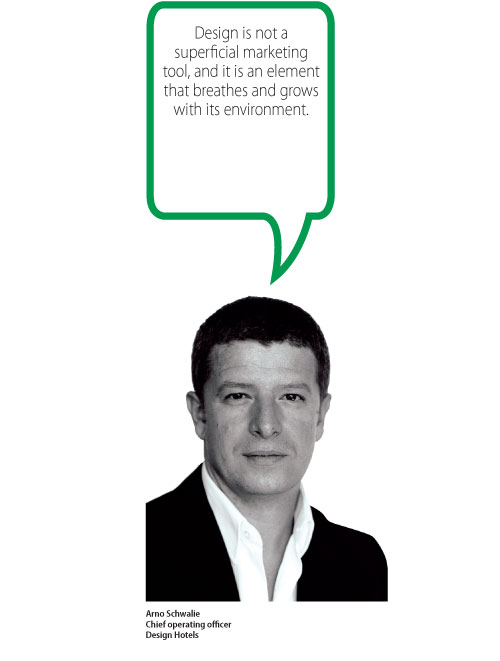
SCHWALIE The guest profile is constantly evolving, so hotels and brands need to adapt their strategies to meet societal and lifestyle trends. This new crop of lifestyle brands is doing just that, targeting the customer who has an eye on technology, who wants to be among like-minded people through networking spaces, etc. We at Design Hotels have always had our pulse on trends right from the beginning. Design is not a superficial marketing tool, and it is an element that breathes and grows with its environment.
AICHER Having realised modern travellers’ yearning for a point of differentiation and unique hotel stay experience, it has become a strong trend among established, big hotel chains to create brand clusters which exude a lifestyle feel, or are design-oriented. We believe that while each brand has a potential to succeed, being an individual hotel property which constantly reinvents its service promise, seeks ground-breaking service propositions – handy smartphones, electric eco-friendly limousine transfers, creative thematic coffee breaks – keeps us at the forefront of the competition.
NAGATA Unfortunately these new brands do not represent competition for design hotels. Design hotels will always be design-focused while lifestyle brands have been created to capture segments of the market that chains are unable to attract with their more traditional brands.
BECK Definitely there are more ‘lifestyle’ choices available than a few years back… We’re quite excited to see how other brands interpret this concept and how they will distinguish themselves from the current players. Competition, yes for sure, but isn’t that what makes the design world exciting and pushes quality?
How do design hotels stay ahead of the new ‘lifestyle’ breed?
SCHWALIE They push the boundaries of design, experience and technology. For example, the growing movement in beacon and other mobile technology allows them to customise a guest visit. Knowing in advance what the guest’s preferences are allows for a more intelligent and personalised service. In terms of the experience, authenticity is the key. Whether for business or pleasure, lifestyle travellers seek places where the architecture, design and ambience reflect the local environment and offer an authentic experience. The challenge is proving that you have a vision, that there is some substance behind the glossy marketing, that differentiates your hotel from the copycats. It is all about individuality, personalisation, recognition, self-education and sustainability.
One of our new member hotels in Umbria, Eremito, is encouraging travellers to make time for themselves and truly get away from it all. With single rooms that evoke the cells of monasteries and an atmosphere that encourages contemplation and soul-searching, they are pushing
the boundaries of solo travel. They have silent dinners in the restaurant; there is no Wi-Fi, TV or phone – the experience is truly about digital detox and self-discovery.
Hotels have also started to immerse their properties within a village environment. Examples include Hotel Hotel in Canberra and Ham Yard Hotel in London. A guest is only a few steps away from the local community and activities, from a haircut, cinemas and theatres to flower shops, a bowling alley or library.
AICHER Both individual travellers and meeting organisers expect certain services to be included in their stay. The Mira Hong Kong has been offering free Wi-Fi since its opening in 2009 – imagine, there are still hotels out there charging you for Wi-Fi or limiting the number of devices you can connect! We listen to our guests and we regularly meet up with department heads to discuss their needs. It’s not always easy to predict what the next step is, but in most cases it’s about the basics.
Who are the current trendsetters in design hotels?
NERI We think André Balazs is always pushing the boundary especially with the Chiltern Firehouse. He has the notion of a winter garden, so he placed a bar in the middle of a space that is usually given to a lounge area. His rooms are large and eclectic.
Also, the Soho (House club) and its community of creative individuals. Edition by Ian Schrager is also interesting. In Asia, Alila as a group is bringing a lot of sophisticated products and The Unlisted Collection has an eclectic mix.
SCHWALIE Eremito, as mentioned above, is right in the heart of the trend towards digital detox and self-discovery. The Firmdale Hotels is also the group to watch.
Georgia is becoming a popular destination and we have two new member properties there, Rooms Hotel Kazbegi and Rooms Hotel Tbilisi. A new opening that is on everyone’s radar this year is Les Bains in Paris, a hybrid development encompassing a club, performance space, a restaurant and bar, and 39 luxury rooms and suites.
BECK The Indigo brand has been successful and is one of the first design hotels in Asia. We’re thrilled that HBA recently completed Indigo Bangkok Wireless Road, the first Indigo in South-east Asia. The vibrancy and bright colours of Bangkok really suit the concept of Indigo and we found lots of inspiration around its energetic neighbourhood to integrate into the design. We are looking forward to more Indigo hotels opening in Asia, but it will also be interesting to see how other brands, for instance, CitizenM, adapt to the local style.
But it seems there are more trendsetters outside Asia.
NAGATA The current trendsetters are primarily in the US. But brands like Ace Hotels, CitizenM and Thompson Hotels are all looking to expand into Asia where there is huge demand. While we see many Millennial-focused restaurants like Potato Head, no one has successfully created a Millennial-focused design hotel.
SCHWALIE Europe continues to be our strongest market, both for new hotels in the pipeline and (as market source).
Overall we are targeting a 10 to 15 per cent growth this year for Design Hotels. In 2014, room revenue into our hotels closed at 189 million euros (US$208 million) compared with 160 million euros in 2013, both through distribution performance and a portfolio net growth of 20 hotels. For 2015, we expect room revenue to surpass 220 million euros and for us to reach a portfolio of over 300 hotels.
What trends are design hotels embracing and why?
NERI A strong social agenda. You see it in Ace Hotel in New York, the Camper hotels in Berlin and Barcelona, Amanpuri in Phuket, Eet Heim in Stockholm, Chiltern Firehouse in London, etc.
Amanpuri, for example, creates a courtyard surrounding the pool and all activities are held in this courtyard. With Eet Heim, the domesticity of the hotel makes interaction easier.
NAGATA Creating new experiences and locally relevant interiors. As hotel guests are inundated with so many experiences, it is becoming harder to curate unique experiences. Fairmont Sanur, for example, has outdoor living rooms and a submerged spa to create such new experiences.
The other trend is to create spaces as if they were born out of the land through the innovative use of local materials and textures. The floor of the guestroom at Fairmont Sanur, for example, is laid out in a handmade grayish green ceramic tile. The colour and texture of the tile, along with the local sandstone walls, help in creating a design respectful of its location.
BECK The lobbies are undergoing the biggest change, from large halls that people just pass through, to smaller, intimate spaces that invite people to stay, lounge, work and socialise. The traditional set-up of people working from their office desk is shifting; people want other spaces to work where they can order a coffee, sit on a comfortable lounge chair and socialise with other travellers while working on a laptop or tablet. The traditional reception desk will soon be merely a part of the lobby, especially with the introduction of self check-in stations and mobile check-in.
Rooms are also changing. Guests like to get the most flexibility out of the room, to be able to work not only from their desk but various locations. They love to have a comfortable bed but would not want to pay for unnecessary things. As a result, some brands omit the bathtub for a more spacious, luxurious shower, for example.
What is the biggest challenge facing design hotels?
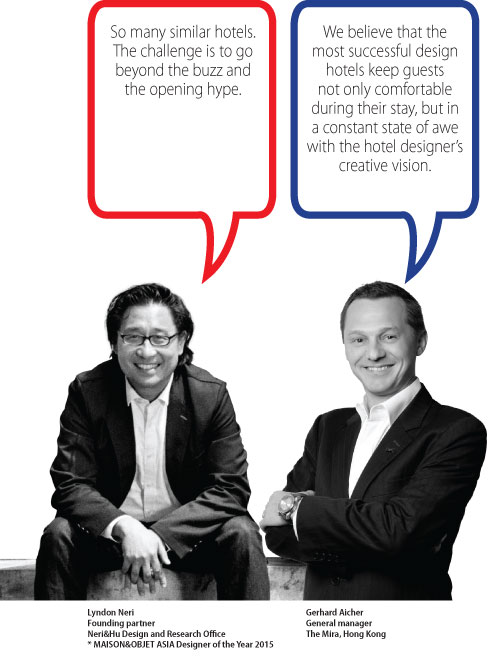
NERI So many similar hotels. The challenge is to go beyond the buzz and the opening hype.
NAGATA Brand recognition. In today’s society, where we have so many choices, the recognition of design hotels as a strong brand versus the international chains is often a challenge.
BECK Initially, design hotels were created out of a desire to change the way the
hotel industry works. To not follow one design scheme where all hotels look and feel alike, but to create identities, to rethink what hotels need to be, how to respond better to guests’ evolving needs and build a product that’s based on the people using it. The 21st century guest was the main focus and the concept of the hotel included design, but also technology and service. The challenge will be not to forget that.
Great design does not only look good but is practical and comfortable, making guests feel good when they are using it. Technology should be user-friendly with switches and power sockets in the right place and is easy to understand.
In some cases, we put design above everything; we forget what it’s all about originally. As lifestyles change, we must constantly reflect on who we’re designing for.
AICHER We believe that the most successful design hotels keep guests not only comfortable during their stay, but in a constant state of awe with the hotel designer’s creative vision. And so, style, comfort and functionality are all important factors which need to be fitted in perfect proportions into the overall concept. Being intuitive and user-friendly cannot be forsaken. This often boils down to simple things like light controls, connectivity, etc.
As a hospitality service provider we love delighting customers, we are passionate about design and we connect like-minded people in fond memories.