CARNIVAL Corporation has formally entered into a joint venture with China State Shipbuilding Corporation (CSSC) and China Investment Corporation (CIC) to launch the first world-class, multi-ship domestic cruise brand in the Chinese market.
With this new agreement, Carnival Corporation and CSSC plan to purchase and operate both new and existing cruise ships to homeport in China.
Meanwhile, the CIC will be involved as a significant investor, hence reinforcing China’s commitment to expanding the Chinese tourism market.
“This cruising joint venture is a significant step forward for the cruise industry in China and a tremendous opportunity for us to work together with CSSC and CIC to grow awareness, interest and demand for cruise vacations among domestic Chinese travellers,” said Buckelew, global COO for Carnival Corporation.
He added: “Cruising is a relatively new vacation experience in China, and we believe this collaborative approach with our partners is critical to not only developing the country’s domestic cruise business, but also supporting China’s goal to become one of the world’s leading cruise markets in coming years.”
The joint venture comes in the wake of recent news that Carnival Corporation is extending its overall market presence in China in the next two years.
VISIT Finland aims to build “solid” tour operator and travel agency partnerships in Asia to develop Finland as a stopover destination for Asian passengers travelling via Helsinki Airport to other destinations in Europe.
It will be introducing a new Stopover Finland programme by May 2016, consisting of 50 attractive packages in Helsinki and beyond that range from five hours to five days. The NTO also plans to increase its visibility at ITB Asia in 2016 in order to build trade partnerships.
Visit Finland’s Stopover Finland programme director, Heli Mende, said: “The success of Stopover Finland requires solid tour operator and travel agent partnerships. By investing in the visibility at ITB Asia 2016, Stopover Finland wants to invite new partners to consider selling Finland as a stopover destination to their clients travelling from Asia to Europe.”
Travellers can experience Finnish highlights from Northern lights to midnight sun, relaxing in Finnish forests, lakes and sauna, shopping for Finnish design items, and meeting popular characters like Moomins and Santa Claus.
Finland’s two largest Asian markets, China and Japan, which accounted for six to seven per cent of total arrivals in 2014, are expected to grow further when Finnair adds two new routes to North Asia in summer 2016.
Starting from May 7, 2016, Finnair will launch a thrice-weekly route to Fukuoka, Japan. In addition, there will be a four-times weekly service from Helsinki to Guangzhou, China, but that seasonal route will operate only from May 6 to October 29, 2016. The two new routes will both use the Airbus A330-300.
Fukuoka will be the fourth Japanese city that Finnair flies to, after Tokyo, Nagoya and Osaka. Guangzhou is Finnair’s sixth destination in Greater China after Beijing, Chongqing, Hong Kong and Shanghai and Xi’an.
Finnair will also take delivery of its first four A350 XWB orders this year, while another seven will be delivered over the next two years. For its Asian network, the A350 XWB will be deployed to Shanghai from November 21, progressively to Beijing and Bangkok by the end of 2015, and to Hong Kong and Singapore by the first half of 2016. The Airbus A350 XWB will replace the A340s currently plying these longhaul routes.
Finnair’s country sales manager, Singapore, Malaysia and Indonesia, Nick Naung Naung, said: “The A350 XWB aircraft is 25 per cent more fuel efficient and quieter than the A340s, and the extra wide body of the A350s offers more space and wider seats for greater passenger comfort. The Finnair A350 XWB has 297 seats – 46 in business class, 43 in economy comfort and 208 in economy class.”
It has been a year since Tourism 2025 was first announced at TRENZ 2014. What has TNZ achieved so far in aligning its activities to the goals of the framework?
It is very important to first understand that Tourism 2025 is owned by the industry and co-created by the industry along with the government. It is unusual in that aspect as most tourism strategies are government-led. It is a good thing though, as we now have the private sector understanding that they need to own it and the framework will outlive political cycles.
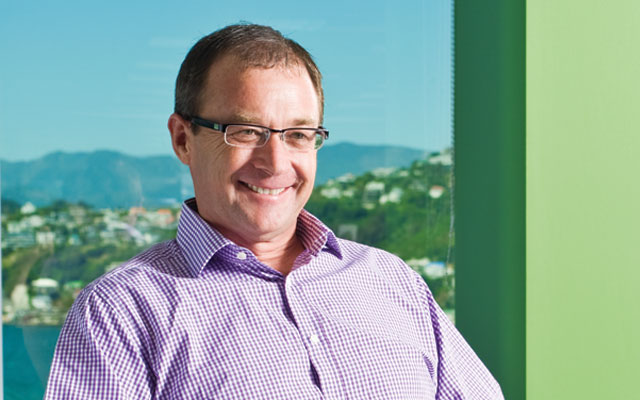
Kevin Bowler
What have we achieved? Firstly, to achieve the framework’s objectives, we need to maintain a growth rate of about six per cent, and in the last 12 months we’ve had about 20 per cent growth in international visitor spend and about 6.9 per cent increase in the number of visitors. We’re in pretty good shape.
One of the components of the framework is to foster air connections and that has been going very well. I think this is a chicken and egg situation. We have the demand so the airlines are supportive, and their support is in turn driving more demand and making airfares more competitive. We have seen great growth since the joint venture between Singapore Airlines and Air New Zealand.
Air New Zealand will add year-round services to Houston and Buenos Aires this December, so this air connectivity piece is going strongly for us.
The second component is to achieve high-value visitors, and our growth in value is exceeding our growth in volume.
Another component is visitor experience, and we are making headway in adjusting for new markets. Our China readiness focus for the industry is an example of efforts we’ve taken.
The fourth focus in the framework is productivity. We are emphasising the shoulder season now, which is a big change from what we’ve been doing. If we can increase demand during the shoulder season when there is excess capacity, we will increase productivity considerably. To achieve this, we are focusing on markets that have a lower high season profile. India is a great example: the peak travel season for Indian travellers to New Zealand is November to December and then April to May, which fits perfectly with our shoulder season.
We are also investing in MICE and special interest markets like golf and cycling, which tend to be outside peak (period).
The final point is the insights. There has been a big programme on improving market data but there’s still much to be done before we can come out and say we’ve got great insights.
Tell us more about what you are doing to get ready for China.
TNZ has been very active in running workshops around New Zealand to help operators understand the needs of the Chinese market – not just travellers from China, but those from other parts of Asia too – and what changes should be made in terms of food, language and activities.
The Chinese love shopping and they often say to us that the shops in New Zealand open too late and close too early. We are increasingly conscious about having to adjust that. We are also aware of the need to adjust food service that suits the Chinese. Here’s a good example: we are working with our premium golf courses to provide hot lunches because wealthy Chinese golfers like to have a little hot meal whereas New Zealanders will be quite happy to grab a sandwich.
The Hurun Report recently noted that young, wealthy Chinese prefer experiential travel and exotic destinations. This should excite TNZ since it wants to grow its value of tourism.
I must say that the rate of change in China is extraordinary. Five years ago most of our Chinese travellers came for low-value shopping trips, mostly on Australia and New Zealand itineraries.
We are getting a different profile these days although only a few of them are in the ultra-premium segment – less than two per cent of the business at our luxury lodges are from China.
Frankly, the expansion of our focus on high-end travellers hasn’t really extended to China. Where we are getting our value improvements from China is from longer-length stays and more travelling around the country. I think part of this is because the ultra high-end Chinese customer is still looking for traditional luxury accommodation as opposed to lodges which are more rural. New Zealand has a more rural perspective around luxury accommodation which may not be what everyone is looking for. Some of these lodges are very small, with only six rooms, quite different from a six-star hotel in the Middle East.
Our view is that our high net worth traveller market will develop and (our luxury lodges will) target travellers who like outdoor activities. Now we are still at the very beginning of that phase.
The other challenge we have (in attracting high net worth travellers) is that because these lodges are small, they sell out pretty fast. I’ve been informed that they are almost all taken for the next summer peak period, mostly by US visitors who really like this experience.
Wealthy Indians are also desiring the same. Are you seeing the same shifts in this market yourself?
Oh yes, a little bit more so for the Indian market. We are already catering strongly to the Indian market, especially the honeymoon segment which favours our luxury lodges. We are very encouraged by the results in India – we’ve almost doubled our Indian arrivals in the last five years.
We’ve just co-hosted the 2015 Cricket World Cup with Australia and that gave us a boost. Indians love cricket, and there are a number of New Zealand coaches in India. We have a little bit more of a cultural connection with India that way.
Which other Asian markets are top performers for New Zealand’s high-end travel segment?
Japan and Singapore. While these markets will remain strong, we feel that China will become a much more important source over the next five years.
Many Asian destinations are courting these source markets too. How will New Zealand stand out in the region?
New Zealand offers such different experiences from the rest of the region that we are probably more up against Africa or even South America. Africa’s luxury lodges and safaris, for instance, are the sort of products that we are competing with.
What drove the creation of TNZ’s Every day a different journey campaign and how does it serve the new framework?
It is an evolution of a campaign that has lasted for 16 years. 100% Pure New Zealand has a long history now and over the period of its life we’ve been able to continue to keep it contemporary and move messages to the opportunities we see. The most recent one was connecting New Zealand with Middle Earth. We had three years of emphasising how Middle Earth was 100% Pure New Zealand. We’ve been very successful. Of course, with the three movies all out, we needed to think what our next message would be.
Our research told us that a large number of people liked the idea of visiting New Zealand but there was quite a low level of awareness about the variety of things that could be experienced and as a consequence of that, we’ve done a campaign which emphasises the variety and diversity of activities one could do.
Our research has also found that different activities, places and things appealed to different key markets, and that drove the prioritisation of which ads are shown. They range from walking on ice glaciers, to swimming in subtropical beaches.
We use the line Every day a different journey to bring all that to life.
When you boil down the things that make New Zealand different from other parts of the world, two things stand out: diversity of activities and how easily accessible they are, and our indigenous culture.
Hence, the other part of our new campaign is to work closely with our Maori community to find ways to visually distinguish us from other destinations. We’ve worked with a Maori carver who’s carved our logo out of timber. The reproduction of our logo now comes from this wonderful piece of wood, allowing the grain to show up. The logo will appear on everything that we print and produce. It will be a lovely and more distinctive connection with New Zealand.
How is TNZ deploying this campaign to spread demand to shoulder season?
While we usually begin our media investments in September, this year we are running it from July to promote spring and autumn travel. In fact, 80 per cent of our efforts will now focus on the shoulder season. Previously, it was about 20 per cent.
I think it is the natural things that will also help us (achieve more footfalls in the other months). Prices will be more reasonable during the shoulder seasons and availability will be much better as well.
New Zealand is loved for its natural environment and rich culture. How does TNZ ensure that tourism development does not erode all that?
We have been fortunate there, as our arrivals are small compared to our land area. We have almost the same land area as Japan, four million inhabitants and about three million visitors. Furthermore, we have a strong legislative framework for protecting the environment. Expansion of businesses require a lot of permission, and a lot of care and consideration for the environment go into these decisions.
We are also a majority shareholder of a company called Qualmark, which deals in quality assessment of local businesses and issues the Enviro Award which encourages operators to accomplish a higher level of sustainability. We’ve had that programme for about seven years and are just reviewing it now. We may lift its standards further. We will know the outcomes of this review a year from now.
It is great that there are a lot of sustainability ambitions and aspirations in the industry. We are working very closely with industry players and getting excellent encouragement to continue to raise the benchmarks on sustainability.
How is the reconstruction of Christchurch coming along, and what other infrastructure developments are worth watching out for?
We are well into rebuilding Christchurch, but are probably four or five years away from restoring (its pre-earthquake) accommodation capacity. Once work is completed, Christchurch will be our most modern, most beautiful city.
Because of the nature of the earthquake, a lot of services that run underground such as storm water, sewage and electricity have taken many years to rebuild. We are only now starting on the buildings.
We are keeping the Christchurch airport operating at 100 per cent capacity so there is still a gateway to the South Island.
One of the biggest development to come is our convention centre in Christchurch, and that will stimulate the emergence of more hotels. It should be announced this year along with a completion date.
We have another convention centre in Auckland. It is in the design phase now, and will open in 2019 or 2020. It will have capacity for 3,500 people – the biggest that we’ve got at the moment.
The local trade has much to rave about and promote for the city-state’s Golden Jubilee
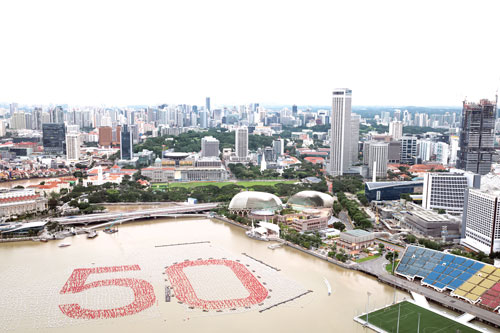
In a bid to reverse slowing visitor figures, the Singapore Tourism Board (STB) has launched a S$20 million (US$14.8 million) global marketing campaign to ride the wave of interest on the nation’s 50th founding anniversary.
Lynette Pang, assistant chief executive of STB’s marketing group, said: “2015 is not only a tremendous milestone for Singapore, but also an opportunity for STB to leverage the international attention to ramp up marketing efforts for destination Singapore. SG50 is a once-in-a-lifetime event for Singapore and has caught the interest of the world, placing us on numerous lists of top places to visit.”
Inbound tour operators and hotels in Singapore have been eager to roll out packages in conjunction with the nation’s 50th birthday.
Judy Lum, Tour East’s group vice president of sales and marketing, said: “We are currently looking at reiterating SG50 to convey the message that some packages come once in 50 years. For instance, tourists would be more compelled to retrace the Singapore history during the World War II with visits to the Changi Chapel and Museum and Kranji War Memorial.”
More than 35 hotels, including Park Hotel Group and Sheraton Towers Singapore, have already committed to offering a Pay Two, Stay Three offer, while children will have complimentary access to several Singaporean attractions.
The Pan Pacific Hotels Group (PPHG) has launched a SG50 promotion at its two Pan Pacific and three Parkroyal hotels in Singapore to offer selected travel consultants who book through the group’s website 50 per cent savings.
Timur Senturk, PPHG’s vice president, operations, ASEAN, said: “With many large-scale celebratory events planned throughout the year, we see SG50 as a great opportunity to heighten awareness and excitement of Singapore.
“We will be unveiling more rooms and dining promotions throughout the year that can be enjoyed by both Singaporeans and visitors to the country,” he added.
Over at the Ritz-Carlton, Millenia Singapore, a new Celebrate Singapore, Celebrate You room package was rolled out at the beginning of the year “to leverage the jubilant nationwide atmosphere”, said Andreas Kohn, director of sales & marketing, The Ritz-Carlton, Millenia Singapore.
Kohn said: “To date, the performance of our Celebrate Singapore, Celebrate You room package has exceeded the projected annual number of room nights. In the month of August alone, the total number of bookings for the month outperformed the total number of bookings in the preceding seven months of the year.
“This is likely attributed to the four-day National Day jubilee weekend which made it an additional incentive for locals to book a staycation at our hotel in order to enjoy the fireworks and fringe festivities in the Marina Bay area,” Kohn explained.
THE year-old Angsana Xi’an Lintong hotel has conducted several public events, from symphony concerts to festival celebrations, to raise its profile and showcase its event capability to MICE planners.
Since its opening in October 2014, the 400-key luxury hotel in the Lintong district of Xi’an has hosted a poolside Valentine’s Day party, a Mid-Autumn celebration that saw 80 hotel guests releasing sky lanterns in the courtyard, and a symphony orchestra concert for 300 hotel guests – also in the courtyard – in celebration of China’s National Day.
The events were marketed as a room and/or dinner package.
Angsana Xi’an Lintong’s general manager, Jerry Mong, told TTGmice that the events were an effective way of demonstrating the hotel’s MICE ability.
“Our hotel sits on a large piece of land and has many beautiful open spaces, such as the courtyard. Our internal events utilise these spaces and they show the variety of activities that can be done here,” said Mong, adding that the events were captured on film which are used as part of the hotel’s marketing activities.
Besides a ballroom for up to 800 guests and seven meeting rooms with spacious foyers, Angsana Xi’an Lintong also offers several outdoor venues such as landscaped gardens, indoor and outdoor pool decks, and a courtyard that can accommodate up to 1,000 pax for welcome receptions, gala dinners and teambuilding games.
The hotel, whose architecture and layout are a modern interpretation of a Tang Dynasty court, was also the venue of the 2015 Banyan Tree General Manager Operation Review, an event in July that was attended by 200 general managers and directors of sales and marketing from the company’s properties worldwide. The delegation was welcomed by a royal procession that recalled the grandeur of the Tang Dynasty’s heyday, executed by 200 actors dressed in ancient garb and armed with elaborate props.
“We planned that opening ceremony on our own, and it is proof that the hotel can facilitate strong welcome receptions for our clients,” Mong remarked.
To celebrate the hotel’s first anniversary, a Halloween party has been planned for 300 hotel guests, trade partners and the media on October 31. It will be held at the soon-to-open Angsana Hot Spring Xi’an Lintong which sits next to the hotel. The two-storey complex features an indoor pool, 25 outdoor hot springs and private cabanas, among other facilities.
GLOBAL events marketing specialist, Ian Wainwright, has been appointed event director for the Asia-Pacific Incentives and Meetings Expo (AIME).
Armed with over 13 years of experience, Wainwright possesses a vast understanding of the industry and is capable of offering rich perspectives to AIME. He will lead the AIME team in preparing for the trade show from February 23 to 24, 2016 at the Melbourne Convention & Exhibition Centre.
“With strong relationships with numerous industry stakeholders, including convention bureaux and tourism, government and private bodies, Ian is well positioned to drive Asia-Pacific’s leading business events trade show,” said Sally Coventry, ibtm events portfolio director, Reed Travel Exhibitions.
BRAND experience specialist Freeman has acquired global event services company Staging Connections Group Limited (SCGL), giving it an immediate presence across Asia-Pacific through the latter’s network of 15 offices.
SCGL is now part of Freeman’s audiovisual division and will retain its brand.
“As our clients are expanding globally, they want the same level of Freeman quality, service, technology and support in markets around the world. This acquisition provides us with an immediate presence in ANZPAC and connects us with an organisation and team that shares our values and our design-driven, customer-centric approach to business,” said Joe Popolo, CEO of Freeman, in a press release.
“There are tremendous growth opportunities by combining these two great companies. (SCGL) has strong relationships with the leading brands in ANZPAC and a reputation for superior production design. Together, we will continue to deliver an unparalleled suite of services to our clients around the world,” continued Popolo.
SCGL, which has offices in Australia, New Zealand, China, Singapore and Fiji, is aligned with Freeman’s value system and culture, and brings a customer-centric approach focused on innovation, partnerships, employee development and customer success, noted the press release.
Tony Chamberlain, SCGL managing director, commented: “There are a lot of synergies between the (SCGL) culture and that of Freeman, particularly our customer-centric approach to event delivery. We’re confident that we will fit together seamlessly.”
AUSTRALIA’S first aerial playground, MegaAdventure Aerial Park, has its eyes firmly set on the local and international MICE market ahead of opening in November.
Located in Adelaide, MegaAdventure is the second park under the MegaAdventure Group umbrella, which also owns and operates MegaZip Adventure Park on Sentosa Island in Singapore and a mobile adventure attractions business in South-east Asia.
MegaAdventure’s main attraction will be the SkyMate – a purpose-built, 26-metre-high structure crafted by the company’s subsidiary, Touch Cloud Global, which specialises in adventure constructions. The SkyMate will launch with 50 ‘crossings’ comprising of scramble nets, rope bridges, beams, swings, log steps, aerial surfboards and even Adelaide wine barrel steps.
“No one can bring a team together like MegaAdventure,” according to CEO and founder Alex Blyth, who is also a former instructor of the British Army who used aerial assault courses to train recruits.
“We provide a range of teambuilding and bonding activities that enable organisations to come together for the benefit of the individual, their workplace and the group.”
MegaAdventure have employed former Australian netballer, Jane Altschwager, to attract corporate groups from the local market.
“She has a great understanding of how businesses can achieve new heights with a strong and dynamic team,” said Blyth, “She is spending a lot of time talking to different companies about the way MegaAdventure can help build their company through teamwork.”
MegaAdventure is now taking bookings for corporate groups.
THE Incentive, Conference & Event Society Asia-Pacific (ICESAP) has formed a joint-venture partnership with Angliss International Singapore, part of William Angliss Australia, to offer professional development courses.
ICESAP president Nigel Gaunt said the programmes will start in December with a six-part online introductory course and followed by intermediate courses in 2016.
Gaunt added: “The majority of content will be delivered online and in late-2017 ICESAP will offer a degree course in IC&E management.
“ICESAP is further committed to growing the IC&E sector by implementing a universal accreditation scheme for the intermediary agency businesses operating in the sector across Asia-Pacific.”
Established in January 2014 and headquartered in Hong Kong, ICESAP is still the only association in the region to represent the IC&E segments.
Gaunt said: “Being by nature a cross-border industry there needs to be a consistent approach in key areas, such as industry standards, education and accreditation.”
Gaunt also said there were many customer examples where all incentive, conference and event components, and not just one, were required to meet different business needs.
He gave the example of Tupperware where several thousands of top achievers were rewarded with an incentive to Macau, and where a conference and an exhibition were also organised.
In 2014, the estimated IC&E sector in Asia-Pacific was valued at over US$120 billion, Gaunt said, adding: “Eighty per cent of this spend came from within Asia-Pacific. Despite the scale of the industry there has been no peak body until the formation of ICESAP.
To professionalise and “up-skill” practitioners in the industry, ICESAP will form an accreditation scheme early 2016. Applicants must abide by a code of conduct, demonstrate financial security and participate in a guarantee fund to “de-risk” customers and suppliers.
Although accreditation cannot be mandated, Gaunt said the scheme will be made attractive and be a “game changer” for the industry.
A JOINT study by ACTE and American Express Global Business Travel has found a majority of travel managers intending to tackle traveller behaviour to achieve savings.
The Evolution of Travel Policy: A Global View on the Future, which surveyed 350 corporate travel managers around the world, reported that 52 per cent of respondents said savings was the primary driver of their managed travel programme over the last one to two years, followed by duty of care (23 per cent) and traveller service (16 per cent).
However, the balance between savings and service is expected to change as corporate travel managers are looking to traveller behaviour, rather than supplier cost reductions, to drive savings.
Eighty-four per cent of respondents said savings would be achieved through demand management and compliance in the next one to two years. Yet, communications tools to drive compliance were often missing: 44 per cent of respondents have no formal systems for gathering traveller feedback.
While 75 per cent of respondents see improved traveller service as a route to savings, few organisations have measures to justify these improvements to procurement or finance leaders. Twenty-one per cent of them use traveller productivity metrics, nine per cent use work-life balance metrics and just five per cent use stress reduction metrics.
However, 12 per cent of corporate travel managers plan to introduce stress reduction metrics in the next one to two years.
Commenting on the findings, Caroline Strachan, vice president of global business consulting at American Express Global Business Travel, said: “Demand management is the bedrock of a strong managed programme so it’s significant to see that travel managers are embracing the traveller and traveller service. Clearly, they understand the future’s going to be traveller-centric. What’s less clear, is whether travel managers feel they have the right technology and tools needed to deliver this future.
“Communication is critical for building relationships, engagement and compliance. The research suggests there’s scope for travel managers to upgrade their communications systems and practice.”
Greeley Koch, ACTE executive director, said, “The report’s findings are consistent with ACTE’s Traveller Centricity education pillar, which puts the traveller and the traveller’s needs at the heart of policy.”
Koch pointed out that influencing traveller behavior and supporting the traveller in the field is far more conducive to meeting the primary objective – raising corporate revenue – than savings alone. “While savings remain a key driver, profitability is the objective of business travel.”
A copy of the study is available at www.amexglobalbusinesstravel.com/acte.



 Credit: Carnival Corporation