Grassroots accommodation providers in secondary destinations in the Greater Mekong Subregion (GMS) are set to receive a helping hand getting their rooms filled, after Mekong Tourism Coordinating Office (MTCO) partnered with Agoda to develop online training to upscale their digital skills.
“There are a lot of hidden gems and secondary destinations in our region, and a lot of accommodation providers, like eco-lodges, guesthouses and home stays, that might not even have a presence online,” said Suvimol Thanasarakij, executive director of MTCO.
Suvimol: a lot of hidden gems and secondary destinations, and accommodation providers, do not have a presence online
She added that currently, the vast majority of these MSME accommodation providers sell rooms manually. “They don’t know how to be online, how to sell their rooms on a digital platform, or how to run online promotions.”
The training course, set to run in the local languages of all six GMS countries and tentatively scheduled for rollout in the last quarter of 2025, will teach participants how to strengthen their online presence and boost sales through the use of OTAs such as Agoda.
“We will develop the curriculum together with Agoda and in consultation with the member countries to see exactly which gaps need filling,” Thanasarakij told TTG Asia at the Mekong Tourism Forum, which took place in Luang Prabang, Laos, from June 24 to 27.
“I was looking at which areas are lacking, and wanted to focus on supporting secondary destinations in the region. I looked at what is missing, and it’s really digital skills to promote and sell. Agoda is the largest OTA in Asia-Pacific, so we will together introduce this training for the first time.”
A market intelligence update presented by Visa Business and Economic Insights at the Opening Forum for ILTM Asia Pacific 2025 on Monday evening has painted a promising picture for luxury tourism industry stakeholders. Visa sees opportunities in an aging but increasingly affluent population in Asia-Pacific, along with emerging source markets as well as wellness being a top travel motivator.
Simon Baptist, principal Asia-Pacific economist at Visa Business and Economic Insights, started his presentation with a caveat: “This is the time where there is so much change and so much unpredictability in the international environment.”
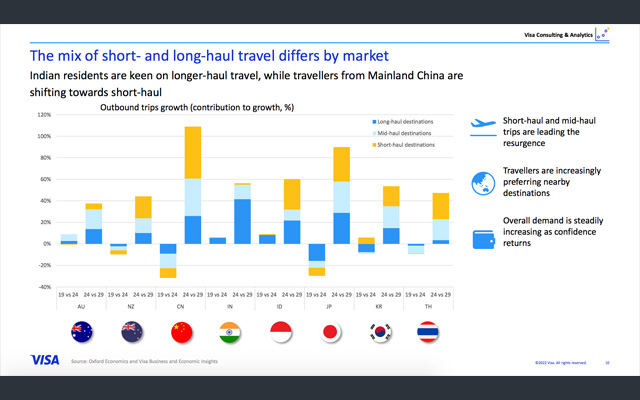
Emerging markets like India and the Philippines are driving outbound growth, with shorthaul trips dominating – while China and Australia lead in high-value longhaul travel
Baptist stated that despite volatility in the international environment, Asia-Pacific has continued to grow “very fast”, due to urbanisation of populations, internationalisation into the global supply chains, and government reforms towards more efficient economies.
“Asia has done a better job (at these things) than any other region in the last few decades,” said Baptist. “Hence, the big rise in the number of not just average wealth, but also the big rise in the number of affluent people.”
But growth in Asia is “getting tougher” due to three reasons: China’s big slowdown, where growth will moderate downwards to around three per cent by the end of the decade; higher interest rates that will impact cost of capital and investment, which has been the core generator of wealth for the region; and the change in geopolitics as a result of international trade barriers, dampening internationalisation that has been fuelling the region’s growth.
“We still have a good picture (in Asia-Pacific), but growth is not going to be as easy as it was,” he stated.
Elaborating on what defines a “good picture”, Baptist highlighted Asia-Pacific’s growing affluent population. Visa’s research shows that 48 per cent of the world’s new affluent will be in Asia-Pacific, with current analysis estimating a total addressable market of US$2.14 trillion across 10 key markets in the region.
Furthermore, as Asia’s population ages, it is also becoming wealthier – a trend that, according to Baptist, is giving rise to new consumer segments in the region.
Providing an overview of population changes in this region, Baptist shared that the populations of Japan, South Korea and China are shrinking. Meanwhile, core population growth in the region stems from India and Indonesia, while immigration flows are lifting the population in New Zealand and Australia, and creating new markets for luxury travel businesses to tap into.
He added that while Japan and Australia have historically been the two largest sources of high net worth individuals (HNWIs) in the region, China has overtaken to become number one since the pandemic and remains the dominant source of elite spenders despite economic woes.
Baptist also discussed changes in currency valuations as a factor influencing spending power in Asia-Pacific. He noted that the region has witnessed “massive changes”, where the Japanese yen has weakened by 45 per cent against the green back, the Korean won is down about 30 per cent, and the Chinese yuan is down by about 20 per cent.
“On the hand, some places have strong currencies, like Hong Kong, Singapore, and Thailand, allowing consumers from these markets to have more spending power out in the international environment at the moment,” he remarked.
Asia-Pacific’s rising affluence fuels a US$2.14 trillion luxury travel market, with China now leading elite outbound spend
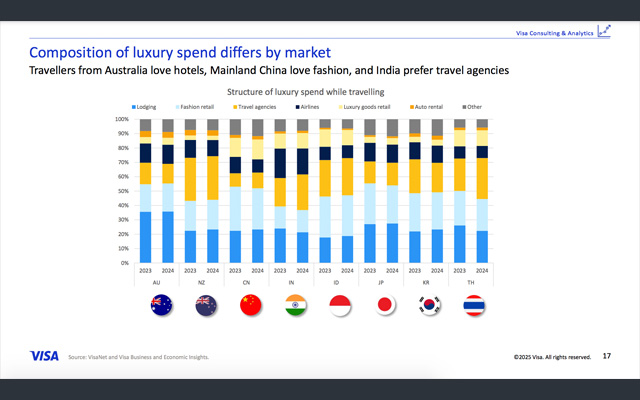
He pointed to business opportunities in following where outbound growth is occurring in the region. Massive growth is observed in the Philippines and India, although these markets do not spend as much as the affluent in China and Australia.
Travellers from the Philippines and India spend about US$1,000 per trip, whereas Chinese or Australians would spend about US$3,000, according to Visa findings.
Vietnam and Indonesia are new source markets to watch, added Baptist.
While travel motivations may differ in a region as diverse as Asia-Pacific, Visa research shows that HNWIs in the region have five main priorities when making spending decisions: focus on physical health and well-being; pursuit of long-term financial security; focus on family and social relationships; expressing wealth through cultural proficiency; and seeking curated luxury goods and experiences.
Breaking travel motivations down by geographical source markets, Baptist said Relaxation was a strong motivator for affluent travellers from Taiwan and Hong Kong while Spending time with family/friends was most important for affluent travellers from Malaysia, South Korea, and New Zealand.
Travel plans of regional travellers are also shaped by desires for culinary experiences, shopping, cultural activities, seasonal attractions, theme parks, and visiting family/friends who are living overseas.
Phuket was placed on alert early last Tuesday after two men from Pattani were arrested in Phang Nga while travelling to the island with a suspected timed home-made bomb concealed in their car.
The vehicle raised suspicion after attempting to evade a checkpoint.
Phuket, pictured, and Krabi remain secure after coordinated attacks, with authorities reinforcing safety measures and engaging international tourism bodies to prevent misinformation; photo by Quang Nguyen Vinh
During questioning, the suspects admitted to planting other devices in Phuket. Between June 24 and 27, authorities defused four suspicious objects in Phuket and five in Krabi.
Three suspects were also arrested in Krabi in conjunction with the devices, and a motorcycle linked to the case was confiscated from a local mosque.
On June 30, the Internal Security Operations Command (ISOC) Region 4 – Thailand’s national security agency responsible for the southern provinces – released a news statement confirming that all known suspicious objects, which the suspects admitted to planting, had been safely removed.
Colonel Kiatisak Niwong, spokesman for the ISOC Region 4 forward command, revealed the incidents to be part of a coordinated effort by the Barisan Revolusi Nasional (BRN) group to pressure the government into peace negotiations.
He stated that BRN’s strategy involves staging low-impact attacks outside the southernmost provinces to draw attention to touristic or symbolic locations, aiming to instil fear rather than cause harm.
Thai tourism and sports minister Sorawong Thienthong urged the media to avoid sensationalism, emphasising the importance of balanced reporting to maintain tourism confidence.
Tourism operators surveyed by local Thai media have reported no cancellations thus far.
Claude Sauter, general manager at The Slate, told TTG Asia: “We did not receive any cancellations, and hopefully there will be no further incidents.”
Bjorn Courage, president of the Phuket Hotels Association, also weighed in: “Naturally, any threat must be taken seriously, and travel advisory boards are quick to respond as they see appropriate – but the Phuket governor stated it well by saying that the devices were apparently ‘designed to alarm, not harm’.”
On Friday, the Phuket provincial office issued an official statement on its Facebook page confirming public safety and detailing enhanced security and screening measures across the island; security has also been reinforced in Krabi.
Phuket governor Sophon Suwannarat confirmed on Thursday that international tourism bodies had been contacted and informed to help prevent the spread of misinformation.
SAii Hotels & Resorts has relaunched with a new brand identity centred on personal wellbeing and sustainable travel. Under the theme Peace of Mind is the Ultimate Luxury, the lifestyle brand – part of S Hotels & Resorts – aims to offer guests more meaningful, intentional stays through updated services, redesigned spaces and community-focused experiences.
The relaunch introduces SAii Brand Signatures, including guided wellness sessions, local discovery programmes, tech-enabled or in-person check-in, digital detox options, and a new dining concept focused on fresh, sustainably sourced ingredients. These features are now available across its key properties in Thailand and the Maldives.
SAii Hotels’ revamped rooms offer a modern, nature-inspired environment designed for relaxation and comfort
SAii properties have also undergone physical upgrades, including revamped guest rooms, new dining venues, the beachside SAii Beach Club and a refreshed wellness-focused SAii Spa.
Sustainability remains central to the brand, with SAii maintaining Green Globe certification and receiving the Environmental Impact Certification from the Events Industry Council for select resorts. Initiatives include eliminating single-use plastics, reducing emissions and supporting local communities.
“At SAii, peace-of-mind isn’t just part of the experience – it defines it,” said Michael Marshall, CEO of S Hotels & Resorts. “Today’s travellers want more than just a place to stay; they seek a sense of ease, connection, and purpose. Our refreshed identity reflects that shift. Through SAii Brand Signatures, we’re creating spaces where guests can truly unwind, knowing that their well-being, the environment, and local communities are all genuinely cared for.”
Resorts World Sentosa has opened ticket sales for the Singapore Oceanarium, which will welcome the public from July 24, 2025, following a closed-door ceremony on July 23. The oceanarium launch will include a series of workshops, installations and presentations aimed at promoting ocean literacy and conservation.
Research & Learning Week, from July 25 to 27, will offer talks and workshops by institutional partners and in-house experts, hosted at the oceanarium’s Research and Learning Centre. Featured exhibits include Living Oceans, a collaboration with the National University of Singapore and Sentosa Development Corporation, and Ties That Bind, a photo gallery by Singaporean photographers Toh Xing Jie and Michael Aw.
Dive into Ancient Waters and come face-to-face with prehistoric sea giants; photo by Singapore Oceanarium, Resorts World Sentosa
Programmes include behind-the-scenes tours such as the Singapore Oceanarium Insider Experience, fossil workshops, and guided visits focused on sea jellies, corals and deep-sea animals. A mobile app, launching July 23, will feature augmented reality content, ticketing, volunteer opportunities and a pledge board encouraging visitor action on marine conservation.
App users will receive complimentary access to Pier Adventure, valid through August 31, with admission.
Travellers are choosing to avoid travelling to and transiting in the Middle East while regional tensions remain
Preference for Asian destinations grows as interest in Middle East wanes, but impact is expected to be short-lived
Travel insurance is ever more crucial, but attention to exclusions and official travel alerts needed
Travel agencies faced flight and trip changes throughout the Israel-Iran conflict
Festering unrest in the Middle East and a fragile ceasefire between Israel and Iran are keeping travel agents in Asia-Pacific on their toes, as customers seek regular updates and assistance with flight adjustments and trip changes.
Hellen Xu, CEO of Panorama JTB Tours Indonesia, told TTG Asia that some customers “are understandably anxious”.
“When tensions escalated, it’s only natural that people start to worry. We had a group scheduled to travel to Türkiye but decided to cancel — not because of any flight disruptions, but purely out of concern about how the situation might unfold,” Xu said.
She added that “a few” travellers have chosen to change their flights to airlines that do not fly through the Middle East.
Hendri Yapto, chief operating officer, Dwidaya Tour in Indonesia, said customers on flights transiting in the Middle East or Türkiye are concerned, and his team is assisting with changes and cancellations.
Malaysian travel specialists also see an impact on Middle Eastern destinations and transit hubs.
Mint Leong, managing director of Sunflower Holidays, said travellers heading to Europe in the coming months have asked to avoid transiting in Middle Eastern hubs like Doha and Dubai.
“Instead, they are opting for China-based airlines, despite the longer flight times and significantly higher airfares,” Leong said, adding that clients are willing to pay more for peace of mind and route certainty.
While there has been no cancellation yet for De Kim Tour & Travel’s scheduled group tours to the UAE in December, executive director Kathryn Lee said demand has slowed.
Lee told TTG Asia: “There are still seats available for the December departure, but we’ve decided to hold off on promoting the tour until there’s more clarity and stability in the region. We’re closely monitoring the situation. By October, we will assess whether to proceed as planned or make adjustments, depending on the geopolitical climate and traveller sentiment.”
Operations at Hamad International Airport in Doha are “gradually recovering and returning to normal”, reported the Civil Aviation Authority on June 25
Airline support cushions blow amid flight woes Indonesia’s Golden Rama Tours & Travel had to grapple with flight changes for customers who wanted to avoid the Middle East altogether, especially in the early days of the Israel-Iran conflict and after Iran’s retaliation with an attack on US forces stationed at the Al Udeid Air Base in Qatar on June 23.
Edhi Sutadharma, director of tour leisure, recalled several hours of flight delays when Hamad International Airport in Doha was temporarily shut for safety, followed by delayed baggage arrivals. The suspension of several codeshare flights with Qatar Airways, including four operated by Garuda Indonesia, also added to his customers’ woes.
“As a result, finding alternative flights for our passengers was quite difficult. Some had to postpone their trips to as late as June 29, and even then, direct flights from Doha to Jakarta were unavailable. In certain cases, passengers had to be rerouted via Doha, Kuala Lumpur, and finally Jakarta,” Edhi said.
Recalling the peak of travel disruptions in June, travel agents were unanimous that how airlines responded during times of crisis would determine the impact on travellers.
Xu said: “Qatar Airways handled it really well. The team was proactive, cooperative, and quick to offer refunds or rescheduling where needed. That made a huge difference, both for our staff managing the situation and for reassuring clients.”
Edhi echoed Xu’s observations: “Qatar Airways’ communication has been clear and consistent, and has been helpful in offering refunds and rescheduling options for individual travellers”.
Qatar Airways has allowed customers with travel up to and including June 30 to amend their travel dates without paying a fee until July 15.
Xu noted that as the Israel-Iran conflict is taking place during a low season for Indonesian outbound, crisis management has been smooth.
“As long as we have clear communication and supportive airline partners, we can guide our customers through uncertainties. The key is staying flexible and focused on safety,” she added.
Intrepid Travel’s Natalie Kidd expects demand to rebound quickly once stability returns to the Middle East
Short-lived travel hesitancy Intrepid Travel, a group tour and adventure travel company with itineraries around the world, has seen a softening in demand for the Middle East and some cancellations to Jordan and Egypt.
However, Natalie Kidd, managing director of Asia and head of global operations, said the impact was “not as much as we initially expected”.
“Encouragingly, cancellations began to slow following positive developments including a ceasefire. We remain confident that Egypt and Jordan will rebound quickly, as they’ve historically been strong sellers for us globally. Global bookings for Egypt and Jordan in June are up 131 per cent and 137 per cent respectively year-on-year,” Kidd detailed.
When asked how destination preferences are changing amid Middle Eastern tensions, she said Asian destinations tended to see stronger interest as demand for the Middle East waned.
“From our Asian customer base, we’re seeing customers book Cambodia and Nepal. From our main source markets (Australia and New Zealand, Europe, the Middle East and Africa, and North America) we’re seeing strong growth in Asia for the month of June. Vietnam is up 21 per cent year-on-year, Japan up 19 per cent, and Sri Lanka up 29 per cent. Thailand is also performing well, particularly in the Australia and New Zealand market, where it’s up 35 per cent year-to-date,” she added.
Edhi told TTG Asia that Middle Eastern carriers like Qatar Airways and Emirates remained crucial for Indonesians travelling long-haul. As long as the “situation does not escalate into full-blown conflict”, he does not expect a major decline in upcoming travel demand.
“That said, if things worsen, alternative routes to Europe exist, so travel is still possible,” he added.
Kidd believes that travel hesitancy will be short-lived, as “history shows us that demand tends to rebound quickly once stability returns in the region”.
She said: “As a global business with 31 offices around the world, more than 3,000 staff and tour leaders, and operations in 118 countries, we know that travel is important for keeping families, cultures, communities and economies connected and thriving. We believe that travel has the power to connect people and build understanding – especially in times of uncertainty.
“That said, we appreciate that safety is a personal and evolving consideration, and we want to be upfront and transparent about the realities on the ground. We always advise travellers that their government travel advice is the best source of up-to-date information.”
Travel with protection Growing volatility, uncertainty, complexity and ambiguity of conditions around the world has an impact on travel and tourism, forcing travellers to get wiser about travel insurance.
According to a spokesperson for Zurich Cover-More, Zurich’s global travel insurance and assistance business, travellers today are seeking more protection and proactive care from their travel insurance providers, and the uptake of travel insurance has seen a marked upward trend worldwide since the global Covid-19 pandemic.
Beyond the purchase of travel insurance, there has also been a stronger reliance on supportive travel apps.
The spokesperson said: “Zurich Cover-More is witnessing increasing interest in, and uptake and usage of, our portfolio of travel safety and assistance apps. These apps provide destination-specific safety advice as well as real-time safety alerts based on a traveller’s location and include click-to-call access to emergency assistance from our global command centres.”
However, with more flash points occurring across the world, would travel insurance policies’ range of coverage evolve?
In response, Zurich Cover-More’s spokesperson warned that not all travel insurance policies are the same, so travellers must pay attention to policy details.
“Though exclusions are generally standard across all travel insurance providers in all markets, people should pay attention to travelling against government advice (such as Do Not Travel warnings by government bodies); travel impacted by war, civil war, invasion, revolution or any similar event; disinclination to travel, change of mind or fear of travelling; and other circumstances as described in relevant Policy Wording and Product Disclosure Statements.
“We recommend that travellers should always read their policy documents prior to purchasing travel insurance and speak with their local travel insurance provider if they have questions.” – Additional reporting by Tiara Maharani and S Puvaneswary
The final draft of the Greater Mekong Subregion (GMS) Tourism Strategy 2030 has officially launched, outlining key actions for each of the six countries to individually and collectively strive for a brighter tourism future, focusing on sustainability, human capital, stakeholder engagement and strong marketing.
The GMS comprises Cambodia, China (specifically Yunnan province and the Guangxi Zhuang Autonomous Region), Lao, Myanmar, Thailand, and Vietnam.
Tourism leaders of the Greater Mekong Subregion unveil outlines for their 2030 tourism strategy at Mekong Tourism Forum 2025
Speaking at the Mekong Tourism Forum 2025 in Luang Prabang, Laos, Suvimol Thanasarakij, executive director of Mekong Tourism Coordinating Office (MTCO), said the strategy, which was developed by MTCO and Asian Development Bank and has been 20 months in the making, is a “significant milestone” for GMS countries.
“The strategy is the product of collaboration among the six countries, and we have to share visions and wishes to have an integrated, inclusive, sustainable and prosperous tourism sector in the region,” she said.
In 2024, GMS countries welcomed more than 69 million international visitors, marking a strong post-pandemic rebound.
However, Suvimol said continued predicted growth makes it imperative that catering to this demand while preserving the unique environment, culture and heritage of each destination is key.
“We recognise that we must manage and plan our tourism sustainably, not only in terms of environment and social and economic impacts, but keeping our nature and cultural heritage. This is challenging, and why we have developed the strategy as our roadmap for the future,” Suvimol stated.
The strategy outlines four main strategic directions: building sustainable tourism destinations, developing human capital, strengthening stakeholder engagement and enhancing destination marketing. These pillars encompass various themes that span digital transformation, environmental sustainability, inclusiveness and private sector development.
“The key takeaway is we want to be a greater Mekong region. We want to be prosperous, inclusive and not leave anyone behind; we want to be sustainable. This is our vision,” she told TTG Asia.
“Developing sustainable destinations, includes accessible tourism. For example, we know in many countries, including Thailand, the society is aging. There are a lot of elderly who can’t travel easily. So, accessible tourism is part of the strategic direction.”
She added that human capital is increasingly becoming a major challenge, and a concern that needs to be addressed. “We know that the tourism industry is labour intensive, but the number of people working in the industry is lessening, predominantly due to the low income.”
With regards to stakeholder engagement, she said this involves smooth collaboration, vision and understanding between various parties, including governments, tourism players, NGOs, the private sector and media.
She added that while each country’s NTO has its own marketing strategy and priorities, effective collective marketing is essential for cross-border tourism.
“Collectively, we see the benefits of cross-border tourism So, we need to marketing that, and work together to do so,” she noted.
“While the strategy outlines what we should be doing as a region, it includes activities that each country should be doing individually – not only to benefit themselves, but to benefit the region.”
MTCO is currently finalising the typeset version of the strategy before publishing it online.
Left to right: Panawan Khaikaew, director of sales, Thailand – Amadeus; Katie Moro, vice president, data partnerships, hospitality – Amadeus, and Edward Wright, regional vice President, Asia – Amadeus Hospitality)
Thailand’s travel market has staged a swift recovery in the wake of the March 28 earthquake, with digital travel data confirming a resilient return to booking activity within days.
“We saw a noticeable dip in bookings around Songkran, which coincided with the aftermath of the earthquake, but once authorities confirmed Thailand was safe and insurance companies reinstated coverage, the pickup returned just three to four days later,” said Panawan Khaikaew, director of sales, Thailand at Amadeus.
Amadeus executives share a 2Q2025 Thailand market update in early June 2025; from left: Panawan Khaikaew, Katie Moro and Edward Wright
Amadeus data shows passenger traffic to Bangkok is up 13 per cent year-on-year, supported by an increase in scheduled seat capacity.
“This indicates sustained interest and strong conversion from intent to actual travel,” commented Panawan.
The recent Travel Insights 2025 report released by Amadeus and UN Tourism shows that Thailand continues to be the dominant destination in South-east Asia and holds the top spot in both searches and bookings.
Inbound travel to Thailand continues to be dominated by mature, affluent travellers aged 36 to 65. Despite this high-value demographic, hotel occupancy has softened since May, falling below 2024 levels, even as ADRs remain consistently higher year-on-year.
Most months in 2025 have seen higher ADRs than the previous year, particularly in Bangkok, suggesting that many guests are willing to pay more for value-added experiences.
“This ‘demand up, occupancy down’ trend points to resilient pricing power and stronger traveller spending,” said Katie Moro, vice president of data partnerships at Amadeus.
“However, the gap between elevated rates and falling occupancy may also indicate pricing fatigue or competition from alternative accommodation,” she elaborated, observing that this underscores the need for hotels to align pricing with guest expectations through better segmentation, added inclusions, and targeted offers.
Despite a slight drop in direct bookings – from 43 per cent to 41 per cent – and a steady OTA share, Panawan sees opportunity.
“Our data shows that reinvesting in loyalty, SEO, and retargeting will be key to reclaiming direct guests,” she advised.
Moro pointed out how giving hotels access to airline booking data can inform hotel revenue and marketing strategies.
“Over 50 per cent of passengers flying to Bangkok book 61-plus days in advance. That gives hotels a lead window for pre-arrival upselling, personalised marketing, and strategic pricing,” she noted.
“Take South Korea, for instance – they may rank lower in travel searches, but they rank second in confirmed (air) bookings to Bangkok. And we’ve now identified a surge in premium-class ticket sales from this market – that’s a strong indicator for luxury hotels,” said Moro.
Hotels historically have not turned to airline data, but Moro noted its value lies in longer lead times – 60 to 180 days for flights versus just 0 to 14 for hotels – giving hoteliers more time to plan.
Panawan added that Thai hotels, especially local chains, are becoming more data-driven in response.
The Aseer Region Development Authority (ASDA), the government body leading the development of Saudi Arabia’s Aseer Province, has joined PATA as its newest member.
Known for its cool mountain climate, rich cultural heritage, and spectacular natural landscapes, Aseer, in the southwest of Saudi Arabia, is rapidly emerging as one of Saudi Arabia’s most distinctive tourism destinations.
Aseer Region Development Authority wants to work with PATA to elevate Aseer’s profile on the global tourism stage
ASDA’s decision to join PATA highlights the region’s growing visibility on the global tourism map and reflects a shared commitment to building an inclusive and sustainable visitor economy aligned with PATA’s vision.
PATA CEO Noor Ahmad Hamid said: “We are delighted to welcome the Aseer Region Development Authority to the PATA family. Aseer is a powerful example of how destinations can embrace tourism not only as an economic driver but also as a catalyst for cultural celebration, environmental responsibility, and community empowerment.
“As Saudi Arabia continues to diversify its tourism offerings, Aseer’s distinctive identity – rooted in heritage, nature, and innovation – offers meaningful inspiration to our global network. We look forward to learning from and working with ASDA as we collectively shape a more responsible and resilient future for travel.”
Hashem Al Dabbagh, CEO, ASDA, added: “Joining PATA represents a significant milestone in our journey to establish Aseer as a world-class sustainable tourism destination – renowned for its stunning natural landscapes and vibrant cultural heritage. We look forward to collaborating with PATA to elevate Aseer’s profile on the global tourism stage and to showcase the region’s exceptional visitor experiences.”
Saudi Arabia is a key region for PATA, and the association is collaborating with the Saudi Tourism Authority to support the Kingdom’s tourism goals.
The expansion of Yas Waterworld Yas Island in Abu Dhabi has completed and welcomes first guests today. The new zone is a continuation of the park’s original story, The Legend of the Lost Pearl, and offers more than 20 new exhilarating rides, slides and experiences across 13,445m2 of space.
With this expansion, Yas Waterworld is now home to more than 60 rides, slides, and attractions, promising more aquatic adventures than ever before.
Families can now dive into an array of new adventures including Al Mafras, a twisting, desert water slide for kids; Red Dunes, a twisting, closed aqua tube slide designed for maximum excitement; and Al Falaj Race, the region’s first side-by-side duelling tube raft race, with high-speed drops, sharp twists, and head-to-head action.
The expanded waterpark also features Al Sahel Junior, the region’s first mini zero-gravity boomerango, featuring exciting drops, winding slides, and vertical zooms; young thrill-seekers can take on Dawwama Junior, a scaled-down version of the park’s iconic tornado slide.
Thrill seekers should make a beeline for Bahamut’s Rage, wshich offer exhilarating drops on a high-thrill log flume water ride.











 Families can now dive into an array of new adventures including Al Mafras, a twisting, desert water slide for kids; Red Dunes, a twisting, closed aqua tube slide designed for maximum excitement; and Al Falaj Race, the region’s first side-by-side duelling tube raft race, with high-speed drops, sharp twists, and head-to-head action.